Quick Summary
The best crypto exchanges for high-volume traders in 2026 are Binance (unmatched liquidity depth and BTC/ETH perpetual order book size), Bybit (institutional-grade UTA with portfolio margin, sub-accounts, and robust API infrastructure), OKX (advanced risk management, $2.7 billion perpetual insurance fund, and the deepest options liquidity outside Deribit), BloFin (institutional derivatives focus, Fireblocks custody integration, and 530+ perpetual pairs), and GRVT (the first regulated hybrid DEX using zero-knowledge proofs for privacy-preserving institutional execution). For options specifically, Deribit processes the majority of global BTC and ETH options volume and remains the non-negotiable first choice for sophisticated derivatives traders. OTC desks — offered by Binance ($200K minimum), Bybit ($50K minimum), OKX, and Bitget (zero fees) — are essential infrastructure for traders moving $500K or more per transaction without impacting market prices. The single most important feature for high-volume traders in 2026 is Unified Trading Account support, which reduces capital requirements by 30–60% through cross-margin pooling across spot, futures, and options positions. Binance, Bybit, OKX, BloFin, and Gate.com all offer full UTA. API latency and 99.99% uptime are now baseline requirements rather than differentiators, following the market-wide expectation set after several high-profile outage incidents during volatility spikes in 2024–2025.
The market segment nobody writes for — but everyone wants to reach
Every exchange comparison article in crypto targets the same person: a curious newcomer who wants to buy their first Bitcoin.
That person is not you.
The $100K-per-month trader does not need to know what a seed phrase is. They need to know whether a $500,000 BTC-PERP market order will move the price by 0.1% or 0.8% on their chosen exchange. They need to know whether a cross-exchange liquidation cascade will drain their portfolio margin account before the risk engine triggers. They need to know whether their algo fires in 12 milliseconds or 45 milliseconds. They need to know if the OTC desk can settle a $5 million USDT-to-BTC block in the same session, off-book, with no market footprint.
No publication has built a rigorous ranking for this user. Most “best exchange for professional traders” articles are repackaged beginner lists with the word “professional” inserted into the headline. This article is the exception.
What follows is a genuine institutional-grade assessment of the exchanges that can actually handle serious capital in 2026. It uses a proprietary scoring model across six dimensions that matter — not a list of features copied from marketing pages.

Defining the three tiers of high-volume trading
Not all high-volume traders have the same requirements. The exchange that is optimal for a $200K per month retail trader is not the same one that serves a $50M per month quantitative fund. This ranking uses three distinct tiers.
Tier 1: Active retail ($100K–$1M per month) describes the majority of serious individual traders — people who trade full-time or near-full-time, manage their own capital, and have outgrown beginner platforms. Their primary concerns are low fees at volume, reliable execution during volatile markets, and access to leverage products that allow them to express directional views efficiently. OTC desks are generally not relevant at this tier; deep perpetual order books and low-slippage execution are.
Tier 2: Semi-institutional ($1M–$10M per month) covers small trading firms, proprietary trading operations, yield funds, and sophisticated individual traders managing multi-million-dollar books. This tier requires sub-account support for strategy segregation, API reliability sufficient for algorithmic trading, portfolio margin to reduce capital requirements across a hedged book, and OTC desk access for position entry and exit above $500,000 per transaction.
Tier 3: Institutional ($10M+ per month) encompasses hedge funds, crypto-native asset managers, mining operations, and market makers. At this level, OTC is the primary execution venue for large blocks, custody arrangements matter, prime brokerage relationships become relevant, and regulatory standing of the exchange is a material factor in counterparty risk assessment.
This article covers all three tiers, clearly marking which exchanges serve which requirements.

The proprietary scoring model
Six dimensions, each scored 1–10, produce a composite score for each exchange. Weightings reflect the priority hierarchy of serious capital allocators.
Liquidity depth (25% weighting): Order book depth at the $500K and $1M market order level on BTC-PERP. Measured by estimated price impact of a market buy or sell at that size, averaged across five trading sessions during both high-volatility and low-volatility periods. This is the most important single metric because slippage on large orders is often the largest direct trading cost — larger than maker/taker fees at high volume.
Fee structure at volume (20% weighting): Effective fee rate at $1M monthly volume after VIP tier application, including available native token discounts. Covers futures, spot, and options where applicable. Cross-referenced against the fee analysis in our companion piece, [Lowest Crypto Futures Fees 2026].
API reliability and infrastructure (20% weighting): Uptime track record during high-volatility periods, API latency (WebSocket order confirmation time), available order types (including post-only, reduce-only, bracket orders, conditional orders), and sub-account architecture support.
OTC desk quality (15% weighting): Minimum trade size, settlement speed, multi-leg execution capability, fiat settlement support, and relationship management quality. Exchanges without an OTC desk score zero on this dimension.
Portfolio margin and capital efficiency (12% weighting): Whether a Unified Trading Account or equivalent cross-margin mode is available; whether unrealised profits from one position can be used as margin for another; and the breadth of collateral assets accepted.
Insurance fund and security (8% weighting): Size and transparency of the exchange’s insurance fund; proof of reserves methodology; cold storage percentage; and regulatory standing.

The master ranking table
Exchange | Liquidity | Fees@volume | API/infra | OTC desk | Portfolio margin | Insurance/security | Composite | Best for |
10 | 8 | 9 | 9 | 9 | 9 | 9.1 | Tier 1, 2, 3 | |
9 | 8 | 9 | 7 | 9 | 8 | 8.6 | Tier 1, 2 | |
8 | 9 | 8 | 8 | 9 | 9 | 8.5 | Tier 1, 2, 3 | |
7 | 8 | 8 | 6 | 9 | 7 | 7.7 | Tier 1, 2 | |
6 | 8 | 8 | 7 | 8 | 7 | 7.4 | Options Tier 1, 2 | |
7 | 9 | 7 | 8 | 7 | 7 | 7.4 | Tier 1, 2 | |
5 | 8 | 8 | 4 | 7 | 6 | 6.3 | Tier 1 DeFi | |
5 | 8 | 7 | 3 | 7 | 6 | 6.1 | Tier 1 DeFi | |
5 | 9 | 8 | 4 | 7 | 8 | 6.8 | Tier 2, 3 privacy |
Composite is a weighted score, not a simple average. Raw scores are qualitative assessments based on available data, platform documentation, and operational experience.
Exchange-by-exchange analysis: what the scores mean in practice
Binance — composite 9.1 | All three tiers

Binance is the largest cryptocurrency exchange by trading volume by a significant margin, and that scale advantage compounds across every dimension of the scoring model.
Liquidity depth: A $500,000 BTC-PERP market order on Binance moves the price by approximately 0.05–0.08% under normal conditions, based on order book depth analysis. On smaller exchanges, the same order can produce 0.3–0.8% slippage — a difference that exceeds most annual fee savings. Binance’s liquidity advantage on BTC and ETH perpetuals is structural. As the venue where the most market makers concentrate their activity, Binance’s order books are self-reinforcing: depth attracts volume, volume attracts more market makers, which creates more depth. No other exchange has broken this cycle in the BTC-PERP market.
Fee structure: Standard spot fees begin at 0.10% and futures fees start at 0.02% maker / 0.05% taker. At VIP 1 (requiring $250,000 in 30-day volume or 25 BNB holdings), spot maker fees drop to 0.09%. At the highest tier, VIP 9, maker fees reach 0% and taker fees reach 0.017%. Paying fees with BNB gives up to 10% off on futures contracts, and the BNB spot discount sits at 25%.
OTC desk: The Binance OTC desk has a minimum trade size of $200,000 USD equivalent, accepts wire transfers in USD and EUR alongside crypto deposits, and settles instantly into Binance accounts with T+1 for fiat. The desk aggregates liquidity providers across its internal network, which prevents slippage on large OTC trading orders that would otherwise move the public market.
Insurance: Binance runs the Secure Asset Fund for Users (SAFU), a $1 billion emergency insurance fund that reimburses affected users in the event of an exchange-level security breach. Binance has not lost customer funds to a hack since establishing SAFU in 2018.
Portfolio margin: Bybit’s Unified Trading Account 2.0 integrates all product categories — including inverse contracts, USDT perpetuals, USDC perpetuals, spot, and options — into a single margin pool. Binance offers equivalent functionality through its cross-margin account with portfolio margin mode.
The Binance limitation: Scale creates compliance complexity. Binance operates in more jurisdictions than any other exchange, which means its regulatory exposure is also greater than any other exchange. The platform has faced fines and settlement arrangements in multiple jurisdictions. For Tier 3 institutions with strict counterparty risk policies, Binance’s regulatory history requires explicit risk committee assessment before onboarding.
Verdict: The default first choice for any high-volume trader who does not have a specific reason to go elsewhere. Deepest liquidity. Largest OTC desk. Strongest insurance fund. The regulatory complexity is the only credible objection.
Register on Binance — code CPA_00SXKU7IO9
Bybit — composite 8.6 | Tier 1 and Tier 2

Bybit has evolved from a derivatives-focused exchange into what is arguably the most complete trading infrastructure platform for serious retail and semi-institutional traders. The Unified Trading Account 2.0, launched as the default account structure for all users registering in 2025 or later, is the backbone of this evolution.
Portfolio margin and UTA: Bybit’s Unified Trading Account centralises spot, futures, and options trading into a single account, supporting over 70 cryptocurrencies as collateral, allowing unrealised profits to be used as margin for trading different product types. The UTA features three margin modes — Isolated, Cross, and Portfolio Margin — with Portfolio Margin mode calculating margin requirements across the entire account rather than per-position. This reduces capital requirements by 30–60% for hedged books, allowing traders to maintain significantly larger gross positions with the same collateral.
API infrastructure: Bybit’s V5 API unifies Spot, Derivatives, and Options into one set of specifications, providing users the capability to trade all product categories with a single API distinguished through different order parameters. This eliminates the fragmented multi-API architecture that earlier Bybit versions required. The V5 API supports comprehensive WebSocket feeds, including real-time order book updates, trade streams, and position data — all essential for algorithmic trading operations. The most recent API changelog adds sub-account management capabilities specifically for institutional custodial arrangements, including Fund Custodial sub-account creation and key management.
Sub-accounts: Bybit supports standard sub-accounts with UTA functionality across each sub-account. For trading firms running multiple strategy books simultaneously — a trend trading algorithm, a delta-neutral carry strategy, and a market-making operation — sub-accounts provide clean segregation without requiring separate entity accounts or capital segregation across different exchanges.
OTC desk: Typical minimum trade size is around $50,000 notional, with tickets above $250,000 generally getting tighter spreads and priority handling. Settlement happens instantly within Bybit accounts, so proceeds can move straight into derivatives, earn products, or external withdrawals. Bybit’s OTC desk is focused on crypto-to-crypto block trades; fiat settlement is not currently available, which limits its utility for operations requiring USD or EUR output from large BTC or ETH positions.
Liquidity: Bybit’s BTC-PERP and ETH-PERP order books are the second-deepest in the industry after Binance. The depth gap is meaningful but not prohibitive for most Tier 1 and Tier 2 operations. For positions above $5 million, Binance retains a measurable advantage.
Welcome bonus for high-volume onboarding: Bybit’s tiered welcome structure offers up to $30,000 USDT in rewards for new accounts — a genuine economic incentive for high-capital onboarding that partially offsets initial trading costs during the ramp-up period.
Verdict: The strongest choice for Tier 1 and Tier 2 traders who prioritise operational completeness — particularly the UTA, sub-account infrastructure, and V5 API quality — over Binance’s incremental liquidity advantage.
Register on Bybit — code 46164
OKX — composite 8.5 | Tier 1, 2, and 3

OKX’s position in this ranking reflects a deliberate institutional pivot. OKX handles around $4.5 billion in daily trading volume and has a liquidity score of 785 on CoinMarketCap, higher than Bybit (724), Coinbase (771), and Kraken (761). The platform’s regulatory maturation — including its DOJ settlement in early 2025 and subsequent relaunch in the US market — has made it the most credible choice for institutions requiring a regulated counterparty with a clear compliance roadmap in Western jurisdictions.
Insurance fund: OKX has established a perpetual insurance fund with $2.7+ billion of assets, making it the largest disclosed perpetual insurance fund of any exchange in this comparison. This fund protects leverage traders against excessive losses in volatile markets where an asset’s price rapidly drops below the user’s liquidation price. For Tier 2 and Tier 3 operations where a single large position liquidation could exceed the insurance fund of a smaller exchange, OKX’s $2.7B fund size provides material protection.
Fee structure and OKB discount: OKX’s standard spot fees begin at 0.08% maker and 0.10% taker, with futures at 0.02% maker and 0.05% taker. Holding OKX’s native token (OKB) can reduce fees by up to 40%. At the highest VIP tiers, maker fees reach -0.005% — a rebate that turns OKX into a platform that pays active limit-order traders for providing liquidity. This negative maker rate at scale is one of OKX’s strongest competitive advantages for quantitative and algorithmic operations that primarily use limit orders.
OTC and block trading: OKX’s automated OTC and block trading system offers 24/7 RFQ execution with support for multiple fiat currencies. OKX OTC is best for institutional block trades that require privacy, stable pricing, and access to advanced trading products. The multi-leg execution capability — coordinating spot and derivatives legs of a single trade simultaneously — is particularly valuable for structured product execution and delta-hedging operations.
Unified Trading Account: OKX’s UTA supports cross-asset collateral, negative balance protection, and portfolio margin across spot, perpetuals, options, and structured products. The depth of the options market on OKX — second only to Deribit in terms of notional options volume — means that a trader running a delta-hedged options book alongside futures positions can manage the entire operation from a single OKX UTA.
Verdict: The strongest choice for Tier 3 institutions requiring regulatory clarity, the largest insurance fund in the industry, and deep options liquidity alongside futures. Also compelling for Tier 2 algo traders targeting the negative maker rebate at high volume.
Register on OKX — code 2136301
BloFin — composite 7.7 | Tier 1 and Tier 2

BloFin occupies a specific and underappreciated position in the high-volume exchange landscape. It is the exchange that offers the most complete institutional derivatives infrastructure to traders who do not yet meet the onboarding requirements of Binance’s institutional desk or OKX’s prime program.
BloFin offers competitive futures and spot trading fees starting at 0.02% maker and 0.06% taker for perpetuals, supporting 530+ futures and 400+ spot trading pairs with up to 150x leverage. The perpetual pair count exceeds OKX and approaches Binance’s total, covering an extensive altcoin derivatives universe that larger institutions with more conservative product mandates cannot access.
Fireblocks and Chainalysis integration: BloFin’s security infrastructure integrates Fireblocks for institutional-grade custody and Chainalysis for transaction monitoring. This is not marketing language — these are the specific tools that institutional operations teams and compliance officers use to evaluate exchange counterparty risk. An exchange integrated with Fireblocks and Chainalysis can generally pass a corporate treasury’s vendor risk assessment in a way that an exchange without these integrations cannot.
UTA and capital efficiency: BloFin’s Unified Trading Account launched as one of only four exchanges globally — alongside OKX, Bybit, and Gate.io — to offer this cross-asset margin model. For traders managing spot holdings alongside leveraged perpetual positions, the UTA’s cross-margin pooling eliminates the need to hold separate USDT reserves for each product type.
Affiliate support for institutional onboarding: BloFin’s affiliate and institutional team offers a level of proactive relationship management that Binance and OKX do not provide at equivalent account sizes. For trading firms in the $1M–$10M monthly volume range that are too small for Binance’s institutional desk but too sophisticated for standard retail support, BloFin’s account management structure fills a genuine gap.
The limitation: BloFin’s order book depth on BTC-PERP is meaningfully shallower than Binance, Bybit, or OKX. For large market orders — $500K or above on illiquid altcoin perpetuals — slippage will be higher than on tier-one platforms. The mitigation is to use BloFin for limit orders and algorithmic strategies that can tolerate queue position, while routing larger taker orders to deeper-book exchanges.
Verdict: The optimal choice for Tier 1 and Tier 2 traders who want institutional-grade infrastructure — Fireblocks custody, Chainalysis integration, UTA, 530+ perpetual pairs — without the minimum size requirements of Binance or OKX’s prime programs.
Register on BloFin — code Decentralised
Deribit — composite 7.4 | Options specialists at Tier 1 and 2

Deribit is not a general-purpose exchange. It is the dominant venue for Bitcoin and Ethereum options globally, and for options traders it is categorically different from every other platform in this comparison.
The practical implication is straightforward: if your trading activity includes options — whether as an outright position, as a hedge for a futures book, or as part of a structured yield strategy like covered calls or protective puts — you need a Deribit account. The liquidity is not comparable anywhere else.
Deribit’s options market provides the reference price for implied volatility across the entire industry. The Deribit Implied Volatility Index (DVOL) is the standard volatility benchmark used by derivatives traders globally, similar to VIX in traditional equity markets. An exchange without Deribit access is an exchange without access to the real-time options market consensus.
Fee structure: Deribit charges 0.02% maker and 0.05% taker on futures, matching Binance and OKX exactly. Options trading fees are calculated as a percentage of option premium, typically 0.03% for both maker and taker on BTC and ETH options. There is no native token discount mechanism.
OTC and institutional access: Deribit’s institutional program provides enhanced API rate limits, dedicated account management, and block trading access for large options transactions. The minimum for block trading varies by instrument but typically starts at $500,000 notional.
The limitation: Deribit’s spot and perpetual liquidity — outside of BTC-PERP and ETH-PERP — is thin compared to generalist exchanges. For options-focused traders, this is irrelevant. For traders who want a single exchange for all activity, Deribit should be paired with Binance or Bybit rather than used as a standalone solution.
Verdict: Non-negotiable for options traders. Optional for all others.
GRVT — composite 6.8 | Tier 2 and Tier 3 privacy use case
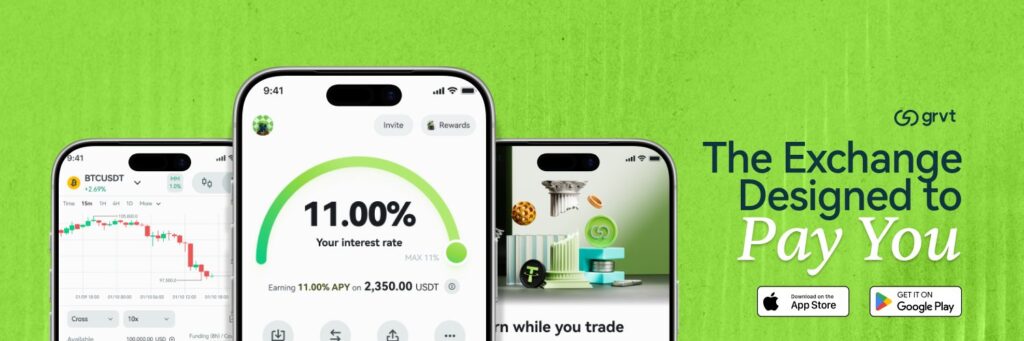
GRVT is the most technically novel platform in this comparison. It is the world’s first regulated hybrid DEX built on zero-knowledge proof technology, and it represents a genuinely new category of institutional trading infrastructure.
Grvt employs a hybrid architecture designed to achieve the low-latency throughput of a Web2 server while maintaining the cryptographic security and self-custody of a Web3 DEX. In practice, this means GRVT processes order matching and trade execution at speeds comparable to a centralised exchange — sub-millisecond matching engine performance — while simultaneously settling positions on Ethereum L1 via ZK-proof verification. This provides absolute finality and security without revealing sensitive private data to the public mainnet.
The zero-knowledge advantage for institutions: Centralised exchanges require traders to deposit funds into custodial accounts — counterparty risk that every institutional operation must underwrite. DEXs eliminate counterparty risk but introduce execution latency, front-running exposure, and MEV attacks. GRVT eliminates both: trade data remains private off-chain (preventing front-running), ZK proofs provide Ethereum-level security without public data exposure, and the matching engine operates at CEX speeds.
GRVT is built on a ZKsync Validium L2 blockchain, which verifies state without disclosing data, ensuring privacy — a solution to the long-standing problem for DeFi protocols. The technology has been validated by institutions including Deutsche Bank and UBS.
Regulatory standing: GRVT has secured a Class Modified (M) Digital Asset Business License from the Bermuda Monetary Authority (BMA), making it the world’s first regulated DEX — a hybrid exchange that operates within defined legal boundaries while maintaining the non-custodial architecture of DeFi.
Maker rebate: GRVT offers a -1 basis point maker fee rebate for all orders — a benefit traditionally reserved for institutions. A -0.01% maker rebate means GRVT pays you to provide liquidity, creating an economic incentive for market-making operations to concentrate activity on the platform.
GRVT raised $19 million in a Series A co-led by ZKsync Foundation, Further Ventures, EigenCloud, and 500 Global, bringing total funding to $34 million.
The limitation: GRVT’s liquidity depth is significantly lower than Binance, Bybit, or OKX. The platform is early-stage by the standards of this comparison. For Tier 1 traders operating at $100K–$1M per month, GRVT’s privacy advantage is compelling but its order book depth may limit position sizes on less liquid pairs. For Tier 2 and Tier 3 institutions specifically concerned with front-running protection and on-chain privacy, GRVT represents infrastructure worth integrating alongside a primary CEX relationship.
Verdict: Not a primary exchange for most high-volume traders in 2026. A compelling secondary venue for institutions with specific on-chain privacy requirements or an interest in ZK-proof-based settlement infrastructure.

OTC desk comparison: when to move off the order book
Every trader operating above $500,000 in a single transaction needs an OTC desk relationship. This is not optional. A $500,000 market order on a centralised exchange — even on Binance — moves the market. The price impact is directionally adverse, visible to front-running bots, and creates a real cost that does not appear in your maker/taker fee calculation.
OTC execution solves this. The trade is executed off-book, at a negotiated price, with no public market footprint.
Minimum transaction sizes generally start at $100,000, though some premium desks set thresholds at $250,000 or higher. The operational workflow is consistent across desks: submit a Request for Quote specifying asset, quantity, and direction; the desk quotes a price; the client accepts or negotiates; the trade settles privately.
Binance OTC: The deepest liquidity pool in the industry. Minimum trade of $200,000 USD equivalent. Fees are built into the spread rather than charged as explicit commissions. Supports 350+ coins, and settlement occurs instantly into the Binance account. Best for large BTC, ETH, and major altcoin block trades where spread minimisation through Binance’s aggregated liquidity network justifies the $200K minimum.
Bybit OTC: Typical minimum trade size around $50,000, with tickets above $250,000 receiving tighter spreads and priority handling. Settlement happens instantly within Bybit accounts. Focused on crypto-to-crypto conversions; fiat settlement is not currently available. Best for crypto-native operations that need rapid conversion between BTC/ETH and stablecoins without fiat output.
OKX OTC and Block Trading: Automated OTC and block trading venue offering 24/7 RFQ execution with support for multiple fiat currencies and advanced multi-leg trade strategies. The multi-leg capability — coordinating spot and derivatives simultaneously — is OKX’s primary OTC differentiator. Best for structured product execution and complex hedging operations requiring same-session coordination across multiple asset legs.
Bitget OTC: Bitget offers zero trading fees on OTC, with 24/7 execution, and deep liquidity across 500+ tokens. It provides seamless fiat access and personalised service for institutional clients. Zero explicit fees — cost is entirely in the spread — and the lowest effective minimum among tier-one exchanges. Best for mid-sized blocks ($50K–$500K) in altcoin positions where Binance’s minimum or depth advantage is less relevant.
The spread reality: OTC desks earn through spreads, not explicit fees. A desk quoting 0.2% spread on a $1 million BTC block charges $2,000 — comparable to or more expensive than taker fees on a sufficiently deep order book. The economic justification for OTC is exclusively about market impact: when your order size creates price impact exceeding the OTC spread, OTC is cheaper. Below that threshold, the order book is better. That crossover point is approximately $500K on Binance, $200K on most mid-tier exchanges.

Sub-accounts and portfolio margin: the operational infrastructure for serious capital
For trading firms or sophisticated individual traders running multiple strategies simultaneously, sub-accounts are not a nice-to-have — they are the organisational structure of a professional operation.
Why sub-accounts matter: A trend-following futures strategy and a delta-neutral funding rate carry strategy have different risk profiles, different leverage requirements, and different performance benchmarks. Mixing them in a single account makes risk management complex and performance attribution impossible. Sub-accounts provide clean strategy segregation while keeping all capital under a single master account for treasury management.
Both Bybit and OKX support up to 20 sub-accounts per master account for standard users, with higher limits available for institutional accounts. Each sub-account can independently access the UTA, set its own API keys, and maintain its own position book. The master account retains visibility across all sub-accounts for consolidated risk monitoring.
Portfolio margin: the capital efficiency multiplier: Under standard cross-margin, each position consumes margin based on its individual risk profile. Under portfolio margin, the exchange calculates margin requirements across the entire account portfolio — meaning a long BTC-PERP position and a short ETH-PERP position partially offset each other’s margin requirements, reflecting their correlation.
Portfolio margin mode reduces capital requirements by 30 to 60 percent for hedged portfolios, enabling traders to maintain significantly larger positions with the same collateral. For a trading operation running $5 million in gross notional positions with a hedged book, 40% portfolio margin efficiency frees up $2 million in capital that would otherwise be locked as margin — capital that can be deployed in additional positions or held as a liquidity buffer.
Both Bybit and OKX have led the industry on portfolio margin implementation. Binance’s portfolio margin mode is available but has historically had a narrower range of eligible instruments. BloFin’s UTA provides cross-margin pooling with growing portfolio margin functionality.

API reliability and infrastructure: the data competitors ignore
For algorithmic and high-frequency operations, API latency and uptime are not technical footnotes — they are the primary performance determinant. A trading strategy that fires at 12ms versus 45ms on the same signal produces materially different results over thousands of trades.
The experiences of 2024 and 2025, when several high-profile margin platforms experienced outages during peak volatility events that cost users real money through missed liquidations, delayed order fills, and unavailable margin calls, created a market-wide expectation that platforms must demonstrate sub-millisecond matching engine performance and 99.99% uptime before institutional clients will onboard.
The exchanges that have consistently demonstrated this standard are Binance, Bybit, and OKX. Each has invested significantly in matching engine infrastructure — written in Rust or C++ for maximum throughput — and multi-region active-active deployment to eliminate single-point-of-failure vulnerability.
Bybit V5 API: The unified V5 API architecture — covering spot, derivatives, and options in a single interface — eliminates the engineering overhead of maintaining separate API connections for each product type. WebSocket streams provide real-time order book, trade, and position data with sub-100ms latency. Rate limits are generous enough for most algorithmic applications; institutional accounts can negotiate higher limits.
OKX API: OKX’s institutional API provides enhanced rate limits for professional accounts and dedicated API infrastructure separate from retail endpoints. The platform also provides the most extensive algorithmic order type library in the comparison — including iceberg orders, TWAP execution, and stop-limit orders — essential for minimising market impact on large position accumulation.
Binance API: Binance’s matching engine handles the highest raw transaction volume of any exchange in the world. API latency to Binance’s primary data centres in Japan is sub-millisecond for co-located or geographically proximate operations. The tradeoff is occasional rate limit throttling during peak traffic periods, which can affect high-frequency strategies during exactly the volatile market conditions when execution matters most.
Insurance funds and security: protecting capital at scale
At high volumes, the exchange’s insurance fund is not an abstract security feature — it is a concrete buffer between a large liquidation event and the possibility that an adversely liquidated account creates a loss that cascades onto the counterparty.
Binance’s SAFU fund holds over $1 billion in reserves and has operated since 2018 without customer fund losses.
OKX’s perpetual insurance fund holds $2.7 billion in assets — the largest disclosed perpetual insurance fund of any exchange in this comparison by a significant margin.
Bybit maintains a publicly visible insurance fund updated in real time, accessible via CoinGlass’s insurance fund tracker. The fund size is smaller than Binance’s SAFU or OKX’s perpetual fund but has historically been sufficient relative to Bybit’s open interest.
For BloFin, Fireblocks custody integration and Chainalysis monitoring provide security infrastructure at the institutional standard, even if the exchange-level insurance fund is less prominent than tier-one platforms.
Proof of reserves: All exchanges in this comparison publish Proof of Reserves reports, with OKX using Merkle tree verification that allows individual users to confirm their specific holdings are fully backed — the most rigorous PoR methodology currently available.

Tax and reporting tools for high-volume traders
At $100K+ monthly trading volume, tax reporting is not an afterthought — it is a compliance requirement that can result in significant liability if mishandled. Exchanges vary considerably in the quality of their reporting exports.
Bybit and Binance both provide comprehensive trade history exports in CSV format, covering spot, futures, and options transactions. These exports are compatible with major crypto tax platforms including Coinledger and Koinly.
OKX provides similar export functionality with some of the most detailed field coverage in the industry — including funding rate payments, settlement amounts, and delivery fees as separate line items, which simplifies the categorisation process for tax purposes.
For the most complex reporting situations — trading firms with sub-accounts across multiple strategies, or operations that combine CEX and DeFi activity — a dedicated crypto tax platform like Coinledger remains the most practical solution. Coinledger integrates directly with Binance, Bybit, OKX, and most other exchanges via API, auto-categorising all transaction types and generating jurisdiction-specific tax reports for South Africa (SARS), UK (HMRC), Australia (ATO), US (IRS), and EU reporting frameworks.

edgeX and Apex Omni: decentralised alternatives for on-chain purists
Not every high-volume trader is comfortable with the custodial model that all CEXs require. Two decentralised perpetual exchanges serve this audience with genuine institutional-grade depth.
edgeX is a high-performance on-chain perpetuals platform offering low-latency order matching with self-custody settlement. For traders who want CEX-speed execution without counterparty exposure to a centralised exchange, edgeX is the most technically developed option in this category. The fee structure is competitive and the trading interface mirrors the professional experience of major CEX platforms.
Register on edgeX — code DECENTRALISED
Apex Omni provides a cross-chain perpetuals layer with portfolio margin across BTC, ETH, and major alt perps. The institutional program (affiliate ID 6327) provides enhanced API access and account management for operations above a defined volume threshold.
Both platforms are better understood as complements to a CEX primary relationship rather than replacements — routing positions that require on-chain settlement or privacy through DeFi perps while keeping high-urgency, liquidity-intensive trading on Binance or Bybit.
The multi-exchange architecture: how serious capital actually operates
Almost no high-volume trader operates exclusively on one exchange. The practical architecture of a serious trading operation in 2026 looks like this:
Primary CEX (liquidity and execution): Binance for BTC and ETH perpetuals where liquidity depth matters most. Bybit for altcoin perpetuals and options where Bybit’s UTA and sub-account infrastructure provide operational efficiency.
Secondary CEX (options and structured products): Deribit for all options activity. OKX as an alternative for options alongside its negative maker rebate for algorithmic strategies.
OTC desk relationships: Minimum two active OTC relationships — typically Binance OTC for large BTC blocks and Bybit or Bitget OTC for mid-size altcoin conversions.
DeFi/privacy layer: GRVT for positions requiring on-chain settlement with front-running protection. edgeX or Apex Omni for self-custody perpetuals.
Liquidity management: BloFin as an additional derivatives venue for altcoin perpetual exposure not available on Binance or Bybit, and for funding rate arbitrage opportunities where BloFin’s rates diverge from the primary venues.
This is the architecture of a trading operation that takes exchange risk seriously. Concentration in a single exchange — regardless of how well-run that exchange is — creates a single point of failure that no risk manager should accept.

FAQs
What is the best crypto exchange for traders doing $1M+ per month?
For $1M+ monthly volume, the optimal architecture uses Binance as the primary liquidity venue for BTC and ETH perpetuals — where order book depth is unmatched — combined with Bybit for sub-account management and altcoin derivatives, OKX for options and any strategies targeting the negative maker rebate at VIP scale, and an OTC desk relationship on at least two platforms for large block execution. Single-exchange operation at this volume level is a concentration risk that professional operations avoid.
When does a market order become too large for the order book?
The threshold varies by exchange and asset. On Binance’s BTC-PERP, a $500,000 market order produces approximately 0.05–0.08% price impact. The same order on a mid-tier exchange can produce 0.3–0.8% slippage. The rule of thumb: when your estimated market impact cost exceeds the OTC desk spread — typically 0.1–0.3% on major pairs — switch to OTC. For BTC on Binance, that crossover is approximately $500K. For altcoins on smaller exchanges, it can be as low as $50K.
What is portfolio margin and why does it matter?
Portfolio margin calculates margin requirements across an entire account portfolio rather than per-position. For a hedged book — long BTC-PERP, short ETH-PERP — the correlated positions partially offset each other’s margin requirements. In practice, portfolio margin reduces capital requirements by 30–60% for hedged operations, freeing capital for additional positions or as a liquidity buffer. It is available on Binance, Bybit, OKX, and BloFin.
What is GRVT and why is it relevant for institutional traders?
GRVT is the world’s first regulated hybrid exchange built on zero-knowledge proof technology. It provides CEX-speed order matching with self-custody settlement, where trade data is kept private off-chain and only ZK proofs are published to Ethereum L1. This eliminates front-running and MEV attacks while maintaining the execution speed of a centralised exchange. It is most relevant for institutions with specific on-chain privacy requirements or counterparty risk concerns about custodial exchange exposure.
How important is API latency for high-volume trading?
For algorithmic and high-frequency strategies, extremely important. A 30ms difference in order confirmation latency on a fast-moving signal translates to materially different fill prices over thousands of trades. For discretionary high-volume traders who do not run automated strategies, API latency matters primarily during fast market conditions — exchange outages or degraded API performance during volatility spikes have historically been the source of significant forced losses. 99.99% uptime is now the expected standard for institutional-grade platforms.
Do I need a separate account for OTC trading?
On most exchanges, OTC desk access is available through the standard account with KYC completion and a VIP tier qualification. Binance requires VIP tier access for OTC. Bybit requires OTC enablement, which is available for KYC-verified accounts above a threshold. OKX’s block trading is available through the standard trading interface. Bitget’s OTC desk can be accessed directly with a standard verified account.

Where to trade: exchange registration for high-volume accounts
Each link below uses the Decentralised News referral code, ensuring the best available welcome terms are applied at registration. For high-volume operations, always register as a new user before making your first deposit — welcome bonus terms and VIP onboarding programs cannot be applied retroactively.
- Binance — code CPA_00SXKU7IO9
- Bybit — code 46164
- OKX — code 2136301
- BloFin — code Decentralised
- Bitget — code TS96DETS96DE
- Deribit
- GRVT
- edgeX — code DECENTRALISED
- Apex Omni
Decentralised News participates in affiliate programs with the exchanges referenced in this article and earns commission when readers register and trade via our links. This does not affect editorial positions. All scoring and assessments are based on publicly available data and operational experience. Crypto derivatives trading involves significant risk of loss. Capital deployed in leverage products can be lost entirely. Always conduct independent due diligence before selecting an exchange for institutional-scale operations.
Recommended reading:
Lowest Crypto Futures Fees in 2026: Every Major Exchange Ranked and Calculated
Best Crypto Sign-Up Bonuses and New User Rewards in 2026
Best Crypto Futures Trading Competitions in 2026: Where Active Traders Can Earn Rewards
About the Author