Is It Altseason? The DN Altseason Index and Dominance Rotation Signal for 2026
Is It Altseason? The DN Altseason Index and Dominance Rotation Signal for 2026
A single, transparent reading of whether capital is consolidating into Bitcoin or rotating out into altcoins — and what to do about it.
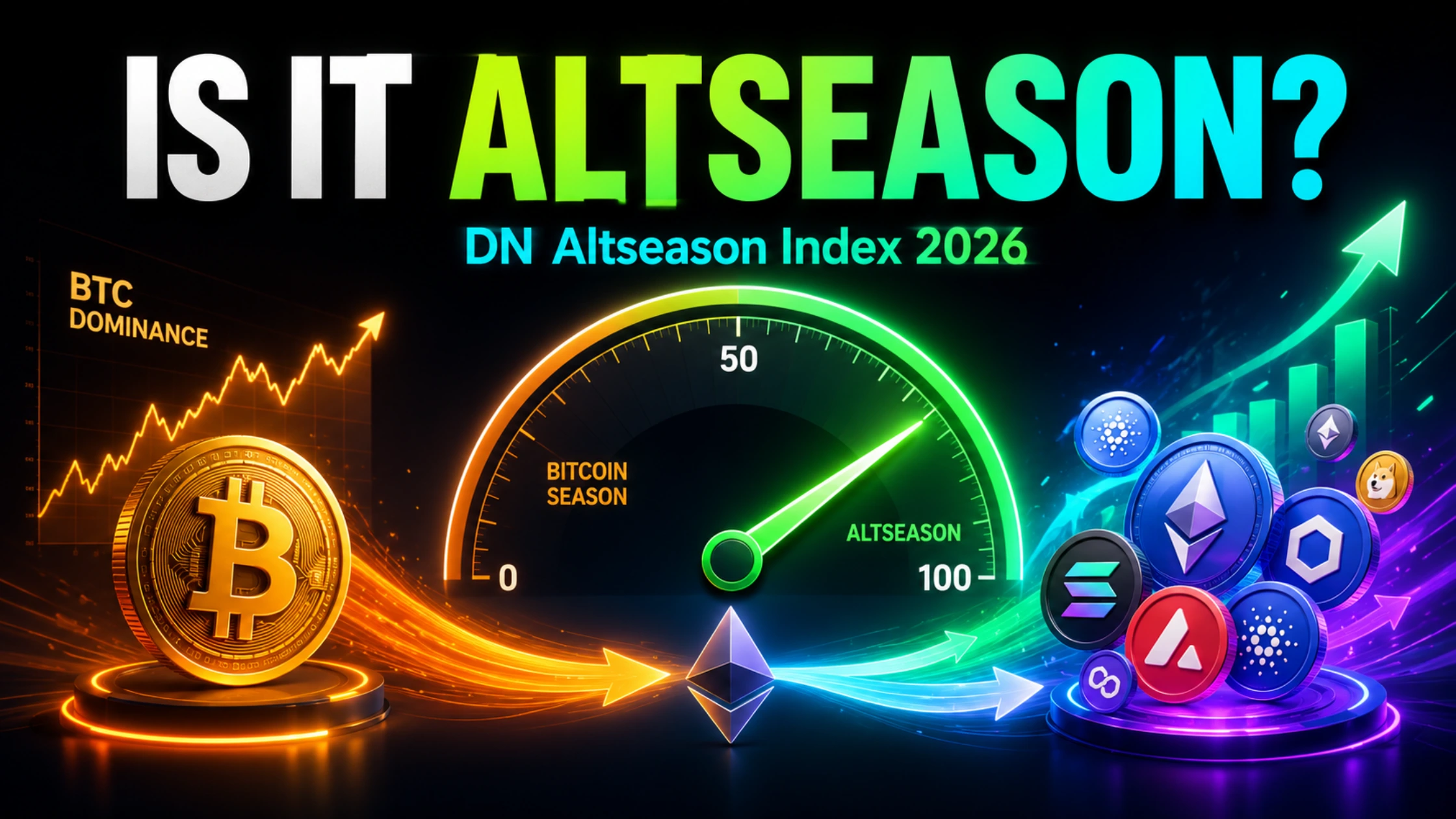
Altseason is the phase of the crypto cycle when capital rotates out of Bitcoin and into altcoins, so most major alts outperform BTC at once. The DN Altseason Index measures it on a 0–100 scale by blending three forces: market breadth (how many top coins are beating Bitcoin), Bitcoin dominance and its direction, and Ethereum's relative strength. A reading below 25 is deep Bitcoin season; above 75 is a confirmed altseason. Use the live gauge below to see today's signal and adjust the inputs to your own view.
Every cycle, the same question dominates crypto group chats, search bars and increasingly the answer boxes of AI assistants: is it altseason yet? It is the most consequential timing question a crypto investor can ask, because the difference between holding Bitcoin and holding the right basket of altcoins during a rotation is the difference between a respectable year and a generational one. It is also the question most often answered with vibes, hopium and a single screenshot of a chart nobody fully understands.
We built the DN Altseason Index to replace the vibes with a number. Not a black box, and not a marketing gimmick — a transparent composite you can read, interrogate and adjust, drawing on the same forces that have governed every rotation since the first altcoin cycle. The tool below gives you a live reading. The rest of this piece explains exactly how it works, why each input matters, and how disciplined traders actually rotate capital when the signal turns.
—
The DN Altseason Index is an educational market-structure gauge, not a buy or sell signal. It tells you what the market is doing, not what you should do.
What altseason actually means
An "altseason" is not simply a period when altcoins go up. Altcoins routinely rise in Bitcoin's slipstream while still underperforming it — you make money in dollar terms but lose ground in the only benchmark that matters in this market, which is BTC itself. True altseason is something sharper and rarer: a phase when the majority of major altcoins outperform Bitcoin simultaneously, when capital that has been hiding in the relative safety of BTC fans out across the risk curve in search of higher returns.
This rotation happens for a structural reason. Bitcoin is the reserve asset of crypto and the primary on-ramp for new capital. When fresh money enters the market — whether from institutions, a macro liquidity wave or a fresh retail cohort — it tends to buy Bitcoin first. Bitcoin rallies, dominance rises, and altcoins bleed against it. Then, once Bitcoin's move matures and consolidates, that capital starts hunting for assets that have not yet run. It moves into Ethereum, then into large-cap alts, then mid-caps, then the speculative far end of the curve. Each step down the risk ladder is altseason intensifying. The index is, at heart, a measurement of how far down that ladder capital has travelled.
How the DN Altseason Index is built
Most altseason indicators rely on a single input — usually the share of top coins beating Bitcoin over a fixed window. That number is useful but fragile: it can be distorted by a handful of outliers, and it tells you nothing about why breadth is improving or whether the move has fuel left. The DN Altseason Index blends three independent forces, each capturing a different dimension of the same rotation, so that no single quirk of the data can hijack the reading.
The share of the top 50 coins by market cap, with stablecoins removed, that have outperformed Bitcoin over the trailing 90 days. This is the truest definition of altseason — are most alts beating BTC, or just a lucky few? It carries the heaviest weight because it is the cleanest direct measurement of the phenomenon itself.
Bitcoin dominance — BTC's share of total crypto market capitalisation. Falling dominance is the fuel of altseason; rising dominance starves it. We map the current level onto a sub-score where roughly 70%+ dominance reads as deep Bitcoin season and the low-to-mid 40s reads as full rotation.
Ethereum is the bellwether of risk-on rotation; it is the first major stop for capital leaving Bitcoin. ETH's 90-day return spread against BTC acts as an early-warning gauge — when ETH/BTC turns up decisively, the broader alt market usually follows within weeks.
The three sub-scores are combined into a single 0–100 reading and sorted into four regimes. The bands are deliberately conservative: we would rather call altseason late and certain than early and wrong, because the most expensive mistake in this market is rotating into illiquid alts on a false signal and watching dominance reclaim everything.
Capital is consolidating hard into BTC. Alts bleed against Bitcoin. Patience and accumulation, not rotation.
Bitcoin still leads but breadth is thawing. Early scouts may build positions in highest-conviction alts.
Rotation is building. ETH and large caps lead; the market is tilting toward alts but not yet euphoric.
Broad rotation confirmed. Most alts beat BTC. The phase of maximum opportunity — and maximum risk of buying the top.
Bitcoin dominance: the master dial
If you only watch one chart alongside this index, make it Bitcoin dominance. Dominance is the tide that lifts or sinks the entire alt fleet, and its direction matters more than its level. A dominance figure that is high but falling is bullish for alts; a figure that is low but rising is a warning that the rotation is exhausting and capital is fleeing back to safety.
There is an important subtlety the headline dominance number hides. As stablecoins have ballooned into hundreds of billions of dollars, they distort the simple BTC-versus-everything-else calculation. A more honest reading strips stablecoins out, and watches the relationship between Bitcoin, Ethereum and the long tail of alts separately. This is why the index does not lean on dominance alone — it cross-checks dominance against breadth and ETH strength, so a misleading dominance print cannot, by itself, declare altseason.
How to read today's signal
The gauge gives you a number; the discipline is in what you do with it. Read the index as a description of market structure, not as an instruction. A reading of 30 does not mean "do nothing" — it means the structural wind is at Bitcoin's back, so any alt position you take is fighting that wind and must be sized and timed accordingly. A reading of 80 does not mean "buy everything" — by the time the index is that high, the easy money in the major alts has often already been made, and the prudent move may be to rotate profits down the risk curve carefully rather than chase what has already tripled.
The most valuable signals come from the transitions, not the absolutes. The move from the high 40s into the 50s — Bitcoin-leaning tipping into alt-leaning — is historically the sweet spot, the moment when rotation is confirmed but the bulk of the move still lies ahead. Watch the factor bars beneath the gauge: when breadth and Ethereum strength start rising together while dominance pressure climbs, you are watching the rotation begin in real time, before it shows up in the price of your bags.
The rotation playbook: how capital actually moves
Capital does not flood into all altcoins at once. It cascades down a predictable ladder, and understanding the sequence lets you position one rung ahead of the crowd rather than one rung behind.
- Stage one — Bitcoin leads. New money buys BTC. Dominance rises, alts underperform. The index sits low. This is the accumulation window for patient alt buyers.
- Stage two — Ethereum follows. Once Bitcoin consolidates, ETH/BTC turns up. Ethereum is the gateway; its strength is the single best leading indicator that rotation has begun. The index climbs into the 40s and 50s.
- Stage three — large caps catch a bid. Capital fans out into the established large-cap alts with real liquidity and narratives. Breadth expands meaningfully. The index pushes into alt-leaning territory.
- Stage four — mid and small caps run. Risk appetite peaks. Mid-caps, then small-caps and finally the speculative far end light up. The index hits the altseason band. This is the most lucrative and most dangerous stage — the music is loudest right before it stops.
The traders who compound wealth across cycles are not the ones who call the exact top. They are the ones who rotate with the cascade — into ETH early, down into large caps as breadth confirms, and crucially back out into Bitcoin or stables as the index pins into the high 80s and 90s, because that pinned, euphoric reading is the market's way of telling you the rotation is nearly out of fuel.
Where to rotate when the signal turns
A rotation thesis is worthless without execution, and execution lives or dies on where you trade. Different stages of the cascade call for different venues — deep liquidity for the large-cap leg, broad listings for the long tail. These are the exchanges we use and rate for rotation plays:
Whichever venue you choose, the principle is the same: liquidity first on the early legs, breadth later, and never chase a token onto an exchange you do not trust simply because the index is green.
What the index will not tell you
The DN Altseason Index is a measure of market structure, and structure is only part of the picture. It cannot price in a macro shock, a regulatory headline, a black-swan exchange failure or the specific fundamentals of any single token. A high reading tells you the rotation environment is favourable; it says nothing about whether the particular alt you hold deserves to participate. Plenty of coins have died during the strongest altseasons.
Treat the index as one input among several. Combine it with your own research on the assets you hold, with disciplined position sizing, and with a clear plan for taking profit before the euphoric stage rather than during it. The index can tell you the tide is coming in. It cannot tell you which boats are seaworthy, and it certainly cannot stop you from staying in the water too long.
Frequently asked questions
Is it altseason right now?
Check the live gauge at the top of this page. A DN Altseason Index reading above 75 signals a confirmed altseason, where most major altcoins are outperforming Bitcoin. A reading between 50 and 74 means rotation is building but not yet broad, and anything below 50 means Bitcoin is still leading the market.
What is the DN Altseason Index?
It is a 0–100 composite gauge built by Decentralised News that measures whether crypto capital is rotating from Bitcoin into altcoins. It blends three forces: market breadth (the share of top-50 coins beating Bitcoin over 90 days, weighted 60%), Bitcoin dominance pressure (25%) and Ethereum's relative strength against Bitcoin (15%).
What Bitcoin dominance level signals altseason?
There is no single magic number, and direction matters more than level. Broadly, dominance falling from the high 50s or 60s toward the mid 40s is the classic altseason signature. A high but falling dominance is bullish for alts; a low but rising dominance warns the rotation is fading. The index reads dominance alongside breadth so the figure is never interpreted in isolation.
How is altseason calculated?
The cleanest core measure is market breadth — the percentage of the top 50 cryptocurrencies (excluding stablecoins) that have outperformed Bitcoin over the trailing 90 days. The DN Altseason Index uses this as its heaviest input and cross-checks it against Bitcoin dominance and Ethereum's relative strength to produce a single, robust reading.
What is the difference between Bitcoin season and altseason?
In Bitcoin season, capital concentrates in BTC, dominance rises and most altcoins lose ground against Bitcoin even if they rise in dollar terms. In altseason, capital rotates outward, dominance falls and the majority of altcoins outperform Bitcoin at the same time. The two phases alternate throughout every market cycle.
Should I move from Bitcoin to altcoins during altseason?
That is a personal decision and not financial advice. Historically the lowest-risk rotation window is the transition into altseason rather than its peak, because by the time the index is pinned in the 80s and 90s much of the move has already happened. Altcoins carry far higher risk than Bitcoin, so any rotation should be sized accordingly and paired with a clear profit-taking plan.
This tool and article are for educational and informational purposes only and do not constitute financial, investment or trading advice. Cryptocurrency markets are highly volatile and altcoins carry substantially higher risk than Bitcoin, including the risk of total loss. The DN Altseason Index is a market-structure indicator, not a recommendation to buy or sell any asset. Always do your own research and consider consulting a licensed financial professional before making investment decisions. Decentralised News may earn a commission from exchanges linked in this article at no additional cost to you.
About the Author