The Pass-Rate Math Prop Firms Never Publish
The Pass-Rate Math Prop Firms Never Publish
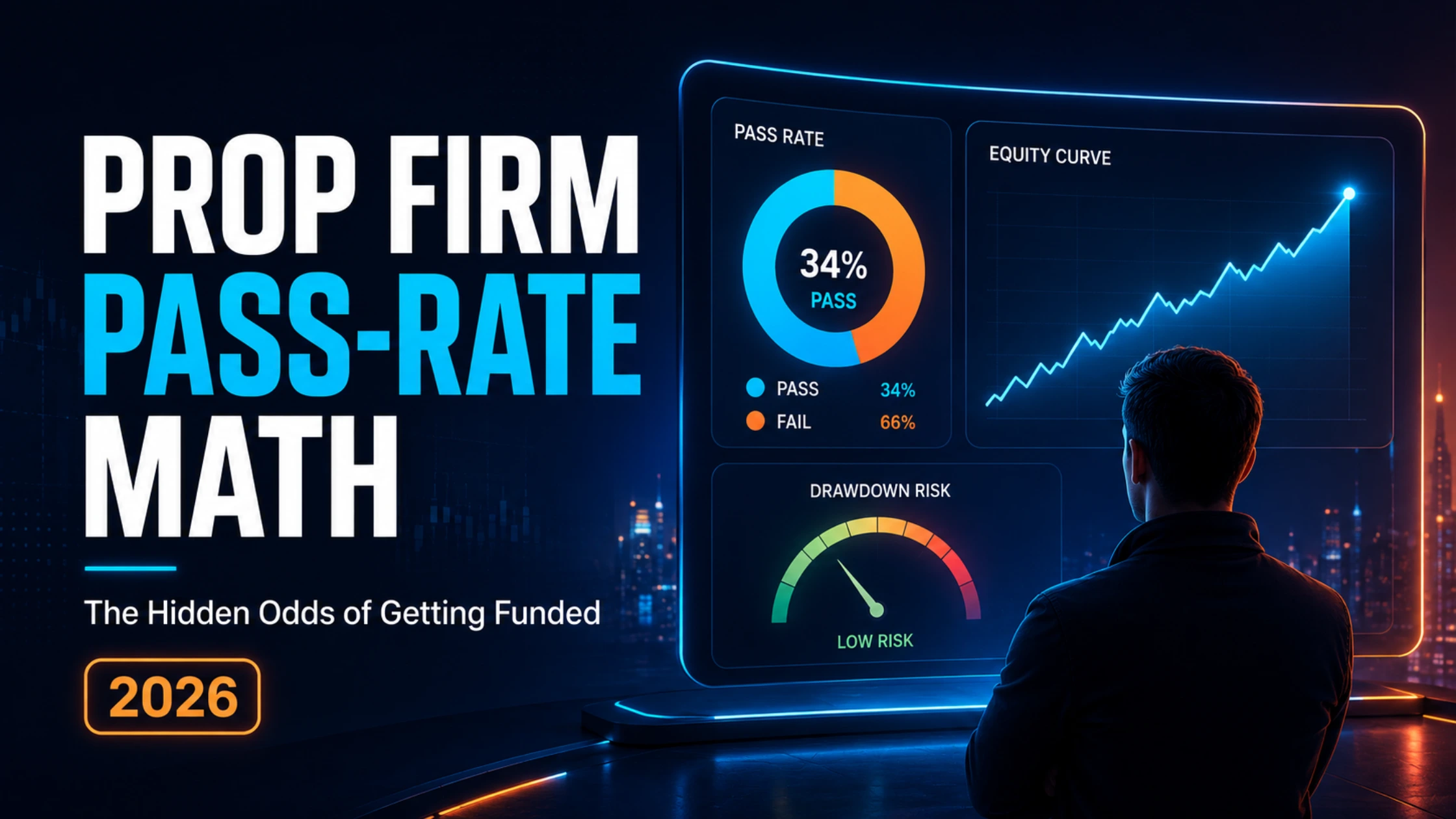
We simulated 280,000 challenge attempts so you don't have to buy them. A coin-flip trader passes half the time, a gambler improves his odds by risking more, and the daily loss rule exists for exactly one kind of person. The receipts are below.
Decentralised News · Updated June 12, 2026 · Original simulation · Reading time 14 min · Tool included
What percentage of traders pass prop firm challenges? The published consensus: between 5 and 10 percent at most firms, around 9 to 10 percent historically at the most transparent large firm, and 14 percent in the largest independent dataset, a study of more than 300,000 accounts, which also found that only 7 percent of all traders ever received a payout. Those numbers are real. They are also profoundly misleading, because the mathematics of the challenge itself is dramatically easier than they suggest, and the difference between the math and the data tells you exactly where funded trading careers actually die.
So we did what the firms will not: we built the challenge as a probability model and ran it 280,000 times. Forty thousand simulated attempts for each of seven trader profiles, against the standard ruleset, with the full methodology published below and the simulator itself embedded so you can run your own numbers, your own rules, and check our work. This is a Receipts piece: every figure in this article was generated by the model on this page, and the model is yours to interrogate.
What the firms publish, and why it stops there
No major firm publishes audited pass rates in its marketing, and the incentive is structural: the evaluation business earns its revenue from challenge fees and resets, not from your eventual success. The fragments that do surface are consistent: self-reported rates of 5 to 10 percent across the industry, the 300,000-account dataset showing 14 percent passing and 7 percent ever paid, one large firm's leadership admitting that of its funded traders only about a fifth ever receive a payout, and the telling detail that the majority of failures happen in the first week, almost always by daily-loss breach. One firm reports that first-attempt passes in the 15 to 20 percent range jump to about 40 percent once account resets are counted, which quietly reveals what resets are for. Keep all of those numbers in mind. The simulation is about to explain every one of them.
The receipts: 280,000 simulated attempts
| Profile | Pass rate | Expected attempts | Median trades to pass | How it dies |
|---|---|---|---|---|
| Real edge (55% WR, 1.5:1, 1% risk) | 99.4% | 1.0 | 17 | Barely ever |
| Conservative pro (45% WR, 2:1, 0.75% risk) | 99.0% | 1.0 | 25 | Barely ever |
| Slight edge (52% WR, 1.5:1, 1% risk) | 98.3% | 1.0 | 22 | Barely ever |
| Coin flip, sized sane (50% WR, 1:1, 1% risk) | 52.7% | 1.9 | 50 | Slow drawdown bleed (41%) |
| Coin flip, gambler (50% WR, 1:1, 4% risk) | 51.2% | 2.0 | 4 | Daily loss, almost instantly (44%) |
| Negative edge, gambler (45% WR, 1:1, 5% risk) | 25.2% | 4.0 | 2 | Daily loss, almost instantly (75%) |
| Negative edge, sized sane (45% WR, 1:1, 1% risk) | 17.5% | 5.7 | 42 | Slow drawdown bleed (80%) |
Five findings, each one a small scandal.
1. The coin flip passes half the time. A trader with literally zero edge, 50 percent win rate at 1:1, risking a sane 1 percent per trade, passes 52.7 percent of attempts. No skill is involved; the geometry does the work, because the target sits 8 percent above the start while the floor sits 10 percent below it, so a random walk simply hits the nearer wall more often. Every marketing page that frames passing as proof of skill is selling you this coin.
2. The gambler's pass is real, and it is a trap. Take a trader with a losing strategy, 45 percent at 1:1, and have him quintuple his risk to 5 percent per trade: his pass rate improves from 17.5 to 25.2 percent, and his median passing run is two trades. Variance is the no-edge trader's best friend at the challenge stage, which is why so many funded accounts are held by traders whose strategy is a coin held tightly. It is also why those accounts die at the funded stage, where the same variance executes them before the first payout, and why the industry's funded-to-paid conversion collapses to a fifth.
3. Any genuine edge passes, essentially always. Move the win rate to just 52 percent at 1.5:1 and the pass rate is 98.3 percent. The challenge is close to a perfect classifier in one direction only: it almost never fails a trader with real expectancy. It just also passes half the traders without any. The evaluation does not find skill; it finds the absence of catastrophic sizing, plus a coin toss.
4. The breach signature is a confession. How an attempt dies identifies the trader. Sane sizing never trips the daily limit in our model, not rarely, never, because three trades at 1 percent cannot reach a 5 percent daily floor; it dies slowly by cumulative drawdown when the edge is absent. The gambler dies by daily loss within days. Recall the industry's own observation that most real-world failures are first-week daily-loss breaches, and the conclusion writes itself: the daily loss rule exists to execute over-sizers, the population most real challenges are mostly made of.
5. The math and the data disagree, and the disagreement is the diagnosis. Our model says a merely random trader passes half the time; the industry's own data says 5 to 14 percent of real attempts pass. Both are true. The gap is the measured weight of everything the model charitably excludes: strategies that are worse than coin flips after spreads, fees and slippage; rule violations that have nothing to do with P&L, the consistency clauses and news bans that void otherwise passing runs; attempts abandoned in frustration; and tilt, the compounding of risk after losses that turns the sane profile into the gambler profile mid-attempt. The challenge is not hard. What traders bring to it is.
Run your own numbers
The simulator below is the same engine that produced the table, running live on your inputs: your win rate, your reward-to-risk, your sizing, and the exact ruleset of the firm you are considering, including its fee, so it prices the expected cost of your pass in dollars, not hope.
Your strategy against any firm's ruleset. Honest inputs in, honest odds out: if you do not know your live win rate, the simulator cannot save you, and neither can the challenge.
Educational model, not financial advice and not a prediction. Assumes independent fixed-size trades and a static drawdown; trailing drawdowns, consistency clauses, news rules, fees inside trades and tilt are excluded, and every exclusion flatters you. Passing a challenge is not the goal; surviving the funded stage is, and the same math applies there with a paycheck attached. Some links are referral links that support our free tools at no cost to you. Other publications may embed this tool with a followed credit link to the canonical page on decentralised.news.
What actually moves your odds
- Edge, then nothing for a long while, then sizing. The table is unambiguous: the jump from 50 to 52 percent win rate at 1.5:1 is worth more than every sizing trick combined. If your live, fee-inclusive expectancy is not positive, the challenge is a lottery ticket with extra steps, and the simulator will tell you the ticket price.
- Size below the daily tripwire. Keep risk per trade × trades per day comfortably under the daily limit and that rule cannot kill you, which removes the single largest real-world cause of failure before your first trade. At 1 percent risk and three trades, a 5 percent daily floor is mathematically unreachable.
- Respect the asymmetry of the floors. A trailing drawdown is meaningfully crueler than the static one we model, because your floor chases your equity peak. If two firms differ only there, the static-drawdown firm is offering you free percentage points of survival.
- Count resets as tuition, not bad luck. Expected attempts × fee is the honest price of your pass. At a 17.5 percent pass rate, a $100 challenge costs an expected $570 before you ever see funded capital, and the firm's reset pricing is built on exactly that arithmetic.
- Remember what the real exam is. Passing puts a coin-flip trader and a 55 percent trader in identical funded accounts. The payout statistics, a fifth of funded traders ever paid, are the funded stage re-running this same simulation with real money and stricter rules. The instrument for choosing the firm whose funded terms you can actually survive is our DN Funded Account Fit Score.
Where to take a challenge, honestly routed
If the simulator says your profile clears the math, the firm choice is about rulesets, instruments and payout credibility, not marketing. For crypto-native traders, Breakout Prop (code DR5DTX) runs evaluations built specifically around crypto market structure, the natural fit if your edge lives in the venue dynamics we cover in the DN Perp DEX Power Rankings. HyroTrader (coupon 5agfeyq) funds crypto traders on real exchange conditions, which matters precisely because the gap between simulated and live fills is one of the silent edge-killers our model excludes. And PropW offers the multi-asset evaluation route at competitive fee levels, relevant to the expected-cost arithmetic above. Whichever you choose, read the funded-stage rules harder than the challenge rules: the challenge is the door, and the table shows the door is not the test.
The honest bottom line
The pass-rate question everyone asks has a published answer, 5 to 14 percent, and a mathematical answer, roughly 50 percent for anyone who merely avoids over-sizing, and the distance between those two numbers is the most useful fact in funded trading. It means the challenge is not the obstacle; the obstacle is arriving with negative expectancy, breaking rules that have nothing to do with profit, and sizing like the daily limit is a suggestion. It means a pass is not validation, since the coin passes too. And it means the only number worth optimizing before you pay any fee is the one no firm can sell you: your own live, cost-inclusive expectancy, measured honestly, which is the same discipline we demand of trading bots in the DN Bot Reality Score DN Bot Reality Score. The simulator is above. It does not care what you hope. That is exactly what makes it useful.
Frequently asked questions
Published and independent figures range from 5 to 14 percent: most firms self-report 5 to 10 percent, and the largest independent dataset of over 300,000 accounts found 14 percent passed while only 7 percent of all traders ever received a payout.
Industry data shows most failures happen in the first week via daily-loss breaches, which simulation identifies as the signature of over-sizing. The deeper causes are negative expectancy after trading costs, violations of non-profit rules like consistency clauses, and abandoning attempts.
Yes, roughly half the time. Simulation shows a zero-edge trader risking 1 percent per trade passes about 53 percent of attempts under a standard 8 percent target and 10 percent drawdown, because the target is closer than the floor. Surviving the funded stage without an edge is another matter entirely.
For traders without an edge, yes: simulation shows a negative-expectancy trader improves from 17.5 to 25.2 percent pass rate by raising risk from 1 to 5 percent per trade, passing in a median of two trades. The same variance then destroys the funded account, which is why this is a trap rather than a strategy.
Expected attempts equal one divided by your pass probability. A genuine edge passes in one attempt almost always; a zero-edge trader needs about two; a negative-edge trader needs four to six, making the expected cost several multiples of the advertised fee.
For correctly sized traders, the overall drawdown; the daily loss limit is mathematically unreachable at modest sizing. Trailing drawdowns are harsher than static ones because the floor follows your equity peak, and consistency clauses void otherwise passing runs.
The largest independent dataset found about 7 percent of all traders, and roughly 45 percent of those who reached funded status, ever received a payout, while one major firm has stated only about a fifth of its funded traders are ever paid. Passing the challenge is not the real exam.
The simulated probability of passing a specific challenge ruleset with your strategy profile, computed by a 5,000-trial Monte Carlo over win rate, reward-to-risk, sizing, profit target, daily loss, maximum drawdown and trade limits, with expected attempts and expected cost derived from it.
Only with measured positive expectancy: the math then passes you almost always and the fee buys leverage on real capital. Without it, the expected cost of repeated attempts plus the near-certainty of funded-stage failure makes the challenge an expensive lottery.
Decentralised News publishes research, not financial advice. Simulation results are model outputs under stated assumptions, not predictions of any individual outcome; real challenges include rules and frictions the model excludes, all of which lower real-world odds. Industry figures cited are third-party and self-reported data as of June 12, 2026. Funded trading involves fees that can exceed any payout received. Some links are referral links that support our free tools at no cost to you. The DN Challenge Survival Score methodology, and the wider instrument suite documented in the editor's books Blockchain Applied and Tokenized Trillions, is open to challenge via the contact page.
About the Author