Points Farming Perp DEXs: The ROI Reality Check
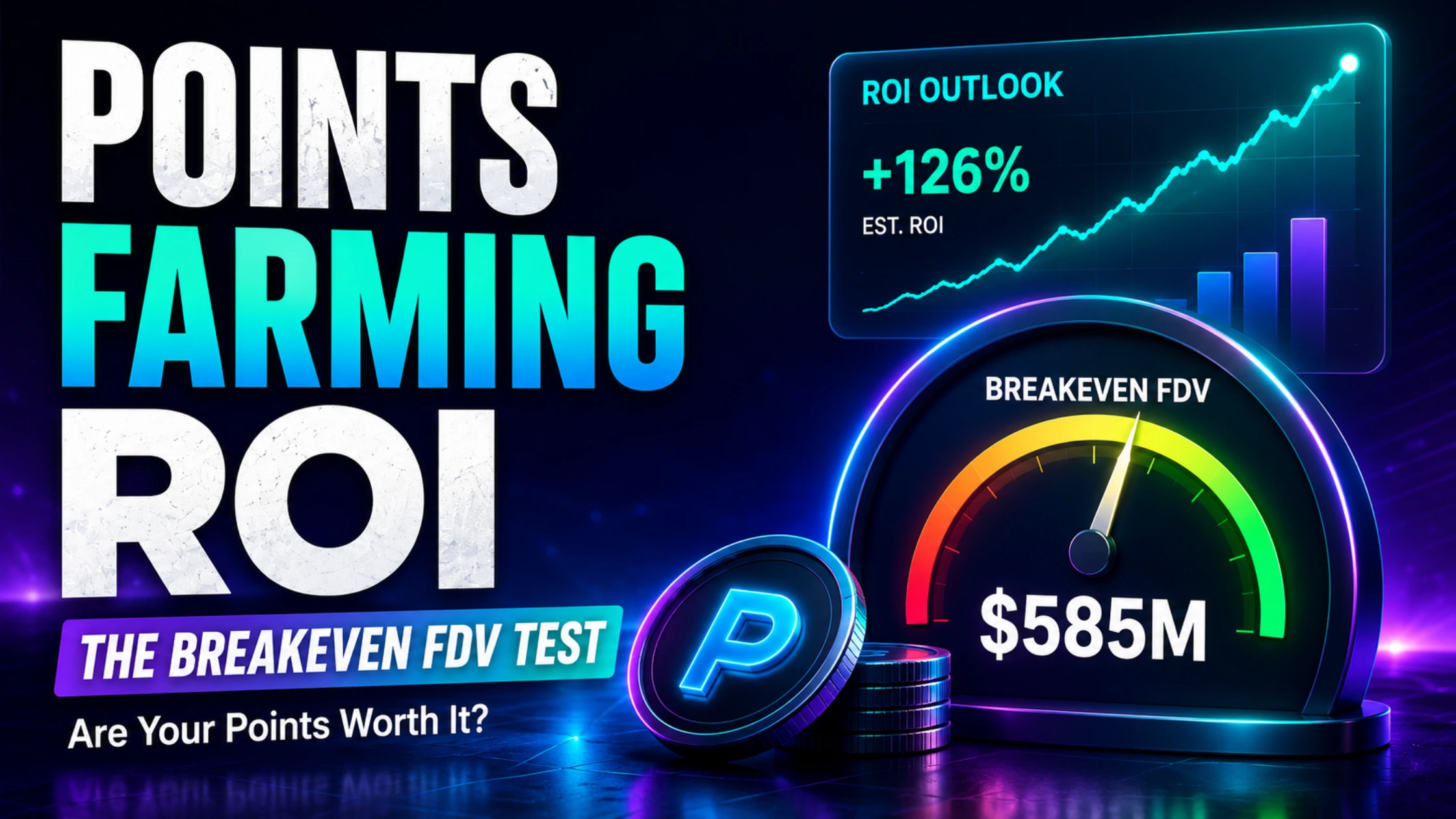
Points Farming Perp DEXs: The ROI Reality Check
Every farmer does the airdrop math after they get paid. The DN Points ROI Model does it before: your fees, your funding bleed and your time against the expected token value, and the honest answer is that most of it depends on a number you cannot control.
Decentralised News · Updated June 12, 2026 · Reading time 12 min · Tool included
Is farming perp DEX points worth it? It depends almost entirely on one number you do not control: the fully diluted valuation the token launches at. Your costs are knowable and certain, the trading fees on every dollar of volume you generate, the funding you bleed if you farm directionally, and the yield you forgo on locked capital. Your reward is a wager: your slice of whatever the protocol allocates to farmers, multiplied by a token price that does not exist yet. The DN Points ROI Model below turns that asymmetry into a single breakeven FDV, the launch valuation above which your farming was rational and below which it was a donation, and the recent record shows tokens landing on both sides of that line.
The stakes are real because the activity is enormous. Through the points-farming boom, perp DEXs have at times reported daily volumes that imply turnover many multiples of their actual deposits, the signature of wash-style farming we documented in the DN Perp DEX Power Rankings. Some of that farming paid spectacularly: Lighter delivered its LIT token in December 2025 with a 25 percent airdrop, fully unlocked. Some of it did not, and the difference was never the farmer's effort. It was the FDV. This page makes that variable visible before you commit a dollar of volume to it.
The two sides of the farming ledger
Points farming is an arbitrage between certain costs and an uncertain payoff, and most farmers only ever measure one side. Here is the full ledger.
The costs, all certain
- Trading fees. Points are earned by volume, and volume is taxed by fees on every round trip. At even 3 basis points taker, $10 million of cumulative farmed volume costs $3,000 in fees alone, and aggressive programs pull farmers toward far more volume than that. This is the single largest controllable cost and the one farmers most consistently underweight.
- Funding bleed. A directional farmer holding leveraged positions pays funding for every hour the position lives, at perhaps 11 percent annualized on notional in a normal regime, far more when funding stretches. A $100,000 notional position held three months bleeds thousands. Delta-neutral farmers, long on one venue and short on another, largely neutralize funding, which is why serious farmers run neutral books, but they pay fees on both legs in exchange.
- Opportunity cost. Capital posted as margin is capital not earning yield elsewhere. It is the smallest cost for most farmers but the one that compounds with the length of the program.
The reward, entirely uncertain
Your reward is a single product: your share of the farmer airdrop pool, multiplied by the token's value at unlock. Your share is your points divided by everyone's points, which means it shrinks every time a new farmer joins, the program is a pie-eating contest where the pie is fixed and the eaters keep arriving. The token's value is the FDV at launch divided across supply, a number set by market conditions, sentiment and timing entirely outside your control. You can work harder to grow your share; you cannot move the FDV. That is the asymmetry that defines the entire activity, and it is why the breakeven FDV is the only number that matters.
Your certain costs against an uncertain airdrop, with the breakeven FDV that decides whether the farm was rational. Every assumption is editable.
Edit airdrop assumptions (total farmed volume · airdrop % of FDV · farmers' share of airdrop · FDV scenarios)
Educational model, not financial advice. Reward is an expectation, not a promise: it excludes Sybil clawback risk, vesting discounts on locked allocations, and the real possibility of no token or a failed launch, each of which lowers true expected value. Total farmed volume is an estimate you must size to the program; your share shrinks as more farmers join. Route buttons are referral links that support our free tools at no cost to you. Other publications may embed this tool with a followed credit link to the canonical page on decentralised.news.
The reality check, in three findings
Run the model across realistic farmer profiles and three uncomfortable truths emerge, each one a correction to the farming hype.
1. The breakeven FDV is higher than farmers assume. A modest delta-neutral farmer pushing $2 million of volume over two months, costing roughly $670 all-in, needs the token to launch near a $555 million FDV just to break even on a typical 10 percent airdrop with farmers taking 60 percent of it. Below that, the farm lost money no matter how diligently it was run. Plenty of 2025 and 2026 launches came in under their farmers' breakeven, which is the quiet half of the airdrop story nobody screenshots.
2. Directional farming is a different, worse bet. The same farmer running $10 million of directional volume at 10x, paying funding, faces over $6,900 in certain costs and needs an FDV above $1.1 billion to break even, double the neutral farmer's hurdle, because funding bleed stacks on top of fees. This is why every serious farmer runs delta-neutral: not for safety, but because directional funding bleed silently raises the breakeven past the point most tokens reach.
3. Your edge is share, not effort, and share is contested. Doubling your volume doubles your costs immediately and certainly, while only raising your reward if your share grows faster than the farming crowd. In a hot program, total farmed volume balloons as everyone piles in, diluting every participant's share even as absolute volume climbs. You are racing a denominator that grows when you are not watching. The model's volume-share input is where this bites, and stressing it down is the honest way to farm.
How to farm rationally, if you farm
- Run delta-neutral. Long one venue, short another, neutralize funding, earn points on both. You pay double fees but delete the directional funding bleed that pushes breakeven past most launch FDVs. This is the only structurally defensible way to farm at size.
- Treat the breakeven FDV as your go/no-go. Before committing, compute the breakeven and ask honestly whether comparable tokens are launching above it. If recent launches in the category cluster below your breakeven, the rational farm size is zero.
- Discount for the things the model cannot see. Vesting means a locked allocation is worth less than its face value today. Sybil detection can claw back multi-account farming entirely. And some programs ship no token at all. Each is a haircut on the reward side that a naive calculation ignores, so treat the model's expected value as a ceiling, not a forecast.
- Prefer venues that have already delivered. A protocol with a live token and a clean distribution has proven it pays; an unproven points program is a promise priced at full face value. The custody, volume-integrity and token-credibility scoring that separates them is the DN Perp DEX Power Rankings, and the all-in trading cost that becomes your farming fee base is the DN True Cost of Leverage.
Where the points still live
If the model clears your breakeven and you farm, these are the venues with active or recent programs, routed by where the points actually are. Lighter already delivered LIT on clean terms, the reference for what a good distribution looks like, and continues to reward activity. edgeX runs an active program ahead of an expected token with the strongest stress-test record among challengers, and Paradex farms toward a token while uniquely offering perps and options under one margin. GRVT is the licensed-hybrid farm for traders who need a regulated venue, Aster brings the highest raw volume and the multichain reach if you are chasing program scale, and Vest is the frontier farm, highest uncertainty and therefore highest potential share for early movers. The honest order to weigh them in is the Power Rankings; the honest size to farm them at is whatever the model above says clears your breakeven, and not a dollar more.
Frequently asked questions
Only when the token launches above your personal breakeven FDV, which for a typical delta-neutral farmer sits near $500 million and for a directional farmer paying funding can exceed $1 billion. Your costs are certain; your reward depends on a launch valuation you cannot control, so many farms lose money regardless of effort.
Subtract certain costs (trading fees on volume, funding bleed if directional, opportunity cost of capital) from expected reward (your share of the farmer airdrop pool times the token's value at unlock). Expected value divided by cost is your ROI; the FDV at which reward equals cost is your breakeven.
The fully diluted valuation at which the token's launch makes your farming exactly break even. Above it, the farm was rational; below it, you spent more on fees, funding and time than the airdrop returned. It is the single most important number to compute before farming.
Delta-neutral, almost always. Holding offsetting long and short positions on different venues neutralizes funding bleed, which on a directional position can double your breakeven FDV. You pay fees on both legs, but you delete the funding cost that pushes most farms underwater.
The farmer airdrop pool is fixed, but the number of farmers competing for it grows as a program heats up. Your share is your points divided by everyone's points, so each new participant dilutes you, and total farmed volume can balloon while your slice falls.
Trading fees on every dollar of volume (the largest controllable cost), funding payments if you farm with directional leverage, and the opportunity cost of capital locked as margin. Aggressive volume targets make fees the dominant expense.
Yes, routinely. If the token launches below your breakeven FDV, vests over a long schedule, claws back multi-account farming as Sybil activity, or never ships at all, your certain costs exceed your realized reward. The model treats expected value as a ceiling for exactly this reason.
As of mid-2026, edgeX, Paradex, GRVT, Aster and Vest run active or ongoing programs, while Lighter has already delivered its token. The relative credibility of each is scored in the DN Perp DEX Power Rankings.
A calculator that weighs the certain costs of farming (fees, funding, opportunity cost) against the uncertain airdrop reward (your volume share times an assumed FDV), returning your breakeven FDV and expected value across pessimistic, base and optimistic launch scenarios.
Decentralised News publishes research, not financial advice. Airdrop value is an expectation, not a promise: model outputs exclude Sybil clawback, vesting discounts and the risk of no token, and assume an estimated total farmed volume that you must size to each program. Leveraged farming involves risk of loss including liquidation. Token and program details referenced are as of June 12, 2026 and change. Some links are referral links that support our free tools at no cost to you. The DN Points ROI Model methodology, and the wider instrument suite documented in the editor's books Blockchain Applied and Tokenized Trillions, is open to challenge via the contact page.
About the Author