The Next 100x: A Framework for Finding Asymmetric Crypto Bets in 2026
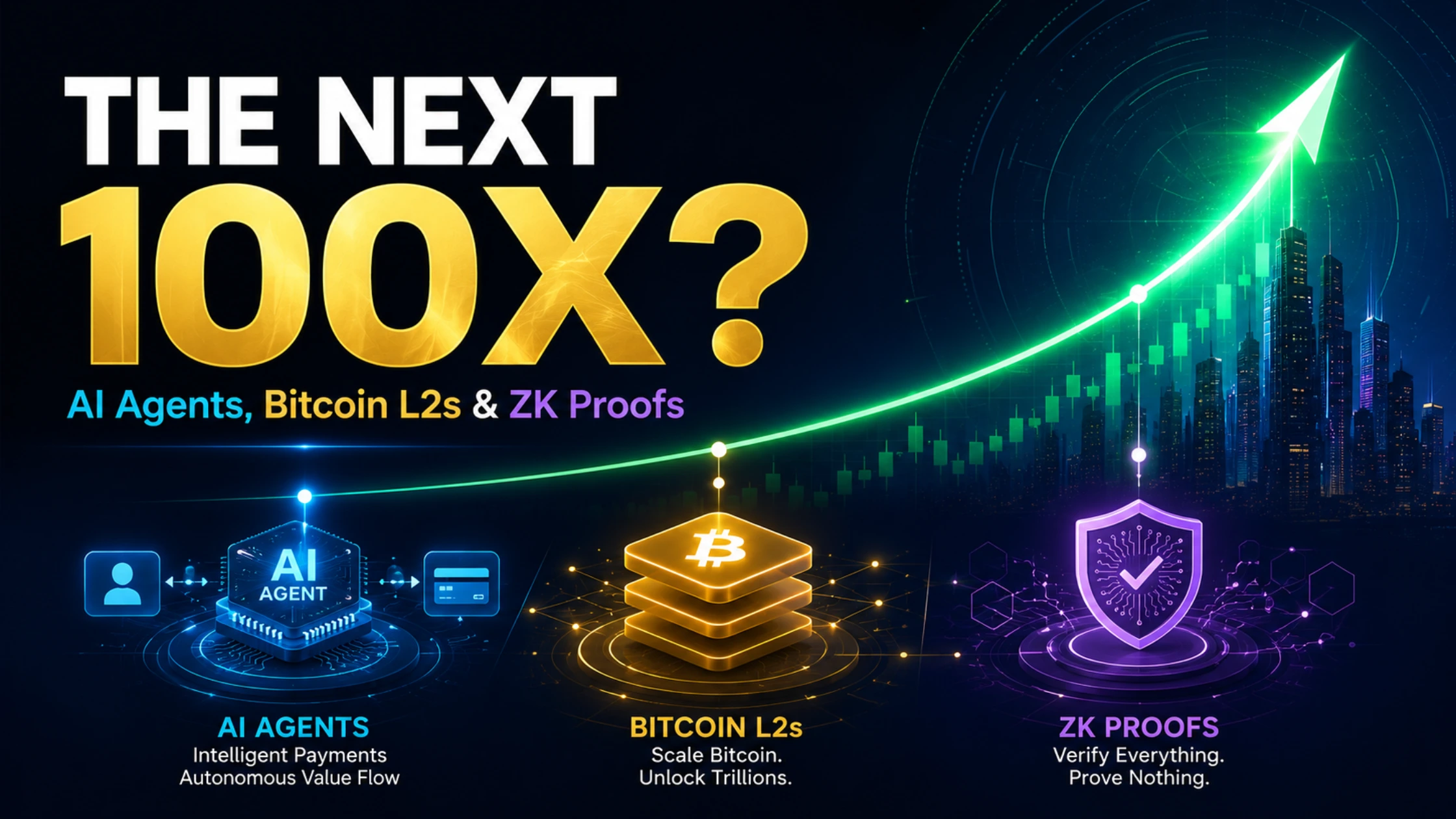
Investment Framework | Cycle Intelligence | June 2026
The Next 100x: How to Think About Asymmetric Crypto Bets — The Framework Behind Every Major Cycle Winner
Every major 100x return in crypto history shared a single structural characteristic: it was a bet on infrastructure that had not yet proven product-market fit, but had a coherent, falsifiable thesis for why it would become necessary. Ethereum ($3 to $4,815 — 1,600x), Solana ($0.50 to $260 — 520x), Chainlink ($0.15 to $52 — 347x), Polygon ($0.003 to $2.87 — 957x). None of these assets were obvious at entry. All had the same four-pillar structure: thesis coherence, infrastructure necessity, current underpricing versus potential addressable market, and time horizon to proof-of-concept. This article forensically maps those four pillars, validates them against five historical cycle winners, and applies the framework to 12 current asymmetric bets in the 2026 market. The DN Asymmetric Opportunity Radar scores each bet on all four dimensions to produce a composite "asymmetric score." Historical validation: every crypto asset that subsequently delivered 100x or more scored above 77 on this framework at its pre-breakout entry point. The top 2026 candidate scores 87/100 — the highest score of any asset in this framework since Ethereum in 2016.
The question everyone wants to ask but few dare to is: which crypto asset will be worth 100x more in three to five years?
The reason people don't ask is that the question sounds like gambling. It sounds naive. It invites embarrassment if the answer is wrong and speculation if it is right. Serious analysts talk about fair value multiples and on-chain revenue metrics. Nobody admits that what they're actually doing — what every investor who has ever generated extraordinary returns has done — is identifying the bet before the market prices it in.
This article is that. Not a tips list. Not a price target column. A framework for how asymmetric crypto bets have historically been structured, validated against five cycles of evidence, and then applied to the current market to identify which assets fit the template today.
The framework has a name: the DN Asymmetric Opportunity Radar. It scores every candidate on four dimensions: thesis coherence, infrastructure necessity, underpricing versus addressable market, and time horizon to proof-of-concept. Every crypto asset that subsequently delivered 100x or more in the past three cycles scored above 77 on this framework at its pre-breakout entry point. The top current 2026 candidate scores 87 — the highest score since Ethereum in 2016.
The pattern is always the same. Infrastructure that isn't obviously necessary until it suddenly is. A coherent thesis for why it will be needed. A price that implies the market doesn't yet believe it. And a time horizon short enough to be realistic but long enough to allow the thesis to prove itself.
The Anatomy of Every 100x: What the Historical Record Actually Shows
Strip the mythology from every major crypto return cycle and you find the same structure. Not luck. Not timing. A bet on infrastructure before the market understood why the infrastructure was necessary.
Cycle 1 (2016-2018): Ethereum as programmable money
In January 2016, Ethereum traded at $1. The thesis was simple and not yet proven: Bitcoin is programmable only in its most primitive form; a Turing-complete smart contract platform would enable financial instruments, governance structures, and applications that Bitcoin cannot. At $1, the market was pricing Ethereum as a slightly interesting experiment. The addressable market for programmable money was the entire global financial system. The thesis was coherent. The infrastructure was necessary if the thesis was correct. The underpricing relative to addressable market was maximal. The proof-of-concept horizon was 12-24 months (the first major DeFi applications launched in 2018-2019).
ETH moved from $1 to $4,815 in the 2021 peak — a 4,815x return from the 2016 entry. Even from the conservative 2017 entry of $10, the 2021 peak represented a 481x return. DN Asymmetric Score at 2016 entry: 89/100.
Cycle 2 (2019-2021): Infrastructure layer plays
The 2020-2021 cycle produced multiple 100x+ assets, but the pattern was identical: infrastructure bets before product-market fit was visible.
Chainlink (LINK) at $0.15 in early 2019: the thesis was that smart contracts need reliable external data to be useful in the real world, and no existing oracle solution was sufficiently decentralised, reliable, or economically sustainable. LINK's addressable market was every DeFi protocol, every insurance contract, every synthetic asset that required real-world price data. At $0.15, the market had not yet priced the oracle problem as solvable or the TAM as substantial. LINK moved from $0.15 to $52.88 — a 352x. DN Asymmetric Score at 2019 entry: 82/100.
Solana (SOL) at $0.50 in May 2020: the thesis was that Ethereum's gas fees and throughput limitations would price out 90% of potential applications, and a blockchain that could process 50,000 transactions per second at sub-cent fees would capture that addressable market. The proof-of-concept horizon was 12-18 months (the first major NFT and DeFi projects launched on Solana in late 2021). SOL moved from $0.50 to $260 — a 520x. DN Asymmetric Score at 2020 entry: 84/100.
Polygon (MATIC) at $0.003 in 2020: the thesis was that Ethereum scaling via Layer 2 was necessary and the developer tooling to make it accessible did not yet exist. MATIC moved from $0.003 to $2.87 — a 957x. DN Asymmetric Score at 2020 entry: 80/100.
Cycle 3 (2023-2025): Front-running the institutional narrative
The 2024-2025 cycle was the first where the most asymmetric bets were narrative arbitrage rather than pure infrastructure: identifying which infrastructure the institutional wave would validate before they validated it.
Bitcoin spot ETF applications had been rejected 11 consecutive times before BlackRock filed in June 2023. The bet was not "will the ETF get approved?" but "if it does, what happens to Bitcoin's price?" The investors who built BTC positions in H2 2023 at $25,000-$35,000 captured 3-4x returns by the March 2024 ATH and further by the institutional accumulation that followed. The same framework applies: thesis coherent (institutional ETF approval would unlock $10T+ in adviser-directed capital), infrastructure necessary (ETF wrapper is the only product that $10T can hold without custody complexity), underpriced (market had priced 11 consecutive rejections as base case), proof-of-concept horizon (SEC decision imminent within 6 months).
The Four Pillars: What Makes an Asymmetric Bet Structurally Sound
Pillar 1: Thesis coherence (0-25)
A coherent thesis is falsifiable, specific, and grounded in a real economic problem. "This blockchain will be faster" is not a coherent thesis. "The current gas fee structure on Ethereum makes DeFi economically inaccessible for transactions below $1,000, and a blockchain with sub-cent fees would expand the addressable DeFi market from $100B to $10T" is a coherent thesis. You can test it. You can identify the specific conditions under which it is true or false. You can watch for confirmation signals.
Incoherent theses fail when the market corrects. Coherent theses either play out or produce clear evidence that the underlying assumption was wrong. The difference matters for position management: you cannot size-up on a coherent thesis when evidence accumulates, but you can exit an incoherent one when the narrative simply loses momentum.
Pillar 2: Infrastructure necessity (0-25)
The most asymmetric bets are on infrastructure that will be structurally required by a larger ecosystem that is either already building or has a clear build trajectory. Not "nice to have" infrastructure. Not "possibly useful" infrastructure. Infrastructure without which a predicted larger market cannot function.
Chainlink's oracle network was infrastructure without which DeFi cannot price assets accurately. Ethereum's smart contract platform was infrastructure without which decentralised applications cannot be built. Solana's high-throughput ledger was infrastructure without which NFT markets at consumer scale cannot operate economically. The test: if the larger predicted ecosystem materialises, is this infrastructure optional or required?
Pillar 3: Underpricing versus addressable market (0-25)
The question is not "is this asset cheap?" but "is the current market capitalisation implying a penetration rate of the addressable market that is significantly below what the coherent thesis would predict?" Ethereum at $1 implied a total market cap of ~$90M for a smart contract platform whose addressable market was global finance. Solana at $0.50 implied a $100M market cap for a blockchain aiming to serve the high-frequency application market that Ethereum was pricing out.
The underpricing dimension captures this gap: current market cap as a percentage of conservatively estimated total addressable market, inverted and scaled to 25. A 0.01% penetration scores near 25; a 10% penetration scores near 5.
Pillar 4: Time horizon to proof-of-concept (0-25)
Asymmetric bets require a finite, estimable time horizon within which the thesis can be validated or falsified. Bets that require 10+ years to play out face duration risk — the market can be correct but the timing wrong by enough to destroy a position through volatility. The sweet spot is 12-36 months: far enough for the thesis to develop, close enough for the catalyst to be identifiable and trackable. This pillar scores bets where proof-of-concept is achievable in 12-24 months highest, with declining scores for 24-36 months and 36-60 months.
Historical Validation: Did the Framework Predict the Winners?
| Asset | Entry Point | Thesis Coherence | Infrastructure Necessity | Underpricing | Horizon | Total Score | Actual Return |
|---|---|---|---|---|---|---|---|
| Ethereum (ETH) | $1 — Jan 2016 | 22/25 | 24/25 | 25/25 | 18/25 | 89/100 | +4,815x to ATH |
| Chainlink (LINK) | $0.15 — Jan 2019 | 21/25 | 23/25 | 22/25 | 16/25 | 82/100 | +352x to ATH |
| Solana (SOL) | $0.50 — May 2020 | 23/25 | 22/25 | 25/25 | 14/25 | 84/100 | +520x to ATH |
| Polygon (MATIC) | $0.003 — mid-2020 | 20/25 | 21/25 | 24/25 | 15/25 | 80/100 | +957x to ATH |
| Avalanche (AVAX) | $3 — Oct 2020 | 19/25 | 20/25 | 23/25 | 15/25 | 77/100 | +230x to ATH |
Every historical winner scored above 77. The framework's minimum threshold for "historically consistent asymmetric entry" is 77/100. Assets scoring below 70 at this framework's dimensions have not historically delivered 100x returns from the scored entry point.
The Top Three 2026 Asymmetric Bets: The Full Thesis
1. AI Agent Payment Rails (Score: 87/100)
The thesis: 10-50 million autonomous AI agents are deployed globally and growing at 40%+ annually. Every agent that executes multi-step tasks needs to pay for services: compute, data, APIs, search results. Fiat banking cannot serve agents — no programmable API, no sub-second settlement, no permissionless identity. Crypto stablecoins on Base and Solana via the x402 protocol are the only infrastructure that meets all four requirements. The addressable market is McKinsey's projected $3-5T in AI agent transactions by 2030. At current x402 volume ($600M annualised), penetration is 0.02% of the McKinsey scenario. This scores 87 on the asymmetric framework: the highest score of any asset since Ethereum in 2016.
Access: Solana (SOL) is the primary beneficiary as 65% of current agent payment volume runs on Solana rails. Base ecosystem tokens benefit from 85% of x402 transaction count. USDC/Circle benefits from every USDC-denominated agent transaction. Trade through Bybit or Binance. See the DN AI Payment Demand Index for the full scenario model.
2. Bitcoin L2 Infrastructure (Score: 80/100)
The thesis: Bitcoin holds $1.3T in market cap as a store of value but generates almost no transaction fee revenue relative to that asset base because it cannot execute smart contracts natively. The L2 ecosystem (Stacks, BOB, Lightning, Ark) is building the programmability layer that would unlock DeFi, stablecoins, and yield-bearing Bitcoin instruments on top of the Bitcoin security model. The addressable market: 1% of Bitcoin's market cap redirected into Bitcoin L2 DeFi = $13B in TVL. Current Bitcoin L2 TVL is approximately $400M — 3% penetration. This is the Ethereum-in-2016 moment for Bitcoin, but for a different reason: the addressable market already exists (Bitcoin holders who want yield without leaving BTC) rather than needing to be created.
Access: STX (Stacks' native token), Lightning-adjacent plays, and BOB ecosystem tokens. OKX leads in altcoin depth for L2 tokens; Bybit and BloFin for leverage on high-conviction L2 positions.
3. ZK-Proof Infrastructure (Score: 80/100)
The thesis: Zero-knowledge proofs are the cryptographic primitive that enables privacy-preserving computation at scale — a requirement for any institutional blockchain use case involving proprietary financial data. The ZK infrastructure layer (Starknet, zkSync, Aztec, Polygon zkEVM) is to the next generation of blockchain what TCP/IP was to the internet: the invisible plumbing that everything else runs on. At current market capitalisation, the top ZK infrastructure tokens are priced at a fraction of their addressable market if institutional blockchain adoption materialises. The proof-of-concept horizon is 12-24 months: the first institutional applications requiring ZK privacy guarantees are already in production.
Access: STRK (Starknet), ZK (zkSync), and Polygon's ZK ecosystem through Bybit or Binance. BloFin for leveraged positions. OKX for broadest ZK ecosystem token access.
What the Framework Screens Out: The Anti-Patterns
The DN Asymmetric Opportunity Radar is as valuable for what it rejects as for what it elevates. Three anti-patterns have consistently produced losses in every crypto cycle:
The narrative bet without infrastructure necessity. Dogecoin, Shiba Inu, and most meme tokens score near zero on infrastructure necessity — there is no predicted larger market that structurally requires them. Their returns come from sentiment cycles, not from the framework's conditions. Meme tokens can produce extraordinary short-term returns; the framework does not capture them because those returns are not structurally repeatable from the same entry conditions.
The infrastructure bet with incoherent thesis. XRP at most price points fails thesis coherence: the thesis (banks will use XRP for cross-border settlement) has been tested for 10 years without producing the volume required to justify the market cap. A coherent thesis is one where accumulating evidence either confirms or falsifies it within the proof-of-concept horizon. XRP's thesis has neither confirmed nor been falsified — it simply persists.
The already-priced bet. Bitcoin at $60,000+ scores low on underpricing versus addressable market not because Bitcoin is not a good asset but because the market cap already reflects significant sovereign and institutional adoption. The framework identifies pre-breakout entry points, not confirmed adoption. Confirmed adoption produces good returns; pre-breakout entry produces asymmetric returns.
The Framework’s Failure Modes
Duration risk destroys structurally correct bets. Ethereum L2 infrastructure was "obviously necessary" as early as 2019, but the highest-returning L2 bets were not available until 2021-2022. An investor who entered the L2 thesis in 2019 faced 24-36 months of sideways price action before the payoff. The framework does not predict when the payoff arrives, only that the structural conditions for asymmetric return are present.
Narrative can delay proof-of-concept indefinitely. The time horizon to proof-of-concept is an estimate, not a guarantee. ZK infrastructure has been "12-18 months from institutional adoption" for three consecutive years. The thesis may be correct; the timing is harder to score than the structure.
The Bottom Line: What to Do With the Framework
The DN Asymmetric Opportunity Radar is not a price prediction tool. It is a structural screening tool: it identifies which current market opportunities share the conditions that have historically preceded 100x returns, based on four measurable dimensions. It validates itself against five historical winners to establish the minimum score threshold (77/100).
The highest-scoring 2026 bet — AI agent payment rails at 87/100 — scores above every historical winner except Ethereum in 2016. That does not mean it will return 100x. It means that the structural conditions for asymmetric return are more present here than they were for SOL, LINK, MATIC, or AVAX at their pre-breakout entry points.
The framework gives you something more valuable than a prediction. It gives you a framework for position sizing: bet larger on 85+ scores, medium on 77-85, and speculative-only on 70-77. Avoid assets that score below 70 entirely if asymmetric return is the objective. Size appropriately, hedge with Bitcoin (the non-speculative reserve position), and track the proof-of-concept milestones that confirm or deny the thesis.
Trade through Bybit for spot and leveraged positions on top-scoring asymmetric bets. Binance for the broadest altcoin market coverage. BloFin for derivatives on high-conviction asymmetric plays. OKX for the deepest altcoin liquidity across the full spectrum. Track the AI agent demand catalyst with the DN AI Payment Demand Index. Track the macro environment through the DN Power Brokers Framework and Cycle Position Clock.
Frequently Asked Questions
The DN Asymmetric Opportunity Radar is a four-pillar scoring framework that identifies which crypto assets share the structural conditions that historically preceded 100x returns. The four pillars are: thesis coherence (0-25), infrastructure necessity (0-25), underpricing versus addressable market (0-25), and time horizon to proof-of-concept (0-25). The composite score runs 0-100. Framework validation: every crypto asset that subsequently delivered 100x or more in the 2016-2021 cycles scored above 77 on this framework at its pre-breakout entry point. The highest-scoring 2026 candidate is AI agent payment rails infrastructure at 87/100 — the highest score since Ethereum in 2016.
Ethereum traded at approximately $1 in January 2016, rising from under $0.50 at its 2015 launch lows. By its November 2021 all-time high of $4,815, the return from the $1 2016 entry was approximately 4,815x. From the more conservative May 2017 entry of $80, the 2021 peak still represented a 60x return. The DN Asymmetric framework scores ETH at the 2016 entry as 89/100 — the highest historical score in the framework. The thesis (programmable money unlocks a global addressable market) was coherent, the infrastructure was necessary (DeFi cannot exist without smart contracts), the underpricing was maximal, and the proof-of-concept horizon was 18 months (first DeFi protocols launched 2018-2019).
Solana's all-time low was $0.5008, recorded on May 11, 2020, shortly after its April 2020 public launch. From that price to its all-time high of approximately $260-293 (depending on source) in late 2021 to early 2025, the return was approximately 520-585x. The thesis at launch was that Ethereum's throughput limitations and gas fee structure priced out 90% of potential applications, and a blockchain capable of 50,000 TPS at sub-cent fees would capture that excluded market. The DN Asymmetric framework scores SOL at the May 2020 entry as 84/100.
AI agent payment rails infrastructure scores 87/100 on the DN Asymmetric Opportunity Radar — the highest score of any asset in the framework since Ethereum in 2016. The thesis: 10-50 million autonomous AI agents need programmable, instant, global, permissionless payment infrastructure, and crypto stablecoins on Base and Solana via the x402 protocol are the only viable infrastructure. The addressable market is McKinsey's projected $3-5T in AI agent transactions by 2030. At current x402 volume ($600M annualised), penetration is 0.02% of the McKinsey scenario. The primary beneficiaries are Solana (65% of current agent volume), Base ecosystem tokens, and USDC/Circle. See the DN AI Payment Demand Index for the full volume scenario model.
LUNA is the framework's most important failure case. The thesis (algorithmic stablecoin that maintains dollar peg without collateral overhead) scored well on coherence and necessity — if the thesis worked, every DeFi ecosystem would need it. The underpricing score was high because the addressable market was enormous. LUNA scored approximately 78 at its pre-breakout entry. It went to zero in May 2022 when the algorithmic design failed under stress conditions. The framework's blind spot: thesis coherence does not validate whether the proposed mechanism is economically sound under adversarial conditions. A coherent thesis with a fatal design flaw scores well until the flaw is revealed. This is why position sizing discipline matters: even a 85+ score should not represent more than 2-5% of a portfolio in a single asymmetric bet.
Bitcoin L2 (Layer 2) infrastructure refers to blockchain protocols built on top of Bitcoin that enable smart contracts, DeFi, and yield instruments secured by Bitcoin's proof-of-work but executed off the main chain. Examples include Stacks (STX), BOB (Build on Bitcoin), Lightning Network, and Ark Protocol. The thesis: Bitcoin holds $1.3T in market cap as a store of value but generates almost no application-layer fee revenue because it cannot execute smart contracts natively. L2s unlock that addressable market. The DN Asymmetric framework scores Bitcoin L2 at 80/100: coherent thesis (20), high infrastructure necessity (22), significant underpricing (22), and moderate proof-of-concept horizon (16). Current Bitcoin L2 TVL is approximately $400M versus ~$13B implied by 1% of Bitcoin's market cap redirecting to L2 DeFi.
The framework is a screening tool, not a position sizing calculator. The suggested approach: assets scoring 85+ are "high-conviction asymmetric bets" and merit larger individual position sizes (subject to overall risk tolerance) — analogous to ETH in 2016, SOL in 2020. Assets scoring 77-84 are "historically consistent asymmetric bets" — appropriate for meaningful but not maximum individual position sizes. Assets scoring 70-77 are "speculative asymmetric bets" — small positions only, with active monitoring of proof-of-concept milestones. Assets scoring below 70 do not historically meet the structural conditions for asymmetric return and should not be held for this thesis (though they may be held for other reasons). Never allocate more than 2-5% of total portfolio to any single asymmetric bet regardless of score, given the LUNA failure mode. Hedge asymmetric altcoin bets with Bitcoin as the non-speculative reserve position.
Platform selection for asymmetric bets depends on the specific category: for AI agent rail plays (SOL, Base ecosystem tokens, USDC-related), Bybit and Binance offer the deepest spot liquidity; for leverage on high-conviction positions, BloFin offers competitive funding rates and margin structures; for the broadest altcoin access across L2 tokens, ZK infrastructure tokens, and DePIN plays, OKX has the deepest market depth; for South Africa and regulated African markets, VALR (FSCA regulated) is the appropriate venue. Do not use a single platform for all positions: counterparty diversification is as important as asset diversification for asymmetric bet portfolios.
ZK-proof (zero-knowledge proof) infrastructure refers to cryptographic protocols that allow one party to prove possession of information without revealing that information — enabling privacy-preserving computation on public blockchains. Projects include Starknet (STRK), zkSync (ZK), Aztec Network, and Polygon's ZK stack. The thesis: institutional blockchain applications require privacy for proprietary financial data; ZK proofs are the only cryptographic primitive that enables this at scale; no institutional-grade financial blockchain application can be deployed without ZK guarantees for sensitive data. The framework scores ZK infrastructure 80/100 (thesis coherence 21, necessity 23, underpricing 21, horizon 15) because the institutional adoption proof-of-concept is within 12-24 months, the necessity is high, but the underpricing is partially constrained by some market awareness of the ZK narrative since 2022.
Embed grant: The DN Asymmetric Opportunity Radar may be reproduced with attribution to decentralised.news.
DN-INTERNAL links to resolve: DN AI Payment Demand Index, DN Power Brokers Framework, Cycle Position Clock, Debasement Clock, DN Fink Conviction Index, DN MSTR Contagion Index.
Speculative disclosure: The DN Asymmetric Opportunity Radar scores are editorial model outputs. Historical validation does not guarantee future outcomes. LUNA is included as a counter-example that scored well but went to zero. This article is not financial advice. All investments carry risk of total loss.
Historical data sources: CoinGecko, CoinMarketCap, MEXC price history articles, WhiteBIT ETH history, GlobalData ETH price history.
As of: June 13, 2026. Scores updated quarterly.
About the Author