AI Cannot Predict Crypto Prices. Here Is What It Can Actually Do
Can AI Predict Crypto Prices? What the Models Actually Get Right
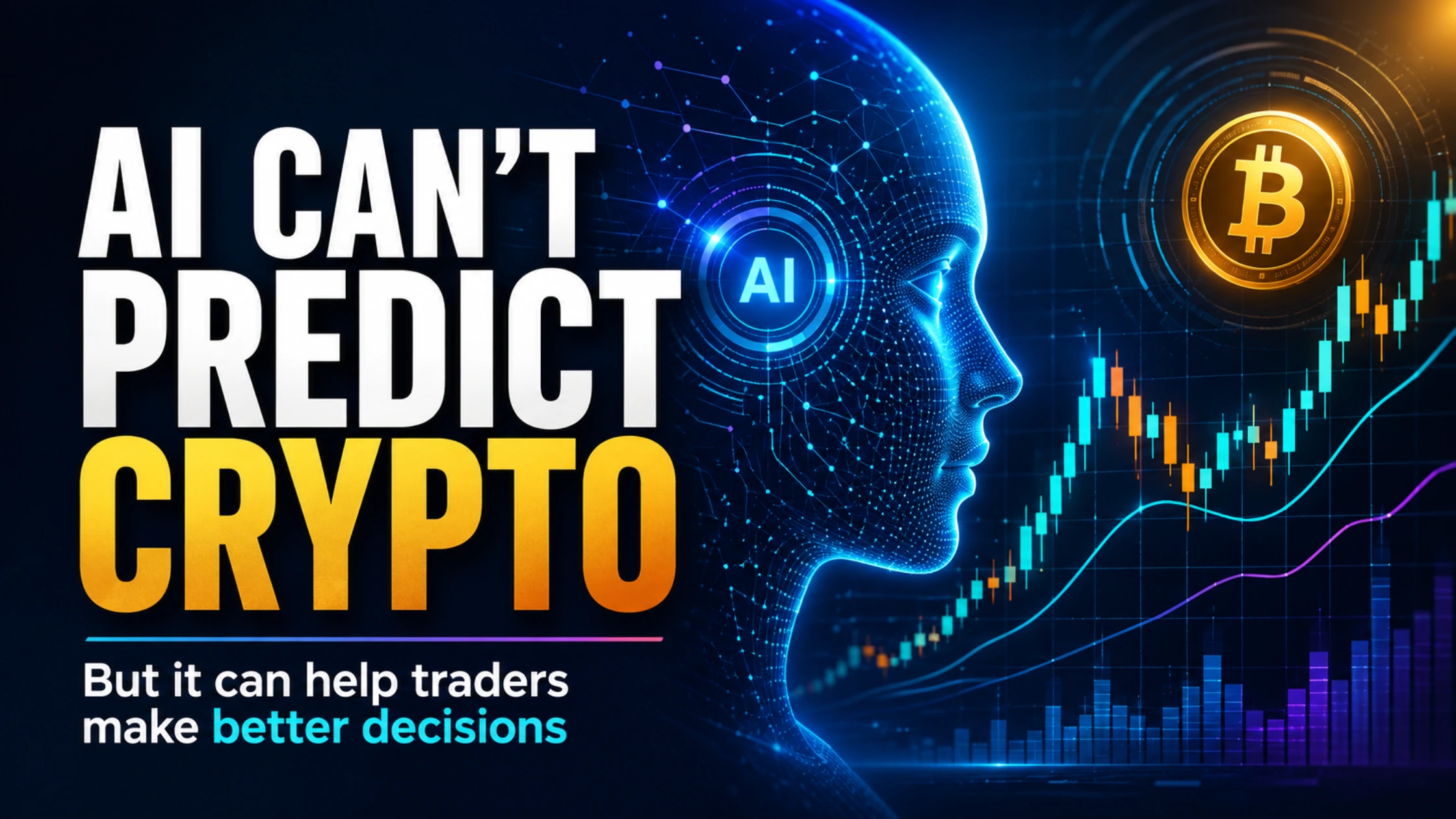
Type "AI crypto prediction" into any search bar and you will be buried in promises: bots that call the top, algorithms that see the next pump, neural networks that turned a thousand dollars into a fortune. It is one of the most seductive pitches in all of trading, and in 2026, with AI genuinely transforming so much of finance, it has never sounded more plausible. So it is worth stating the truth plainly, because almost no one selling these tools will: AI cannot reliably predict crypto prices, and anyone who tells you otherwise is selling a story.
But "no" is where the lazy answer stops and the useful one begins. Because while AI is not a crystal ball, it is an extraordinarily capable analyst, and the gap between what it genuinely does well and what the hype claims is exactly where traders get fooled — or find a real edge. This guide separates the two honestly: why prediction is structurally impossible to do reliably, what AI actually gets right and is worth paying for, and how to tell a legitimate tool from a black-box signal scam. The Signal Trust Score below lets you score any AI claim before you risk money on it.
The short answer, and why
The reason AI cannot reliably predict prices is not that the models are not clever enough — it is baked into how markets work. Markets are close to efficient, meaning known information is already reflected in the price, and they are reflexive, meaning the act of trading on a prediction changes the very thing being predicted. This creates a beautiful paradox: if a model could genuinely forecast that an asset would rise, traders acting on it would buy immediately, pushing the price up now and erasing the future move. A predictive edge, once discovered and used at scale, destroys itself. This is why the genuinely profitable quantitative firms guard their methods like state secrets and never sell signals to the public — because selling an edge is the fastest way to kill it.
Three more forces seal it. Crypto prices are dominated by noise — random, meaningless fluctuation that models happily mistake for signal. Backtests that look spectacular are usually overfitted, tuned so perfectly to past data that they describe history flawlessly and predict the future not at all. And the events that move crypto most — a regulatory shock, an exchange collapse, a geopolitical jolt — are precisely the black swans no model trained on the past can see coming. A prediction is only as good as the assumption that tomorrow resembles yesterday, and in crypto, it often violently does not.
What AI actually gets right
Here is the part the flat "no" misses, and it is genuinely valuable. AI is not useless in markets; it is useless as an oracle and powerful as an analyst. It can read patterns across more data than any human could process in a lifetime, surfacing correlations and structures worth investigating. It can gauge market sentiment by digesting millions of news articles and social posts in real time, quantifying a mood shift before it is obvious. It can detect on-chain flows — large wallets moving, coins leaving exchanges — that hint at supply and demand pressure. It can spot arbitrage gaps and pricing anomalies across venues faster than any person. It can enforce risk management ruthlessly, sizing positions and honouring stop-losses without the fear and greed that wreck human traders. And it can execute strategies tirelessly, around the clock, without emotion.
Notice what unites all of these: none is a prediction. Each is AI doing what it is genuinely brilliant at — processing scale, recognising patterns, removing emotion, acting fast — in service of a decision that a human still owns. That is the correct and profitable way to use AI in crypto: as a tireless analyst and executor that sharpens your judgement, not as a fortune-teller that replaces it. The traders who win with AI use it to see more and act more consistently. The ones who lose hand it their decisions and ask it to see the future.
The model types, and what they realistically forecast
Not all "AI predictions" are the same, and understanding which kind of model is behind a claim tells you a great deal about how much to trust it. The table below sets out the main types honestly.
| Model type | What it does | Realistically gives you | The honest limit |
|---|---|---|---|
| Price pattern models (LSTM, transformers) | Learn patterns in price & volume history | Short-term probabilities, never certainties | Overfit to the past; degrade as markets shift |
| Sentiment / NLP models (LLMs) | Read news and social mood at scale | Sentiment shifts and narrative momentum | Sentiment is not price; it can be manipulated |
| On-chain analytics models | Track wallet and exchange flows | Supply/demand pressure signals | Correlation, not causation; often lagging |
| Arbitrage / anomaly detection | Spot price gaps and inefficiencies | Real but fleeting opportunities | Competitive; fees and execution erode it |
| "Black-box signal" services | Claim to predict future price | Usually nothing reliable | No genuine edge survives being sold publicly |
The first four are legitimate analytical tools with honest limits; the last is where most "AI predicts crypto" marketing lives. Treat any claim of reliable price prediction as a red flag, not a feature.
The Signal Trust Score
Whenever you encounter an AI signal, bot, or prediction service, the question is not "is AI smart?" but "how much should I trust this specific claim?" The Signal Trust Score answers it by scoring the claim against the markers that reliably separate legitimate tools from hype: whether it promises guaranteed returns, whether its method is transparent, whether it has a real and verifiable track record including losses, whether it discloses risk honestly, and whether it augments your decision or asks you to blindly follow. Run any signal through it below before you trust it with a cent.
The Signal Trust Score
Score any AI signal, bot or prediction before you trust it. Runs entirely in your browser.
Educational tool, not financial advice. A high score means a signal shows fewer hallmarks of a scam — not that it will be profitable. No tool reliably predicts prices, and you remain responsible for every decision.
How to use AI tools the right way
Used as augmentation rather than oracle, AI tools genuinely sharpen a trader, and the legitimate ones share an honest pitch: they help you see and act, they do not promise to predict. For charting, screening and analysis you control, TradingView is the industry standard, letting you build, test and visualise your own ideas with a vast library of indicators rather than outsourcing your thinking to a black box. For the data layer — tracking on-chain wallet flows, exchange movements and arbitrage opportunities across venues — ArbitrageScanner surfaces the kind of verifiable, real-time information AI is genuinely good at processing. And for those who want to automate a strategy they understand, ASCN offers AI-assisted trading automation — valuable precisely when it executes a plan you have chosen, with rules and risk limits you set, rather than when it asks you to trust its predictions blindly. In every case the principle holds: the tool informs, you decide.
The honest part
The crypto world is awash in AI signal services, and the uncomfortable truth is that the great majority of those promising to predict prices are selling hype, and some are selling outright fraud. The markers are consistent and easy to spot once you know them: guaranteed or specific returns, a secret algorithm they will not explain, a track record made of cherry-picked screenshots rather than verifiable history, no honest disclosure of risk, and a pitch built on urgency and the promise that you need only follow. Any one of these should give you pause; together they are a flashing warning. Remember the logic that underpins all of it — a genuine edge, sold publicly, stops being an edge — and you will understand why the people who can truly predict markets are not selling you a subscription. Use AI to become a better-informed, more disciplined, faster-executing trader, and it is a genuine advantage. Ask it to tell you the future, and you become the product. This is general education, not financial advice, and no tool, however sophisticated, removes your responsibility for your own decisions or the risk of loss.
Frequently asked questions
Can AI actually predict crypto prices?
Not reliably. Markets are near-efficient and reflexive, so any genuine predictive edge is erased once traders act on it. Add market noise, the tendency of backtests to overfit, and unforeseeable black-swan events, and reliable price prediction becomes structurally impossible. AI is powerful for analysis and execution, but not as a price oracle.
What is AI genuinely good at in crypto trading?
Processing vast datasets, recognising patterns, gauging market sentiment from news and social media, detecting on-chain flows and arbitrage gaps, enforcing risk management without emotion, and executing strategies tirelessly around the clock. None of these is prediction — they are ways AI sharpens a human's decisions and consistency, which is where its real value lies.
Why can't a working prediction model just be sold?
Because selling it destroys it. If a model genuinely forecast that an asset would rise, everyone acting on that signal would buy immediately, pushing the price up now and erasing the future move. A real edge, used at scale, eliminates itself, which is why profitable quantitative firms guard their methods and never sell public signals.
Are AI crypto trading signals a scam?
Many are, though not all. The ones promising guaranteed returns, hiding their methodology, showing only cherry-picked results, and telling you to just follow are classic scam markers. Legitimate AI tools inform your decisions transparently rather than promising to predict prices. The Signal Trust Score above helps you tell them apart.
What's the difference between an AI tool and an AI oracle?
An AI tool augments your judgement — analysing data, screening markets, executing your strategy, managing risk — while you keep the decisions. An AI "oracle" claims to predict the future and asks you to follow blindly. The first is a legitimate and valuable use of AI; the second does not reliably exist and is the usual shape of hype and fraud.
Can AI help with risk management?
Yes, and this is one of its most underrated strengths. AI can size positions, enforce stop-losses and maintain discipline without the fear and greed that cause human traders to abandon their plans. Removing emotion from execution is often more valuable than any prediction, because poor risk management destroys more accounts than poor forecasts do.
Should I trust an AI bot to trade for me automatically?
Only if it executes a strategy you understand, with rules and risk limits you set, on a transparent platform. Automation is valuable when it carries out your plan consistently; it is dangerous when it asks you to trust opaque predictions. Never hand full control to a system whose logic you cannot see or explain.
What are the best legitimate AI crypto tools?
Tools that inform rather than command: charting and screening platforms like TradingView for analysis you control, on-chain and arbitrage data scanners like ArbitrageScanner for verifiable real-time information, and transparent automation platforms like ASCN for executing a strategy you have chosen. The common thread is that they augment your judgement rather than replace it.
About the Author