Bybit, Binance and OKX: The Insurance Fund Transparency Test
Market Structure | Derivatives Risk | June 2026
The Drawdown Transparency Gap: What "$1 Billion Insurance Fund" Doesn't Tell You About Whether It Has Ever Actually Worked
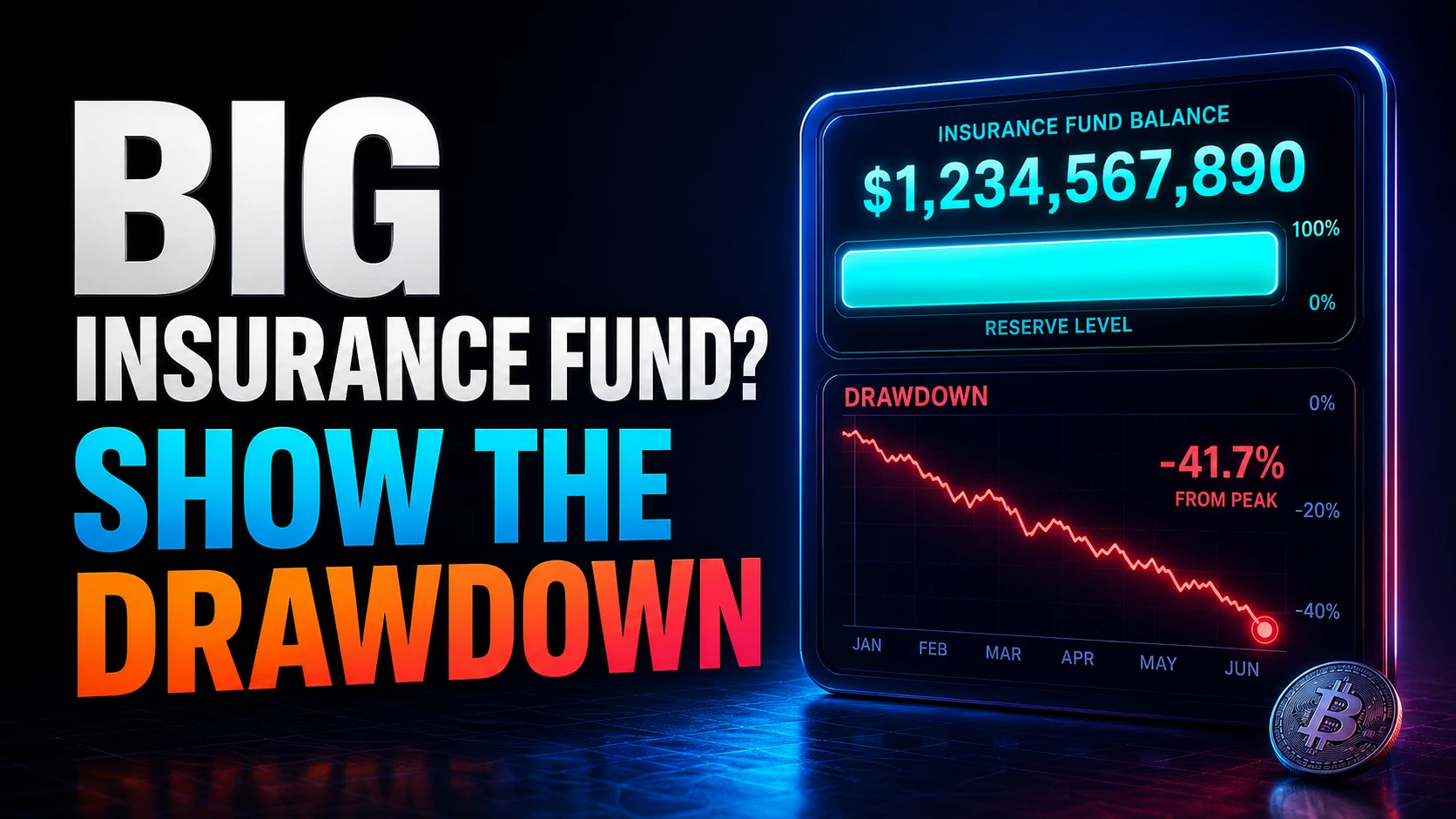
Every major derivatives exchange markets its insurance fund as a single headline figure, a current balance that grows quietly during calm markets and is presented as proof the exchange can absorb liquidation shortfalls. That figure says almost nothing about whether the fund has ever actually been tested by a real, named volatility event, how far it was drawn down, or how quickly it recovered, because almost no exchange publishes its historical balance over time with the same prominence as the current snapshot. The October 10 to 11, 2025 liquidation cascade, in which over $19 billion in leveraged positions were wiped out within hours and at least two major venues, Hyperliquid and Lighter, activated auto-deleveraging while a third, dYdX, went offline for nearly eight hours, was the most significant live stress test of exchange insurance fund mechanics in crypto's history, and it is the natural benchmark against which every exchange's drawdown disclosure should be measured. Bybit is a partial exception: following its February 2025 hack and subsequent $1.5 billion reserve restoration, the exchange now publishes a dedicated, genuinely historical Daily Insurance Fund Balance page rather than only a current figure, with the fund standing at roughly $400 million as of mid-2026. Binance publishes a current balance through its website and a REST API endpoint, but according to third-party data infrastructure provider Amberdata's own published description of its services, Binance does not natively retain the historical time series itself, meaning third parties must capture and store it independently to reconstruct any drawdown history at all. This article forensically compares actual insurance fund disclosure practices across major exchanges against the October 10 stress test and introduces the DN Drawdown Transparency Score, a framework that scores historical disclosure depth rather than the current balance figure alone.
"$1 billion insurance fund" is one of the most recognizable risk-management claims in crypto derivatives marketing, and it is also, on its own, almost meaningless. A fund that has grown to a billion dollars by quietly accumulating liquidation-engine surplus during eighteen calm months tells you nothing about whether that fund can actually absorb a real shortfall, because it has never been asked to. A fund that grew to the same size by absorbing a genuine drawdown during a named volatility event and recovering tells you something completely different. The current balance figure cannot, on its own, distinguish between these two funds. Only the historical time series can, and that is precisely the data almost no exchange publishes with anything like the prominence of the headline number.
This gap stopped being theoretical on October 10 and 11, 2025. Over roughly fourteen hours, a geopolitical shock triggered the largest deleveraging event in crypto history, more than $19 billion in liquidated positions, a concentration so severe that 70% of the total damage occurred in a 40-minute window. It was, by any reasonable definition, the most significant real-world stress test that exchange insurance fund mechanics have faced. It is also the natural benchmark this article uses to test what each major exchange's disclosure practices actually reveal, because a comparison built only from current balance figures would have told you almost nothing about how each venue's backstop actually performed.
"Infrastructure failures, depegging events, and lack of transparency will prompt demands for third-party audits of liquidation engines, standardized oracle pricing, and disclosure of insurance fund levels."
— CoinGecko Learn, "What Is October 10th?", post-event analysis, 2026.What October 10 Actually Tested: The Mechanics Behind the Headline Number
To understand why drawdown history matters more than a current balance, it helps to walk through what an insurance fund is actually built to absorb. Under normal liquidation logic, when a leveraged position falls below its maintenance margin, the exchange closes it through the order book; if the position is closed at a better price than its bankruptcy price, the surplus flows into the insurance fund, which is how these funds grow during calm markets without any drawdown at all. The fund's purpose is the opposite scenario: when a position cannot be closed before crossing its bankruptcy price, because the market moved too violently or liquidity vanished, the resulting deficit is paid out of the insurance fund instead of being passed on to other traders. Only when the fund itself is exhausted does an exchange resort to auto-deleveraging, forcibly closing profitable opposing positions to cover the shortfall, which is the mechanism of last resort every insurance fund exists specifically to delay or avoid.
October 10 forced this mechanism into the open at multiple venues simultaneously, in a way that is unusually well documented because so many traders and analysts were watching in real time. Total liquidations across the event reached between $19 billion and $19.89 billion depending on the measurement window, roughly nine times larger than any single-day total before it. At the worst point, $3.21 billion in positions were liquidated in a single minute. Several venues' own public statements and trader reports from the event confirm the insurance-fund-to-ADL sequence played out live: Hyperliquid activated auto-deleveraging for short positions and, by its own account, did so without incident, effectively catching the market bottom. A separate venue, Lighter, reported avoiding ADL activation entirely, attributing this to sufficient insurance fund reserves, while disclosing a serious operational outage between 10:30 p.m. and 3:00 a.m. EST during the same window. dYdX was offline for nearly eight hours. Binance, the largest venue by volume, ultimately offered $600 million in compensation to affected users and businesses following the event, after traders reported being unable to place risk-reducing orders during the worst of the cascade and after the exchange's internal oracle pricing for USDe diverged sharply from the broader market, deepening the liquidation spiral for accounts using it as collateral.
The Disclosure Gap: Why None of This Is Easy to Verify After the Fact
Here is the structural problem this article is built around: despite October 10 being one of the most thoroughly reported single events in crypto market history, with detailed minute-by-minute liquidation data published by multiple independent analytics firms, reconstructing exactly how much each individual exchange's insurance fund was drawn down during the event, and how quickly it recovered, is genuinely difficult, because almost no exchange publishes that specific time series as a standing, comparable disclosure. The liquidation totals are well documented. The insurance fund's role in absorbing or failing to absorb those liquidations, venue by venue, is not, because the underlying data that would let you verify it is not consistently published anywhere with the same rigor as the headline current-balance figure.
Bybit is the clearest partial exception in this comparison, and its current disclosure practice is itself the product of a real stress test: following the February 2025 security breach in which the exchange lost assets to a sophisticated attack, Bybit fully restored $1.5 billion in reserves and, in the process, increased the frequency and depth of its public disclosures. The exchange now maintains a dedicated, genuinely historical Daily Insurance Fund Balance page, not merely a current snapshot, with the fund standing at roughly $400 million as of mid-2026. This is a meaningfully different disclosure posture than a single static figure, because a daily time series at least makes it possible to observe whether and when the balance moved, even without explicit named-event annotation marking which specific volatility events caused which specific drawdowns. For a derivatives trader weighing where to hold leveraged exposure specifically because of this gap, that disclosure practice is itself a relevant selection factor independent of fees or asset coverage. Traders evaluating Bybit specifically for its insurance fund transparency can review current account terms here, alongside the daily balance history referenced above.
Binance's disclosure sits at the opposite end of the same spectrum in a specific and verifiable way. Binance publishes a current insurance fund balance through both its website and a documented REST API endpoint, `GET /fapi/v1/insuranceBalance`, which is a real and useful disclosure as far as it goes. What it does not do, according to third-party market data infrastructure provider Amberdata's own published description of its historical futures and insurance fund data products, is retain the historical time series natively: Amberdata's documentation states plainly that it captures and stores data, including insurance funds, that the exchange itself does not store, a service explicitly built around capturing snapshots via the REST API on an ongoing basis because the underlying data would otherwise not persist anywhere in queryable historical form. A trader wanting to reconstruct Binance's insurance fund balance through the October 10 cascade cannot do so from Binance's own published materials; the only path is through a third party that happened to be capturing snapshots before the event occurred.
Score = sum of four answers (0–2 each, max 8) × 12.5. A high score means a trader can independently verify whether the fund has been stress-tested and how it recovered, not merely that a large current balance is claimed. This is a structural evaluation aid built from disclosure practices, not a guarantee of fund solvency or future performance.
Scores use the same four-question methodology as the scorer above, applied to each venue's own published disclosure as of June 2026. CoinGlass is included as a third-party aggregator, not an exchange, specifically because it currently scores higher than any individual exchange's native disclosure, illustrating that the market currently depends on outside aggregation to fill a gap exchanges themselves have not closed. Re-verify against current disclosure pages before relying on any single score.
Activated auto-deleveraging for short positions; by its own account, executed without incident and effectively caught the market bottom. Reported gaining over $40M in fees and liquidations from traders seeking alternatives to centralized exchange opacity during the event.
Avoided ADL activation, attributed to sufficient insurance reserves, while disclosing a "serious outage" between 10:30pm and 3:00am EST during the same window.
Offline for nearly eight hours during the cascade.
Traders reported API lockouts preventing risk-reducing orders; internal USDe oracle pricing diverged from the broader market, deepening liquidations on affected collateral. Binance offered $600M in compensation to affected customers and businesses following the event.
None of these venue-by-venue outcomes can be independently cross-referenced against each exchange's own historical insurance fund balance data with consistent rigor, which is the central finding of this article: the event that should be the definitive public stress test of insurance fund mechanics is reconstructable mainly through scattered trader reports and third-party analytics, not through standing, comparable exchange disclosures.
The Disclosure Snapshot, June 2026
| Venue | Current Balance Disclosed | Native Historical Series | Oct 10 Drawdown Reconstructable from Own Data |
|---|---|---|---|
| Bybit | Yes, ~$400M (mid-2026) | Yes — dedicated daily history page | Partially, no explicit event annotation |
| Binance | Yes, via site + REST API | No — not natively retained per Amberdata | No, requires third-party capture |
| OKX | Strong PoR, not insurance-fund-specific | Unclear — no dedicated insurance-fund history page identified | No |
| CoinGlass (aggregator) | Cross-exchange, historical | Yes | Partially, depends on underlying exchange API continuity |
Read across that table and the structural finding of this article is contained in the last column: even the strongest individual exchange disclosure in this comparison, Bybit's daily history page, does not explicitly annotate which balance movements correspond to which named volatility events, and the market currently depends on third-party aggregation to approximate the cross-exchange picture that none of the underlying exchanges fully provide on their own.
Why This Gap Matters More As Leverage Concentrates in Fewer Venues
None of the disclosure gaps documented in this article are evidence of bad faith, and several of the exchanges compared have genuinely improved their transparency practices following real incidents, Bybit's daily history page is itself a direct product of its February 2025 hack recovery, and Binance's $600 million compensation following October 10 was a substantive response to a real failure even without the underlying drawdown data being natively published. The problem this article identifies is structural rather than a matter of any single exchange's intent: insurance fund marketing has settled on a single comparison metric, the current balance, that is genuinely useless for answering the only question that matters in a real crisis, which is whether the fund has previously absorbed a comparable shock and how it behaved while doing so.
This gap compounds specifically as derivatives open interest concentrates in fewer, larger venues, which is the trend October 10 itself accelerated: open interest fell more than 40% from its pre-crash highs as leveraged positions were flushed out, and surviving capital has tended to consolidate toward venues perceived as more resilient during the event. A trader choosing where to hold leveraged exposure today is making exactly the decision a drawdown-blind current balance figure cannot inform: not which exchange has the largest fund right now, but which exchange's fund has demonstrated, through transparent and verifiable historical data, that it can actually absorb a shock of the size that already happened once in 2025 and will, on the evidence of crypto market history, happen again.
What This Score Does Not Claim
Auto-deleveraging activation is not necessarily evidence of insurance fund failure. ADL is a designed contingency mechanism, not an emergency improvisation; Hyperliquid's own account of its October 10 ADL activation describes it as functioning as intended, and venues that avoided ADL entirely are not automatically better-managed than venues that used the mechanism as designed.
Disclosure practices change. Several exchanges compared in this article have materially improved transparency following specific incidents, and this comparison reflects publicly available disclosure as of June 2026; verify current practices directly before relying on any score.
This is not trading or investment advice. Insurance fund transparency is one input among many in evaluating exchange risk; this article does not evaluate liquidity, execution quality, regulatory status, or any other factor relevant to choosing a trading venue.
The Bottom Line: A Fund That Has Never Been Tested Is a Claim, Not a Track Record
"$1 billion insurance fund" and "$1 billion insurance fund that absorbed a $19 billion market-wide cascade and recovered within weeks" are not the same claim, even when the headline number is identical, and current comparison content across the derivatives exchange category treats them as interchangeable because the only figure most venues publish prominently is the one that cannot tell the two apart. October 10, 2025 was, on any reasonable reading, the live test that should have settled this question venue by venue, with enough independently documented liquidation, outage, and compensation detail to reconstruct most of what happened. What it could not settle, because the underlying data was not consistently published, is the one number this article is built around: how much each fund was actually drawn down, and how it recovered. That number is the only one that distinguishes a tested backstop from an untested marketing figure, and as of this article's publication, reconstructing it for most major venues still requires going around the exchange, not through it.
Frequently Asked Questions
An exchange insurance fund is a reserve maintained by a derivatives exchange to cover losses when a leveraged position is liquidated at a price worse than its bankruptcy price. Under normal conditions, liquidations closed at better-than-bankruptcy prices add surplus to the fund, which is how it grows during calm markets. When losses exceed what the fund can cover, exchanges typically resort to auto-deleveraging (ADL), forcibly closing profitable opposing positions to absorb the shortfall.
A large current balance does not reveal whether the fund grew through years of undisturbed calm-market accumulation or through surviving and recovering from a genuine drawdown during a real volatility event. Only historical balance data, ideally annotated against specific named events, can distinguish a fund that has been stress-tested from one that has simply never been asked to absorb a real shock.
Triggered by a U.S. tariff announcement on Chinese imports, crypto markets experienced the largest deleveraging event in their history: over $19 billion in leveraged positions were liquidated within roughly 14 hours, with $3.21 billion liquidated in a single minute at the cascade's peak. Multiple major exchanges experienced operational failures, including extended outages at dYdX and Lighter, while Binance later offered $600 million in compensation to affected users following reports of API lockouts and oracle pricing divergence during the event.
Binance publishes a current insurance fund balance through its website and a documented REST API endpoint, but according to third-party data infrastructure provider Amberdata's own published service description, Binance does not natively retain the historical time series; Amberdata states it captures and stores insurance fund data, among other data types, that the exchange itself does not store, requiring ongoing third-party snapshot capture to reconstruct any historical view.
Based on the methodology in this article, Bybit's dedicated Daily Insurance Fund Balance page, which publishes a genuine historical time series rather than only a current snapshot, represents the strongest native exchange disclosure compared, a practice that followed Bybit's February 2025 security incident and subsequent $1.5 billion reserve restoration. Even this disclosure, however, does not explicitly annotate which balance movements correspond to specific named volatility events.
Auto-deleveraging is a contingency mechanism that activates when losses from liquidated positions exceed what an exchange's insurance fund can absorb. Rather than letting the exchange take on bad debt, ADL forcibly closes profitable positions on the opposing side of the trade to cover the shortfall. During the October 10, 2025 cascade, Hyperliquid activated ADL for short positions while Lighter reported avoiding activation due to sufficient insurance reserves, illustrating how differently the same mechanism can play out across venues during the same event.
The score evaluates four dimensions of an exchange's own published disclosure: whether historical balance data is published at all versus only a current snapshot, whether drawdowns during specific named volatility events are identifiable, whether fund replenishment speed and mechanism are explained, and whether the disclosed figures can be independently verified. Each dimension scores 0 to 2, summing to a 0 to 100 scale, where a higher score reflects genuine historical transparency rather than the size of the current balance figure.
Embed grant: The DN Drawdown Transparency Score may be reproduced with attribution to decentralised.news.
Sources: Forbes "Locked Out And Liquidated: Traders Blame Binance For $19 Billion Crash" (Oct 21, 2025), CoinGecko Learn "What Is October 10th? Crypto's 10/10 Mass Market Liquidation Event" (2026), FTI Consulting "Crypto Crash Oct 2025: Leverage Meets Liquidity" (Apr 2026), CoinShares "Billions in Crypto Liquidations" (Oct 2025), insights4vc "Inside the $19B Flash Crash" (Feb 2026), Amberdata blog "How $3.21B Vanished in 60 Seconds" (Jan 2026) and Amberdata service documentation, Bybit Insurance Fund History page and Memeburn "Bybit Review 2026", Binance Open Platform API documentation (Insurance Fund Balance endpoint), CoinGlass Futures Insurance Fund dashboard, Hacken "Proof of Reserves Audit for OKX" case study, Castle Crypto "OKX Review 2026".
As of: June 28, 2026. Insurance fund balances, disclosure pages, and venue practices are subject to change; verify current figures and disclosure pages directly against each exchange before relying on any figure in this article. Not trading or investment advice.
About the Author