Best AI Agent Platforms for Businesses in 2027: No-Code Builders, RAG, Actions, Integrations and Governance Ranked
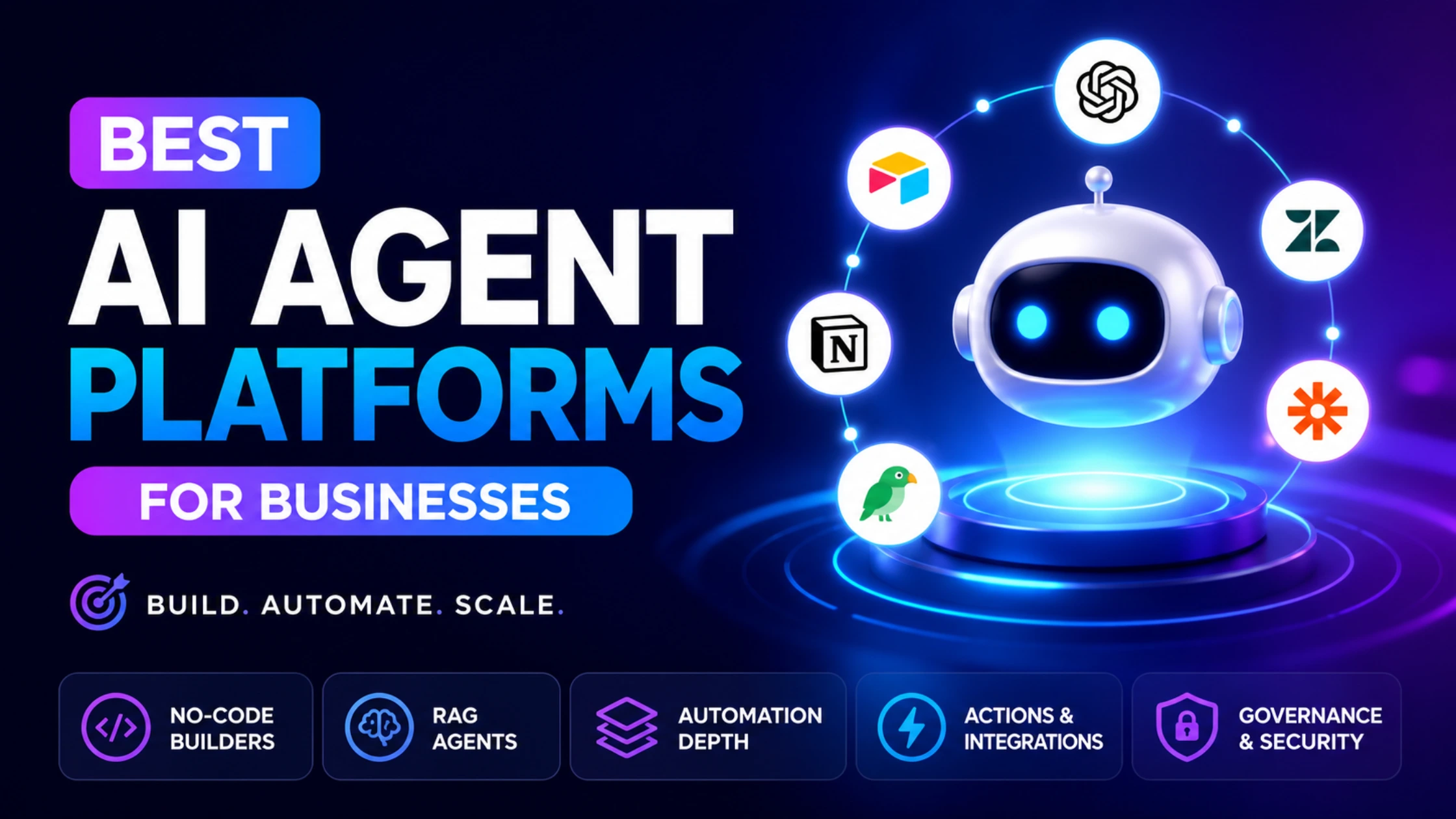
The definitive 2027 comparison of AI agent platforms for businesses, ranked across no-code development, RAG, automation, actions, integrations, deployment flexibility and enterprise governance.
Executive Verdict
The AI agent market has split into five distinct platform categories:
- Business-user agent builders
- Automation and integration platforms
- Enterprise ecosystem platforms
- RAG and knowledge platforms
- Developer agent infrastructure
A platform can lead one category and remain a poor choice in another.
Microsoft Copilot Studio is our leading enterprise low-code platform.
Make AI Agents leads visual cross-application orchestration.
Gemini Enterprise Agent Platform offers the broadest Google Cloud architecture for building, grounding, governing and optimising custom agents.
Salesforce Agentforce is the strongest CRM-native option.
Glean leads permissions-aware enterprise knowledge.
n8n and LangGraph are stronger when technical control matters more than business-user simplicity.
Taskade is one of the most accessible options for small-team agentic workspaces.
2027 Rankings at a Glance
Rank | Platform | Best for | DN score |
1 | Microsoft Copilot Studio | Enterprise low-code agents | 95/100 |
2 | Make AI Agents | Visual automation across applications | 94/100 |
3 | Gemini Enterprise Agent Platform | Enterprise RAG, model choice and Google Cloud | 94/100 |
4 | Salesforce Agentforce | CRM-native sales and service agents | 93/100 |
5 | OpenAI Frontier and API Platform | OpenAI-native custom and enterprise agents | 93/100 |
6 | Glean Agents | Enterprise knowledge and permissions-aware RAG | 92/100 |
7 | Relevance AI | No-code specialist and multi-agent workforces | 91/100 |
8 | n8n | Self-hosted low-code automation | 91/100 |
9 | Zapier Agents | Connector breadth and business-user actions | 90/100 |
10 | Taskade | Small teams, agencies and agentic workspaces | 89/100 |
11 | LangGraph and LangSmith | Developer-controlled production agents | 92/100 |
12 | Voiceflow | Customer-facing voice and chat agents | 89/100 |
13 | Botpress | Visual conversational-agent development | 88/100 |
14 | Amazon Bedrock AgentCore | AWS-native agent infrastructure | 91/100 |
15 | IBM watsonx Orchestrate | Enterprise multi-agent control plane | 90/100 |
The ranking order reflects broad business accessibility. A lower-ranked technical platform may be the superior choice for a specific engineering or regulated deployment.
Methodology notice: DN scores are editorial assessments based on documented capabilities, integration depth, governance, implementation friction and use-case fit. They are not independent laboratory benchmarks.
DN AI Agent Platform Scorecard
Factor | Weight |
Business use-case relevance | 20% |
Automation and action depth | 17.5% |
RAG and enterprise context | 15% |
Integration breadth | 15% |
Governance and auditability | 15% |
Build experience | 10% |
Deployment and developer flexibility | 7.5% |
The methodology deliberately gives less weight to model marketing.
A platform does not become a production agent system merely because it provides access to a powerful model.
Critical Market Changes Before 2027
OpenAI’s Older Agent Builder Is Being Wound Down
OpenAI announced that the earlier Agent Builder and Evals products were being wound down in June 2026.
Its current direction is centred on:
- Agents SDK
- Responses API
- workspace agents
- the wider API Platform
- OpenAI Frontier for enterprise deployments
Businesses should not base a long-term procurement decision on screenshots or reviews of an older product that is no longer central to OpenAI’s roadmap.
Amazon Bedrock Agents Classic Entered Maintenance Mode
Amazon Bedrock Agents, launched in 2023, became Bedrock Agents Classic and stopped accepting new customers after 30 July 2026.
AWS now directs new agent infrastructure decisions toward Bedrock AgentCore and its current registry, identity, runtime and observability services.
These changes demonstrate why AI agent articles need continuous maintenance. A recommendation can become outdated within months.
1. Microsoft Copilot Studio
Overall Score: 95/100
Capability | Score |
No-code and low-code building | 9.5/10 |
RAG and knowledge | 8.5/10 |
Workflow automation | 9.5/10 |
Actions | 9.5/10 |
Integrations | 9.5/10 |
Governance | 9.5/10 |
Developer flexibility | 8/10 |
Microsoft Copilot Studio is the most balanced enterprise low-code agent platform in this ranking.
It brings together:
- graphical agent creation
- Microsoft 365 context
- Power Platform connectors
- Dynamics workflows
- computer interaction
- voice
- authentication
- enterprise administration
Its computer-using agents can operate websites and desktop applications through the interface, allowing automation where a system has no usable API.
Microsoft sells stand-alone capacity through Copilot Credit packs of 25,000 credits at $200 per month in the United States. Different actions and responses consume different credit amounts.
Why it ranks first
Copilot Studio provides a credible bridge between business-user accessibility and enterprise control.
Primary weakness
The cost model can become difficult to predict across agents, Power Platform services, Microsoft 365 licences and premium connectors.
Best deployment
An internal or customer agent that already depends on Microsoft data, identity and workflows.
2. Make AI Agents
Overall Score: 94/100
Capability | Score |
No-code and low-code building | 9.5/10 |
RAG and knowledge | 7.5/10 |
Workflow automation | 10/10 |
Actions | 9.5/10 |
Integrations | 9.5/10 |
Governance | 8.5/10 |
Developer flexibility | 8.5/10 |
Make is the strongest platform in this ranking for visible, cross-application agent execution.
Its central advantage is not merely that an agent can call a tool. It is that the business can see the surrounding scenario:
- trigger
- data
- decision
- application
- transformation
- exception
- approval
- output
Make provides execution history showing tools called and cost locations, and its enterprise platform adds governance, observability and on-premises connectivity.
Why it ranks second
Many businesses need action orchestration more urgently than another conversational interface.
Primary weakness
The organisation may need an additional retrieval or knowledge layer for complex enterprise RAG.
Best deployment
A measurable workflow involving several cloud applications and clear human escalation.
Partner link: Start building with Make
3. Gemini Enterprise Agent Platform
Overall Score: 94/100
Capability | Score |
No-code and low-code building | 7.5/10 |
RAG and knowledge | 10/10 |
Workflow automation | 9/10 |
Actions | 9/10 |
Integrations | 8.5/10 |
Governance | 10/10 |
Developer flexibility | 10/10 |
Google’s Gemini Enterprise Agent Platform combines low-code design, developer frameworks, RAG, model selection, evaluation, deployment and governance.
Its architecture is organised around four functions:
- build
- scale
- govern
- optimise
The platform includes Agent Studio, Agent Development Kit, Agent Garden, Model Garden and RAG Engine.
The governance layer covers agent discovery, identity, gateways, audit trails, data access and operational oversight. Google also allows administrators to restrict the models available through Model Garden at organisation, folder or project level.
Why it ranks third
It offers one of the deepest combinations of RAG, model flexibility and enterprise governance.
Primary weakness
Implementation is materially more technical than an ordinary SaaS agent builder.
Best deployment
A custom enterprise agent that requires controlled access to internal data and several possible model providers.
4. Salesforce Agentforce
Overall Score: 93/100
Capability | Score |
No-code and low-code building | 8.5/10 |
RAG and knowledge | 9/10 |
Workflow automation | 9.5/10 |
Actions | 10/10 |
Integrations | 8.5/10 |
Governance | 9.5/10 |
Developer flexibility | 8.5/10 |
Agentforce is the most commercially relevant platform for Salesforce-centred organisations.
An agent can work close to the customer record and take CRM-native actions across service, sales, commerce and field operations.
Salesforce prices standard Agentforce actions at the equivalent of $0.10 through Flex Credits, while conversation-based pricing remains available for relevant use cases.
Why it ranks fourth
It combines agent reasoning with customer data and operational CRM actions.
Primary weakness
The business case deteriorates quickly when Salesforce data and workflows are not already mature.
Best deployment
A lead-qualification, case-resolution or account-management workflow with measurable customer or revenue outcomes.
5. OpenAI Frontier and API Platform
Overall Score: 93/100
Capability | Score |
No-code and low-code building | 6/10 |
RAG and knowledge | 9.5/10 |
Workflow automation | 9.5/10 |
Actions | 9.5/10 |
Integrations | 8.5/10 |
Governance | 9.5/10 |
Developer flexibility | 10/10 |
OpenAI Frontier is designed for enterprise agents that need business context, systems-of-record access, explicit permissions, production execution and evaluation.
The developer platform adds:
- Agents SDK
- Responses API
- file search
- web search
- computer use
- MCP
- realtime voice
Frontier provides agent identities intended to prevent unnecessary over-permissioning and an enterprise layer for auditable actions and continuous improvement.
Why it ranks fifth
OpenAI combines strong agent models and developer tooling with a more structured enterprise operating layer.
Primary weakness
The most advanced enterprise offering is contact-sales, and custom deployments still require significant technical work.
Best deployment
A strategic enterprise workflow requiring OpenAI models and custom systems-of-record integration.
6. Glean Agents
Overall Score: 92/100
Capability | Score |
No-code and low-code building | 8/10 |
RAG and knowledge | 10/10 |
Workflow automation | 8/10 |
Actions | 8/10 |
Integrations | 8.5/10 |
Governance | 10/10 |
Developer flexibility | 7/10 |
Glean is the strongest knowledge-first platform in this ranking.
It connects enterprise context and permissions to agents, allowing an employee’s access rights to continue influencing what the agent can retrieve and use.
Glean provides more than 250 connectors and gives administrators control over the MCP tools available to users and groups.
Why it ranks sixth
Permissions-aware context is one of the hardest production problems in enterprise RAG.
Primary weakness
The platform is less compelling when the organisation has a small, simple information environment.
Best deployment
An enterprise knowledge agent where search accuracy, context and permissions matter more than broad workflow automation.
7. Relevance AI
Overall Score: 91/100
Capability | Score |
No-code and low-code building | 9.5/10 |
RAG and knowledge | 8/10 |
Workflow automation | 8.5/10 |
Actions | 9/10 |
Integrations | 9/10 |
Governance | 8.5/10 |
Developer flexibility | 7.5/10 |
Relevance AI offers a business-friendly path to specialist agents and multi-agent teams.
Its enterprise capabilities include thousands of integrations, custom actions, evaluations, A/B testing, role-based access controls and audit logs.
Why it ranks seventh
It makes multi-agent design accessible to teams that do not want to build an orchestration framework.
Primary weakness
Businesses may create an unnecessarily complex workforce before proving one reliable workflow.
Best deployment
A sales, research, support or customer-success workflow requiring several specialist roles.
8. n8n
Overall Score: 91/100
Capability | Score |
No-code and low-code building | 8/10 |
RAG and knowledge | 8.5/10 |
Workflow automation | 10/10 |
Actions | 9.5/10 |
Integrations | 8.5/10 |
Governance | 9/10 |
Developer flexibility | 10/10 |
n8n sits between a business automation product and a technical orchestration platform.
It supports low-code workflows, custom code, agent nodes, human approval and self-hosting.
Its enterprise features include governance controls, while self-hosting gives organisations greater infrastructure control.
Why it ranks eighth
It offers more deployment and technical flexibility than most visual business automation platforms.
Primary weakness
The organisation becomes responsible for more of the operational burden.
Best deployment
A technically owned workflow where self-hosting, custom integrations or data control are important.
9. Zapier Agents
Overall Score: 90/100
Capability | Score |
No-code and low-code building | 9.5/10 |
RAG and knowledge | 7/10 |
Workflow automation | 9.5/10 |
Actions | 9.5/10 |
Integrations | 10/10 |
Governance | 8.5/10 |
Developer flexibility | 8/10 |
Zapier Agents benefits from an ecosystem of more than 9,000 application integrations.
Zapier is also extending that integration and authentication layer to MCP, SDK and code-driven agent environments.
Why it ranks ninth
Connector breadth can eliminate months of custom integration work.
Primary weakness
Task and activity consumption can become expensive or difficult to forecast for high-volume workflows.
Best deployment
A small or mid-sized company that needs an agent to work across a broad collection of popular SaaS products.
10. Taskade
Overall Score: 89/100
Capability | Score |
No-code and low-code building | 9.5/10 |
RAG and knowledge | 8/10 |
Workflow automation | 8/10 |
Actions | 8/10 |
Integrations | 8/10 |
Governance | 7/10 |
Developer flexibility | 6/10 |
Taskade combines agents with the workspace in which employees already manage projects, knowledge and recurring work.
Its agents can learn from files and web sources, use built-in tools, call integrations and retain workspace context.
Why it ranks tenth
It reduces the fragmentation between an agent builder and the team’s everyday operating environment.
Primary weakness
It is less suitable for complex regulated infrastructure or highly specialised software products.
Best deployment
A founder, agency or small team automating recurring research, content, client and project workflows.
Partner link: Explore Taskade
11. LangGraph and LangSmith
Overall Score: 92/100
Capability | Score |
No-code and low-code building | 3/10 |
RAG and knowledge | 9.5/10 |
Workflow automation | 10/10 |
Actions | 10/10 |
Integrations | 8.5/10 |
Governance | 9/10 |
Developer flexibility | 10/10 |
LangGraph is one of the strongest engineering options for complex stateful and long-running agents.
LangSmith provides tracing, evaluation, deployment and observability around the agent lifecycle. Its current public tiers include a free developer plan, a $39-per-seat Plus plan plus usage, and custom enterprise options.
Why it is ranked outside the top ten despite a higher score
This ranking prioritises accessibility across the broad business market. LangGraph is technically powerful but unsuitable for non-technical teams.
Best deployment
A custom agent product where state, control, evaluation and engineering ownership are essential.
12. Voiceflow
Overall Score: 89/100
Voiceflow is the strongest specialist platform in this ranking for designing customer-facing chat and voice agents.
It combines conversational design, knowledge grounding, API actions, environments, testing and monitoring.
Best deployment
Customer service, voice automation, appointments, qualification and conversational product experiences.
Primary weakness
It may need a separate workflow automation layer for complex back-office execution.
13. Botpress
Overall Score: 88/100
Botpress provides a visual development environment, knowledge bases, conversation analytics and human handoff.
Its public plans begin with pay-as-you-go access plus AI spend, with paid tiers adding production features.
Best deployment
Website and product agents requiring a visual conversational builder.
Primary weakness
Businesses must model AI usage and add-ons rather than comparing only the base subscription.
14. Amazon Bedrock AgentCore
Overall Score: 91/100
AgentCore is AWS’s current infrastructure layer for running and governing production agents.
It supports capabilities such as agent registries, controlled resource discovery, identity, observability and AWS-native infrastructure.
The Agent Registry can catalogue agents, tools, skills and MCP servers and integrate with approval and CloudTrail systems.
Best deployment
A technically sophisticated AWS enterprise.
Primary weakness
It is not a no-code product and requires cloud engineering capacity.
15. IBM watsonx Orchestrate
Overall Score: 90/100
IBM watsonx Orchestrate has evolved into an enterprise platform for coordinating and governing agents across an organisation.
Its Agentic Control Plane is intended to manage agent discovery, policies, orchestration and performance across heterogeneous systems.
Best deployment
A large enterprise operating many internal, partner and third-party agents.
Primary weakness
The control-plane architecture may be premature for organisations without a proven agent portfolio.
The DN RAG Maturity Ladder
Level | Capability | Business implication |
1 | Manual file upload | Suitable for prototypes |
2 | Managed document knowledge base | Suitable for bounded assistants |
3 | Connected enterprise sources | Better freshness and scale |
4 | Permissions-aware retrieval | Required for sensitive internal data |
5 | Structured and unstructured retrieval | Supports complex workflows |
6 | Evaluated retrieval with citations | Enables measurable quality control |
7 | Real-time context with governed actions | Suitable for production agents |
A product that reaches Level 7 is not automatically preferable. The business should pay for the level the workflow genuinely requires.
The DN Agent Action Maturity Ladder
Level | Agent authority | Required control |
1 | Read information | Source and access controls |
2 | Generate recommendation | Human judgement |
3 | Prepare draft action | Human approval |
4 | Execute reversible action | Logs and rollback |
5 | Modify customer or company records | Scoped identity and monitoring |
6 | Create financial or contractual effects | Approval thresholds and audit |
7 | Coordinate other agents | Registry, policy and system-wide oversight |
The largest governance mistake is granting Level 6 authority to a system that has only been evaluated at Level 2.
Platform Selection by Strategic Priority
Best for No-Code Building
- Microsoft Copilot Studio
- Make AI Agents
- Relevance AI
- Zapier Agents
- Taskade
- Voiceflow
Best for RAG
- Gemini Enterprise Agent Platform
- Glean Agents
- LangGraph and LangSmith
- OpenAI API Platform
- AWS AgentCore
- Salesforce Agentforce
Best for Automation Depth
- Make AI Agents
- n8n
- LangGraph
- Copilot Studio
- Agentforce
- Zapier Agents
Best for Governance
- Gemini Enterprise Agent Platform
- Microsoft Copilot Studio
- Glean Agents
- OpenAI Frontier
- AWS AgentCore
- IBM watsonx Orchestrate
Best for Customer Voice and Chat
- Voiceflow
- OpenAI API Platform
- Copilot Studio
- Agentforce
- Relevance AI
- Botpress
Minimum Production Architecture
A production agent should include seven layers.
1. Identity
The agent needs a defined identity and scoped permissions.
2. Context
The platform must know which information the agent is allowed to retrieve.
3. Reasoning
The selected model or models interpret the task and choose the next step.
4. Tools
The agent receives controlled access to business functions.
5. Execution
The platform runs and records the workflow.
6. Evaluation
The organisation measures whether the agent completed the task correctly.
7. Governance
Administrators monitor access, cost, risk, incidents and changes.
A platform that solves only one layer should not be mistaken for a complete enterprise agent architecture.
30-Day Platform Pilot
Week 1: Define
Document:
- trigger
- inputs
- expected output
- approved information
- tools
- prohibited actions
- human owner
- KPI
Week 2: Build
Connect only the minimum required systems.
Use representative test data and create an evaluation set.
Week 3: Observe
Measure:
- task completion
- hallucination rate
- retrieval accuracy
- tool failures
- human overrides
- latency
- cost
- user satisfaction
Week 4: Decide
Expand only when:
- successful outcomes are repeatable
- exceptions are understood
- permissions are appropriate
- costs are acceptable
- employees know when to intervene
DN AI Agent Platform Selector
The DN AI Agent Platform Selector scores leading products against the reader’s actual deployment requirements.
Inputs include:
- company size
- primary builder
- business use case
- current technology ecosystem
- deployment preference
- data sensitivity
- agent autonomy
- integration complexity
- required platform qualities
Outputs include:
- four ranked recommendations
- fit scores
- capability strengths
- platform cautions
- pilot recommendations
- governance requirements
- architecture guidance
DN AI Agent Platform Selector
Compare business AI agent platforms across no-code building, retrieval-augmented generation, workflow depth, actions, integrations, governance and developer control. The tool recommends a focused pilot shortlist, not a one-click enterprise procurement decision.
Describe the deployment
Platform capability map
| Platform | Best for | No-code | RAG | Automation | Actions | Integrations | Governance | Developer control |
|---|
Educational decision-support tool. Product names, capabilities, pricing and availability can change. Verify current security, legal, data-processing and commercial terms before deployment.
Frequently Asked Questions
Are AI agent platforms the same as AI models?
No. A model provides intelligence. A platform adds context, tools, execution, deployment, integrations, monitoring and governance.
Is no-code sufficient for production AI agents?
It can be sufficient for bounded workflows. High-risk, custom or infrastructure-intensive agents often require technical development and formal governance.
Which platform has the most integrations?
Zapier advertises more than 9,000 app integrations. Make and Relevance AI also provide extensive integration ecosystems. The number of connectors matters less than whether the required connector supports the correct triggers, actions and permissions.
Which platform offers the best self-hosting?
n8n is one of the strongest low-code self-hosted options. LangGraph and LangSmith are better suited to fully developer-controlled systems.
Which platform is best for enterprise knowledge?
Glean is the strongest knowledge-first choice. Gemini Enterprise Agent Platform, OpenAI’s developer platform and LangGraph are stronger when the organisation wants to build a more customised RAG architecture.
Which platform is best for small businesses?
Taskade, Make, Zapier, Voiceflow and Botpress are more accessible than large enterprise platforms. The best choice depends on whether the business needs a workspace, workflow automation or customer conversations.
Which platform is best for regulated businesses?
Copilot Studio, Gemini Enterprise Agent Platform, OpenAI Frontier, Glean, AWS AgentCore and IBM watsonx Orchestrate provide relevant enterprise-governance capabilities. A regulated business must still perform its own legal, security and risk assessment.
Final Verdict
There is no single winner across every agent architecture.
Choose Microsoft Copilot Studio when Microsoft is already the company’s operational foundation.
Choose Make AI Agents when visible cross-application execution matters most.
Choose Gemini Enterprise Agent Platform for advanced RAG, model choice and Google Cloud governance.
Choose Agentforce for Salesforce-native customer and revenue workflows.
Choose OpenAI Frontier and the API Platform for OpenAI-native custom enterprise systems.
Choose Glean when trusted enterprise context is the main constraint.
Choose n8n or LangGraph when technical control and deployment flexibility matter more than no-code simplicity.
Choose Taskade when a smaller team needs agents, projects and knowledge in one accessible workspace.
The strategic rule is:
Select the platform that gives the agent the minimum information and authority required to produce a measurable outcome.
More autonomy is not automatically progress.
More tools are not automatically capability.
More agents are not automatically intelligence.
About the Author