Best Stablecoins for Institutional Treasury Settlement in 2027
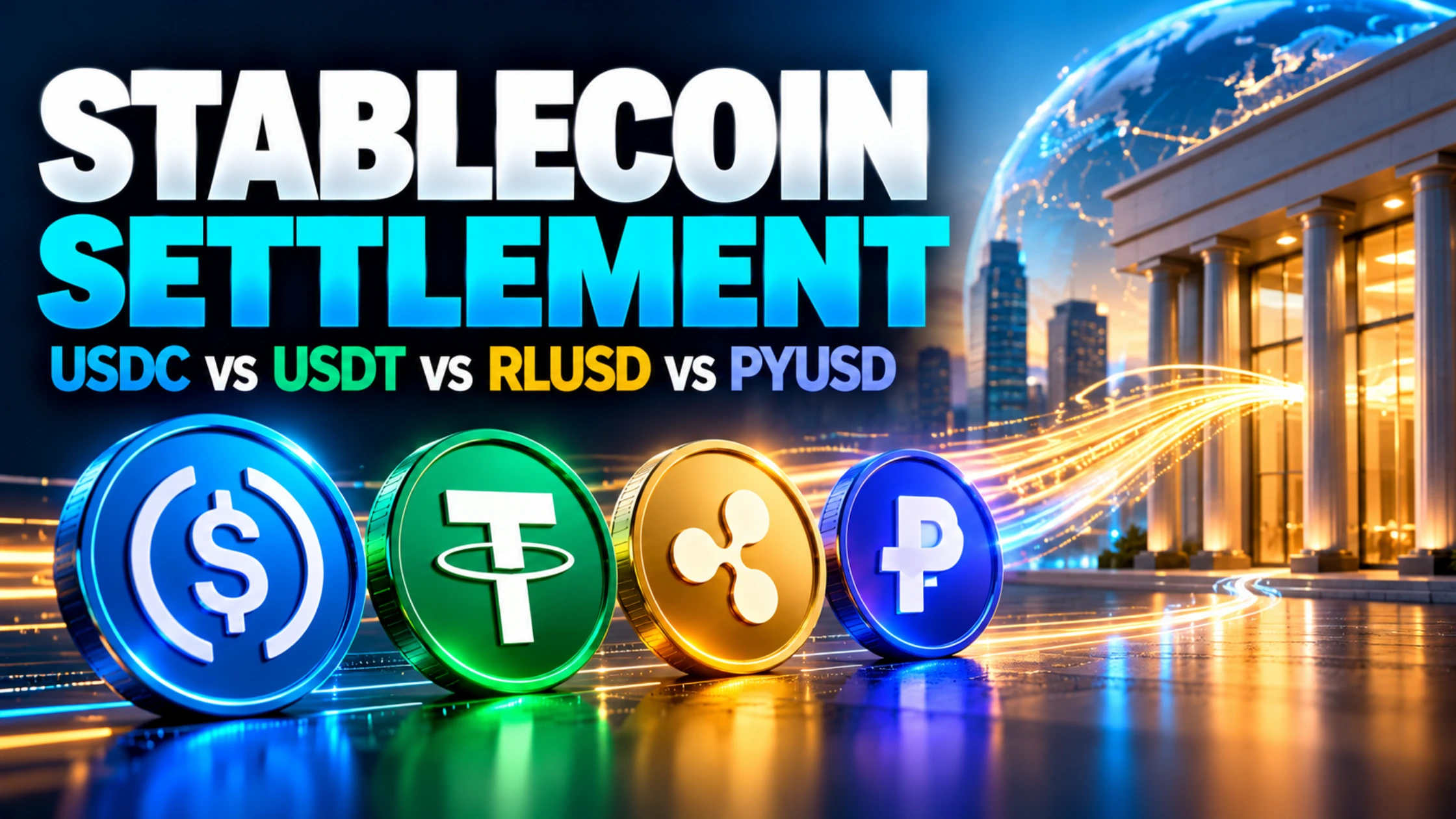
Institutional Stablecoin Settlement Benchmark 2027: USDC vs USDT vs RLUSD vs PYUSD
For an institution, stablecoin settlement is not finished when a blockchain marks a transaction final. The full workflow can include minting, wallet screening, cross-chain movement, issuer redemption, banking cut-offs, fees and reconciliation. The DN Institutional Stablecoin Settlement Benchmark compares the infrastructure behind USDC, USDT, RLUSD and PYUSD rather than treating every digital dollar as the same settlement instrument.
Last verified: 2 October 2026 • Benchmark year: 2027 • DN Institutional Settlement Framework v1.0
USDC currently has the strongest all-round institutional settlement architecture in the DN model because Circle combines direct institutional mint/redemption, native support across 38 blockchains, 24/7 funding options and CCTP for native cross-chain movement. USDT remains exceptionally useful for crypto-native liquidity but direct issuer redemption starts at $100,000 and carries explicit fees. RLUSD is built around enterprise-only issuer access and bank settlement, while PYUSD benefits from Paxos's programmable conversion, payments and bank-withdrawal orchestration.
DN Evidence Block
- Circle says USDC is natively supported on 38 blockchains as of 16 September 2026, while Circle Mint is institution-only and supports international wires and domestic bank transfers across 185+ countries.
- Circle Mint supports 24/7/365 funding rails such as book and RTP transfers for near-instant minting, while wire settlement still depends on the banking network.
- Circle's canonical CCTP uses native burn-and-mint cross-chain transfers; CCTP Fast Transfer can settle faster than source-chain finality for latency-sensitive treasury movement.
- Tether's current direct purchase/redemption minimum is $100,000. Acquisition costs 0.1%; redemption costs the greater of $1,000 or 0.1%.
- Ripple limits direct RLUSD customers to enterprise institutions meeting bank-level KYC/AML requirements. RLUSD redemption is processed in real time by Ripple, while actual USD arrival depends on the receiving bank.
- Paxos supports programmable stablecoin-to-USD redemption and bank withdrawal through its Orchestrations API and describes stablecoin pay-ins as real-time settlement.
Author: Decentralised News Research
Methodology: DN Institutional Stablecoin Settlement methodology
Primary evidence: Issuer and platform documentation
Onchain finality and institutional settlement are not the same event. A stablecoin can arrive in seconds while the recipient still waits hours or days for fiat, compliance approval or treasury reconciliation. DN therefore measures the path to usable institutional value, not merely block confirmation.
The Five Settlement States Institutions Should Separate
DN Institutional Settlement Readiness Score
The DN score measures documented settlement infrastructure, not stablecoin market capitalisation or a live promise that every transfer will complete within a fixed number of minutes.
| Component | Weight | What DN Assesses |
|---|---|---|
| Direct mint / redemption access | 25% | Issuer or platform access, fiat funding, redemption mechanics and institutional eligibility. |
| Native network breadth | 20% | How broadly the stablecoin is natively available without relying on unofficial wrapped forms. |
| Cross-chain treasury mobility | 15% | Native burn/mint, bridging or issuer-supported movement between chains. |
| Automation & reconciliation | 15% | APIs, orchestrations, transaction states and integration into treasury workflows. |
| Compliance & reserve framework | 15% | Institutional onboarding, reserve disclosure, wallet controls and regulatory structure. |
| Liquidity & market access | 10% | Practical ability to source or deploy the asset across crypto and payment markets. |
2027 Institutional Settlement Readiness Ranking
| Rank | Stablecoin | DN Score | Best For | Main Constraint | Issuer Redemption | Status |
|---|---|---|---|---|---|---|
| 1 | USDC | 98/100 | Multichain institutional treasury, direct mint/redeem and cross-chain settlement | Fiat leg still depends on banking rail and customer tier | Circle Mint / qualified institutions | LIVE |
| 2 | RLUSD | 91/100 | Institution-first regulated settlement and direct bank redemption | Narrower network and market footprint than USDC/USDT | Enterprise institutions only | LIVE |
| 3 | PYUSD | 89/100 | Payments, Paxos API orchestration and programmable fiat conversion | Smaller network footprint and distribution than the two largest dollar stablecoins | Paxos platform / eligible users | LIVE |
| 4 | USDT | 87/100 | Crypto-native treasury liquidity and settlement across widely used networks | $100K direct redemption floor plus explicit issuer fees | Tether verified customers | LIVE |
Decision-Ready Comparison
| Stablecoin | Direct Institutional Access | Native Network Footprint | Cross-Chain Model | Fiat Boundary | Best Institutional Use |
|---|---|---|---|---|---|
| USDC | Circle Mint is institution-only | 38 native networks as of 16 Sep 2026 | CCTP native burn/mint; Standard and Fast Transfer | Wires plus supported 24/7 rails; tiered redemption economics | Global treasury mobility and multichain settlement |
| RLUSD | Enterprise institutions with bank-level KYC/AML | XRPL plus multiple EVM networks | Ripple-supported multichain/bridge workflow | Real-time redemption processing; bank arrival varies | Compliance-heavy institutional settlement |
| PYUSD | Paxos / PayPal ecosystem and eligible Paxos customers | Ethereum, Solana, Arbitrum, Polygon PoS, X Layer in current Paxos mainnet docs | Paxos platform routing and stablecoin conversions | Programmable stablecoin → USD → bank orchestration | Payments and API-driven treasury workflows |
| USDT | Verified Tether customers | Multiple protocols including Ethereum, Tron, Solana, TON, Aptos and others | Multi-protocol issuance; no Circle-style universal end-user burn/mint rail | $100K minimum direct redemption; greater of $1K or 0.1% fee | Crypto-native settlement where USDT liquidity is already desired |
1. USDC: Strongest All-Round Institutional Settlement Stack
USDC ranks first in this framework because Circle has built the fiat boundary and the multichain boundary into one institutional stack.
Circle says USDC is natively supported across 38 blockchain networks as of 16 September 2026. Circle Mint is available to institutions rather than individuals and supports international wires and domestic bank transfers across more than 185 countries.
The important distinction is native support. Circle Mint does not treat arbitrary bridged versions of USDC as equivalent to native USDC on supported networks. That reduces one class of treasury ambiguity: an institution can know whether it is holding an issuer-supported token or a third-party wrapped representation.
24/7 funding matters
Circle says wire transfers still depend on banking hours and the underlying payment network, but it also supports 24/7/365 rails such as book transfers and RTP for near-instant minting where available.
This creates a more useful institutional distinction than saying “USDC settles 24/7.” The blockchain may be open continuously, while the fiat leg depends on which funding route the institution has.
CCTP is the treasury mobility layer
Circle's canonical Cross-Chain Transfer Protocol moves native USDC between supported chains through burn-and-mint rather than locking one representation and issuing a wrapped claim somewhere else.
CCTP supports Standard Transfer, which follows source-chain finality, and Fast Transfer, which can deliver destination USDC before full source finality for latency-sensitive use cases.
Circle's latest published migration schedule says CCTP V1 Legacy deprecation begins 31 October 2026 and completes 1 December 2026, making the canonical CCTP implementation the relevant infrastructure for new integrations.
2. RLUSD: Institution-First Settlement by Design
Ripple's RLUSD architecture is more explicitly institution-gated than most consumer-facing stablecoins. Direct customers are limited to enterprise institutions that satisfy bank-level KYC and AML requirements, including ongoing sanctions screening of customers and wallets.
RLUSD is currently issued natively on the XRP Ledger and across a growing set of EVM-compatible networks including Ethereum, Base, Ink, Optimism, Unichain and the XRPL EVM sidechain.
The redemption path is also unusually explicit. An institutional customer sends RLUSD to Ripple's redemption wallet, Ripple performs compliance checks, then sends fiat payment instructions to partner banks.
Ripple's documentation says redemptions are processed in real time, while actual fiat settlement time can vary depending on the bank. That wording captures the central thesis of this benchmark: issuer processing can be real time while bank usability is not.
3. PYUSD: Strong Programmable Settlement Through Paxos
PYUSD is issued by Paxos Trust Company and is designed as a payments-oriented stablecoin. The current Paxos mainnet documentation lists PYUSD on Ethereum, Solana, Arbitrum, Polygon PoS and X Layer.
The more important institutional feature is the surrounding Paxos platform.
Paxos Orchestrations can mint stablecoins from USD, redeem stablecoins to USD, swap supported stablecoins, send funds to external crypto addresses, and redeem stablecoin to USD and withdraw to a bank in one workflow.
Paxos's payments APIs also support real-time stablecoin pay-ins, automated conversion to fiat or retention in stablecoin, reconciliation and USD settlement to a bank account.
For institutions building a payment or treasury application rather than simply holding a settlement asset, that orchestration layer is a meaningful advantage.
4. USDT: Powerful Crypto-Native Settlement, More Expensive Direct Redemption
USDT's institutional advantage is its broad crypto-market distribution and support across multiple blockchain protocols. Tether currently lists support across networks including Ethereum, Avalanche, BNB Smart Chain, Cosmos via Kava, Celo, Kaia, Tron, Liquid, Solana, Polkadot AssetHub, Tezos, Near, TON and Aptos.
For institutions whose counterparties already want USDT, that network effect can remove the need to convert into another stablecoin simply for settlement.
Direct issuer access, however, has a meaningful economic threshold. Tether's current published terms state a minimum direct acquisition and redemption amount of $100,000 equivalent, a 0.1% acquisition fee and a redemption fee equal to the greater of $1,000 or 0.1%.
A $100,000 direct redemption therefore faces a $1,000 minimum fee, equivalent to 100 basis points. At $1 million, $1,000 equals 10 basis points, but the percentage rule also equals $1,000.
That does not make USDT economically poor for institutional settlement. It means an institution should distinguish secondary-market liquidity from direct issuer redemption economics.
The Fiat Boundary Is Usually the Bottleneck
Onchain settlement can be technically final while treasury settlement remains incomplete.
An institution that ultimately needs bank USD still faces issuer or platform acceptance, compliance checks, bank operating hours, payment-network availability, beneficiary-bank processing and reconciliation.
This is why a settlement benchmark that ends at blockchain confirmation systematically understates enterprise friction.
Settlement Liquidity Cost
Time is not free when large balances are immobilised.
At a 10% annual cost of capital, keeping $10 million unusable for 24 hours has an implied financing cost of roughly $2,740. The same balance immobilised for one hour costs roughly $114.
Those values are modelled financing costs, not issuer fees. They illustrate why settlement time becomes economically meaningful at institutional size.
$100K, $1M and $10M Settlement Economics
| Settlement Size | What Usually Matters Most | 1 bp Equals | Why Institutions Care |
|---|---|---|---|
| $100K | Minimum issuer fees and on/off-ramp access | $10 | A fixed $1,000 charge equals 100 bps. |
| $1M | Redemption percentage, bank speed and treasury routing | $100 | Small bps differences become four-figure costs. |
| $10M | Capital lock, counterparty exposure and automated reconciliation | $1,000 | Hours of settlement delay can create measurable financing cost. |
DN Institutional Settlement Diagnostic
Use the calculator below with your actual issuer, bank and network assumptions. It does not guess live fees. It converts your own observed or quoted settlement path into comparable basis points.
Calculate Your Settlement Friction
DN Settlement Friction Score: —
Benchmark the complete route, not just the token.
For a real treasury decision, enter the issuer/redemption fee quoted to your institution, the actual network or cross-chain cost, your expected bank-settlement time and your internal cost of capital. Two institutions using the same stablecoin can have radically different settlement economics because their banking access, customer tier and destination chain differ.
Cross-Chain Settlement: Native Mobility vs Wrapped Liquidity
Institutional treasuries often need to move the same dollar liability across chains. There are three very different ways to do that:
These architectures have different counterparty, contract, liquidity and reconciliation risks. A treasury policy should therefore specify not only the ticker, but the issuer-supported contract and network.
The Native Token Rule
DN rule: “USDC,” “USDT,” “RLUSD” or “PYUSD” is not enough information for institutional settlement. Record the issuer, contract address, source chain, destination chain and whether the token is native or bridged.
Weekend Settlement Is Really Two Clocks
Stablecoins can transfer onchain on Saturday night. That does not mean the receiving institution can always convert the balance into bank money at the same speed.
Fiat Clock: Provider + Bank + Payment Rail Dependent
Circle's support for some 24/7 funding rails narrows that gap. Ripple's RLUSD redemption workflow can process the stablecoin leg in real time, but Ripple explicitly notes that fiat settlement time varies by bank. Paxos can automate stablecoin-to-bank redemption, but the receiving banking rail still determines final availability.
Reconciliation Is Part of Settlement
An institution cannot close its books on the statement “the blockchain says confirmed.” Treasury operations may also require transaction IDs linked to internal payment references, wallet screening evidence, issuer conversion records, bank confirmation, fee attribution and accounting classification.
This is why APIs and orchestration tooling matter. A slightly slower rail with deterministic transaction state and clean reconciliation can be operationally better than a theoretically faster transfer that requires manual investigation.
DN Alpha Thesis: Stablecoins Turn Settlement Into an Inventory Problem
The institutional advantage of stablecoins is not merely faster payment. It is the ability to pre-position dollar inventory on programmable rails and move it when banks are closed.
Instead of asking whether every payment should begin and end in fiat, an institution can decide how much working capital should remain in stablecoin form across exchanges, custodians, payment processors, market-making accounts and operating wallets.
The trade-off is that reducing bank-settlement dependence increases exposure to issuer, blockchain, custody and smart-contract risks.
What DN Should Test Next
The long-term moat is an observed settlement dataset rather than a documentation-only score.
| Test | Size | Route | Primary Metric |
|---|---|---|---|
| Issuer mint | $100K / $1M | Bank USD → stablecoin | Time to spendable onchain balance + all-in bps |
| Same-chain treasury transfer | $100K / $1M / $10M | Institution A wallet → Institution B wallet | Finality + fee + reconciliation time |
| Cross-chain transfer | $100K / $1M | Native stablecoin chain A → chain B | End-to-end settlement + failure/recovery path |
| Issuer redemption | $100K / $1M | Stablecoin → bank USD | Time to usable fiat + direct fees |
| Weekend settlement | $100K | Saturday stablecoin transfer → fiat availability | Gap between onchain finality and bank usability |
Future DN Institutional Settlement Dataset
What Would Change the Ranking?
- Direct issuer mint or redemption terms materially change.
- A stablecoin expands or contracts its native chain footprint.
- Cross-chain infrastructure adds stronger native transfer guarantees or suffers material incidents.
- Banking access becomes more or less continuous.
- Redemption minimums or fees change.
- Institutional API and reconciliation capabilities materially improve.
- Observed DN testing reveals materially different completion times or failure rates from documented readiness.
- An issuer or stablecoin becomes restricted, migrating, winding down or inactive.
Methodology & Limitations
The DN Institutional Settlement Readiness Score is a modelled research framework built from current issuer documentation and public platform capabilities.
It does not claim that DN has executed matched $100K, $1M or $10M institutional settlement tests across all four stablecoins.
The model weights direct institutional mint and redemption access, native network breadth, cross-chain treasury mobility, automation and reconciliation, compliance and reserve framework, and market access.
The score is specifically about institutional settlement readiness. It is not a ranking of token safety, investment quality, market capitalisation or universal liquidity.
Evidence Classification
| Classification | Meaning |
|---|---|
| Issuer-reported | Network support, redemption terms, fees or workflow documented by the issuer/platform. |
| Modelled | DN readiness score or settlement-cost scenario derived from documented inputs. |
| Calculated | Arithmetic derived from quoted fees, settlement time or user-entered values. |
| Observed | Direct DN matched settlement measurement. No observed cross-stablecoin speed ranking is claimed in this edition. |
Related DN Research
FAQ
Which stablecoin is best for institutional settlement?
USDC ranks highest in the current DN institutional-settlement model because Circle combines direct institutional mint/redemption, broad native chain support and CCTP cross-chain infrastructure. The correct choice still depends on the counterparty, desired chain, fiat exit and jurisdiction.
Is stablecoin settlement instant?
The onchain transfer may complete quickly, but institutional settlement can continue through issuer redemption, compliance, banking and reconciliation. “Instant blockchain transfer” should not be treated as identical to “instant usable fiat.”
What is the minimum direct USDT redemption?
Tether currently publishes a minimum direct purchase or redemption amount of $100,000 equivalent for verified customers. Redemption costs the greater of $1,000 or 0.1% under the current published fee schedule.
Can institutions redeem USDC directly?
Qualified businesses can use Circle Mint to mint and redeem USDC directly. Circle Mint is currently institution-only rather than a retail service.
How does CCTP differ from a conventional bridge?
Circle CCTP transfers native USDC across supported chains using burn-and-mint mechanics rather than relying on a third-party wrapped USDC representation. Standard and Fast Transfer modes have different finality and speed characteristics.
Is RLUSD designed for institutions?
Ripple's direct RLUSD customer model is explicitly institutional: direct customers must be enterprise institutions that meet bank-level KYC and AML requirements plus sanctions screening.
Primary Research Sources
- Circle USDC - native network breadth, Circle Mint access and reserve framework.
- Circle USDC Supported Blockchains - issuer-supported native USDC and Circle Mint redemption.
- Circle CCTP - native burn-and-mint cross-chain settlement.
- Circle CCTP Legacy Migration - current 2026 migration schedule.
- Circle Mint Redemption Structure - current institutional redemption tiers and net-flow adjustments.
- Tether Fees - $100K minimum and current acquisition/redemption fees.
- Tether Supported Protocols - current network support.
- Ripple RLUSD - enterprise onboarding, reserve model and mint/redemption workflow.
- Ripple RLUSD Redemption - real-time issuer processing and bank-dependent fiat settlement.
- Paxos PYUSD Networks - current PYUSD mainnet support.
- Paxos Orchestrations: Redeem - stablecoin-to-USD bank withdrawal in one workflow.
- Paxos Stablecoin Payments - real-time pay-ins, conversion, reconciliation and bank settlement.
Change Log & Corrections
2 October 2026: First 2027 methodology edition. Verified current issuer and settlement documentation for USDC, USDT, RLUSD and PYUSD. Added the DN Institutional Settlement Readiness Score, Fiat Boundary Penalty, Settlement Liquidity Cost and interactive Institutional Settlement Diagnostic.
To flag an issuer-policy change or provide primary-source evidence for a correction, use the Decentralised News contact page.
Final Takeaway
The stablecoin ticker is only one part of an institutional settlement decision.
The DN principle: Do not benchmark stablecoin settlement by block time alone. Benchmark the time and cost from institutional money leaving one usable balance to becoming usable again at the destination.
Risk disclosure: Stablecoins carry issuer, reserve, banking, blockchain, smart-contract, compliance, custody, depeg and operational risks. Direct minting and redemption can be restricted by jurisdiction, customer eligibility and account tier. Network and banking conditions can change. This research is educational and does not constitute financial, legal or investment advice.
About the Author