Which AI Trading Bots Actually Use AI? 10 Platforms Compared
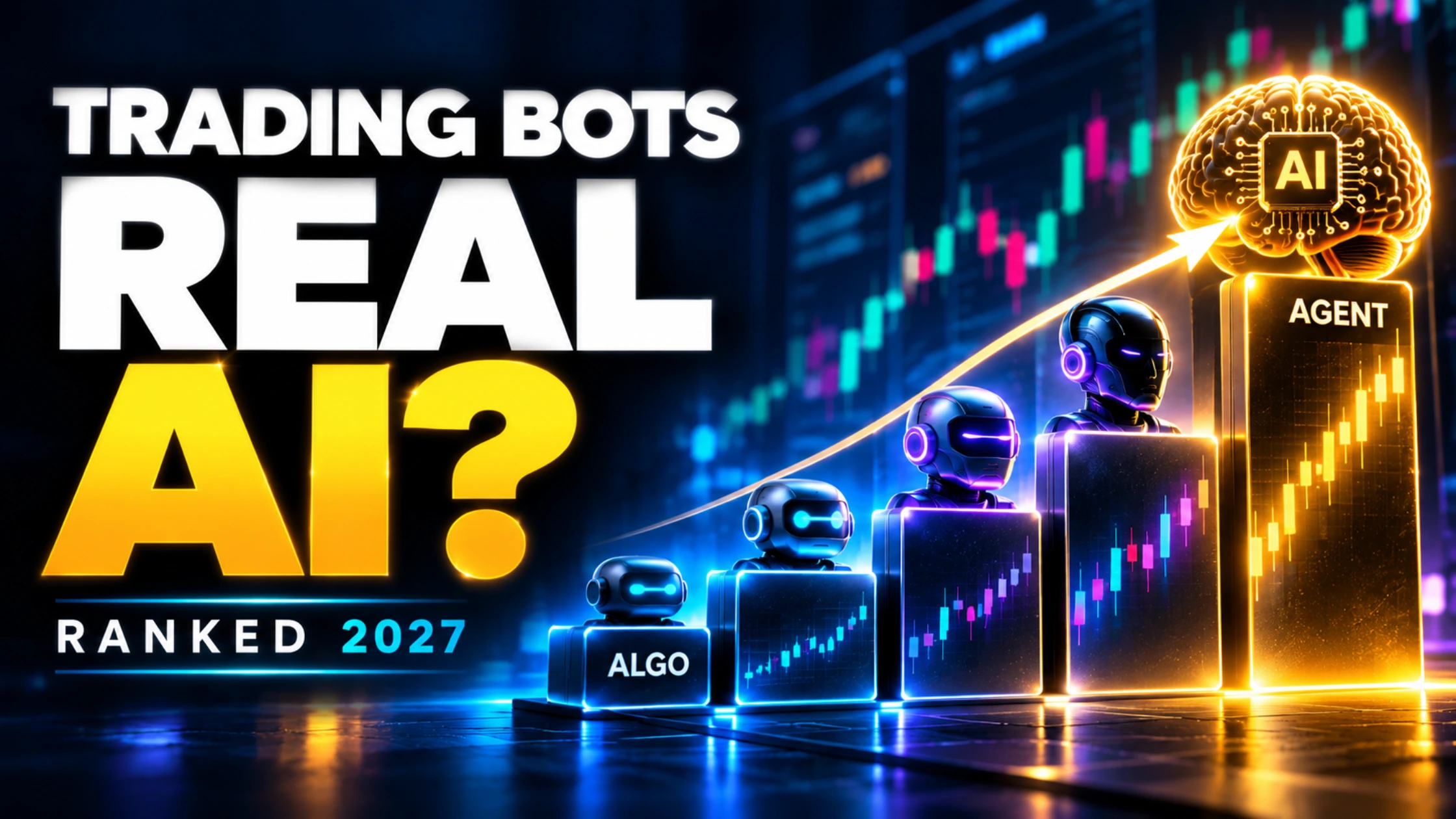
10 “AI Trading Bots” Ranked by How Much AI They Actually Use
Almost every trading bot can now be described as AI-powered. That does not mean artificial intelligence is actually making the trading decisions. DN examined ten prominent AI-labelled or AI-adjacent platforms and ranked them by where machine intelligence sits in the workflow: research, strategy generation, signal creation, parameter selection, tool use or execution.
What Matters
- “AI trading bot” is not a useful technical category. Products marketed under that phrase range from deterministic Grid bots to machine-learning signal systems, natural-language strategy builders and autonomous research agents.
- QuantPilot has the deepest documented agentic workflow in this comparison. Its autonomous agents can research markets, write QuantScript, run backtests and perform iterative parameter optimization. Its current legal terms still characterize QuantPilot as research and strategy-development software rather than a broker or order-execution service.
- Tickeron places machine learning closer to the actual signal-generation layer. Its current crypto pages describe Signal and Virtual Agents as machine-learning systems operating across 5-, 15- and 60-minute timeframes.
- Coinrule uses external LLMs as tool-using trading copilots. ChatGPT, Claude, Grok and compatible assistants can inspect accounts, construct strategies, backtest and, under authorized Write access, manage supported strategies through MCP.
- 3Commas now spans several different AI layers. The core v2 platform remains an automation environment, while its AI Assistant translates ideas into bot configurations, its MCP exposes account and trading tools to external assistants, and sibling product QuantPilot goes substantially deeper into agentic strategy creation.
- HaasOnline is highly agentic upstream but deliberately deterministic at the capital boundary. Its MCP agent can inspect live systems, create strategy code and run backtests, but current cloud documentation says the agent cannot place or cancel trades or start live bots.
- Capitalise.ai uses AI and natural-language processing primarily to translate free-form text into deterministic trading conditions.
- Gunbot uses AI in strategy development, not as the primary live decision engine. Its documentation includes machine-generated strategies created using Gunbot AI, while the deployed JavaScript logic executes explicit conditions.
- Bitsgap's AI Assistant configures portfolios of rule-based bots. Bitsgap explicitly says the Assistant does not improvise each trade using its own discretion.
- Pionex's AI Grid feature is closer to quantitative parameter optimization than autonomous AI trading. It uses historical backtests to recommend Grid ranges and settings.
- Cryptohopper supplies the cleanest reality check of all. Its own documentation says its established “A.I.” stands for Algorithmic Intelligence, not Artificial Intelligence.
DN Evidence Block
- Last verified: 2 October 2026.
- Products assessed: QuantPilot, Tickeron, Coinrule, 3Commas v2, HaasOnline, Capitalise.ai, Gunbot, Bitsgap, Pionex and Cryptohopper.
- Evidence standard: current first-party product pages, documentation, help centres and legal/service descriptions.
- Main question: where does AI materially participate in the trading workflow?
- Not measured: profitability, expected return, security quality or whether users should trade with the product.
- AI categories: Autonomous Agent, ML Decision System, LLM Tool User, Natural-Language Translator, AI-Assisted Builder, Algorithmic Optimizer and Deterministic Automation.
- Important limitation: DN has not independently audited proprietary model architectures. Claims such as “machine learning” or “autonomous agent” are classified according to current first-party documentation unless otherwise stated.
- Commercial independence: affiliate relationships contribute zero points.
- DN test status: Documented unless subsequently upgraded through first-hand DN testing.
Quick Answer: How Much AI Is Actually Inside These Trading Bots?
| Rank | Product | What the AI actually does | Execution layer | DN AI Depth |
|---|---|---|---|---|
| 1 | QuantPilot | Autonomous research, code generation, backtesting and optimization | Deterministic strategy engine / external execution architecture | 96/100 |
| 2 | Tickeron | Machine-learning signal and trading-agent layer | Signals, virtual agents and documented brokerage-agent workflows | 93/100 |
| 3 | Coinrule | LLM interprets requests and selects authorized portfolio, strategy and backtest tools | Coinrule deterministic execution infrastructure | 91/100 |
| 4 | 3Commas v2 | AI Assistant + external LLM tool use through MCP | 3Commas bot and trade infrastructure | 88/100 |
| 5 | HaasOnline | LLM agent inspects systems, writes code and runs backtests | Human-deployed bots; cloud MCP excludes live order tools | 86/100 |
| 6 | Capitalise.ai | AI/NLP translates ordinary language into executable rules | Deterministic automation | 82/100 |
| 7 | Gunbot | AI-assisted strategy and code generation | Explicit JavaScript strategy logic | 75/100 |
| 8 | Bitsgap | AI Assistant recommends pairs, portfolio and bot configuration | Rule-based bots | 68/100 |
| 9 | Pionex | Quantitative algorithms suggest Grid parameters from historical tests | Deterministic Grid execution | 56/100 |
| 10 | Cryptohopper | Established “A.I.” compares strategies algorithmically | Rule-based bot automation | 35/100 |
Important: a higher AI Depth score is not a recommendation. More AI can mean more flexibility, but also greater model uncertainty, larger tool surfaces and more difficult failure analysis.
Most “AI Trading Bots” Are Not the Same Kind of AI
Search for an AI trading bot and almost everything now appears intelligent.
AI Grid Bot.
AI Assistant.
AI Robot.
AI Agent.
Algorithmic Intelligence.
Agentic trading.
Those phrases can describe completely different architectures.
One product may use machine learning to generate a market signal.
Another may use an LLM only to translate your sentence into fixed rules.
Another may use historical statistics to choose Grid parameters.
Another may simply execute DCA rules that contain no artificial intelligence at all.
They can all appear in a search result for:
best AI trading bot.
The DN AI Trading Reality Ladder
DN uses six levels to separate automation from progressively deeper machine intelligence.
| Level | Classification | What happens |
|---|---|---|
| 0 | Deterministic Bot | Executes predefined rules. No meaningful AI required. |
| 1 | Algorithmic Optimizer | Statistics or algorithms select parameters or compare predefined strategies. |
| 2 | AI-Assisted Builder | AI helps create settings, code or configurations. |
| 3 | ML Decision System | Machine-learning models materially contribute to signals or forecasts. |
| 4 | LLM Tool User | A language model reasons over context and calls authorized external tools. |
| 5 | Bounded Agent | AI autonomously plans multi-step research, coding, testing or optimization inside defined boundaries. |
A product can have an AI interface while its trading core remains completely deterministic. Conversely, a product can have an ordinary dashboard while machine learning sits directly inside its signal-generation engine. The amount of visible AI is therefore not the same as the amount of economically consequential AI.
How DN Calculates AI Depth
The DN AI Depth Score measures five things:
- Decision-Path AI - 30%: does AI materially influence market research, signals, strategy construction or decisions?
- Agentic Capability - 25%: can the system plan and perform multi-step tasks rather than produce a single recommendation?
- Adaptability - 15%: can the machine alter analysis or strategy construction according to new information?
- Tool / Data Use - 15%: can AI retrieve live context, run backtests, call tools or manipulate trading infrastructure?
- Evidence Quality - 15%: how clearly does current documentation explain what the AI actually does?
The score deliberately does not reward:
- using “AI” in a product name,
- having a chatbot on the website,
- automating trades,
- or generating impressive backtest screenshots.
1. QuantPilot
QuantPilot
QuantPilot represents the clearest example in this comparison of software that genuinely fits the emerging term agentic trading research.
Its current documentation says autonomous AI agents can:
- research market data,
- use external data tools,
- write QuantScript strategy code,
- run backtests,
- analyze the results,
- optimize parameters,
- and continue experimentation in autonomous mode.
The distinction at the execution boundary is important.
QuantPilot's current legal terms describe it as an AI-assisted research and strategy-development service and state that it does not itself receive, transmit or execute exchange orders in the regulatory sense.
That makes the architecture closer to:
agent builds strategy → deterministic engine validates strategy → separate execution infrastructure deploys strategy.
Biggest misconception: assuming “autonomous agents” means an LLM has unlimited discretionary custody or brokerage authority.
2. Tickeron
Tickeron
Tickeron differs from most products on this list because its documented AI is not primarily a conversational wrapper around ordinary bot logic.
Tickeron's current crypto pages describe Signal Agents and Virtual Agents as powered by machine learning across 5-, 15- and 60-minute timeframes.
The platform also exposes:
- AI trading agents,
- single and multi-agent systems,
- paper-trade views,
- risk-management variants,
- and crypto-specific AI tooling.
That places AI much closer to market-signal generation than platforms where AI merely configures deterministic bots.
Biggest misconception: assuming an AI-generated signal is equivalent to a reliable future price prediction.
3. Coinrule
Coinrule
Coinrule's AI layer is easy to identify because its MCP documentation exposes the architecture explicitly.
A compatible assistant such as ChatGPT, Claude or Grok interprets the user's request.
The model can then select authorized Coinrule tools to:
- inspect holdings,
- review strategies,
- read signals and trades,
- run backtests,
- validate strategies,
- create strategies,
- and manage supported automation.
The language model is therefore genuinely involved in tool selection and strategy interaction.
But Coinrule itself remains the execution and validation layer.
That is an important distinction.
4. 3Commas v2
3Commas v2
3Commas has become more complicated to classify because several layers now coexist.
The core v2 platform remains an automated trading system.
Its AI Assistant helps users turn trading ideas into bot configurations, understand settings and work through backtests.
Separately, 3Commas operates an MCP server that allows compatible external AI assistants to inspect account information and, where suitable permissions exist, invoke supported trading actions.
And the same company operates QuantPilot, which DN treats separately because its agentic strategy-development architecture goes substantially further.
5. HaasOnline
HaasOnline
HaasOnline is one of the most technically interesting cases.
An MCP-connected agent can see live context from TradeServer and:
- inspect bots,
- read positions,
- inspect orders and logs,
- review balances,
- read market data,
- write HaasScript,
- compile scripts,
- run backtests,
- and perform parameter experiments.
That is a large AI tool surface.
Yet current HaasOnline Cloud documentation explicitly removes the most financially consequential actions.
The MCP agent cannot place or cancel trades, move funds or start and stop live bots.
Those tools simply are not exposed.
6. Capitalise.ai
Capitalise.ai
Capitalise.ai has used natural language as a trading interface long before the current wave of agentic-finance products.
Its platform describes itself as powered by AI and natural-language processing.
The core function is straightforward:
the trader expresses a strategy in free-form text.
Capitalise.ai converts that language into executable conditions.
The system can then backtest, simulate or automate those rules.
The AI is therefore meaningful, but concentrated primarily in the translation layer.
7. Gunbot
Gunbot
Gunbot's current documentation contains multiple custom strategies described as machine generated using Gunbot AI.
This makes the AI role relatively easy to isolate.
AI helps produce strategy code.
The resulting JavaScript then contains explicit:
- indicator calculations,
- entry conditions,
- exit conditions,
- cooldowns,
- position logic,
- and order calls.
Once deployed, the live trading engine follows that code.
Gunbot itself repeatedly recommends reviewing machine-generated strategies and testing them in simulation before production use.
8. Bitsgap AI Assistant
Bitsgap
Bitsgap provides one of the clearest examples of an AI-assisted bot rather than an autonomous AI trader.
Its AI Assistant considers factors such as:
- available capital,
- market conditions,
- historical volatility,
- trading pairs,
- and investment horizon.
It then recommends and configures a portfolio of bots.
Bitsgap explicitly says the Assistant does not trade according to its own open-ended discretion.
The bots execute their rule-based strategies after configuration.
9. Pionex AI Grid
Pionex
Pionex describes its Grid Bot AI Strategy as a quantitative system for recommending Grid parameters.
Current documentation says it can use historical backtest windows to suggest:
- price ranges,
- grid counts,
- and related starting parameters.
Once the Grid bot is running, however, it follows the Grid strategy.
It places buys and sells according to the configured range and Grid structure.
That means AI is concentrated near the beginning of the workflow.
The execution is algorithmic.
HvkLD4aU
10. Cryptohopper
Cryptohopper
Cryptohopper deserves inclusion because its documentation answers the article's central question unusually directly.
Its established A.I. feature does not stand for Artificial Intelligence.
It stands for:
Algorithmic Intelligence.
Cryptohopper describes it as something similar to an automatic backtester.
Users provide multiple strategies.
The system compares them and attempts to select the strategy that has been most successful under the current conditions.
That can still be useful.
It is adaptive algorithmic automation.
But the platform itself explicitly distinguishes it from artificial intelligence.
The Most Important Distinction: AI Can Sit Upstream or Downstream
Consider two systems.
System A uses an advanced LLM to create a strategy.
Once deployed, ordinary deterministic code places every order.
System B has no conversational interface at all.
But a machine-learning model produces the trading signal used every few minutes.
Which one uses more AI?
There is no meaningful answer until we specify:
where in the economic decision chain the AI sits.
| AI location | Typical role | Economic consequence |
|---|---|---|
| Research layer | Explains markets and gathers data | Indirect |
| Strategy layer | Generates rules or code | Potentially significant after deployment |
| Optimization layer | Chooses parameters | Changes future bot behavior |
| Signal layer | Determines whether a market condition is actionable | Direct |
| Tool layer | Chooses which external function to invoke | Depends on tool permissions |
| Execution layer | Controls actual order creation | Direct financial consequence |
The amount of AI in a system matters less than the distance between the AI output and irreversible financial action. DN calls this AI Proximity to Capital. A powerful research agent with no trading permission may have lower direct financial authority than a simpler model whose signal automatically triggers leveraged orders.
Why “Autonomous” Is Also Misleading
Autonomy is not binary.
An AI agent may autonomously:
- search data,
- write code,
- run experiments,
- compare backtests,
- or monitor a market.
It can do all of those things without having authority to place one live trade.
HaasOnline demonstrates this clearly.
The agent can perform sophisticated multi-step work.
Live-order tools are deliberately absent from its cloud MCP interface.
This means:
agentic intelligence and financial authority are separate variables.
The AI Marketing Gap
DN calls the distance between the AI implied by a product's presentation and the AI actually documented in its workflow the:
AI Marketing Gap.
A low gap looks like:
“AI analyzes your portfolio and recommends deterministic bots.”
The documentation explains exactly that.
A high gap would look like:
“Autonomous AI trader”
while the underlying system merely launches a Grid strategy using fixed conditions.
The point is not that deterministic bots are bad.
The point is that buyers should know what they are buying.
DN AI Trading Reality Checker
Use this tool when a product calls itself an AI trading bot.
AI Trading Reality Checker
Select what the product actually does. DN classifies whether you are looking at automation, an optimizer, an AI-assisted builder, machine learning, an LLM tool user or an agent.
Deterministic Automation
The Seven Questions to Ask Any “AI Trading Bot”
1. What exactly is generated by AI?
A strategy?
A signal?
Parameters?
Code?
Or merely the explanation shown to the user?
2. Does AI make decisions after the bot launches?
Some AI systems stop being relevant once the configuration is created.
3. Is the model choosing among predefined options?
That is different from creating a genuinely new strategy.
4. Can the AI call tools?
Tool use moves the product closer to an agentic architecture.
5. Can it perform multi-step work without another human instruction?
Research → code → backtest → revise is materially more agentic than one parameter recommendation.
6. What ultimately places the order?
This question often reveals whether AI sits in the actual execution path or merely upstream.
7. Can the company explain this without saying “AI-powered”?
If not, the marketing may be doing more work than the model.
More AI Does Not Mean Better Trading
This article deliberately ranks AI depth.
It does not rank expected returns.
That distinction matters.
A deterministic Grid bot may be:
- easier to understand,
- easier to audit,
- cheaper to run,
- more predictable,
- and easier to stop
than an advanced autonomous agent.
A sophisticated model can also:
- misinterpret instructions,
- hallucinate assumptions,
- overfit backtests,
- choose the wrong tool,
- or adapt in ways the user did not anticipate.
AI depth and product quality are different axes. A lower-AI system can be the more appropriate financial tool when predictability, auditability and constrained behavior matter more than flexible reasoning.
What Counts as a Real AI Trading Agent?
DN would reserve the term for systems where AI can perform several of the following:
- interpret an objective rather than only a parameter,
- gather market information using tools,
- plan multiple steps,
- form or modify strategy logic,
- test that logic,
- evaluate results,
- revise its approach,
- and act inside explicitly defined authority boundaries.
Simply repeating:
“If RSI is below 30, buy”
every fifteen seconds does not become artificial intelligence because the interface calls the process smart.
The Bigger 2027 Shift: AI Is Moving Upstream
The most interesting pattern across these ten systems is that AI increasingly sits above the execution engine.
It researches.
It translates.
It creates.
It tests.
It optimizes.
It selects tools.
Then deterministic infrastructure executes the final rules.
That may prove more durable than putting an unconstrained generative model directly inside every order decision.
The emerging architecture looks like:
probabilistic intelligence upstream → deterministic capital controls downstream.
Limitations
- The DN AI Depth Score measures architecture, not quality. A higher score does not mean better returns or lower risk.
- Proprietary models are not independently auditable from public documentation. Where vendors describe machine-learning or AI systems, DN reports that documented classification rather than asserting access to the underlying models.
- Products can use more than one architecture. 3Commas, for example, combines deterministic bots, a native AI Assistant and external MCP-connected assistants.
- QuantPilot execution terminology requires care. Its product interface supports a strategy lifecycle toward live Hyperliquid deployment, while its current terms describe QuantPilot itself as research and strategy-development software rather than an exchange or order-execution service.
- Agentic capability and trading authority are separate. HaasOnline demonstrates that an agent can perform complex strategy work while having no live-order tools.
- AI terminology evolves quickly. Features may materially change after publication.
- DN has not independently live-tested every product in this edition. Test status remains Documented unless stated otherwise.
- Affiliate relationships exist for some products. Commercial relationships contribute zero points.
What Would Change the Ranking?
The ranking will change as products move AI deeper into or farther away from the trading decision chain.
QuantPilot could lose the lead if another system documents a broader autonomous research, strategy-development and optimization loop.
Tickeron could move higher or lower with greater public technical disclosure about the machine-learning systems behind its signals.
Coinrule and 3Commas could move higher as external LLM tool use becomes more autonomous while retaining explicit permission controls.
HaasOnline could move higher in raw AI depth if its agent receives additional planning capabilities, though adding live trading tools would also materially increase its authority surface.
Bitsgap and Pionex could rise if their AI moves beyond configuration and parameter recommendation into genuine adaptive reasoning.
Cryptohopper could rise if separate, genuine artificial-intelligence functionality becomes central to the live product rather than its established Algorithmic Intelligence feature.
The Bottom Line
There is no single technology called an AI trading bot.
The phrase currently covers:
rules,
algorithms,
machine learning,
natural-language interfaces,
LLM copilots,
tool-using agents,
and autonomous strategy researchers.
Those systems should not be evaluated as if they were interchangeable.
The right first question is:
Where exactly is the AI?
Then ask:
Does it research?
Does it translate?
Does it generate signals?
Does it write strategy code?
Does it invoke tools?
Does it optimize?
Does it execute?
And most importantly:
how close is that probabilistic intelligence to my actual capital?
That is a more useful question than whether the marketing page contains the letters A and I.
DN reviewed current first-party documentation for ten products commonly described as AI trading tools, bots, agents or AI-assisted automation platforms.
The proprietary DN AI Depth Score weights: 30% Decision-Path AI, 25% Agentic Capability, 15% Adaptability, 15% Tool / Data Use, and 15% Evidence Quality.
Scores measure the depth of documented AI participation in the workflow. They deliberately do not measure expected profitability, security or investment suitability.
DN distinguishes: Deterministic Bot, Algorithmic Optimizer, AI-Assisted Builder, ML Decision System, LLM Tool User and Bounded Agent.
Affiliate relationships contribute zero points. Current commercial pathways are used only after the DN operational-status gate independently classifies a platform as LIVE.
DN testing classifications remain: Documented, Paper-Tested and Live-Tested. This edition uses Documented unless stated otherwise.
Primary Sources & Evidence
- QuantPilot, current AI Strategies documentation and autonomous-mode description.
- QuantPilot, current platform homepage and Terms of Use.
- Tickeron, current Crypto AI Trading and AI Trading Agent product pages.
- Coinrule, MCP overview, MCP capabilities and MCP permissions documentation, July 2026.
- 3Commas, MCP connection documentation, August 2026.
- 3Commas, current AI Assistant documentation and QuantPilot product material.
- HaasOnline, current Model Context Protocol product page and AI Agent Access documentation.
- Capitalise.ai, current automation platform description and AI/NLP functionality.
- Gunbot, current custom-strategy documentation and machine-generated Gunbot AI example strategies.
- Bitsgap, current AI Assistant documentation and July 2026 AI bot portfolio guide.
- Pionex, current Grid Bot AI Strategy reference, updated September 2026.
- Cryptohopper, current Algorithmic Intelligence documentation.
Frequently Asked Questions
Are AI trading bots actually AI?
Some are, but many products grouped under the term use ordinary deterministic automation, quantitative algorithms or AI only during configuration. DN therefore classifies where artificial intelligence actually participates in the workflow.
Which trading bot uses the most AI?
In this edition, QuantPilot receives the highest DN AI Depth Score because current documentation describes autonomous agents that research markets, generate strategy code, run backtests and perform iterative optimization. The score measures AI depth, not expected returns.
Is Coinrule a real AI trading platform?
Coinrule's underlying execution infrastructure is structured automation, but its official MCP lets compatible language models such as ChatGPT or Claude inspect account information, create and validate strategies, run backtests and use authorized strategy-management tools.
Is 3Commas actually AI?
3Commas v2 combines traditional automated trading infrastructure with newer AI layers including its AI Assistant and an MCP connection for external AI assistants. The 3Commas team also operates QuantPilot, which is classified separately because its agentic architecture is substantially deeper.
Is Cryptohopper AI really artificial intelligence?
Cryptohopper explicitly states that its established A.I. feature means Algorithmic Intelligence rather than Artificial Intelligence. The feature compares supplied strategies and selects among them algorithmically.
Is Pionex AI Grid really AI?
Pionex uses quantitative algorithms and historical backtest information to recommend Grid parameters. The running Grid bot then executes according to the configured Grid strategy. DN classifies this as algorithmic optimization rather than an autonomous AI agent.
Does Bitsgap AI make every trade?
No. Bitsgap says its AI Assistant recommends and configures bot portfolios, while the underlying bots execute according to predefined rule-based logic.
Can HaasOnline's AI agent trade by itself?
Current HaasOnline Cloud MCP documentation says the agent can inspect trading infrastructure, create strategy code and run backtests but cannot place or cancel live orders, move funds or start and stop live bots through that MCP interface.
What is AI Proximity to Capital?
AI Proximity to Capital is a DN framework describing how close probabilistic AI output sits to financially consequential actions. A research agent with no execution permission can have lower direct authority than a simpler model whose signal automatically creates live positions.
What is the AI Marketing Gap?
The AI Marketing Gap is the difference between how much machine intelligence a product's presentation appears to imply and how much artificial intelligence its documented workflow actually contains.
Does more AI make a trading bot better?
No. Greater AI depth can provide flexibility and richer analysis while also increasing model uncertainty and complexity. Deterministic automation may be preferable where predictable and auditable behavior is more important.
Freshness, Change Log & Corrections
| Date | Change |
|---|---|
| 2 October 2026 | Initial 2027 edition published with ten AI-labelled or AI-adjacent trading products. |
| 2 October 2026 | Verified current QuantPilot agentic strategy workflow and service terms. |
| 2 October 2026 | Verified Tickeron machine-learning agent descriptions and current crypto-agent pages. |
| 2 October 2026 | Verified Coinrule and 3Commas MCP functionality and current permission architectures. |
| 2 October 2026 | Verified HaasOnline AI Agent restrictions, including absence of live-order tools in current Cloud MCP. |
| 2 October 2026 | Verified current Bitsgap AI Assistant, Pionex AI Grid and Cryptohopper Algorithmic Intelligence descriptions. |
| 2 October 2026 | Added DN AI Trading Reality Ladder, AI Proximity to Capital, AI Marketing Gap and AI Trading Reality Checker. |
Last verified: 2 October 2026.
Correction policy: AI trading architectures are changing rapidly. DN will update this research when model roles, agent capabilities, permission systems, execution architecture or platform operating status materially changes.
Factual corrections can be submitted through the Decentralised News Contact page. Commercial relationships do not prevent score changes or removal.
Related reading:
AI Trading on a Small Budget: 7 Platforms Compared
9 Best AI Trading Tools for ChatGPT Users in 2027
Best AI Crypto Trading Tools for Beginners: 11 Platforms Compared
9 Best AI Trading Agents to Try With Paper Money Before Risking Real Cash
The 25 Best AI Trading Experiments to Try in 2027: From ChatGPT to Fully Autonomous Agents
About the Author