AI Trading Agent vs Trading Bot: 7 Platforms Compared
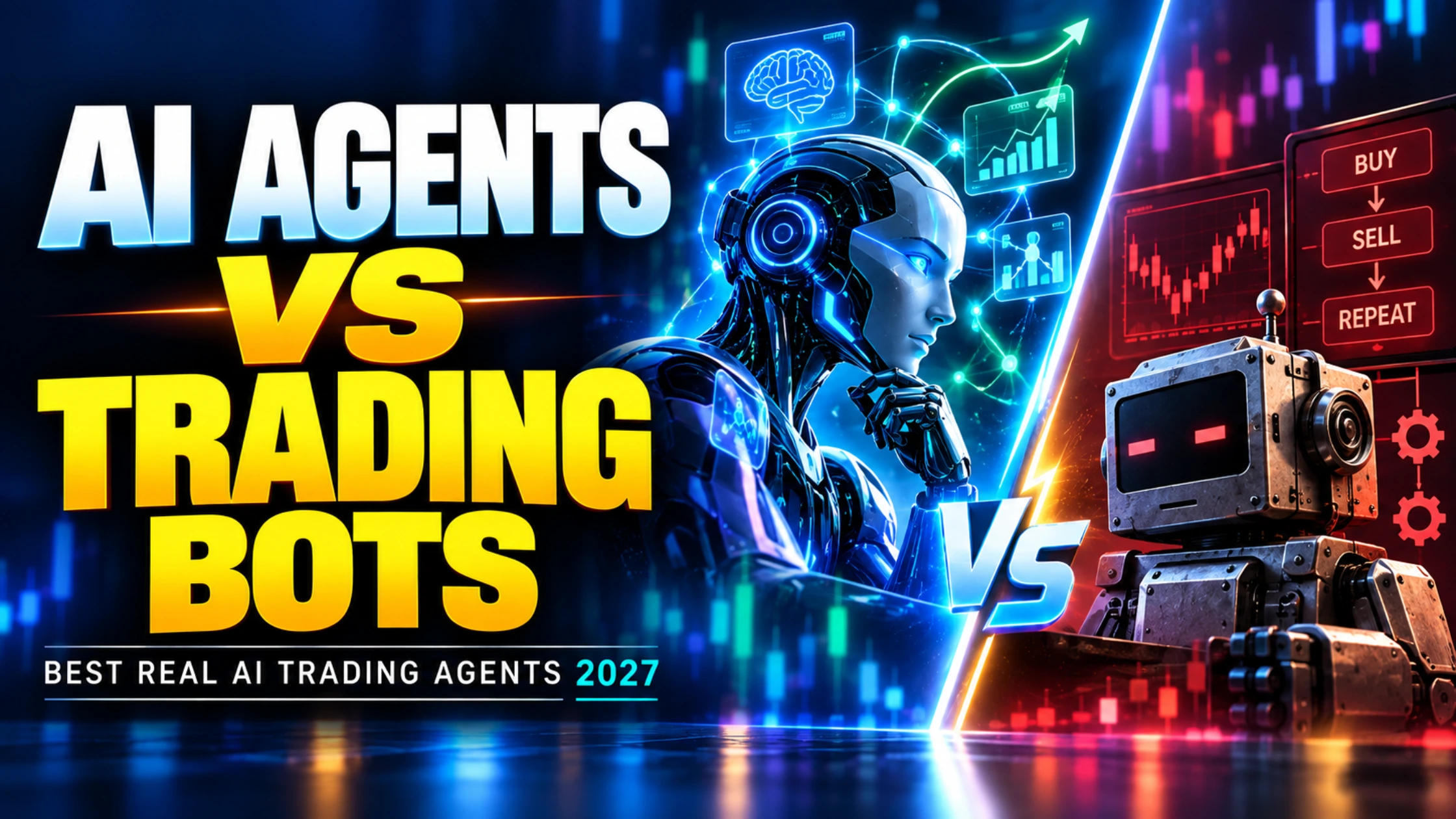
7 Best Real AI Trading Agents vs Traditional Trading Bots in 2027
Traditional trading bots follow rules. Real AI agents can interpret objectives, choose tools, process changing context and complete multi-step tasks without every action being explicitly scripted in advance. DN compared seven emerging agentic trading systems and built a framework for deciding when an AI agent actually adds value over a conventional bot.
What Matters
A real AI trading agent is not simply a bot with a chatbot attached. The defining difference is machine discretion between the objective and the action. An agent can decide which intermediate steps, tools or analyses are required. A traditional bot normally repeats logic already defined by the user or developer.
- Wayfinder is the clearest live execution-agent architecture in this comparison. Its current platform describes autonomous agents for cross-chain execution and presents an agent-native interface spanning Hyperliquid perps and spot, onchain markets and Polymarket.
- QuantPilot is the strongest strategy-development agent. Its agents can research, write QuantScript, run backtests and optimize strategies autonomously. Current terms say QuantPilot itself does not send exchange orders, so execution remains a separate layer.
- Coinrule is one of the clearest bounded LLM-to-trading architectures. Compatible AI assistants can inspect portfolios, build strategies, backtest and, with explicit Write permission, manage supported trading automation.
- 3Commas v2 allows external MCP assistants to cross further into execution. Current documentation says compatible AI assistants can review account information and place or close trades when the required access is supplied.
- HaasOnline deliberately stops the agent at the capital boundary. Its MCP agent can inspect live infrastructure, write code and run backtests, but current Cloud MCP tools cannot place trades, move funds or start live bots.
- Tickeron represents a different type of agent. Its AI Robots and trading agents rely on machine-learning systems that generate trading ideas and signals rather than general-purpose LLM reasoning.
- ASCN AI combines multi-agent crypto research with no-code workflow construction. Its main crypto assistant currently states that ASCN itself does not execute trades, while separate workflow templates show how users can route agent output toward external APIs. DN therefore treats ASCN as an agentic research/workflow layer rather than a native execution venue.
- Traditional bots are not obsolete. They remain stronger when the objective is precise, repetitive, latency-sensitive and already expressible as deterministic rules.
DN Evidence Block
- Verification date: 3 October 2026.
- Agentic systems assessed: Wayfinder, QuantPilot, Coinrule MCP, 3Commas MCP, HaasOnline MCP, Tickeron AI Agents and ASCN AI.
- Traditional-bot benchmark set: Gunbot, Bitsgap, Pionex and Cryptohopper.
- Evidence standard: current first-party product pages, documentation, help centres and terms.
- Agent definition: the machine must perform at least some non-trivial combination of objective interpretation, contextual reasoning, tool selection, multi-step planning, adaptation or autonomous action.
- Bot definition: software whose live behavior is substantially predetermined by explicit rules, parameters or predefined strategy logic.
- Important distinction: autonomous reasoning and financial authority are scored separately.
- Commercial independence: affiliate status contributes zero points.
- Testing status: Documented unless separately upgraded through first-hand DN paper or live testing.
Quick Answer: AI Agent or Traditional Trading Bot?
| Rank | System | DN classification | What it can decide | Capital authority | DN Agentic Fit |
|---|---|---|---|---|---|
| 1 | Wayfinder | Execution Agent | Research, plan, select routes and execute supported crypto actions | High, depending on user setup and agent wallet | 97/100 |
| 2 | QuantPilot | Strategy Agent | Research, code, backtest, evaluate and optimize | Low inside QuantPilot itself | 95/100 |
| 3 | Coinrule MCP | Bounded Trading Copilot | Interpret requests, select tools, build and manage strategies | Read Only or Write, user-selected | 93/100 |
| 4 | 3Commas MCP | Tool-Using Trading Agent | Review account context and invoke supported trading actions | Can reach live execution with suitable permissions | 91/100 |
| 5 | HaasOnline MCP | Bounded Build Agent | Inspect, code, compile, backtest and optimize | No live-order authority through current Cloud MCP | 89/100 |
| 6 | Tickeron AI Agents | ML Decision Agent | Generate ML-driven signals and trading ideas | Varies by product and copy-trading configuration | 85/100 |
| 7 | ASCN AI | Research / Workflow Agent | Research, monitor, reason and orchestrate workflows | Native crypto assistant states no direct execution | 82/100 |
DN Agentic Fit measures Objective Interpretation, Multi-Step Planning, Tool Choice, Context Adaptation, Independent Action, Control Boundaries and Evidence Quality. It does not measure profitability, safety or expected investment return.
The Difference Between a Bot and an Agent
Consider a simple Grid bot.
You tell it:
- trade BTC/USDT,
- between two defined prices,
- using a fixed number of grids,
- with a fixed allocation.
The bot does not need to understand why.
It does not need to research the market.
It does not need to decide which strategy class is appropriate.
It repeats the logic it was given.
Now consider an agent receiving:
“My BTC portfolio is too exposed to downside this week. Find a reasonable way to reduce directional risk without selling the spot position.”
That instruction is incomplete.
An agent may need to:
- inspect the portfolio,
- identify BTC exposure,
- review available venues,
- check funding rates,
- compare hedge structures,
- determine position size,
- select tools,
- construct the hedge,
- and monitor whether the hedge still matches the objective.
That gap is the essence of agency.
The DN Agency Test
DN uses five tests to distinguish a genuine agent from ordinary automation.
| Test | Traditional bot | AI agent |
|---|---|---|
| Objective Test | Needs explicit strategy logic | Can start from a higher-level objective |
| Planning Test | Sequence predetermined | Can construct intermediate steps |
| Tool Test | Functions predetermined by workflow | Can select among available tools according to context |
| Adaptation Test | Changes only through predefined conditions | Can reinterpret or revise approach as information changes |
| Action Test | Executes explicit triggers | May choose which permitted action best advances the objective |
The defining variable in agentic trading is the Discretion Envelope: the range of decisions a machine can make after deployment without requiring the human to explicitly encode each decision beforehand.
Why This Distinction Matters Financially
A traditional bot can be wrong.
But its failure modes are often bounded by what the developer already told it to do.
An agent can fail differently.
It can misunderstand the objective.
Choose the wrong tool.
Select the wrong intermediate step.
Misread changing context.
Or pursue a reasonable objective using an unreasonable path.
That does not make agents inherently worse.
It means flexible reasoning creates a new class of risk.
DN calls this:
Agency Risk.
Agency Risk is the possibility that the machine selects an action the user never explicitly programmed but that still falls inside the authority it was given.
1. Wayfinder
Wayfinder
Wayfinder most clearly demonstrates what changes when trading software moves beyond the traditional bot model.
Its current platform describes itself as providing autonomous agents for cross-chain execution.
The current interface presents an agent-native workflow spanning:
- Hyperliquid perpetuals,
- Hyperliquid spot,
- onchain markets,
- Polymarket,
- multi-wallet portfolio context,
- and reusable strategy Paths.
The interaction model is goal-oriented.
A user can describe an objective in ordinary language.
The agent can research, plan and interact with supported execution infrastructure.
Wayfinder's protocol architecture also uses dedicated Web3 wallets and Wayfinding Paths intended to give AI agents structured routes through blockchain applications.
This is materially different from telling a Grid bot:
buy every $500 decline and sell every $500 rise.
Best for: users specifically exploring agent-native onchain and cross-venue execution.
Traditional-bot alternative: a fixed funding-rate, rebalancing or perp bot whose venue, thresholds and actions are fully predefined.
Main agent risk: the agent can interpret a goal and choose actions, so the quality of the permission boundary matters as much as the quality of the prompt.
Explore WayfinderDEC3PE4
2. QuantPilot
QuantPilot
QuantPilot's agency sits primarily in the strategy-development process.
Its current product documentation says the system can:
- research markets,
- work with files,
- use external tools,
- write QuantScript,
- run backtests,
- analyze results,
- keep track of experiments,
- request feedback,
- and optimize strategies in autonomous mode.
That is substantially more agentic than a conventional strategy builder.
The agent is not merely filling in settings.
It can run an iterative research loop.
But QuantPilot's current Terms of Use establish an equally important boundary.
QuantPilot itself is described as an AI-assisted research and trading-strategy development service.
The terms say it does not connect directly to exchanges, hold exchange API keys or send trading orders in the regulatory sense.
Strategy execution occurs through separate third-party infrastructure selected and configured by the user.
Best for: users wanting an autonomous quantitative researcher rather than an autonomous wallet.
Traditional-bot alternative: manually write a strategy, run a fixed parameter sweep and deploy the best reviewed configuration yourself.
Main agent risk: autonomous experimentation can accelerate overfitting just as easily as it accelerates discovery.
Explore QuantPilot3. Coinrule MCP
Coinrule MCP
Coinrule illustrates the difference between an AI agent and an AI-branded bot particularly well.
The LLM is not the exchange connection.
It is not the custody layer.
It sits above a structured trading system and decides which authorized tools to use.
Coinrule's official MCP supports compatible assistants including ChatGPT, Claude and Grok.
With Read Only, the assistant can inspect supported:
- balances,
- holdings,
- strategies,
- trades,
- signals,
- P&L,
- and backtests.
With Read + Write, the assistant can access supported tools to:
- validate strategies,
- create strategies,
- update them,
- start or stop them,
- launch baskets,
- and run backtests.
The assistant therefore has genuine tool discretion.
The available action space is still determined by Coinrule's permission system.
Best for: users who want conversational reasoning while keeping execution inside a structured trading platform.
Traditional-bot alternative: build the same strategy directly in Coinrule's rule interface without an external LLM.
Main agent risk: natural language creates additional ambiguity between user intent and the deterministic strategy ultimately launched.
Explore Coinrule4. 3Commas MCP
3Commas v2 MCP
3Commas demonstrates what happens when a traditional bot platform adds an agentic control plane.
Its original value proposition was automation:
- DCA bots,
- Grid bots,
- Signal bots,
- SmartTrade,
- and other structured trading workflows.
Its newer MCP changes the interface.
Current documentation says an external compatible AI assistant can:
- check how strategies are performing,
- review trading history,
- inspect account information,
- and place or close trades where the supplied access allows it.
That is an important transition.
The same infrastructure can behave like a traditional bot platform when controlled through explicit settings, or like an agentic system when an LLM interprets natural language and chooses which available function to invoke.
Best for: traders already using a mature bot ecosystem who want conversational access layered on top.
Traditional-bot alternative: configure the bot directly and never expose the account to an external reasoning model.
Main agent risk: adding an LLM increases flexibility while also increasing the number of paths by which a user instruction can become a financial action.
Explore 3Commas5. HaasOnline MCP
HaasOnline
HaasOnline proves an important point:
an agent can be powerful without being allowed to trade.
Its current Cloud MCP exposes a rich tool set.
The AI can:
- read bots,
- inspect live runtime,
- read orders and positions,
- inspect logs,
- read balances and portfolios,
- create and edit HaasScripts,
- compile code,
- run backtests,
- create and run Labs,
- and inspect optimization results.
But HaasOnline explicitly excludes several actions from the MCP interface.
The agent cannot:
- place trades,
- cancel trades,
- move funds,
- withdraw funds,
- or start and stop live bots.
Those tools do not exist in the agent interface.
This creates what DN calls a:
Determinism Anchor.
The AI can reason flexibly upstream.
A hard external boundary determines which financially consequential actions remain unavailable.
Best for: sophisticated users who want an AI research and development agent without handing the model live-order authority.
Traditional-bot alternative: manually edit HaasScript, run the same backtests and deploy after review.
Main agent risk: the agent can still delete or alter research artifacts and produce flawed code even if it cannot touch live capital directly.
Explore HaasOnline MCP6. Tickeron AI Agents
Tickeron
Tickeron's concept of an AI agent differs from the LLM-based systems above.
Its current platform describes AI Robots as machine-learning systems that generate trading ideas.
Its crypto product includes:
- Signal Agents,
- Virtual Agents,
- multiple machine-learning timeframes,
- paper-trade views,
- risk-management variants,
- and copy-trading workflows.
This makes Tickeron more agentic than a fixed indicator bot because machine-learning systems influence the trading signal itself.
But it is a different kind of agency from an LLM that decomposes a natural-language objective into an arbitrary multi-step plan.
Best for: users who want machine learning closer to the signal layer rather than a conversational control interface.
Traditional-bot alternative: a fixed RSI, trend or moving-average system.
Main agent risk: proprietary signal generation may be harder to reconstruct than deterministic trading logic.
Explore Tickeron7. ASCN AI
ASCN AI
ASCN is particularly interesting because it exposes the ambiguity around the word “trading agent.”
Its current crypto assistant describes a six-agent Web3 research system connected to:
- onchain data,
- DEX activity,
- CEX information,
- wallet behavior,
- social signals,
- token analytics,
- and market information.
ASCN also provides a broader no-code agent platform capable of constructing multi-step workflows and calling external services.
Some ASCN trading templates describe workflows that can route output toward HTTP or exchange-connected actions.
But the current primary crypto-assistant page explicitly states:
ASCN does not execute trades or manage customer funds.
DN therefore separates:
the native ASCN research product
from
user-built external automation workflows.
This is the more defensible classification.
Best for: crypto-native research workflows where reasoning quality matters more than immediate execution.
Traditional-bot alternative: feed a fixed indicator or external signal directly into a bot.
Main agent risk: adding more data and more reasoning does not guarantee that the final market conclusion is correct.
Explore ASCN AI4UZ09RW804
What Traditional Bots Still Do Better
The rise of agents does not make traditional automation primitive.
In several trading functions, predictability is an advantage.
| Traditional bot type | Example | Why deterministic behavior may be preferable |
|---|---|---|
| Grid bot | Pionex | Exact range, grid count and order behavior are known in advance. |
| Configured portfolio bots | Bitsgap | AI may assist configuration, but underlying execution follows rule-based bots. |
| Custom strategy engine | Gunbot | Live behavior can be inspected directly in JavaScript strategy logic. |
| Adaptive strategy selector | Cryptohopper Algorithmic Intelligence | Selects among predefined strategies without requiring open-ended reasoning. |
Traditional Bot vs AI Agent: Side by Side
| Dimension | Traditional bot | AI trading agent |
|---|---|---|
| Input | Rules and parameters | Goals, context and instructions |
| Planning | Predefined | Can be generated dynamically |
| Tool selection | Usually fixed | May choose among available tools |
| Adaptation | Defined conditions | Can reinterpret changing context |
| Auditability | Usually higher | Can be harder to reconstruct |
| Flexibility | Lower | Higher |
| Prompt risk | Minimal | Material |
| Prompt injection exposure | Usually low | Can become important where external text is ingested |
| Best use | Known repetitive strategy | Ambiguous multi-step objective |
| Failure pattern | Incorrect rule or parameter | Incorrect interpretation, plan, tool or action |
The Agentic Delta
If an AI agent ultimately performs exactly the same predetermined actions as a traditional bot, the extra agent layer may not add much.
DN calls the additional useful capability created by agency the:
Agentic Delta.
The Agentic Delta is the value created by decisions that could not reasonably have been represented as one simple static workflow.
Examples of high Agentic Delta include:
- researching several markets before choosing a venue,
- comparing multiple hedge structures,
- writing and testing new strategy logic,
- changing research paths when new evidence appears,
- selecting different tools depending on account state,
- or coordinating several specialized agents.
Examples of low Agentic Delta include:
- buy every Monday,
- sell when RSI exceeds a fixed value,
- rebalance to 50/50 every month,
- or maintain a fixed Grid.
Every additional layer of machine discretion should solve a problem that deterministic software cannot solve as reliably. If the task can be represented as a stable rule, an agent may add model risk without adding useful capability.
The Determinism Anchor
The strongest architectures increasingly combine both approaches.
They use AI where uncertainty is useful.
They use hard rules where uncertainty is dangerous.
DN calls the hard deterministic layer the:
Determinism Anchor.
A Determinism Anchor can include:
- maximum order sizes,
- maximum daily loss,
- approved venues,
- asset allowlists,
- leverage ceilings,
- withdrawal restrictions,
- position limits,
- human approval requirements,
- credential expiry,
- or a kill switch.
The AI reasons inside that envelope.
It does not redefine the envelope.
The Ideal Hybrid Architecture
| Layer | AI or deterministic? | Example responsibility |
|---|---|---|
| Research | AI | Interpret market context and gather evidence |
| Hypothesis | AI | Generate candidate strategy |
| Critique | AI + deterministic tests | Challenge assumptions and run validation |
| Backtest | Deterministic engine | Calculate historical behavior |
| Risk limits | Deterministic | Enforce size, leverage and loss ceilings |
| Execution | Deterministic or narrowly bounded agent | Create orders within approved limits |
| Emergency stop | Deterministic / human | Revoke authority immediately |
The strongest agentic trading architecture may not replace deterministic bots. It may place probabilistic intelligence above them while retaining deterministic execution and capital controls underneath.
DN Agent-or-Bot Classifier
Use the tool below to classify a trading product or workflow by what it can actually decide after deployment.
Agent-or-Bot Classifier
Answer six questions about the system. DN estimates whether it is conventional automation, an AI-assisted bot, a tool-using copilot, a bounded agent or a financial execution agent.
Traditional Bot
When You Should Prefer a Traditional Bot
A traditional bot is usually the cleaner tool when:
- the strategy can be written clearly in advance,
- latency and repeatability matter,
- you do not need interpretation,
- the correct response to each condition is known,
- auditability is more important than flexibility,
- or the execution environment should never improvise.
Examples include:
- fixed DCA,
- Grid trading,
- simple stop-loss management,
- scheduled rebalancing,
- fixed indicator triggers,
- or deterministic arbitrage rules.
When an Agent Can Add More Value
Agents become more interesting when the problem itself requires interpretation.
Examples include:
- “Find why my portfolio risk changed.”
- “Research three ways to hedge this position.”
- “Build and test a strategy for this market regime.”
- “Compare funding opportunities across supported venues.”
- “Investigate why this bot stopped working.”
- “Use onchain, market and news data to challenge my thesis.”
- “Find an execution route that satisfies these constraints.”
These are objectives rather than exact scripts.
That is where agency begins to justify itself.
The Agency-to-Control Ratio
DN introduces one additional metric:
Agency-to-Control Ratio.
The concept asks:
How much machine discretion exists relative to the strength of the external controls containing it?
An execution agent with:
- asset allowlists,
- small capital allocation,
- trade-size caps,
- no withdrawal access,
- leverage limits,
- and immediate revocation
can have a very different risk profile from an equally intelligent agent given broad wallet authority and only a natural-language instruction saying:
“be careful.”
The model may be identical.
The financial architecture is not.
The more useful measure is autonomy relative to enforceable control. High agency with strong external limits can be more governable than modest intelligence with broad unrestricted authority.
The Agent-to-Bot Handoff
One of the most promising architectures may be:
agent discovers → bot executes.
The agent can:
- research,
- interpret,
- form hypotheses,
- generate strategies,
- test them,
- or choose among approved templates.
Then the final live system can be converted into explicit deterministic logic.
That approach reduces the number of decisions that remain probabilistic at execution time.
DN calls this:
Agent-to-Bot Compression.
The agent handles complexity during discovery.
The production system compresses the successful workflow into a narrower and more auditable execution policy.
Why This Could Become the Institutional Model
Financial institutions may not need an LLM improvising every order.
They may instead use agents for:
- research,
- scenario analysis,
- strategy generation,
- risk investigation,
- execution planning,
- exception handling,
- and operational monitoring.
The actual money-moving layer can remain deterministic.
That architecture preserves much of the productivity gain from AI while maintaining:
- audit trails,
- hard limits,
- clear permissions,
- repeatability,
- and explicit responsibility boundaries.
Seven Questions Before Giving an Agent Real Money
1. What can the agent decide without asking me?
Map the Discretion Envelope before funding it.
2. What can the agent actually call?
Read the real tool list rather than the marketing page.
3. Which controls exist outside the model?
A prompt is not a position limit.
4. Can the agent move assets?
Trading authority and transfer authority should be treated separately.
5. What is the maximum capital it can affect?
Think in terms of blast radius rather than account balance alone.
6. Can every action be reconstructed?
Agentic systems need logs, tool-call histories and clear order IDs.
7. How do I stop it?
Revocation should be known before the agent is started, not discovered during an incident.
Limitations
- Agentic Fit is not a profitability ranking. It measures how closely each system matches DN's definition of an AI agent.
- Agent terminology remains inconsistent. Vendors use “agent,” “robot,” “assistant” and “AI bot” differently.
- DN has not independently audited proprietary models. Machine-learning and agentic capabilities are classified from first-party product evidence.
- Execution authority differs materially. QuantPilot and HaasOnline demonstrate substantial agency without native live-order authority, while Wayfinder and suitably permissioned 3Commas or Coinrule workflows can sit closer to capital.
- ASCN documentation requires careful interpretation. The main crypto assistant states that ASCN does not execute trades, while some workflow templates describe external API actions. DN therefore classifies native product execution conservatively.
- Traditional bots may outperform agents on specific tasks. Predictability can be an advantage.
- Agents introduce prompt and tool risks. Prompt injection, incorrect planning and inappropriate tool selection create failure modes that deterministic bots may not have.
- Platform architecture can change rapidly. Permissions, supported venues, model providers and tool registries should be verified again before publication or deployment.
- Affiliate relationships exist. Commercial relationships contribute zero points to the ranking.
What Would Change the Ranking?
Wayfinder's position depends on maintaining genuine agent-native planning and cross-venue execution rather than reducing the product to a conversational wrapper around fixed workflows.
QuantPilot could move higher if execution becomes a more directly integrated but still permission-controlled part of the agent architecture.
Coinrule and 3Commas could move higher as their MCP ecosystems gain richer multi-step planning while preserving clear permission boundaries.
HaasOnline could move materially higher in raw agent capability if it adds more autonomous planning tools, although giving the agent live-order authority would also increase its financial risk surface.
Tickeron could move higher with more public documentation showing how its agents adapt across multiple steps rather than primarily generate ML signals.
ASCN could move higher if the boundaries between its native research agents and external trading execution become more explicit and verifiable.
The Bottom Line
Traditional trading bots and AI trading agents solve different problems.
A bot is strongest when you already know:
the rule,
the trigger,
the action,
and the risk limit.
An agent becomes useful when the software must decide:
what to investigate,
which tools to use,
which path to take,
or how to translate an objective into several intermediate actions.
That flexibility is valuable.
It is also the new risk surface.
The future therefore may not be:
AI agents replace trading bots.
It may be:
AI agents decide what should happen. Deterministic systems constrain how money is allowed to make it happen.
That is a much more powerful architecture.
It is also easier to govern.
The smartest question for 2027 is not:
“Bot or agent?”
It is:
“Which decisions actually benefit from agency, and which decisions should never stop being deterministic?”
DN reviewed seven current AI systems with documented agentic functionality and compared them against a benchmark set of deterministic or primarily deterministic trading products.
The proprietary DN Agentic Fit score weights: 20% Objective Interpretation, 20% Multi-Step Planning, 15% Tool Choice, 15% Context Adaptation, 15% Independent Action, 10% Control Boundaries, and 5% Evidence Quality.
Financial authority is deliberately separated from agent intelligence. An agent can score highly for agency while having no live-order authority.
Traditional bots are not penalized for being deterministic. They are used as a comparison group to identify where agentic capability creates a genuine additional function rather than merely a more conversational interface.
Affiliate relationships contribute zero points. Current commercial pathways are added only after a product independently passes the DN Operational Status Gate: LIVE, RESTRICTED, MIGRATING, WINDING DOWN or INACTIVE.
DN testing classifications remain: Documented, Paper-Tested and Live-Tested. This edition uses Documented unless explicitly stated otherwise.
Primary Sources & Evidence
- Wayfinder, current agent-native platform and cross-chain execution product.
- Wayfinder, current Terms of Service and protocol documentation.
- QuantPilot, current AI Strategies documentation.
- QuantPilot, current Terms of Use.
- Coinrule, current MCP overview, permissions and tools documentation.
- Coinrule, current ChatGPT, Claude and compatible-assistant connection documentation.
- 3Commas, current MCP connection documentation, August 2026.
- 3Commas, current AI Assistant documentation.
- HaasOnline, current Model Context Protocol product page.
- HaasOnline, current Cloud AI Agent Access documentation.
- Tickeron, current AI Trading Agents and Crypto AI product pages.
- ASCN AI, current Crypto AI Agent page.
- ASCN AI, current agent and no-code workflow documentation.
- Gunbot, current strategy, simulator and Gunbot AI documentation.
- Bitsgap, current AI Assistant architecture documentation.
- Pionex, current AI Grid strategy documentation.
- Cryptohopper, current Algorithmic Intelligence documentation.
Frequently Asked Questions
What is the difference between an AI trading agent and a trading bot?
A traditional trading bot normally executes predefined strategy logic. An AI trading agent can interpret higher-level objectives, select tools, plan multiple steps or adapt its approach according to changing context within its authorized boundaries.
What is a real AI trading agent?
DN considers a system genuinely agentic when AI performs non-trivial objective interpretation, planning, tool selection, adaptation or autonomous action rather than simply executing predetermined rules.
Which AI trading agent is most autonomous?
In DN's current framework, Wayfinder receives the highest Agentic Fit because its current platform combines natural-language objectives with agent-native research, planning and supported cross-venue crypto execution. The score measures agency, not expected returns or safety.
Is QuantPilot an autonomous trading agent?
QuantPilot is highly agentic in strategy research and development. Its agents can research, write strategy code, backtest and optimize autonomously. Current QuantPilot terms state that QuantPilot itself does not send exchange orders, so DN classifies it as a Strategy Agent rather than a native execution agent.
Is Coinrule an AI trading agent?
Coinrule's MCP allows compatible AI assistants to reason over account context and select authorized tools. With Read Only access they can inspect data, while Read + Write can expose supported strategy-management actions. DN classifies this as a bounded trading copilot architecture.
Can a 3Commas AI assistant place trades?
Current 3Commas MCP documentation says compatible external AI assistants can review account information and perform supported actions including placing and closing trades where the required permissions are provided.
Can HaasOnline's AI agent trade live funds?
Current HaasOnline Cloud MCP documentation says its agent cannot place or cancel trades, move funds or start and stop live bots. It can inspect systems, create and edit strategy code, run backtests and work with Labs.
Is Tickeron a real AI trading agent?
Tickeron documents its AI Robots and trading agents as machine-learning systems that generate trading ideas and signals. DN classifies this as ML decision agency rather than a general-purpose LLM agent.
Does ASCN AI execute trades?
ASCN's primary crypto assistant currently states that ASCN itself does not execute trades or manage customer funds. ASCN also provides no-code agent workflows that can interact with external services, so DN distinguishes native research functionality from user-built external execution workflows.
Are AI agents better than traditional trading bots?
Not universally. Traditional bots can be preferable for precise repetitive strategies where deterministic behavior, speed and auditability matter. Agents add more value when the task requires research, interpretation, multi-step planning or dynamic tool selection.
What is the Discretion Envelope?
The Discretion Envelope is a DN framework describing the range of decisions a machine can make after deployment without requiring the user to explicitly program each decision beforehand.
What is the Agentic Delta?
The Agentic Delta is the additional useful capability produced by agency compared with implementing the same objective through a static deterministic workflow.
What is a Determinism Anchor?
A Determinism Anchor is a hard external control that remains fixed while an AI agent reasons, such as maximum position size, leverage limits, asset allowlists, withdrawal restrictions or human approval requirements.
What is Agent-to-Bot Compression?
Agent-to-Bot Compression describes using AI agents for research, strategy discovery and experimentation, then converting a successful workflow into narrower deterministic execution logic for production.
Freshness, Change Log & Corrections
| Date | Change |
|---|---|
| 3 October 2026 | Initial 2027 edition published comparing seven agentic trading architectures with traditional trading bots. |
| 3 October 2026 | Verified current Wayfinder autonomous-agent and cross-chain execution product architecture. |
| 3 October 2026 | Verified current QuantPilot autonomous research, QuantScript, backtesting and optimization capabilities plus execution boundary in Terms of Use. |
| 3 October 2026 | Verified current Coinrule MCP Read Only and Read + Write architecture. |
| 3 October 2026 | Verified current 3Commas MCP assistant and live-action functionality. |
| 3 October 2026 | Verified HaasOnline Cloud MCP tool boundaries and absence of live-order tools. |
| 3 October 2026 | Verified Tickeron machine-learning AI Agent positioning and current crypto-agent product. |
| 3 October 2026 | Reconciled ASCN native crypto-assistant execution disclaimer with separate external workflow documentation. |
| 3 October 2026 | Added DN Agency Test, Discretion Envelope, Agency Risk, Agentic Delta, Determinism Anchor, Agency-to-Control Ratio, Agent-to-Bot Compression and Agent-or-Bot Classifier. |
Last verified: 3 October 2026.
Correction policy: agentic-finance products change rapidly. DN will update this article when agent capabilities, execution permissions, supported venues, tool registries or operational status materially changes.
Factual corrections can be submitted through the Decentralised News Contact page. Affiliate relationships do not prevent corrections, score changes or removal.
Related reading:
Which AI Trading Bots Actually Use AI? 10 Platforms Compared
AI Trading on a Small Budget: 7 Platforms Compared
9 Best AI Trading Tools for ChatGPT Users in 2027
Best AI Crypto Trading Tools for Beginners: 11 Platforms Compared
9 Best AI Trading Agents to Try With Paper Money Before Risking Real Cash
The 25 Best AI Trading Experiments to Try in 2027: From ChatGPT to Fully Autonomous Agents
About the Author