What Matters
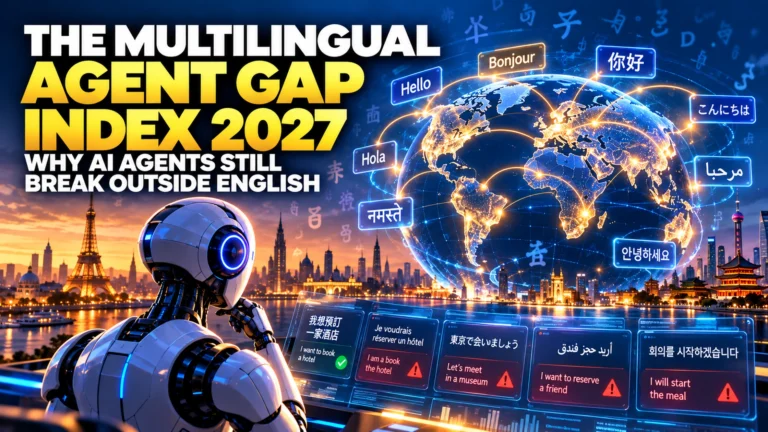
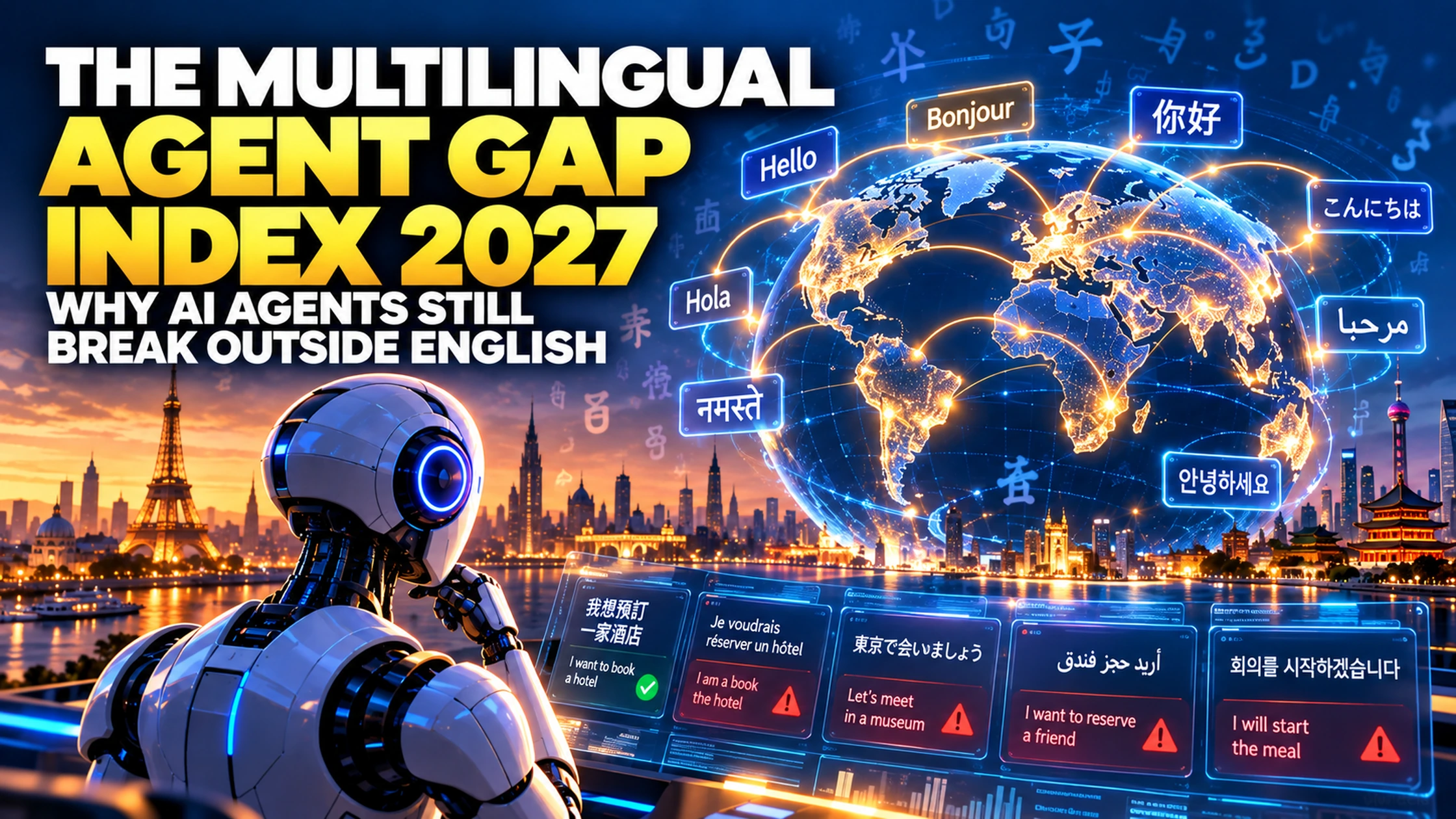
Multilingual AI agents are improving, but the gap outside English is not just about whether the model can translate a sentence. Recent 2026 benchmarks show lower-resource languages suffer more tool-use, control-flow and structured-output failures, and can require substantially more tokens on the same tasks. For businesses, that means language choice can change both reliability and cost.
The agent gap starts after translation
A chatbot can sound fluent in a language and still fail as an agent. The difference is execution. Agents must interpret instructions, navigate interfaces, call tools, preserve structured data, handle interruptions and know when to stop.
BabelArena, published in September 2026, is important because it evaluates the same agentic tasks across 23 languages rather than simply comparing free-form answers. Its findings show that lower-resource languages produce different error patterns, especially in tool use and control flow. On identical tasks, agents can also consume substantially more tokens in lower-resource languages, with some cases approaching roughly twice the English input-token load.
LoWAgent, published in October 2026, narrows the lens to web agents and low-resource languages. Across English, Hindi, Bengali, Urdu and Amharic, both closed and open models lost performance outside English. Interface disruptions such as cookie notices and advertisement pop-ups degraded results further.
The Multilingual Agent Gap Index
DN groups multilingual agent scenarios into four evidence tiers. These are deployment-risk categories, not claims that every language inside a tier performs identically.
| Tier | Typical language context | Expected agent reliability | Main failure mode | Recommended deployment posture |
|---|---|---|---|---|
| A — High-resource | English and other languages with strong web/data/tool representation | Highest relative reliability, but still imperfect | General reasoning, tool or interface errors | Bounded execution with standard monitoring |
| B — Broadly supported | Major global languages with substantial web presence but uneven agent evaluation | Often strong for chat; more variable for tools | Structured-output drift, localization mismatch | Test tool calls and business workflows locally |
| C — Lower-resource | Languages with less training data and fewer localized agent benchmarks | Higher variance | Tool-use and control-flow failures | Recommendation-first, human approval on writes |
| D — Under-evaluated | Languages or dialects with little public agent benchmarking | Unknown, not automatically poor | Coverage uncertainty itself | Build a local evaluation set before production |
DN Multilingual Agent Reliability Planner
Use this tool to estimate how much validation a multilingual agent workflow should receive before production. It is a deterministic editorial model, not a model benchmark.
Why English still has a structural advantage
The World Bank’s 2025 AI Foundations report estimates English at about 45% of global URLs despite representing a much smaller share of the global population. The same report estimates English at 56.3% of open-source Hugging Face datasets in its 2024 language analysis. That affects more than vocabulary: web instructions, support documentation, tool examples and interface text are also disproportionately English-heavy.
For agents, the benefit compounds. A model working in English is more likely to see familiar UI labels, standardized documentation, tool schemas and examples during training or post-training. A lower-resource language can face a double gap: fewer language examples and fewer examples of that language interacting with software.
Why lower-resource agents can cost more
BabelArena reports that lower-resource languages can consume substantially more tokens on the same tasks without equivalent increases in interaction length. That matters economically. An agent can be both less reliable and more expensive per successful task.
The practical metric should therefore be cost per accepted outcome, not tokens per prompt. If a workflow takes more tokens, more retries and more human correction in one language, its real unit cost can diverge sharply from the English version.
Structured output is a hidden language test
Agents often need to return JSON, fill forms, preserve field names or call functions with exact parameters. BabelArena found language consistency can degrade further on structured-output tasks, with switches directed overwhelmingly toward English.
That creates risks for customer-facing and regulated workflows. A support agent may speak the right language conversationally but still output an English field value, break a schema or mis-handle a localized date, address or currency format.
Web interfaces make the gap worse
LoWAgent’s web results highlight another weakness: real websites are messy. Cookie banners, advertisements, pop-ups and localized layouts increase the chance of failure. An English-centric benchmark on clean interfaces can therefore overstate real-world readiness in another language.
Businesses should test the exact local websites and apps their agents will use, including mobile layouts and common interruptions.
The language gap is also an economic-development gap
The World Bank frames AI readiness around four foundations: connectivity, compute, context and competency. Language sits inside “context,” but it interacts with the other three. A local-language agent cannot create much value if users lack affordable connectivity, suitable devices or digital skills.
The World Bank also notes that English dominates text-heavy training sources more than video. That suggests voice and multimodal interfaces may eventually narrow some language gaps faster than text-only agents, particularly where local-language video and speech data are richer than web text.
How to deploy a multilingual agent safely
- Build a local task set. Use 50–100 real workflows in the target language before granting write access.
- Test tools, not just conversation. Measure form completion, API calls, navigation and structured outputs.
- Include interface noise. Add cookie notices, pop-ups, mixed-language pages and mobile layouts.
- Measure language consistency. Track unintended switching into English or another language.
- Measure cost per accepted outcome. Include token usage, retries and human correction.
- Keep high-impact actions gated. Lower public benchmark coverage should reduce autonomy, not increase optimism.
- Retest after model or interface updates. Multilingual behavior can change even when the business workflow does not.
What this means for emerging-market entrepreneurs
For many businesses, the question is not “does this AI support my language?” The better question is: can it reliably complete my workflow in my language, on my local websites, with my customers and my payment systems?
That distinction matters for the tools ranked in DN’s Best AI Agents for Emerging-Market Entrepreneurs. A globally popular platform may still need local workflow testing before it can be trusted with customer support, commerce or operations.
Methodology and limitations
Index version v1.0 (27 October 2026): DN synthesizes evidence from BabelArena, LoWAgent, the World Bank’s Digital Progress and Trends Report 2025 and related global AI-readiness research. The index deliberately uses broad evidence tiers because public benchmarks do not cover every language with equivalent tasks.
Limitations: resource level is not destiny. A language with limited public benchmark coverage may perform well on a particular model or domain. Conversely, a high-resource language can fail on a badly designed tool or interface. Model updates can also change multilingual performance quickly.
Commercial disclosure: this article does not rank vendors and contains no paid placement.
Primary sources
- BabelArena: A Large-Scale Multilingual Benchmark for LLM Agents
- LoWAgent: A Low-Resource Multilingual Benchmark for Web Agents
- World Bank — Digital Progress and Trends Report 2025: Strengthening AI Foundations
- World Bank — How well does AI speak your language?
- Stanford HAI — 2026 AI Index technical performance
FAQ
Do AI agents work worse in every non-English language?
No. The evidence shows cross-language disparities and larger problems for many lower-resource languages, but performance depends on the language, model, task, interface and tool design.
What is the biggest multilingual agent risk?
For real workflows, the largest risk may be execution rather than conversational fluency: tool calls, control flow, structured output and interface navigation can fail even when the text sounds natural.
Why can multilingual agents cost more?
Some benchmarks show higher token consumption and more retries in lower-resource languages. The useful metric is cost per accepted outcome after correction and human review.
How should a business test a local-language agent?
Use real local tasks, interfaces and edge cases, including mobile layouts and interruptions. Measure task success, tool accuracy, language consistency, retries and human correction before granting autonomous write access.
About the Author