What Matters
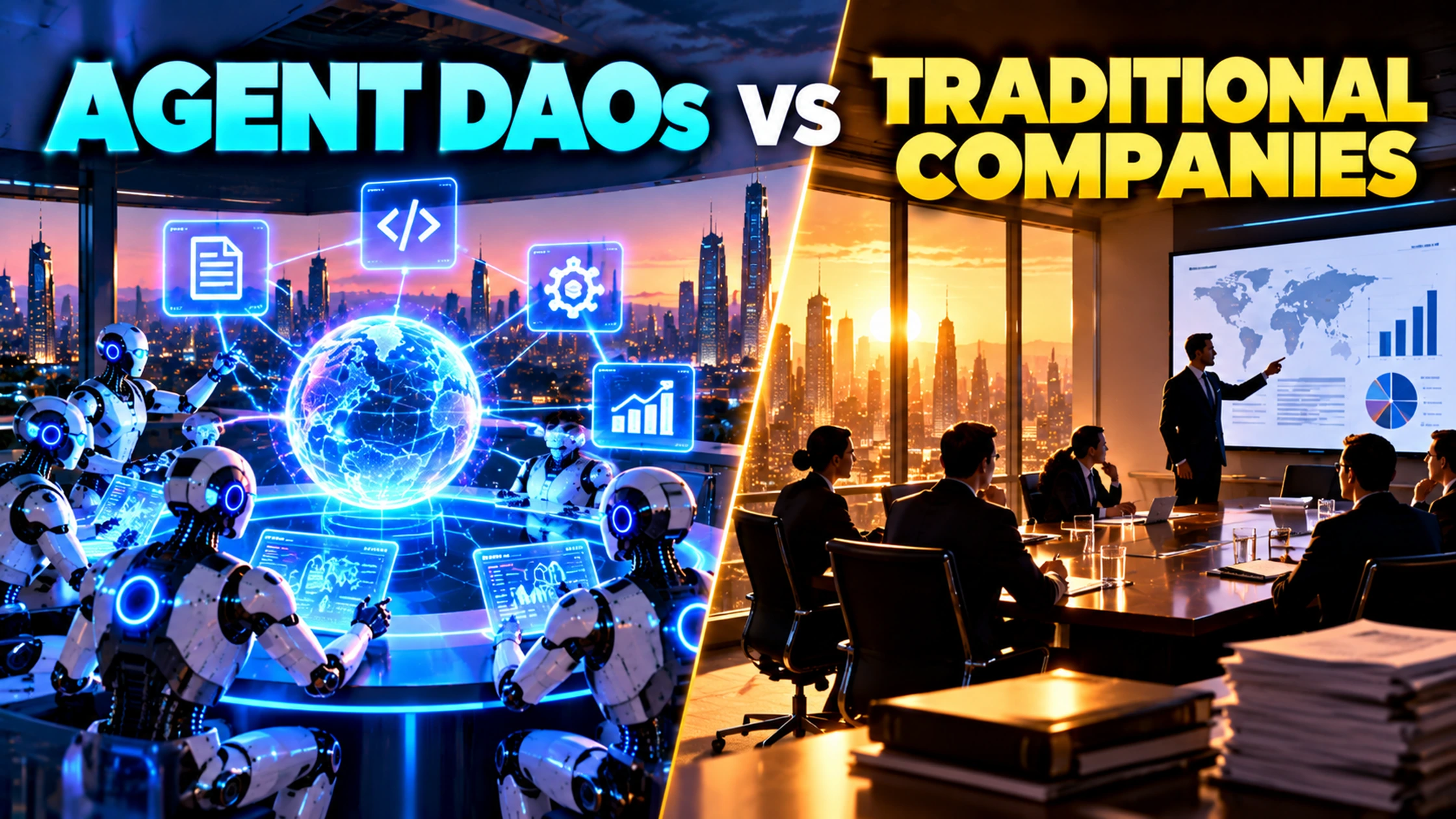
Agent DAOs can move faster than traditional organizations because software can propose, vote, route capital and execute policy continuously. But speed does not remove the need for legal wrappers, accountable humans, tax treatment, custody controls or dispute resolution. The strongest architecture is likely to be hybrid: machine-speed coordination on top of a legal entity that can own assets, sign contracts and absorb liability.
Five architectures, five different trade-offs
| Structure | Decision speed | Accountability | Capital flexibility | Legal clarity | Best fit |
|---|---|---|---|---|---|
| Traditional corporation | Medium | High | High | High | Scaled businesses, equity financing, regulated activity |
| Traditional LLC | Medium-high | High | High | High | Owner-managed and flexible operating businesses |
| DAO LLC | High | Medium-high | Medium-high | Medium-high | Onchain governance with recognized legal wrapper |
| DUNA | High | Medium | Restricted by nonprofit design | Medium-high | Protocol, ecosystem and public-goods coordination |
| Unwrapped agent DAO | Very high | Low | High technically | Low | Experimental coordination only |
DN Organizational Architecture Simulator
Why agent DAOs can move faster
Agents can monitor state continuously, generate proposals, test policies, route tasks, execute treasury rules and coordinate contributors without waiting for a weekly meeting. That speed is real.
But the organization still needs a rule for who can bind it. If an agent signs a contract, moves funds or changes protocol parameters, the legal and operational authority behind that action must be clear.
Traditional companies still dominate accountability
Corporations and LLCs have mature defaults for ownership, management, liability and contracting. Investors, banks, courts and regulators know how to interact with them. That clarity is a major advantage when the organization has employees, customers, intellectual property or regulated activity.
DAO LLCs are the most obvious hybrid
A DAO LLC can preserve onchain governance while giving the organization a legal wrapper. The architecture works best when smart-contract governance handles bounded internal coordination while managers or designated humans retain authority over high-impact legal and financial actions.
DUNAs fit ecosystems better than ordinary businesses
DUNAs are useful where the purpose is ecosystem coordination, public goods, protocol stewardship or decentralized association. They should not be treated as a shortcut around ordinary for-profit governance. The legal design matters because distribution rights, fiduciary expectations and tax treatment differ.
The real design problem is not human versus machine
The useful question is: which decisions are machine-speed, which require token-holder consent, and which require an accountable legal actor?
A strong architecture separates those layers instead of forcing one governance mechanism to do everything.
A practical hybrid governance stack
- Agents: monitor, simulate, propose and execute bounded tasks.
- Smart contracts: enforce treasury limits, voting rules and permissions.
- Token or member governance: approve policy-level changes.
- Managers / directors: handle legal commitments and fiduciary duties.
- External auditors: review controls, treasury and agent behavior.
When a traditional company is better
- External equity financing is central.
- Regulated products or licenses are required.
- Contracts and counterparties expect conventional legal structure.
- Employees and IP ownership are material.
- Fast dispute resolution matters more than fully decentralized governance.
When an agent DAO is better
- Coordination is global and contributor-driven.
- Treasury and policies are naturally onchain.
- Governance transparency matters.
- Operational decisions can be bounded by code.
- The legal wrapper is matched to the actual economic purpose.
Methodology and limitations
Version 1.0, 31 October 2026. DN compares organizational architectures across decision speed, accountability, capital flexibility, governance transparency, legal clarity and agent compatibility.
Limitations: entity law varies by jurisdiction and changes over time. The simulator is a strategic framework, not legal, tax or securities advice.
Commercial disclosure: no legal provider, DAO platform or governance vendor paid for inclusion.
Primary sources
- Wyoming Secretary of State, DAO LLC guidance
- Wyoming Legislature, DUNA amendments
- Delaware General Corporation Law, board management framework
- Delaware LLC Act, management framework
FAQ
What is an agent DAO?
A decentralized organization where AI agents participate in monitoring, proposals, execution, treasury or governance workflows.
Can an AI agent legally run a company?
Not by itself in the ordinary sense. Legal entities still require recognized owners, managers, directors or other accountable persons depending on the jurisdiction.
What is the best legal wrapper for a DAO?
There is no universal answer. DAO LLCs, DUNAs, traditional LLCs and corporations suit different purposes.
Are DUNAs for normal for-profit companies?
Not generally. They are designed around decentralized nonprofit association structures rather than ordinary shareholder-style profit distribution.
Why use a hybrid structure?
It combines machine-speed coordination and transparent governance with legal clarity for contracts, assets, liability and accountability.
What should agents be allowed to do?
Agents are best suited to bounded, auditable tasks where limits are explicit and rollback or escalation exists.
What should remain human-controlled?
High-impact legal commitments, fiduciary decisions, disputes and actions outside predefined authority should remain human-accountable.
What is the biggest risk?
Authority ambiguity: no one knows whether the agent, token holders, managers or smart contract had the right to bind the organization.
About the Author