What Matters
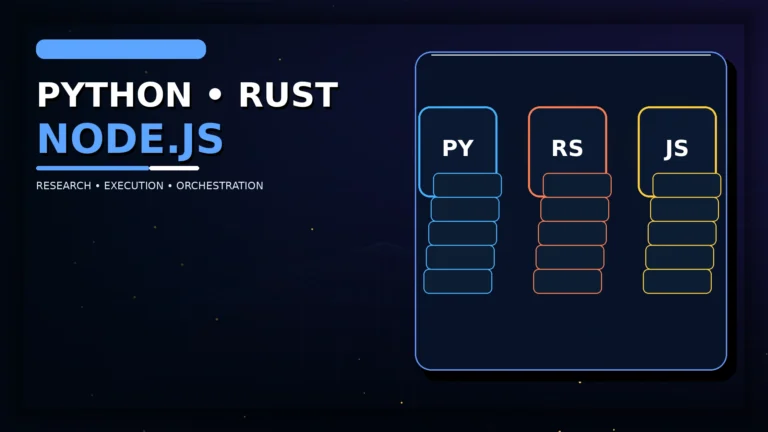
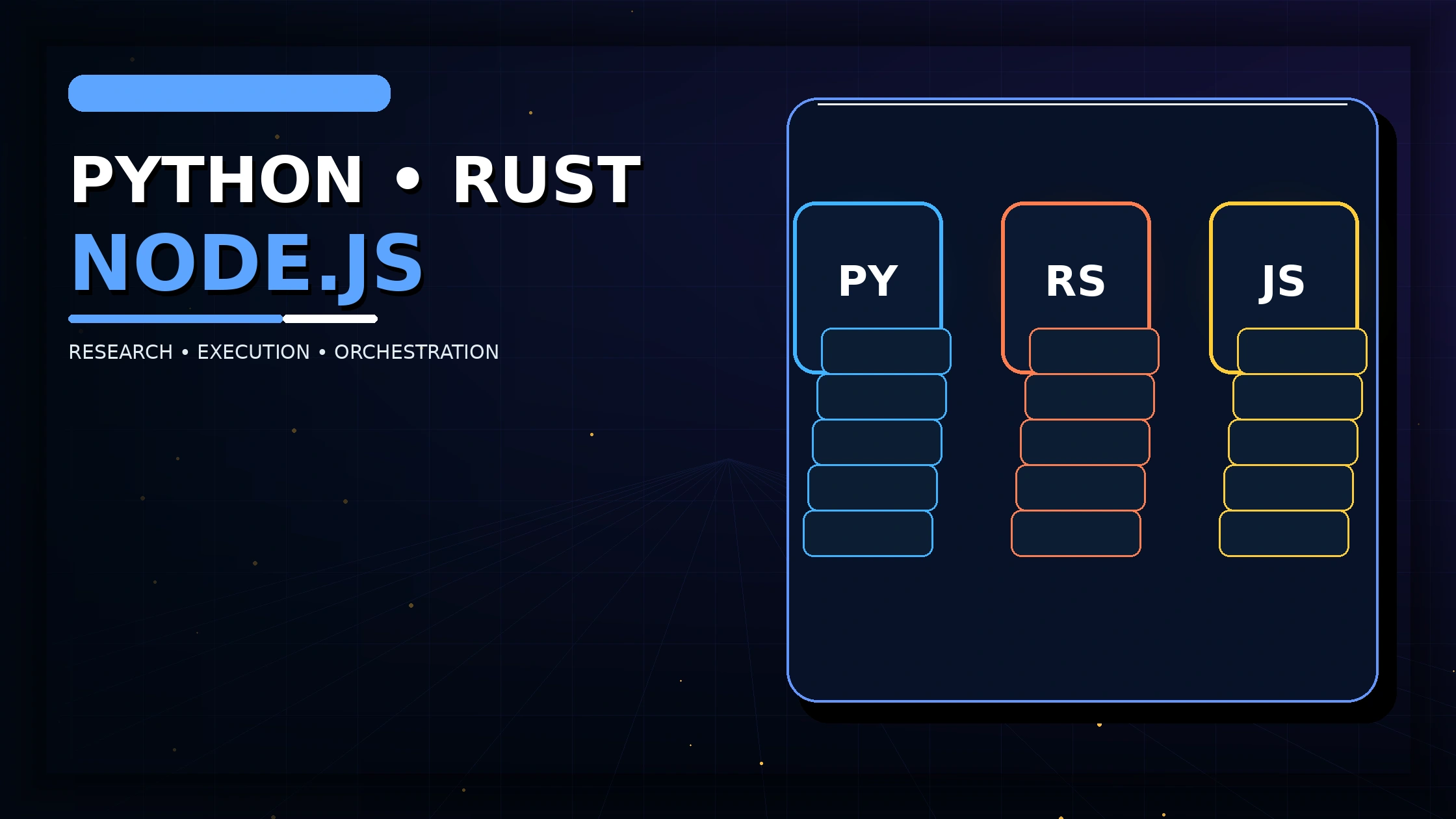
The best language for a crypto AI agent depends on the layer. Python dominates research, machine learning and data analysis. Rust is strongest where memory safety, predictable performance and concurrent execution matter. Node.js and TypeScript are effective for API products, streaming and web integration. A production system can use all three without turning into an unmaintainable patchwork.
DN Evidence Block
Reviewed: 20 November 2026. Primary evidence: Python asyncio, the Rust Book, Node.js event-loop documentation and CCXT’s current multi-language support.
Boundary: language choice does not guarantee execution quality. Library versions, exchange connectors, deployment, team skill and operating controls matter more than benchmark headlines.
Which Language Fits Which Layer?
| Agent layer | Python | Rust | Node.js / TypeScript | DN default |
|---|---|---|---|---|
| Research and notebooks | Excellent ML, statistics and data ecosystem | Possible but less convenient | Usable, smaller quant ecosystem | Python |
| LLM orchestration | Strong agent and ML libraries | Growing, more engineering | Strong SDK and web-tool ecosystem | Python or TypeScript |
| REST and WebSocket integration | Good with asyncio | Strong performance and safety | Natural event-driven fit | TypeScript or Python |
| Low-latency execution | Needs careful optimization or compiled extensions | Strongest of the three | Good I/O, avoid CPU work on event loop | Rust for critical path |
| Smart-contract tooling | Strong scripting and analytics | Strong for Solana and systems tooling | Largest EVM front-end and SDK ecosystem | TypeScript for EVM apps |
| Risk and policy service | Readable and fast to change | Strong type and memory guarantees | Strong typed services with TypeScript | Typed service separate from model |
| Deployment and hiring | Broad talent pool | Smaller specialist pool | Broad web talent pool | Choose maintainability |
Python: Best for Research and Model Work
Python’s advantage is ecosystem density. Pandas, NumPy, scikit-learn, PyTorch, web3.py and exchange libraries make it efficient to move from raw data to features, models, backtests and agent tools. The same language can support notebooks, batch jobs and moderate-frequency execution.
Python’s asyncio is designed for concurrent I/O and structured network code, so it can manage several feeds and APIs. The common mistake is treating async I/O as a substitute for architecture. CPU-heavy model inference, blocking libraries or large dataframe work can stall an event loop and delay order handling.
Use Python when
- The primary work is data science, research or model training.
- Latency is measured in tens of milliseconds or slower rather than microseconds.
- The team needs fast experimentation and broad library support.
- A separate risk and execution service can constrain financial authority.
Do not rely on Python alone when
- A single process handles heavy inference and time-critical order routing.
- Garbage collection, blocking calls or dynamic types create unacceptable uncertainty.
- The organization cannot reproduce environments and dependency versions.
Rust: Best for Safety-Critical and Performance-Critical Components
Rust combines compiled performance with ownership and type systems designed to prevent broad classes of memory and concurrency errors. Its async and message-passing patterns suit market-data engines, risk gateways and execution services where predictable behavior matters.
The trade-off is development cost. Teams need experienced engineers, and library coverage can be narrower. Rewriting an entire research stack in Rust can slow iteration without improving outcomes. Rust earns its place when the failure cost or latency requirement is specific and measurable.
Use Rust when
- The execution gateway must remain responsive under load.
- Concurrency, memory safety and deterministic resource use are material controls.
- The system parses untrusted network data or signs high-value actions.
- A stable service interface can separate Rust from faster-changing research code.
Node.js and TypeScript: Best for APIs, Streaming and Product Integration
Node.js uses an event loop for non-blocking I/O, making it effective for WebSocket clients, web APIs, queues and agent products that coordinate many network requests. TypeScript adds compile-time structure to schemas, tool calls and exchange payloads.
The principal risk is blocking the event loop. Large calculations, synchronous file operations or expensive serialization can delay every connection. Move heavy work to workers or a separate service, apply backpressure and measure event-loop lag.
Use Node.js or TypeScript when
- The agent is exposed as a web API or integrates with SaaS tools.
- Real-time feeds and user interfaces share typed schemas.
- The team already operates TypeScript services.
- Execution is I/O-bound and CPU-heavy research is isolated.
CCXT Does Not Make the Languages Identical
CCXT supports multiple languages and normalizes many exchange methods. The generated or wrapped interfaces reduce connector work, but each runtime still has different concurrency, typing and packaging behavior. The exchange’s native semantics, WebSocket implementation, error handling and rate limits still need testing.
Do not choose a language only because one library has an adapter. Test the exact exchange, order types, authentication, reconnect, precision, timestamps and failure path.
The Strongest Default: A Polyglot Boundary
A practical architecture can use Python for research and model scoring, TypeScript for the customer API and tool orchestration, and Rust for execution or risk checks. The boundary should be narrow: typed messages, idempotent requests, versioned schemas and an explicit timeout.
Polyglot systems fail when every language reaches the exchange, database and wallet directly. One execution service should own order semantics, and one policy service should own limits.
DN Rule
Use the fastest-changing language for research and the most controlled service for money movement. Do not place a language model, dataframe pipeline and unrestricted signer in one process.
Seven Tests Before Choosing
- Define maximum acceptable decision and execution latency.
- Separate network I/O from CPU-heavy work.
- List required libraries and verify maintenance.
- Measure team proficiency and on-call capability.
- Define typed boundaries between research, risk and execution.
- Benchmark a representative workload rather than a toy loop.
- Run failure injection: timeouts, reconnects, malformed data and duplicate requests.
DN Crypto-Agent Language Architecture Matcher
Choose the nearest workload. The output suggests a primary language and whether a split architecture is justified.
Worked Example
A team trains models in Python, serves a customer dashboard in TypeScript and needs a reliable order gateway. The strategy acts every 15 minutes, so the model does not require Rust. The order and risk service nevertheless handles timeouts, precision and duplicate prevention, so the team implements that small boundary in Rust.
The result is not “Rust is faster.” It is a controlled split: Python changes quickly, TypeScript serves users and Rust protects a narrow financial path.
Methodology and Limitations
DN compared documented runtime models, ecosystem coverage, concurrency, safety, deployment and team cost. We did not publish a synthetic benchmark because actual exchange, model and workload behavior matters more than a generic loop.
Frequently Asked Questions
Is Python fast enough for a crypto trading agent?
Yes for research, orchestration and many non-latency-critical strategies. Critical execution loops may need compiled components or a lower-latency service.
When should a team choose Rust?
Choose Rust when memory safety, predictable latency, concurrency and production reliability justify a steeper development and hiring cost.
Is Node.js suitable for exchange WebSockets?
Yes. Its event-driven model fits I/O-heavy WebSocket and API services, provided CPU-heavy work does not block the event loop.
Should one agent use only one language?
Not necessarily. A common architecture uses Python for research, Node.js or TypeScript for APIs and orchestration, and Rust for latency-sensitive or security-critical execution.
What matters more than the language?
Data quality, exchange semantics, risk controls, idempotency, observability, testing and a team capable of maintaining the deployed system.
Primary Sources
- Python asyncio Documentation
- The Rust Programming Language
- Node.js Event Loop
- Node.js: Do Not Block the Event Loop
- CCXT Official Repository
Editorial disclosure: no language vendor, exchange or framework paid for inclusion.
About the Author