What Matters
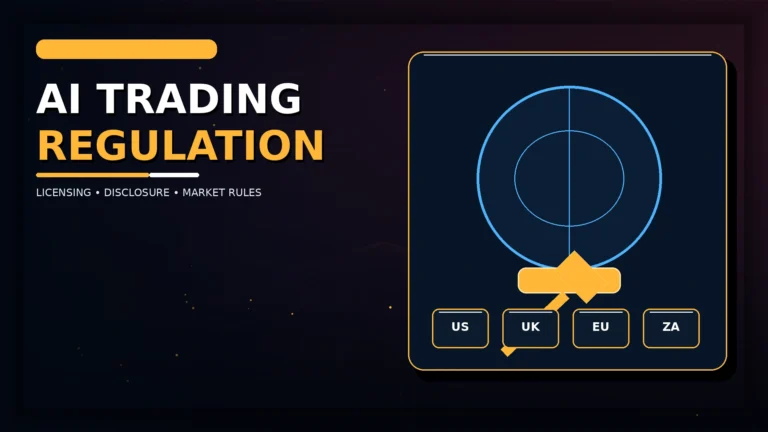
Regulators generally care about what an AI trading bot does, for whom and with whose money—not whether the software is called an agent. Research, personal self-directed trading, signals, investment advice, discretionary management, broker access and running a crypto service can fall into different legal categories.
DN Evidence Block
Reviewed: 20 November 2026. Primary evidence: SEC and FINRA guidance and enforcement, FCA materials, MiFID II Article 17 and ESMA’s 2026 algorithmic-trading briefing, plus FSCA licensing information.
Boundary: this is an issue map, not legal advice. Rules depend on facts, entities, instruments and customer location.
Start With the Activity
| Activity | Regulatory question | Lower-risk boundary | Escalation trigger |
|---|---|---|---|
| Research and education | Is content general or personalized? | No account access or tailored recommendation | Individual suitability or action recommendation |
| User-operated software | Who chooses and controls the strategy? | User configures and approves | Provider exercises discretion |
| Signals | Are signals investment advice or solicitation? | General data with clear methodology | Paid personalized signals or promotions |
| Auto-trading | Who sends orders to the account? | Customer-controlled rules and registered providers | Third party trades without per-order approval |
| Portfolio management | Does the provider allocate client capital? | No custody or discretion | Ongoing discretionary decisions |
| Market access | Does a regulated firm deploy an algorithm? | Tested limits and supervised access | Direct market access and high-frequency activity |
| Crypto service | Is the business exchanging, safeguarding or intermediating crypto? | Pure software without regulated activity | Custody, exchange or financial-service conduct |
United States: Existing Securities and Commodity Rules Still Apply
The SEC has charged investment advisers for false claims about AI use, demonstrating that marketing and adviser obligations apply to AI products. FINRA has warned about unregistered auto-trading services, extraordinary return claims, account access and AI washing.
Whether a provider must register depends on activities and instruments. Investment advice, discretionary trading, brokerage, custody and commodity derivatives can trigger separate federal and state regimes. A crypto spot tool may still face anti-fraud, consumer, money-transmission and state requirements even when a specific token is not treated as a security.
US control questions
- Is the provider giving individualized advice for compensation?
- Does it send orders directly to a customer’s broker or exchange account?
- Does it exercise discretion or custody?
- Does it trade securities, futures, options or swaps?
- Are performance and AI claims substantiated?
United Kingdom: Principles and Existing Perimeters
The FCA says it intends to apply existing outcomes-focused rules rather than create a separate AI rulebook. General-purpose AI research tools are not regulated in the same way as authorised financial advice, but a regulated firm’s AI tool can sit inside its existing obligations.
Investment advice, arranging, dealing, managing investments and financial promotions can be regulated activities. Crypto promotions and cryptoasset service activities have separate UK boundaries. Firms need governance, consumer-duty, operational-resilience and data controls where applicable.
European Union: MiFID II Algorithmic Controls Are Specific
MiFID II Article 17 requires investment firms engaged in algorithmic trading to have resilient systems, sufficient capacity, trading thresholds and limits, erroneous-order prevention, business continuity, testing, monitoring and records. ESMA’s February 2026 supervisory briefing explicitly addresses AI considerations in algorithmic trading.
An AI model in a regulated trading system does not replace these requirements. Outsourcing a model or execution engine does not outsource accountability. Depending on the use case, the EU AI Act, DORA, GDPR, market-abuse and consumer rules can apply alongside financial regulation.
South Africa: FAIS and CASP Licensing Boundaries
The FSCA requires authorisation to provide regulated financial services, and crypto asset service providers must obtain appropriate licensing. A software tool that provides personalized advice, intermediates transactions or manages customer activity may cross a financial-services boundary even if the underlying interface calls an exchange API.
Operators should identify the legal entity, customer location, product and role. POPIA applies to personal data, while exchange-control, tax and financial-intelligence obligations can affect payment and crypto flows.
DN Rule
“The user owns the exchange account” does not automatically mean the bot provider is unregulated. Discretion, advice, compensation, account access and customer promises matter.
Marketing Rules: AI Washing and Return Claims
Claims should identify what the AI does, the data and controls, and the limits of evidence. Do not claim guaranteed returns, risk-free execution, regulated status or AI capabilities that the product does not possess.
Backtests need assumptions, dates, costs and limitations. Testimonials and cherry-picked results can mislead even when technically true.
Governance Controls That Travel Across Jurisdictions
- Named accountable owner and legal entity.
- Written activity and customer-perimeter analysis.
- Versioned model, data and strategy documentation.
- Pre-trade price, size, leverage and loss limits.
- Testing, controlled deployment and rollback.
- Customer consent and clear authority.
- Performance-claim evidence and disclosure.
- Incident, complaint and record-retention process.
DN AI Trading Regulatory Perimeter Screen
Screen one business model before launch. The result identifies the need for formal legal and licensing analysis.
Worked Example
A company sells an app that selects a portfolio for each user, connects to exchange accounts and rebalances without per-order approval. It charges a percentage of assets and advertises stable monthly returns.
Calling the product “software” does not resolve the perimeter. Personalized allocation, discretion, compensation, account access and return claims require jurisdiction-specific adviser, management, broker, crypto-service and marketing analysis.
Methodology and Limitations
DN compared public regulatory materials across four jurisdictions and organized them by activity. We did not analyze a specific firm’s agreements, customer base or instruments.
Frequently Asked Questions
Is there one global AI trading-bot licence?
No. Regulation depends on the activity, client relationship, instrument, jurisdiction and firm status rather than the use of AI alone.
Can an unregistered app auto-trade a customer’s account?
That can trigger investment-adviser, broker, discretionary-management, financial-service or intermediary requirements depending on the jurisdiction and facts.
Does the EU AI Act replace MiFID II algorithmic-trading rules?
No. Financial firms still need to comply with MiFID II and related governance, testing, risk and recordkeeping requirements. Other AI obligations may apply in parallel.
Are general-purpose AI investment answers regulated in the UK?
The FCA states general-purpose AI tools are not regulated like authorised financial advice, while a regulated firm’s tool may fall within existing financial-services rules.
What is the safest launch sequence?
Start with research and education, define who controls decisions, obtain jurisdiction-specific advice, register where required and add execution only after controls and permissions are proven.
Primary Sources
- SEC: AI-Washing Enforcement
- FINRA: Auto-Trading Risks
- FCA Approach to AI
- MiFID II Article 17
- ESMA 2026 Algorithmic-Trading Briefing
- FSCA Licensing Information
Legal disclaimer: educational issue map only; obtain advice in every jurisdiction where the service is offered.
About the Author