One AI datacentre announces a 20-megawatt capacity; another advertises 20 megavolt-amperes. The two headlines may describe different electrical quantities. A factor as mundane as power factor can change the amount of real work a facility can support, and the tariff structure changes what that capacity costs.
Heath Muchena · Decentralised News · Reviewed 23 November 2026 · 2027 editorial edition · AI
What Matters
Translate nameplate MVA into real MW only with the appropriate power factor and equipment boundaries; keep power, energy and demand charges separate.
The signal: Evidence, units and contractual scope decide whether an apparently precise result can be trusted. We separate documented facts, illustrative scenarios and unresolved questions.
The decision that conventional coverage misses
One AI datacentre announces a 20-megawatt capacity; another advertises 20 megavolt-amperes. The two headlines may describe different electrical quantities. A factor as mundane as power factor can change the amount of real work a facility can support, and the tariff structure changes what that capacity costs.
For a reader building a company, using an AI agent or evaluating a financial platform, the useful question is not whether the marketing story sounds impressive. It is what decision changes after the hidden unit, party, right or obligation is identified. This is the reason Decentralised News publishes an inspectable instrument alongside the article, rather than relying on a product score that cannot be reproduced.
We do not claim to have independently audited every institution in this market. The factual boundary of each source is identified below. All examples can be changed by the reader; none is presented as an observed provider performance metric.
MW and MVA are not synonyms
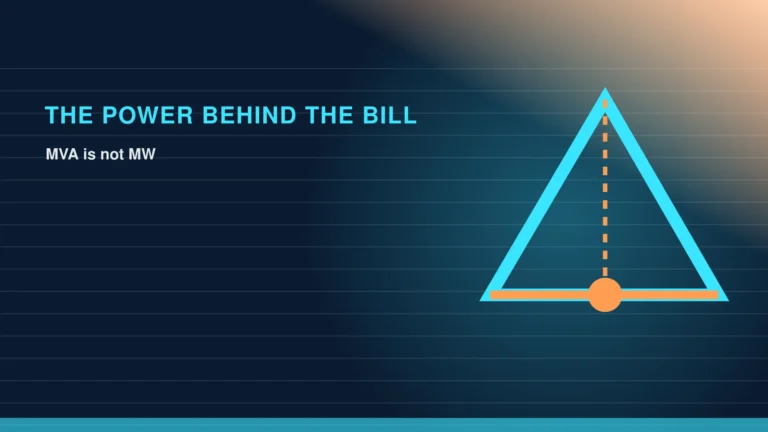
Real power, measured in watts, is the average rate at which electrical energy performs work. Apparent power, measured in volt-amperes, reflects the product of RMS current and voltage. Power factor is the ratio of real to apparent power. Therefore 20 MVA at a power factor of 0.92 corresponds to 18.4 MW, before considering distribution topology, actual operating limits and losses.
An AI rack consumes more than GPU silicon
Reported GPU thermal design power does not by itself measure server, network and facility energy. Power distribution losses, cooling systems, storage, redundancy and part-load effects matter. Facility power usage effectiveness (PUE) is a different metric from electrical power factor. Conflating PUE with power factor can double-count—or fail to count—specific infrastructure burdens.
Energy adds the clock
A 10 MW site operating at that average real demand for 100 hours consumes approximately 1,000 MWh. An announced capacity is not an observation that the facility operated at that level continuously. If an analyst multiplies a peak electrical capacity by 8,760 hours without a defensible utilization scenario, annual consumption may be overstated significantly.
Tariffs have more than one line
Utility contracts can include time-varying energy rates, demand charges, reactive power penalties, minimum payments, connection fees and fuel or network adjustments. A data centre may reserve power capacity without drawing it throughout the month. Its actual bill depends on metered load, contracted demand, power factor conditions and the utility’s published tariff—not merely the campus’s announced megawatts.
The power supply chain
Different boundaries may be quoted for grid interconnection, facility gross load, IT equipment or delivered compute. A transformation from MVA to MW does not answer which of those boundaries a quoted number refers to. Ask for metering location, voltage, inverter efficiencies, redundancy approach and which loads the project includes.
Reliability is part of economic value
A low-priced power contract that cannot deliver at the required hours is not interchangeable with a higher-priced firm capacity agreement. Model curtailment, back-up generator costs and the mismatch between the site’s commitment to AI customers and its rights under the power supply agreement. Contract scope matters as much as electrical conversion.
Calculator assumptions
The model multiplies apparent MVA by an entered power factor to obtain real MW and then multiplies by user-entered equivalent full-load hours for an illustrative energy quantity. It does not estimate cooling demand, tariffs, grid losses, uptime or equipment utilization. Use actual engineering records and utility tariffs for project appraisal.
DN decision instrument: Megawatts, Megavolt-Amps and the AI Power Bill in 2027
Change the illustrative inputs, calculate the result, and export a local JSON record for your own working papers. The form runs in your browser without contacting an external service.
The export is an input record, not an official verification receipt. Recompute against authoritative evidence before relying on an actual decision.
DN methodology and limitations
Scope: this analysis addresses translate nameplate mva into real mw only with the appropriate power factor and equipment boundaries; keep power, energy and demand charges separate.
Evidence hierarchy: primary regulator, issuer, standard-setter or payment-provider documentation outranks promotional copy; the original contractual or technical record outranks a secondary interpretation. Where claims cannot be independently verified, they remain questions. The article is updated from information available on 23 November 2026. References to 2027 indicate forward-looking decision frameworks, not future observations.
Reproducibility: the calculator uses visible arithmetic or document-status logic, user-supplied values and explicit constraints. It neither connects to wallets nor sends transactions. Downloaded input records are not independently audited datasets. Legal, regulatory, accounting and investment decisions require the governing records and relevant professional judgment.
Editorial separation: there are no product rankings, disguised sponsored endorsements or invented real-world measurements in this piece. Any adjacent DN guide linked below is for methodological context; it is not evidence of the claims made in the external sources.
Primary sources and companion records
- Schneider Electric measured power definitions
- DN AI infrastructure megawatt economics
- DN energy-cost measurement
Source documents are linked for independent verification. Publication or website content may subsequently change; preserve the original edition date and consult updated official documentation when applying these rules to live transactions.
Frequently asked questions
Does this article describe a verified 2027 event?
No. The 2027 date identifies the planning edition. Facts are grounded in published sources available by 23 November 2026; user-entered examples are hypothetical.
Does the calculator use live financial, regulatory or market data?
No. It is a deterministic local illustrative model. Inputs are supplied by the reader and no external account or live platform is queried.
When should a reader stop and request additional evidence?
When identity, scope, contract terms, dates, source provenance or rights needed for the decision remain unresolved. A plausible numerical output never substitutes for that missing evidence.
DN Alpha Thesis
Translate nameplate MVA into real MW only with the appropriate power factor and equipment boundaries; keep power, energy and demand charges separate. The durable advantage is not a prediction about 2027. It is having enough source-linked evidence to understand which answer would change when a document, price, contract or input changes.
Disclosure: educational research. No financial product is being recommended. Calculators are deterministic illustrations, not investment, legal or tax opinions.
About the Author