Money Stories · Original fiction · 10 minute read
At the first fitting, Hiba asked whether she would be able to lift her arms.
Salma had heard other questions more often. Would the waist look smaller? Could the neckline come down a finger’s width? Would the dress photograph white rather than yellow? She had already prepared answers to those. Now she stood behind a woman in a cotton trial dress, holding two pins between her lips, and had to ask what the arms were for.
“Dancing,” Hiba said. “Possibly carrying my nephew. He’s decided I’m his mother for the month.”
She lifted both hands. The trial bodice climbed with them.
“We can improve that,” Salma said.
“I was hoping you wouldn’t say I must dance differently.”
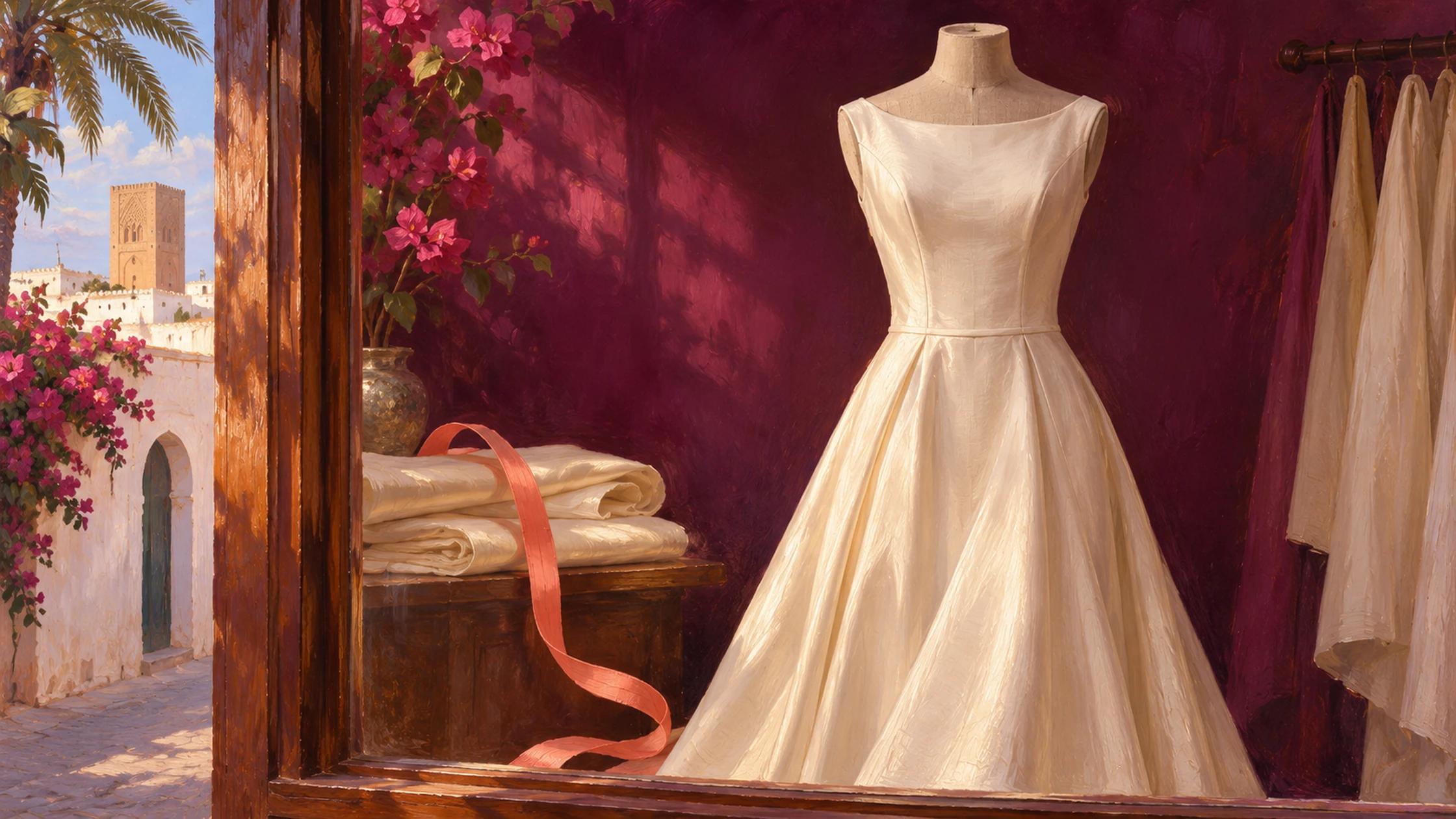
The shop’s plum curtain was drawn across the window. Beyond it, someone was wheeling a delivery trolley over the broken edge of the pavement. Salma could hear each wheel arrive at the same stone. Inside, the old sewing machine gave a small metallic cough, though nobody was touching it. Its motor had been behaving badly for weeks. She had begun speaking louder whenever it started.
Hiba had paid the five-thousand-dirham advance that morning, half the agreed price. The transfer notification still shone on Salma’s phone. Five thousand arrived; five thousand present. For a few seconds she had experienced the number as a room she could stand in.
They worked on the armhole. Hiba wanted a plain ivory dress beneath a detachable overskirt, with lace along the overskirt. She had brought a photograph, but kept turning the phone facedown. Salma recognised the awkwardness of wanting something while suspecting that wanting it was foolish.
“You can keep the photograph out,” she said.
“It’s my sister’s choice.”
“And which part is yours?”
Hiba looked in the mirror. “I haven’t decided.”
After she left, Salma walked to the machine dealer. The replacement she had tested was still available for 4,800 dirhams. She had a thousand of her own available for the business, beyond the money already separated for bills and living costs. Added to Hiba’s advance, it seemed enough to do something decisive.
She paid. The dealer delivered before the afternoon light left the window.
The new machine made a low, even sound. Salma sewed a line through folded cotton and held it up. Every stitch had arrived where it was supposed to. She sewed another line for the pleasure of not being interrupted.
Her helper, Rania, came in carrying bread. She put down the bag and ran a fingertip beside the seam.
“Good,” she said. “Now perhaps you’ll stop shouting at your customers.”
Salma laughed so suddenly that she had to sit down.
Then the fabric supplier called to confirm payment before cutting the order. Salma said tomorrow, as though tomorrow were a drawer in which the money had been put.
The original materials would cost 3,600 dirhams. Rania’s agreed work would cost another 1,200, payable when the dress was finished. The remaining five thousand from Hiba was due only on collection. Salma looked at the account again. After buying the machine, she had 1,200.
She had not misread a price. She had read several prices separately.
That evening Hiba sent a new photograph. Could the back be more open? And perhaps the overskirt less full? Salma enlarged the image until the woman’s face disappeared and only the construction remained. A new back meant changing the trial bodice. There were two other customers’ fittings that week. Their money and materials were already committed to their own work.
She typed Of course, then removed it.
At the second fitting, Hiba found the cotton trial dress hanging exactly where she had left it.
“You haven’t started?”
“I have to discuss something first.”
Salma had laid out three fabric samples. One was the ivory cloth they had chosen. Another looked nearly identical when held against the window; in the hand it was stiff and thin. It cost less. She had put that sample away twice and brought it back twice. Now, before Hiba could touch it, she returned it to the drawer.
“I spent too much of the advance on replacing the machine,” she said.
Hiba looked at the new machine, its pale casing almost luminous in the shop.
“You bought that with my dress money?”
“Yes. I needed it to work. But I didn’t leave enough for the cloth before your final payment.”
The explanation sounded smaller aloud. Salma wanted to tell her about the motor, the interrupted seams, the days when she had finished by hand. She could feel each explanation taking its place behind her teeth.
“That isn’t a reason for you to solve it,” she said instead.
Hiba sat down without taking off her coat.
That morning the dealer had agreed, in writing, to buy the replacement back for 4,500 if Salma returned it by noon the following day. With the 1,200 still in her account, she could refund Hiba’s entire five thousand. She would lose three hundred and be back with the coughing motor. Rania had not begun the agreed dress work and had confirmed there would be no helper charge if the commission was cancelled at this stage. Salma showed Hiba the message and offered that choice first.
“I don’t want to find another person this close to the wedding,” Hiba said.
“I know.”
“Knowing doesn’t make it a small thing.”
Salma nodded.
She put the original sketch between them. Keeping every element, changing the back and meeting the same date would require help and cash she did not have. She could not honestly promise it under the existing payment schedule.
Then she turned over the page. On the other side was a dress without the overskirt, cut from the chosen cloth, with a narrow open back, bare arms and no applied lace. Its shape would come from the seams. It would use less fabric, though changing the pattern meant Rania would still have the same amount of paid work.
Hiba studied it. “You’ve made it simpler because you need it to be.”
“Yes.”
“I need to know whether you would recommend it if you hadn’t bought the machine.”
Salma considered the photograph facedown beside them.
“For lifting your arms, yes. For the entrance your sister has imagined, probably not.”
Hiba laughed once, without quite forgiving her.
They pinned the trial dress differently. Without the extra skirt, Hiba could see her feet. She walked to the window, turned, walked back. Salma watched her decide whether she was being persuaded or choosing. The difference was not hers to announce.
The revised price would be 8,500 dirhams. The five thousand already paid would count in full. Another two thousand would be due when they approved the new design and payment schedule, and the last 1,500 after the final fitting, before collection. There would be no surprise supplement for the changed back.
“Send it to me,” Hiba said. “The picture and all the amounts. I’ll answer tonight.”
Salma did. She also wrote down the completion date, the specified cloth and the refund alternative. Then she waited beside a machine she might have to give back.
After dinner, Hiba accepted the revised agreement. The additional two thousand arrived that evening. Salma now had 3,200. She paid 2,800 for the revised materials the following morning, leaving four hundred. Rania’s twelve hundred still had to be paid when the work was done.
On her costing sheet, the original ten-thousand-dirham dress had left 5,200 after materials and Rania. The revised one would leave 4,500. Neither figure was her take-home pay; her own hours, the shop and the machine had claims on it. She had reduced the price by more than she had reduced the costs.
Rania read the new schedule and moved a fitting on their work board, with the other customer’s agreement.
“You could have told me yesterday,” she said.
“I hadn’t told myself yesterday.”
Rania uncapped the chalk. “Well. Tell yourself sooner next time.”
At the third fitting, two weeks later, Hiba brought the shoes she had forgotten at the first two.
They were lower than Salma had expected. Hiba explained that she had practised crossing her mother’s sitting room in the higher pair and knocked over a small table. Her sister had called it nerves.
“I called it the shoes,” she said.
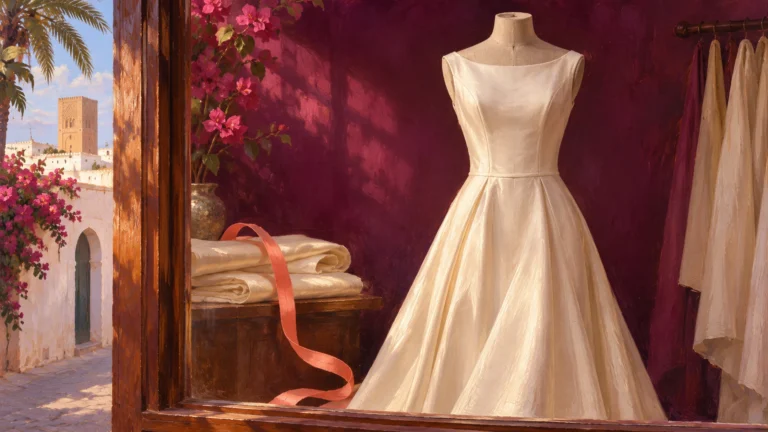
The dress waited on the headless display form against the plum curtain. A coral measuring tape hung beside it. In the morning light the ivory cloth held a little warmth, like paper that had been kept near a lamp. There was no overskirt to hide an uncertain seam. Salma had redone the left side twice.
Hiba changed behind the screen. When she came out, she did not immediately turn to the mirror. She raised her arms above her head, then reached forward as though receiving a child.
“Again,” Salma said, watching the back.
Hiba obeyed. The dress moved and settled.
They needed to shorten the hem slightly for the shoes. Rania knelt with the chalk while Salma checked the waist seam. From outside came the trolley, every wheel striking the same stone.
“My sister wanted to come,” Hiba said.
“You could have brought her.”
“I know.”
They worked quietly after that.
Hiba paid the last 1,500 after approving the fit. Salma had nineteen hundred in the job’s cash pot then; she paid Rania the agreed twelve hundred when they finished the hem that afternoon. Seven hundred remained. The new machine was there too, but it was a machine, not money she could use twice. Her household and existing bills were still covered in their separate accounts. She had made herself less room for the next job than she wanted.
Before collection she changed the little card in the window. It no longer said only Wedding commissions taken. Beneath that she added Design, work stages and payment dates agreed together. The receipt pad would say Advance toward your dress, with the balance still due. She spent an absurdly long time making the lettering even.
Hiba came alone to collect it. Salma held the bag open while she slid in the hanger. For a moment the finished dress hung between the women, and Salma wanted to ask whether they were all right now.
Instead she checked that the folds lay clear of the bag’s zip.
“If you lift him,” she said, “keep his shoes away from the hem.”
“I’ll ask him politely.”
Hiba took the bag. At the door she lifted her free hand to catch the frame, testing the reach once more, though she was back in her ordinary coat.
Money behind the story
A customer’s advance creates cash without removing the work still owed. The IFRS Foundation’s revenue framework links revenue to the transfer of promised goods or services. Its educational material on customer advances explains contract liabilities when payment precedes that transfer. These sources illustrate the distinction; the story does not establish which accounting rules apply to this Moroccan business or when each part of its work qualifies as revenue.
Salma begins with MAD1,000 available, receives MAD5,000 and spends MAD4,800 on equipment: MAD1,200 remains. The revised agreement totals MAD8,500, including that advance, then MAD2,000 at design approval and MAD1,500 before collection. Cash moves from MAD1,200 to MAD3,200, then MAD400 after materials, MAD1,900 after the final receipt and MAD700 after paying her helper MAD1,200.
The revised job contributes MAD8,500 − MAD2,800 materials − MAD1,200 helper = MAD4,500 before Salma’s labour, fixed costs, depreciation and tax. The original estimate was MAD5,200 on the same basis: MAD700 more. Neither is take-home profit. The machine’s entire purchase price is a separate cash investment, not another direct materials charge.
The unused refund alternative was feasible: MAD4,500 dealer buyback + MAD1,200 cash − MAD5,000 refund = MAD700. That offer, all prices and the customer’s revised consent are invented. No general refund entitlement is implied.
Financial sources checked 25 November 2026. Story figures and outcomes are illustrative. General financial education, not individual financial advice.
Stay with the story: three questions
- Which part of money already received still has work, materials or a refund possibility attached to it?
- If a commission must change, what information would let the customer make a real choice?
- What does a job leave after its direct costs, and what still needs to be paid from that amount?
About the Author