Crypto Options for Directional Traders: The 2026 Field Manual
Crypto Options for Directional Traders: The 2026 Field Manual
How crypto options actually work, why they are the only leveraged directional instrument that cannot liquidate you, and how to score any trade before you place it with the DN Options Edge Score.
Decentralised News · Updated June 9, 2026 · Reading time 14 min · Tool included
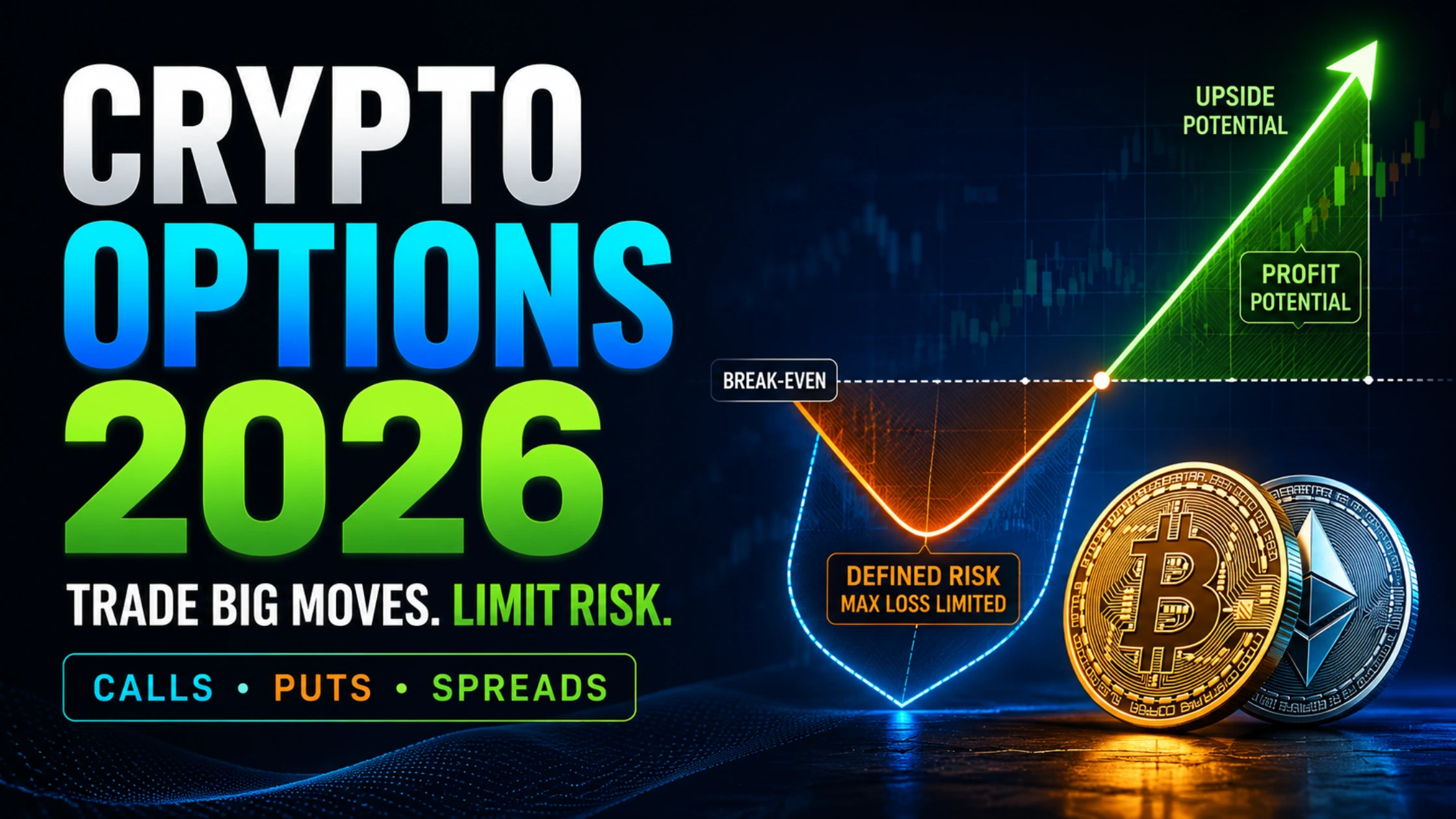
A crypto option gives you the right, but not the obligation, to buy or sell Bitcoin or Ether at a fixed price before a fixed date, in exchange for an upfront premium. That premium is the most you can ever lose on a bought option. There is no margin call, no liquidation price, no funding fee bleeding you at 3am. For a directional trader, that single property changes everything, and this manual shows you how to use it.
It matters more right now than it has in months. Bitcoin is trading near $62,000 after one of the sharpest weekly drawdowns of the cycle, roughly 17 percent in seven days, and more than 50 percent below the October 2025 all-time high above $126,000. Moves like that do two things at once: they wipe out leveraged perpetual futures positions by the billion, and they make traders desperate for a way to express strong directional views without donating their account to a liquidation engine. Options are that way. Most crypto traders never learn them because the vocabulary looks hostile and the venues feel institutional. The vocabulary takes twenty minutes. The venues take five. Both are below.
What an option actually is, in trader language
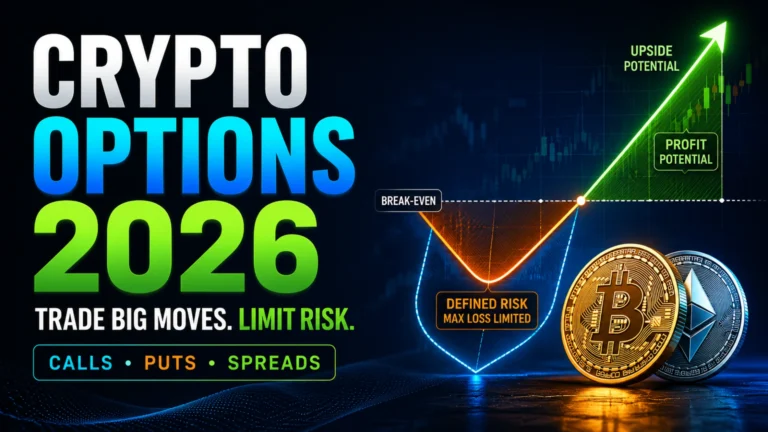
Strip away the Greek letters and an option is a priced bet on a range, with the loss capped at what you paid. Four primitive positions exist, and every structure in finance is built from them:
- Long call: you pay a premium for the right to buy at the strike. You profit if price rises far enough above the strike to cover the premium. Maximum loss: the premium. Maximum gain: unlimited.
- Long put: you pay a premium for the right to sell at the strike. You profit if price falls far enough below the strike. Maximum loss: the premium. Maximum gain: large (the strike, in the theoretical limit of price going to zero).
- Short call: you collect the premium and take on the obligation to sell at the strike if assigned. Capped gain, theoretically unlimited loss. Beginners should only ever sell calls against coins they already hold (the covered call).
- Short put: you collect the premium and take on the obligation to buy at the strike. This is how patient buyers get paid to set limit orders (the cash-secured put).
Two more terms and the vocabulary is done. Expiry is the date the contract settles; crypto venues list everything from daily expiries to contracts more than a year out, and major monthly expiries (the last Friday of the month on Deribit) concentrate the most liquidity. Implied volatility, or IV, is the market's priced expectation of how violently the asset will move, and it is the single number that determines whether the premium you are paying is cheap or expensive. Bitcoin IV in recent months has mostly lived between the mid-40s and the high-60s in annualized terms; in calm regimes it compresses, and in weeks like this one it spikes. Buy options when IV is low and you are buying movement at a discount. Buy them when IV is screaming and you can be right on direction and still lose money when volatility deflates after the move. Traders call that IV crush, and it is the number one reason new options buyers leave confused.
Why directional traders use options instead of perps
The perpetual future is crypto's default leverage instrument, and for short, tactical trades with tight invalidation it remains the cheaper tool: you pay the spread, the taker fee and funding, and nothing else. The full breakdown of that cost stack is in our Exchange Fit Engine analysis. But perps carry one structural property that destroys directional traders with conviction: the liquidation price. A perp position does not let you be early. Be right about a move to $80,000 but sit through a wick to $58,000 first, and at 10x leverage you are not in the trade anymore when the move happens.
The bought option inverts that contract with the market. You pre-pay the worst case. Your position survives any wick, any weekend cascade, any flash crash, all the way to expiry. In exchange, you bleed time value (theta) every day the move does not come, and you pay more upfront than a perp's margin. The honest comparison:
| Property | Perpetual future (10x) | Bought option |
|---|---|---|
| Maximum loss | Entire margin, at the liquidation price | Premium paid, known upfront |
| Can you be early? | No. Wicks end the trade | Yes, until expiry |
| Ongoing cost | Funding, variable, can flip against you | Theta decay, known curve |
| Volatility exposure | None directly | You are long IV; crush risk after events |
| Upside | Linear | Convex: accelerates as the move extends |
The rule of thumb this produces: perps for tight, fast, invalidation-driven trades; options for conviction trades where the path is unknowable but the destination is the thesis, and for any trade you intend to hold through events, weekends or known volatility windows.
Pricing in sixty seconds
You do not need the Black-Scholes formula to trade options, but you need its three honest lessons. First, premium scales with time roughly by the square root: a 90-day option costs about 1.7 times a 30-day one, not three times, which is why buying more time is persistently underrated. Second, premium scales linearly with IV: the same 30-day at-the-money Bitcoin option that costs about 6.4 percent of spot at 55 percent IV costs about 4.6 percent at 40 percent IV. Third, an at-the-money option's fair premium is approximately 0.4 × IV × √(time in years) × spot, a back-of-napkin check you can run in your head against any quote a venue shows you. Everything else, the delta, the gamma, the smile, refines those three facts; it never overturns them.
The DN Options Edge Score
Most options content stops at definitions. The practical question a directional trader actually faces is comparative: given my view, which structure pays best for the risk? The DN Options Edge Score answers it with one transparent number.
Run the Score across the standard directional structures at today's conditions and the results embarrass some popular instincts. The table uses Bitcoin at $62,000, 55 percent IV, 30 days to expiry, model premiums, and a 15 percent expected move as the test:
| Structure | Cost | Breakeven | Payoff at 15% move | Reward:risk | Edge Score |
|---|---|---|---|---|---|
| Bull call spread ($62,000 / $68,200) | $2,222 | $64,222 | +$3,978 | 1.79 | 64 |
| Bear put spread ($62,000 / $55,800) | $2,443 | $59,557 | +$3,757 | 1.54 | 61 |
| Long ATM put ($62,000) | $3,789 | $58,211 | +$5,511 | 1.45 | 59 |
| Long ATM call ($62,000) | $3,992 | $65,992 | +$5,308 | 1.33 | 57 |
| Long 10% OTM put ($55,800) | $1,345 | $54,455 | +$1,755 | 1.30 | 57 |
| Long 10% OTM call ($68,200) | $1,770 | $69,970 | +$1,330 | 0.75 | 43 |
| Long ATM straddle | $7,781 | $54,219 / $69,781 | +$1,519 | 0.20 | 16 |
Three findings worth the price of the whole article. The cheap out-of-the-money call, the structure every newcomer buys because it feels like a lottery ticket, scores worse than every alternative: at a genuine 15 percent move it returns less than it cost, because the strike eats most of the move before the payoff starts. The boring debit spreads score best, because selling the far wing finances the near one and the structure pays its full value on exactly the move you forecast. And the straddle, beloved of event traders, scores a brutal 16 at a 15 percent move: when you buy both sides at elevated IV, the market has already charged you for the move you are predicting. Straddles only earn their keep when realized movement exceeds what IV implied, which is a volatility view, not a directional one.
Now score your own trade. The builder below prices any structure from your inputs using the same transparent model, draws the payoff at expiry, and returns the Edge Score.
Pick a structure, set your market view, get breakevens, max loss, the payoff curve and the Edge Score. Premiums are model estimates at your IV; set IV to match live quotes from your venue for precision.
Educational model, not financial advice. Prices European-style options via Black-Scholes at your inputs, excluding fees and assignment mechanics. The DN Options Edge Score measures payoff asymmetry, not probability of profit. Other publications may embed this tool with a followed credit link to the canonical page on decentralised.news.
The six directional playbooks
1. The conviction call (or put)
The simplest expression of a view: buy the at-the-money option dated past your thesis horizon. The discipline that separates professionals from premium donors is buying more time than feels necessary. The square-root law means the 90-day option costs only about 70 percent more than the 30-day one while tripling your runway, and thesis trades are almost always early. Size so that a total loss of the premium is an acceptable cost of being wrong.
2. The debit spread, the workhorse
Buy the near strike, sell the far one. You cap your upside at the short strike, and in exchange the structure gets dramatically cheaper, partially immunizes you against IV crush (you are short one option's vol against the other), and, as the table above shows, posts the best Edge Score of any standard structure on a defined move. When your thesis has a target, the spread that ends at the target is nearly always the right tool. This is the structure to learn second and use most.
3. The lottery ticket, demoted
Deep out-of-the-money options have their place: genuinely asymmetric tail theses, where you expect a move far beyond consensus. As a routine directional tool they are quietly terrible, which the Edge Score makes visible: the strike consumes most of an ordinary move before the payoff begins. If you find yourself buying 10 percent OTM weeklies, you are not trading a thesis, you are buying scratch cards with a worse interface.
4. The event straddle, with the honest caveat
Buying the straddle into a known event (a Fed decision, an ETF ruling, a protocol upgrade) is a bet that the market is underpricing the coming movement. The trap is that everyone knows the event is coming, so IV inflates beforehand and collapses after, and you need realized movement to beat what was already priced. Check IV against its recent range before buying; if it has already spiked, the trade you want may be the opposite one.
5. The covered call, an exit with a salary
Hold the coins, sell a call above the market, collect the premium. If price stays below the strike you keep coins and premium; if it rises through, you sell at a level you chose in advance and were paid to wait for. For long-term holders this converts dead inventory into yield, and the tool above reports the annualized premium yield when you select it. The cost is truncation: in a violent rally, your upside ends at the strike. Never sell calls on coins you are not genuinely willing to sell there.
6. The cash-secured put, paid limit orders
Sell a put at the price where you wanted to buy anyway, holding the cash to settle it. Either the market never gets there and you keep the premium, or you buy your target level at an effective discount equal to the premium received. In drawdowns like the present one, this is how patient capital accumulates: the premium on downside strikes is rich precisely when fear is high.
Where to trade crypto options in 2026
Liquidity is the entire game in options; a mid-priced fill on a tight market beats any feature list. Four venues matter for a directional trader, and the honest differences between them are structural, not cosmetic.
Deribit remains the deep end of the pool: it has carried the large majority of global Bitcoin and Ether options open interest for years, runs the monthly and quarterly expiries the whole market prices off, and offers the tightest spreads and the fullest strike ladder. If options become a serious part of your trading, you end up here; most professionals simply start here. Contracts are coin-margined and cash-settled, so familiarize yourself with the settlement mechanics before sizing up.
Bybit and OKX are the right answer for traders who want options living beside their perps, spot and earn products in one USDC-margined account. Bybit's options book has grown into a genuine second venue for BTC and ETH with a clean interface that makes spreads easy to leg, and OKX pairs a capable options board with the strongest unified-margin system in the retail market, letting one collateral pool back every position you carry. For the majority of readers making their first options trade, starting where your collateral already sits is the practical choice.
Aevo is the onchain answer: an options and perps exchange built on its own rollup, order book performance with self-custodied settlement. Liquidity is thinner than the centralized venues and concentrated in the major expiries, but if your operating principle after the exchange failures of past cycles is that custody is the position, Aevo is where crypto-native options trading actually works today. Whichever venue you choose, weigh its standing in our Exchange Fit Engine before funding the account.
The mistakes that actually kill directional options traders
- Buying weeklies for thesis trades. Theta decay accelerates brutally in the final week of an option's life. Short-dated options are for short-dated views only.
- Ignoring IV at entry. Direction right, volatility wrong is still a losing trade. Check where IV sits against its recent range before every buy; after a panic spike, spreads beat naked longs because the short leg sells the expensive vol back.
- Sizing options like spot. A bought option is a high-conviction, total-loss-possible instrument. Professionals size premium at risk per trade in low single-digit percentages of the book.
- Selling naked. Unlimited-loss structures have no place in a directional retail book. Covered calls and cash-secured puts are the only short options a non-specialist should carry.
- Trading illiquid strikes. A wide bid-ask spread is a fee you pay twice. Stay near the monthly expiries and round-number strikes where the market actually lives.
- Confusing the Edge Score with probability. Convexity tells you how well a structure pays when right, not how often you will be right. The view is still your job.
One closing reframe, drawn from the same thesis we develop across the DN Cycle Position Clock and our wider derivatives coverage: in a market this leveraged, survival is the strategy. The directional trader's real enemy was never being wrong about direction, it was being removed from the trade before being proven right. Options are the only instrument in crypto that lets you pre-purchase your survival at a known price. Learn the premium, respect the volatility, score the asymmetry, and you hold an edge most of this market still refuses to learn.
Frequently asked questions
A crypto option is a contract giving the buyer the right, not the obligation, to buy (call) or sell (put) an asset like Bitcoin at a fixed strike price before expiry, in exchange for an upfront premium. The buyer's maximum loss is the premium; there is no liquidation price.
The deepest venue is Deribit, which carries most global BTC and ETH options open interest. Bybit and OKX offer liquid options alongside perps and spot in unified accounts, and Aevo offers onchain, self-custodied options trading.
Bought options cap your maximum loss at the premium and cannot be liquidated, so they survive wicks and crashes that would close a leveraged perp position. They are not risk-free: the premium decays with time and can expire worthless.
Implied volatility (IV) is the market's priced expectation of future movement, and option premiums scale linearly with it. Buying options when IV is elevated means you can be right on direction and still lose money when IV deflates, an effect known as IV crush.
A 0 to 100 rating of an options structure's payoff asymmetry: the payoff at your expected move divided by maximum loss, mapped as 100 × R ÷ (R + 1). Scores above 60 indicate favorable convexity. It measures payoff shape, not probability of profit.
Usually not. At standard market conditions a 10 percent OTM call scores worse on payoff asymmetry than an at-the-money call or a debit spread, because the strike consumes most of an ordinary move before the payoff begins. They suit genuine tail theses only.
A debit spread, buying the near strike and selling a strike at your target, typically posts the best reward-to-risk of standard structures. It is cheaper than a naked option and partially protected against IV crush.
Yes, by selling covered calls: you collect premium for agreeing to sell your coins at a strike above the market. You keep the premium either way, but your upside is capped at the strike if price rallies through it.
Venues list options in small fractions of a coin, so positions from roughly $50 to $100 in premium are practical. What matters is sizing: keep total premium at risk per trade to a low single-digit percentage of your account.
Decentralised News publishes research, not financial advice. Options involve substantial risk of loss; nothing here is a recommendation to buy or sell any instrument. Market figures referenced are as of June 9, 2026 and change continuously. Some links are referral links that support our free tools at no cost to you. Methodology questions on the DN Options Edge Score, and the wider instrument suite documented in the editor's books Blockchain Applied and Tokenized Trillions, are welcome via the contact page.
About the Author