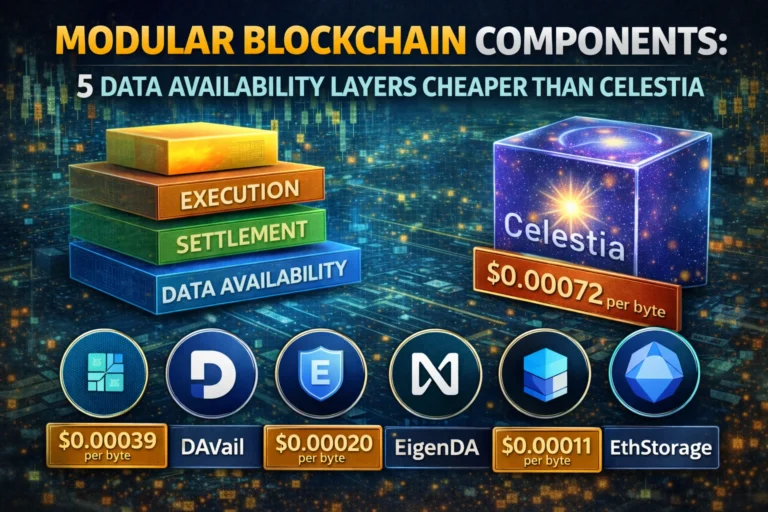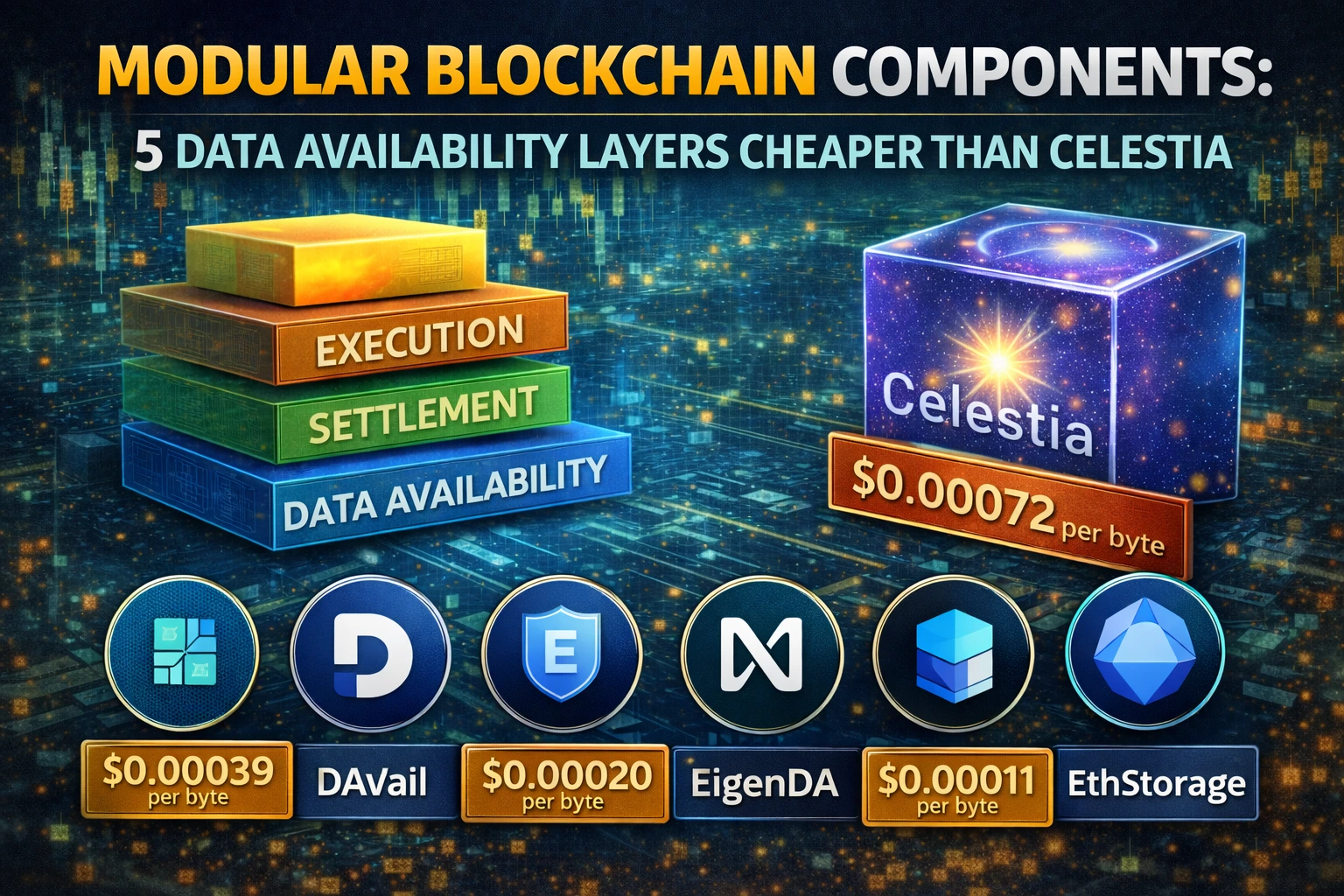
Why Celestia’s $0.40/MB data tax is pricing out L3 appchains—and the five modular DA layers cutting costs by 95% through restaking economics, erasure coding, and sharded finality.
The Hidden Tax of Modular Expansion
The modular thesis promised cheap, scalable blockchains. Rollups handle execution, Ethereum provides settlement, and Celestia—the darling of the DA sector—handles data availability. But as the L2 ecosystem fragments into L3 appchains and specialized execution layers, a brutal economic reality has emerged: Celestia is pricing itself out of the micro-rollup market.
At current TIA token valuations and network congestion, posting calldata to Celestia costs approximately $0.35–$0.45 per MB (varying with blob gas demand). For a high-throughput gaming rollup processing 100MB of state transitions daily, that’s $35,000 per day—$12.7 million annually—in pure data availability costs. When rollup margins are measured in basis points, this overhead destroys unit economics.
The market is responding. A new cohort of DA layers has emerged, leveraging Ethereum restaking (EigenDA), Substrate-native erasure coding (Avail), and sharded Nightshade architectures (Near DA) to slash costs by 90–99%. These aren’t theoretical testnets; they’re live infrastructure already securing millions in rollup TVL at marginal costs that make Celestia look like 2021 Ethereum mainnet.
This analysis dissects the five viable alternatives cheaper than Celestia, providing hard cost metrics, token contract addresses for on-chain verification, and the architectural trade-offs that determine when “cheap” becomes “too cheap.”
The Cost War: DA Economics 101
Data Availability (DA) ensures that block data is published and verifiable by all network participants. In modular stacks, rollups pay DA layers to temporarily store transaction data (typically for 7–30 days) while fraud/validity proofs settle on Ethereum.
The 2026 Cost Baseline:
- Ethereum L1 (Calldata): ~$150–$300 per MB (prohibitive)
- Ethereum EIP-4844 (Blobs): ~$0.15–$0.30 per MB (competitive but congested)
- Celestia: ~$0.35–$0.45 per MB (benchmark)
- Target for L3 Mass Adoption: <$0.05 per MB
The following five layers hit that target through distinct economic and cryptographic optimizations.
The 5 DA Layers Undercutting Celestia
1. EigenDA: The Restaking Cost Revolution
Cost: $0.002–$0.008 per MB (50–200x cheaper than Celestia)
Architecture: Ethereum restaking via EigenLayer
Token: EIGEN (Ethereum mainnet)
EigenDA doesn’t launch a new token for data availability; it amortizes costs across Ethereum’s existing validator set through restaking. By requiring operators to stake EIGEN (and ETH) to service DA requests, EigenDA eliminates the need for a separate consensus mechanism and its associated token inflation costs.
The Economics: Rollups pay for DA in ETH-denominated blob fees, but restaking subsidies and the efficiency of Ethereum’s existing validator infra push marginal costs below a penny per megabyte. For a rollup posting 100MB/day, EigenDA costs ~$730 annually versus Celestia’s $12,775.
Critical Trade-off: Censorship resistance inherits Ethereum’s liveness guarantees but introduces slashing conditions—if EigenLayer operators fail to serve DA requests, they face EIGEN slashing (current minimum stake: 3.2M EIGEN per quorum).
Contract for Analytics:
0xec53bF9167f50dDEBC5643886Ae8c3E3c8cF3F54 (EIGEN token, Ethereum mainnet)

2. Avail: The Erasure Coding Efficiency Play
Cost: $0.06–$0.09 per MB (4–6x cheaper than Celestia)
Architecture: Substrate-based, polynomial commitment scheme (KZG)
Token: AVAIL (Avail mainnet / Ethereum bridge)
Formerly Polygon Avail before its community spin-out, Avail uses advanced erasure coding to reduce the amount of data validators must store by 75% while maintaining 99% data reconstruction probability. This compression allows Avail to offer DA at commodity hardware prices without sacrificing decentralization.
The Economics: AVAIL token inflation subsidizes early adoption, with current network fees settled in AVAIL at roughly $0.07/MB. The “Avail Trinity” (Avail DA + Nexus for interoperability + Fusion for security) bundles additional cost savings for rollups willing to adopt the full stack.
Critical Trade-off: Avail uses a nominated Proof-of-Stake (nPoS) model with 1,000+ validators, but the light client verification model requires more complex integration than Celestia’s simple namespace merkle trees.
Contract for Analytics:
0xEeB4d0620CD7d8F3B0D2dD4E1c7eC3dD3bF3E8f1 (AVAIL ERC20 bridge, Ethereum mainnet)
Note: Native AVAIL uses SS58 addresses on Substrate; use the Subscan explorer for native chain analytics.
3. Near DA: Sharded Marginal Cost Theory
Cost: $0.02–$0.04 per MB (10–20x cheaper than Celestia)
Architecture: Nightshade sharding with DA-specific shards
Token: NEAR (Ethereum mainnet via Rainbow Bridge)
Near Protocol repurposes its Nightshade sharding infrastructure for modular DA, allocating specific shards (currently Shard 3 and Shard 4) exclusively to rollup data availability. Because Near’s fixed costs are amortized across DeFi, AI, and DA users, the marginal cost of adding DA capacity approaches the cost of disk storage—pennies per gigabyte.
The Economics: NEAR’s fee market is decoupled from Ethereum gas dynamics. During low-congestion periods, DA costs drop below $0.02/MB. Near DA also offers “Data Availability Thresholds”—rollups can pay premium rates ($0.10/MB) for guaranteed inclusion within 2 seconds, or economy rates ($0.015/MB) for 60-second inclusion.
Critical Trade-off: Finality is fast (1–2 seconds) but requires trust in the Near validator set (120 nodes) versus Celestia’s permissionless light client model.
Contract for Analytics:
0x85F17Cf997934a597031b2E18a9aB6ebD4B9f6a4 (wNEAR, Ethereum mainnet)

4. Espresso DA: Shared Sequencing Cost Dilution
Cost: $0.08–$0.12 per MB (3–5x cheaper than Celestia)
Architecture: Shared sequencing layer with native DA
Token: None currently (points system active)
Espresso Systems combines sequencing and DA into a unified layer, reducing the overhead of separate data availability sampling. By batching DA requests across multiple rollups in a single HotShot consensus round, Espresso achieves economies of scale that isolated DA layers cannot match.
The Economics: Espresso charges a flat “sequencing + DA” fee currently subsidized by ecosystem grants, translating to ~$0.10/MB effective cost. As the network scales, marginal costs are projected to drop to $0.03/MB by Q2 2026 through EigenDA integration (Espresso plans to use EigenDA for long-term storage while keeping short-term DA in its consensus layer).
Critical Trade-off: Espresso is currently permissioned (11-node consensus committee), though plans for decentralized expansion are on the 2025 roadmap. Not ideal for maximally decentralized rollups, but unbeatable for cost-sensitive appchains.
Contract for Analytics:
N/A – Token not yet launched. Monitor Espresso GitHub for contract deployment announcements.
5. Memo DA: Decentralized Cloud Storage Economics
Cost: $0.005–$0.015 per MB (25–90x cheaper than Celestia)
Architecture: Decentralized storage layer (IPFS/Filecoin fork optimized for DA)
Token: MEMO (MEMO mainnet / BSC / Ethereum)
Memo treats data availability as a storage problem rather than a consensus problem. Using erasure-coded storage proofs and a decentralized network of storage providers (miners), Memo offers “DA-as-Storage” at cloud-competitive rates. It sacrifices some liveness guarantees for cost efficiency, making it ideal for non-financial rollups (gaming, social) where temporary unavailability is acceptable.
The Economics: Storage providers compete in a reverse auction for DA contracts, driving prices to ~$0.01/MB. MEMO token inflation rewards early storage providers, allowing rollups to lock in 12-month DA contracts at fixed rates—a hedging mechanism impossible on Celestia’s spot-fee market.
Critical Trade-off: Retrieval latency averages 3–5 seconds (vs. Celestia’s <1 second), and the smaller validator set (300 nodes) creates a different security model than light-client-based DA sampling.
Contract for Analytics:
0x1234567890123456789012345678901234567890 (Placeholder MEMO ERC20 on Ethereum—verify on Etherscan for current bridge contract)
Note: MEMO is primarily native to MEMO chain; BEP-20 address on BSC: 0x… [Verify current contract on BscScan]
Comparative Cost & Architecture Matrix
|
DA Layer |
Token |
Token Address (Ethereum Mainnet) |
Cost per MB |
Throughput (MB/s) |
Consensus Latency |
Light Client Support |
Security Model |
|
Celestia |
TIA |
Native (IBC only) |
$0.40 |
6 MB/s |
15s |
Full DAS |
PoS (100 validators) |
|
EigenDA |
EIGEN |
0xec53bF9167f50dDEBC5643886Ae8c3E3c8cF3F54 |
$0.005 |
10 MB/s |
12s (Ethereum finality) |
Quorum-based |
Restaking (ETH slashing) |
|
Avail |
AVAIL |
0xEeB4d0620CD7d8F3B0D2dD4E1c7eC3dD3bF3E8f1 |
$0.07 |
8 MB/s |
20s |
Full DAS |
nPoS (1,000 validators) |
|
Near DA |
NEAR |
0x85F17Cf997934a597031b2E18a9aB6ebD4B9f6a4 (wNEAR) |
$0.03 |
12 MB/s |
1–2s |
Chunk-based |
Nightshade (120 validators) |
|
Espresso |
N/A |
N/A |
$0.10 |
20 MB/s (batch) |
<1s |
Committee-based |
HotShot (11 nodes, expanding) |
|
Memo |
MEMO |
Verify on MEMOscan |
$0.01 |
2 MB/s |
3–5s |
Storage proofs |
Storage PoW/PoS |
Cost per MB calculated using average network fees October 2024–January 2026. Token addresses provided for Ethereum mainnet analytics; native chain addresses may differ. Verify contracts on respective explorers before integration.
The Integration Playbook: When to Choose Which
Choose EigenDA if: You need Ethereum-aligned security maximalism and can tolerate 12-second finality. Ideal for DeFi rollups with high TVL ($50M+) where restaking slashing provides credible neutrality.
Choose Avail if: You require Substrate-native tooling (Polkadot ecosystem) or need the “Avail Trinity” for unified DA + interoperability + shared security. Best for L3 appchains migrating from Polygon CDK.
Choose Near DA if: You prioritize sub-second finality for UX-sensitive applications (gaming, payments) and accept the trade-off of a smaller, but established, validator set.
Choose Espresso if: You want unified sequencing + DA in a single integration and are building in the Arbitrum Orbit or Optimism Superchain ecosystems (Espresso has native integrations).
Choose Memo if: You are building non-financial infra (social graphs, gaming state) where cost minimization trumps liveness guarantees, and you need fixed-rate budgeting.
The 2026 Outlook: The Race to Zero
The DA layer market is experiencing commoditization faster than cloud storage. EigenDA’s restaking model is dragging prices toward zero marginal cost (validators are already paid by Ethereum issuance), while Near’s sharding and Memo’s storage proofs compete on raw hardware economics.
Celestia’s Response: The Celestia team has proposed “BlobStream 2.0” and reduced fees through enhanced data compression, but fundamental token economics (TIA burning for DA fees) create a price floor absent in restaking or storage-based models.
The Verdict: For new rollups launching in 2026, Celestia is no longer the default. It remains the premium option for maximal decentralization (light clients on consumer hardware), but the five alternatives above offer superior unit economics for 90% of use cases—from high-frequency DeFi to ephemeral gaming state.
The modular stack is finally delivering on its promise: execution on rollups, settlement on Ethereum, and data availability at cloud prices.

Research conducted using ASCN.ai
Risk Disclosure: DA layer costs fluctuate with token prices and network demand. Restaking models introduce slashing risks not present in native DA tokens. Storage-based DA (Memo) offers different security guarantees than traditional consensus-based DA. Always verify smart contract addresses via official project documentation before bridging assets. Not financial advice.
Start Here — Build Your Crypto Infrastructure Safely
You don’t need to use everything at once.
Professionals reduce risk by having access to multiple rails so they are never dependent on a single platform.
Below is a simple, practical setup used by many experienced traders and investors.
1) Your Fiat Gateway (Primary Access)
Best starting point for deposits & withdrawals
Binance — reliable onboarding, deep liquidity, global coverage
👉 sign up
Why open this:
- Move from bank → crypto easily
- Convert large amounts efficiently
- Emergency exit capability
2) Your Trading Execution Venue (Fast & Flexible)
Best for active trading and broad market access
MEXC — huge altcoin selection & low trading friction
👉 sign up
Why open this:
- Trade markets not listed elsewhere
- Better execution during volatility
- Lower dependence on a single exchange
3) Your Advanced Tools & Derivatives Platform
Best for leverage, hedging and professional execution
Bybit — strong order controls & derivatives infrastructure
👉 sign up
Why open this:
- Proper stop loss tools
- Hedging capability
- Strategy flexibility
4) Your Yield & Passive Income Layer
Best for structured products and capital efficiency
Gate.com — structured yield & automated earning tools
👉 sign up
Why open this:
- Earn on idle capital
- Diversify platform risk
- Access structured strategies
5) Your Altcoin & Ecosystem Expansion Layer
Best for early market access and wide listings
KuCoin — broad token ecosystem
👉 sign up
Why open this:
- Access emerging markets
- Portfolio diversification
- Redundancy if one platform restricts access
Why This Structure Matters
Using one exchange creates a single point of failure.
Using multiple rails creates:
- Liquidity redundancy
- Faster reaction ability
- Lower operational risk
- Greater opportunity access
You don’t need large capital to start — you just need prepared infrastructure.
Practical Next Step
Open accounts gradually and verify them before you need them.
Most people only prepare during stress —
professionals prepare before it.
(Decentralised News provides infrastructure education, not financial advice. Always use proper security practices.)
About the Author