The AI That Writes Code for New Blockchains: Is Human Dev Obsolete?
Imagine a future where you want a new decentralized application, a custom blockchain, or even an entirely new Web3 protocol, and an AI agent crafts the code for it in minutes. Sounds like a sci-fi dream, or perhaps a developer’s nightmare? The reality is, AI is rapidly advancing in its ability to generate, optimize, and even debug complex code, bringing us closer to a world where “human-free” blockchain development isn’t just possible, but potentially dominant.
For decades, coding has been a distinctly human endeavor, a blend of logic, creativity, and meticulous problem-solving. But with the explosion of AI, particularly large language models (LLMs) and specialized code-generating AI agents, the landscape of software development, especially in the intricate world of blockchain, is undergoing a profound transformation.
The question isn’t if AI will write blockchain code, but how much and how fast.
From Helper to Creator: The Evolution of AI in Coding
Initially, AI tools were assistants – code autocompletion, syntax checkers, or bug suggestors. They helped developers be more efficient. Today, they’ve evolved into far more capable entities:
- Code Generation: AI can now generate entire functions, classes, and even full programs from natural language descriptions or high-level specifications.
- Smart Contract Optimization: AI can analyze existing smart contracts for vulnerabilities, suggest gas-fee reductions, or optimize execution pathways.
- Blockchain Architecture Design: Advanced AI agents are being trained on vast datasets of blockchain designs, allowing them to propose novel architectures tailored to specific use cases.
- Automated Testing and Debugging: AI can write test cases, run simulations, and even autonomously fix bugs in existing codebases.

The Power of AI in Web3 Development
Blockchain development is notoriously complex. It demands a deep understanding of cryptography, distributed systems, consensus mechanisms, and often, new programming languages like Solidity for Ethereum. This complexity creates a high barrier to entry and slows down innovation. This is where AI truly shines:
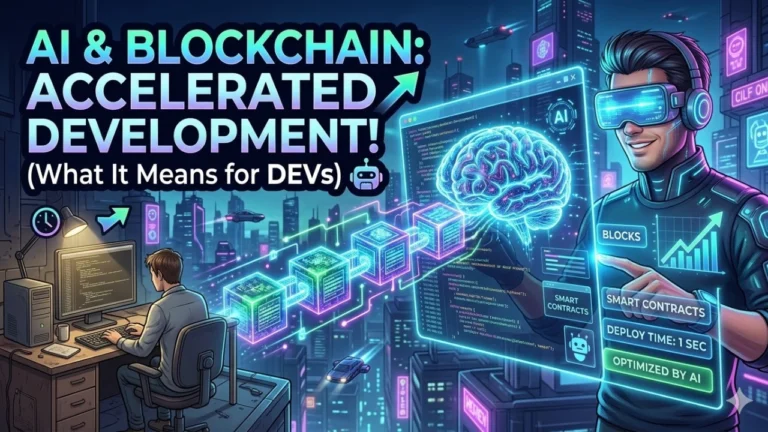
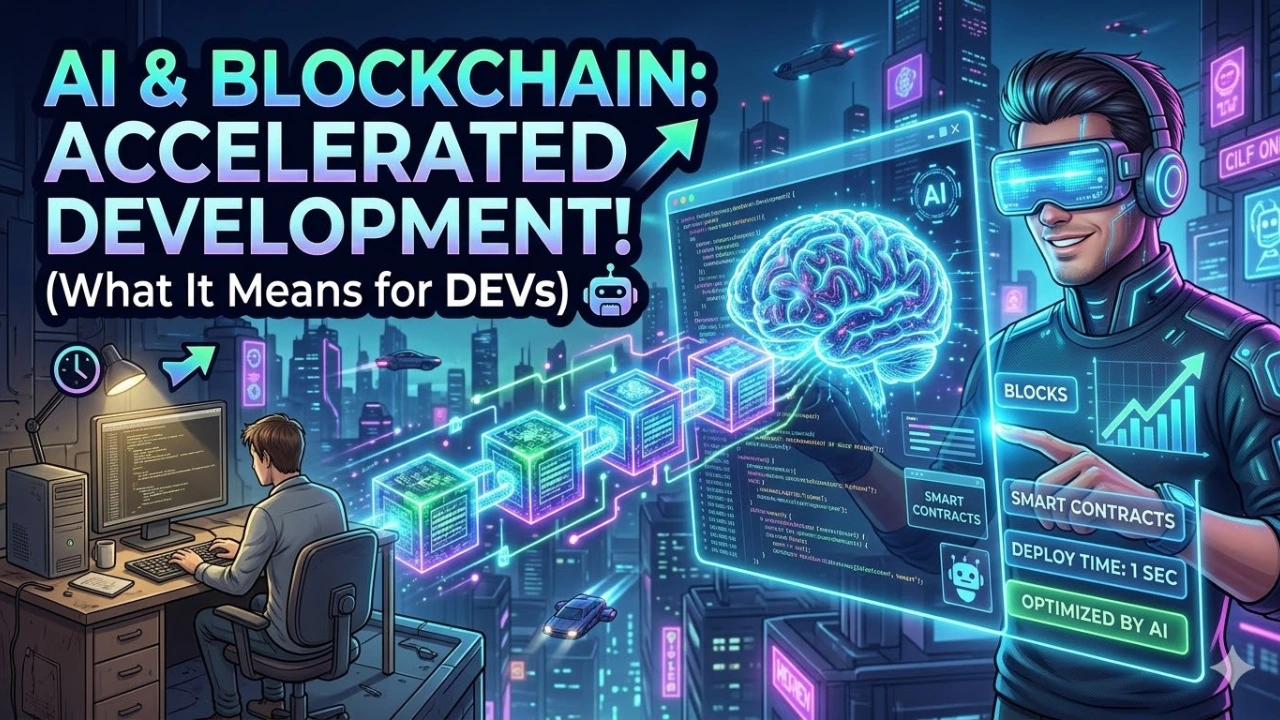
- Accelerated Prototyping: AI can rapidly generate the foundational code for new blockchain projects, dramatically reducing the time from concept to prototype.
- Reduced Human Error: Smart contracts, once deployed, are immutable. Bugs can lead to catastrophic losses. AI’s ability to rigorously test and audit code before deployment can significantly enhance security.
- Lower Barrier to Entry: Imagine a non-coder being able to describe their vision for a decentralized app, and an AI translating that into functional smart contracts. This democratizes development.
- Novel Innovations: By analyzing countless blockchain designs and combining disparate concepts, AI might design entirely new, more efficient, or more secure blockchain protocols that human developers might not conceive.

Is Human Dev Obsolete? (Not Yet, But Evolving!)
While the capabilities of AI are stunning, it’s premature to declare human blockchain developers obsolete. Instead, their role is shifting:
- Architects & Overseers: Humans will become the high-level architects, providing the vision, defining complex requirements, and overseeing the AI’s output.
- Innovators & Problem-Solvers: The truly novel, paradigm-shifting ideas will likely still originate from human creativity, with AI as the tool to bring them to life.
- Ethical Guardians: Understanding the implications of decentralized AI code and ensuring it aligns with human values will be critical.
The most successful developers will be those who learn to effectively collaborate with AI, leveraging its speed and analytical power while focusing their human ingenuity on higher-order challenges.
Tools and Platforms for the AI-Powered Dev
As AI code generation becomes more prevalent, integrating these tools into your development workflow is crucial. Whether you’re an aspiring blockchain developer or a seasoned pro, there are platforms enabling this revolution:
For general coding and AI assistance, services built on large language models are becoming invaluable. They can help you draft initial smart contract code or understand complex Web3 concepts. If you’re looking to explore the practical application of blockchain development, exchanges like Binance and OKX often have educational resources and developer communities that are great starting points.

When it comes to deploying and managing your digital assets or interacting with newly coded blockchains, having robust exchange access is key. Platforms like MEXC and Bybit offer broad token listings and futures trading that might be relevant for projects built on new chains. For those exploring more advanced decentralized finance (DeFi) protocols that AI might help code, GMX and MUX are examples of platforms pushing the boundaries of what’s possible with smart contracts.
And for securing the digital assets that your AI-generated code might manage, a reliable wallet is non-negotiable. While not an affiliate link, research reputable hardware wallets like Ledger for cold storage.
The Future is Collaborative
The future of blockchain development isn’t AI replacing humans, but AI empowering them. It’s about augmenting our capabilities, accelerating innovation, and allowing us to build the next generation of decentralized applications and protocols faster and more securely than ever before. Developers who embrace this shift will find themselves at the forefront of the Web3 revolution.
So, is human dev obsolete? No. But the developer who refuses to work with AI soon might be.

Start Here — Build Your Crypto Infrastructure Safely
You don’t need to use everything at once.
Professionals reduce risk by having access to multiple rails so they are never dependent on a single platform.
Below is a simple, practical setup used by many experienced traders and investors.
1) Your Fiat Gateway (Primary Access)
Best starting point for deposits & withdrawals
Binance — reliable onboarding, deep liquidity, global coverage
👉 sign up
Why open this:
- Move from bank → crypto easily
- Convert large amounts efficiently
- Emergency exit capability
2) Your Trading Execution Venue (Fast & Flexible)
Best for active trading and broad market access
MEXC — huge altcoin selection & low trading friction
👉 sign up
Why open this:
- Trade markets not listed elsewhere
- Better execution during volatility
- Lower dependence on a single exchange
3) Your Advanced Tools & Derivatives Platform
Best for leverage, hedging and professional execution
Bybit — strong order controls & derivatives infrastructure
👉 sign up
Why open this:
- Proper stop loss tools
- Hedging capability
- Strategy flexibility
4) Your Yield & Passive Income Layer
Best for structured products and capital efficiency
Gate.com — structured yield & automated earning tools
👉 sign up
Why open this:
- Earn on idle capital
- Diversify platform risk
- Access structured strategies
5) Your Altcoin & Ecosystem Expansion Layer
Best for early market access and wide listings
KuCoin — broad token ecosystem
👉 sign up
Why open this:
- Access emerging markets
- Portfolio diversification
- Redundancy if one platform restricts access
Why This Structure Matters
Using one exchange creates a single point of failure.
Using multiple rails creates:
- Liquidity redundancy
- Faster reaction ability
- Lower operational risk
- Greater opportunity access
You don’t need large capital to start — you just need prepared infrastructure.
Practical Next Step
Open accounts gradually and verify them before you need them.
Most people only prepare during stress —
professionals prepare before it.
(Decentralised News provides infrastructure education, not financial advice. Always use proper security practices.)
About the Author