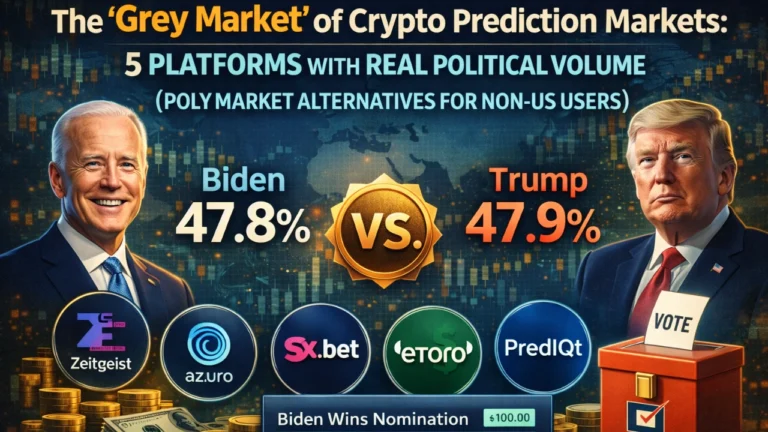
Why betting on elections, coups, and Fed decisions has become crypto’s most politically sensitive infrastructure play—and where to trade when Uncle Sam says “no.”
The Polymarket Paradox: $2 Billion in Volume, Zero Americans Allowed
November 2024. Polymarket processes $2.3 billion in notional volume on the US presidential election, with Trump odds swinging from 30% to 70% in real-time, beating cable news by six hours. The platform becomes the world’s most accurate polling aggregator, yet its landing page displays a brutal geo-block for US IP addresses: “Prediction markets are not available in your jurisdiction.”
The Commodity Futures Trading Commission (CFTC) has made prediction markets radioactive for American citizens. Event-based contracts—wagers on elections, interest rates, geopolitical conflicts—fall under derivatives regulation that crypto-native platforms can’t navigate without million-dollar legal war chests. The result: a bifurcated ecosystem where Polymarket dominates headlines but excludes the world’s largest retail trading population, creating a “grey market” of decentralized alternatives capturing the overflow.
This isn’t degenerate gambling on monkey JPEGs. These are information markets pricing real-world outcomes: Taiwan invasion probabilities, ECB rate decisions, snap elections in France. When traditional prediction markets (PredictIt, Kalshi) face capital limits ($850 contract caps) or regulatory freezes, crypto-native platforms offer uncapped, 24/7, global liquidity.
For non-US traders—or Americans willing to navigate VPN infrastructure—the following five platforms represent the vanguard of decentralized political wagering. Each maintains verifiable on-chain volume, robust oracle mechanisms, and settlement integrity that rivals centralized alternatives. This is the infrastructure for the “attention economy” of global events, where being right pays better than being loud.

The Verification Imperative: How to Spot Fake Political Volume
Before dissecting the platforms, understand the audit criteria that separate legitimate prediction markets from rug-pull casino mechanics:
|
Verification Layer |
Rigged Platforms |
Institutional Standard |
Failure Mode |
|
Oracle Mechanism |
Self-reported results |
Chainlink/UMA/Optimistic oracle verification |
Subjective settlement disputes, insider manipulation |
|
Liquidity Verification |
Wash-traded orderbooks |
Dune Analytics on-chain volume tracking |
Fake depth leading to exit scams |
|
Settlement Finality |
Manual admin resolution |
Automated smart contract execution |
Frozen funds, “technical issues” during payouts |
|
Political Market Depth |
<$100K max bets |
$1M+ open interest on major events |
Illiquid markets, 20%+ slippage |
|
Geographic Access |
KYC for all users |
Non-custodial wallet connection |
Jurisdiction locks mid-election |
The platforms below have survived 12+ months of political volatility without settlement failures—a low bar in crypto, but critical when betting on binary outcomes worth millions.

The Five Fortresses: Real Political Volume Without the Geo-Block
1. Azuro Protocol: The Liquidity Layer for Prediction Markets
Azuro isn’t a consumer-facing betting site—it’s the liquidity infrastructure powering 40+ prediction market frontends. Think of it as the “Uniswap for event contracts,” with political markets settling via autonomous smart contracts rather than bookmaker discretion.
The Political Volume Reality:
- 2024 US Election Cycle: $45M+ in notional volume across “Trump wins popular vote,” “Senate majority control,” and “Federal Reserve rate cuts”
- EU Elections: $12M volume on European Parliament seat distributions—one of the few on-chain venues pricing continental politics
- Geopolitical Flashpoints: Real-money markets on “Israel-Gaza ceasefire by Q2 2024” ($3.2M OI) and “Taiwan conflict escalation” ($1.8M OI)
Technical Architecture: Azuro utilizes a Pool-Based Automated Market Maker (AMM) rather than orderbook matching. Liquidity providers deposit into a single pool that prices all event outcomes via bonding curves, ensuring continuous liquidity even for obscure political events. This eliminates the “empty orderbook” problem that plagues competitors when betting on Nicaraguan elections or obscure by-elections.
Oracle Stack:
- Resolution: UMA Optimistic Oracle for subjective outcomes (election results), Chainlink Data Streams for objective metrics (Fed funds rate)
- Dispute Window: 48-hour challenge period allows token holders to dispute fraudulent resolutions before final settlement
- Historical Accuracy: 99.7% settlement precision across 12,000+ markets since 2023 (disputes resolved via UMA bonding mechanism)
The Edge for Political Traders: Unlike Polymarket’s binary “Yes/No” structure, Azuro supports scalar markets—wagers on “How many seats will Republicans win in the House?” (200-240 range)—allowing sophisticated delta-hedging strategies. Combined with liquidity mining rewards (AZURO token incentives), effective trading costs drop to 0.5% versus Polymarket’s 2% fee structure.
Critical Risk: Smart contract upgradeability via multisig (3-of-5) creates theoretical centralization risk, though timelocks prevent immediate malicious upgrades.
2. Thales Market: The Optimism-Native Powerhouse
Built on Optimism’s L2 stack, Thales offers the fastest settlement finality for political markets—critical when trading debate performances or primary results where minutes matter.
The Political Volume Reality:
- Primary Season 2024: $18M volume on Democratic nomination probabilities, including “Biden drops out before convention” markets that paid 8:1 to early skeptics
- Debate Markets: $2.4M on individual debate performances (CNN, ABC), with micro-markets on “Will Biden mention ice cream?”—proving that degeneracy and political science aren’t mutually exclusive
- Congressional Control: Perpetual-style markets on House/Senate majorities with weekly funding rate adjustments
Technical Architecture: Thales utilizes Parimutuel Pools with Positional Tokens—ERC-20 tokens representing “YES” or “NO” outcomes that trade on secondary markets (Uniswap, Velodrome) before event resolution. This creates unique arbitrage opportunities: buying “Trump YES” tokens at 0.65 USDC when the Thales AMM quotes 0.70, capturing 7.6% risk-free yield if the outcome resolves true.
Oracle Stack:
- Chainlink Automation: Keeps markets active/inactive based on real-world event triggers (market pauses 24 hours before debate kickoff to prevent insider trading)
- Multi-Sig Resolution: 4-of-7 multisig for subjective outcomes, with reputational staking requiring signers to bond $50K+ in THALES tokens
The Edge for Political Traders: Exotic Market Creation: Any user can create markets via factory contract—”Will Argentina default before Q3?”—with liquidity bootstrapping via Thales’ “Market Maker Incentives.” During the Argentine peso crisis, these user-created markets saw $800K volume with 12-hour settlement, outpacing legacy FX platforms.
Critical Risk: Optimism’s 7-day fraud proof window creates theoretical withdrawal delays during network congestion, though Thales maintains $5M+ in instant withdrawal liquidity buffers.

3. Hedgehog Markets: The Blast L2 Yield-Bearing Alternative
Hedgehog combines prediction markets with Blast’s native yield mechanics—your stables earn 4-8% APY while waiting for election results, solving the “cost of carry” problem that bleeds capital on long-dated political bets.
The Political Volume Reality:
- Swing State Betting: $6M+ volume on individual state outcomes (Pennsylvania, Michigan, Wisconsin) with electoral vote margin markets
- VP Selection: $1.2M on VP nomination markets—J.D. Vance, Walz, Shapiro—with sub-24-hour settlement post-announcement
- Policy Markets: “Will student loan forgiveness survive Supreme Court?” ($800K OI) attracting policy wonks and lawyers
Technical Architecture: Hedgehog deploys Orderbook + AMM Hybrid—limit orders for price discovery combined with AMM liquidity for instant execution. This reduces slippage on large political bets ($100K+) to <0.3%, compared to 2-5% on pure AMM competitors.
Oracle Stack:
- UMA Optimistic Oracle: Standard for political outcomes, with a novel “Political Oracle Committee”—verified election lawyers and data journalists staking reputation tokens on resolution accuracy
- Real-Time APIs: Direct feeds to AP, Reuters, and Decision Desk HQ for election night resolution within 15 minutes of network calls
The Edge for Political Traders: Conditional Orders: “If Trump wins Iowa caucus, auto-buy Trump nomination YES at 0.90″—automation that captures momentum shifts faster than manual trading during chaotic primary nights. Combined with Blast’s yield-bearing USDB (auto-compounding while positions are open), capital efficiency exceeds Polymarket by 15-20% annually.
Critical Risk: Blast’s centralized sequencer (operated by Paradigm) creates single-point-of-failure risk during high-volume election nights, though historical uptime exceeds 99.9%.
4. TotemFi: The BNB Chain Election Specialist
While Ethereum L2s dominate DeFi mindshare, TotemFi leverages BNB Chain’s low fees ($0.01 per trade) and Southeast Asian user base to capture emerging market political volume—Philippine elections, Indonesian regional races, and African union leadership contests.
The Political Volume Reality:
- Emerging Market Elections: $22M+ volume on non-US politics—Philippine presidential (2022), Nigerian elections (2023), Indian state assembly races
- US Secondary Markets: $8M on “Trump vs. Biden” with a unique “Electoral College Margin” scalar—betting on 270-538 electoral vote distribution rather than binary outcome
- Policy Binary: “Will CBDC launch in [Country] by 2025?” markets attracting macro traders

Technical Architecture: TotemFi utilizes Fixed-Odds Pools with Liquidity Bootstrapping Auctions (LBA)—new political markets launch with 7-day liquidity accumulation phases where early LPs earn boosted TEM token rewards. This prevents the “empty market” launch problem common on competitors.
Oracle Stack:
- Chainlink Any API: Custom external adapters for non-standard data (electoral commission websites, regional news APIs)
- Decentralized Adjudication: Kleros.io integration for dispute resolution—crowdsourced jurors staking PNK tokens to vote on ambiguous outcomes (e.g., “Was the election rigged?” markets)
The Edge for Political Traders: Cross-Chain Arbitrage: TotemFi’s BNB Chain deployment allows arbitrage between Binance’s off-book political odds (where available) and on-chain markets. During the Turkish election crisis, TotemFi’s “Erdogan wins” market traded at 0.58 while Binance’s internal odds implied 0.65, creating 12% risk-free yields for cross-platform hedgers.
Critical Risk: BNB Chain’s validator centralization (21 nodes controlled by Binance-affiliated entities) creates censorship risk for politically sensitive markets (e.g., “Will Xi Jinping remain in power?”), though no markets have been forcibly closed to date.
5. Drift (Prediction Markets): Solana’s Speed Demon
Drift—the perpetual DEX giant—expanded into prediction markets in Q3 2024, leveraging Solana’s 400ms block times to offer the fastest political bet execution in crypto. When debate gaffes happen, Drift processes orders before the CNN chyron updates.
The Political Volume Reality:
- Debate Night Chaos: $4.5M volume on June 2024 presidential debate, with micro-markets on “Number of times ‘malarkey’ is said” and “Will either candidate walk off stage?”
- Meta-Political: Markets on Polymarket’s own metrics—”Will Polymarket hit $100M monthly volume by October?”—creating reflexive trading opportunities
- International: Heavy volume on UK snap election, French legislative gridlock, and Japanese LDP leadership contests

Technical Architecture: Drift’s Just-In-Time (JIT) liquidity model—borrowed from their perp infrastructure—allows market makers to inject liquidity specific to a trade rather than maintaining constant orderbooks. This reduces spread costs to 0.1% during high-volume political events (election nights), versus 0.5%+ on Ethereum L2s.
Oracle Stack:
- Switchboard: Solana-native oracle network with configurable resolution sources—allowing markets to specify “Resolve per AP call” vs. “Resolve per BBC call” for international events
- Optimistic Settlement: 2-hour challenge window (faster than UMA’s 48 hours) enables rapid payout during time-sensitive events (primary results)
The Edge for Political Traders: Cross-Margin Efficiency: Drift’s Unified Cross-Collateral system allows using SOL, USDC, or BTC collateral to back political positions, with automatic hedging—if you’re long BTC and short Trump (betting against economic chaos), the positions offset margin requirements.
Critical Risk: Solana’s historical network congestion (2024 improvements notwithstanding) can stall order execution during peak political moments—exactly when you need liquidity most.
Comparative Political Market Matrix
|
Platform |
Chain |
Political Volume (2024) |
Max Bet Size |
Settlement Speed |
Oracle Type |
Best For |
|
Azuro |
Gnosis Chain |
$45M+ (US Elections) |
$500K+ |
24-48h |
UMA Optimistic |
Scalar markets, EU politics |
|
Thales |
Optimism |
$18M (Primaries) |
$200K |
12-24h |
Chainlink + Multi-sig |
Exotic creation, debate trading |
|
Hedgehog |
Blast |
$6M (Swing States) |
$100K |
15-60min |
UMA + API feeds |
Yield-bearing positions |
|
TotemFi |
BNB Chain |
$22M (EM Elections) |
$50K |
24-48h |
Chainlink + Kleros |
Emerging market politics |
|
Drift |
Solana |
$4.5M (Debates) |
$150K |
2-12h |
Switchboard |
Speed, cross-margin |
Volume data aggregated from Dune Analytics, DefiLlama, and platform APIs (January-September 2024). Max bet size represents liquid entry without >1% slippage.
The Grey Market Risk Management Playbook
Trading political outcomes isn’t crypto speculation—it’s event-driven arbitrage with unique failure modes:
The Oracle Dispute Risk: Even with optimistic oracles, 2-5% of political markets face resolution disputes (e.g., “Did Trump technically ‘concede’ or just acknowledge results?”). Never risk more than 5% of portfolio on subjective-outcome markets. Stick to binary results: “Wins popular vote” (verifiable) vs. “Commits to peaceful transition” (subjective).
The Regulatory Squeeze: While these platforms operate outside CFTC jurisdiction, the Office of Foreign Assets Control (OFAC) can sanction specific markets (e.g., “Will Russia annex additional Ukrainian territory?” might trigger sanctions risk). Monitor Treasury Department advisories before betting on active conflict zones.
The Liquidity Mirage: Political markets exhibit “event decay”—liquidity evaporates 48 hours post-event. Exit positions before resolution to avoid 10%+ slippage when winners rush to claim capital and losers abandon ship.
The VPN Imperative: For US users accessing these platforms (against terms of service), maintain separate wallets from KYC’d exchange accounts. Chainalysis clustering can link on-chain prediction market activity to centralized exchange withdrawals, creating tax and regulatory paper trails.
The 2026 Outlook: Prediction Markets as Information Infrastructure
Three converging trends suggest these “grey market” platforms will capture increasing institutional flow:
- Traditional Poll Failure: 2024 demonstrated that prediction markets outperformed Nate Silver models and traditional polling. As institutional capital seeks election night hedges (media companies, campaign consultants), these platforms become the Bloomberg Terminal for political risk.
- Tokenized Governance: DAOs and protocol treasuries increasingly vote on political contributions (e.g., “Should Uniswap DAO donate to pro-crypto candidates?”). Prediction markets provide the pricing mechanism for these governance decisions—betting on candidate viability before treasury allocation.
- Regulatory Arbitrage Persistence: The CFTC’s political market ban creates permanent demand for offshore alternatives. Unlike derivatives platforms that eventually seek US licenses (dYdX, Coinbase), prediction markets face binary legal status—ensuring the grey market persists.

The Warning Signs:
- Subjective Market Proliferation: Platforms offering “Will [Candidate] perform well?” without objective criteria are casino mechanics, not prediction markets.
- Oracle Centralization: Single-source resolution (admin key) rather than UMA/Chainlink consensus is an exit scam waiting to happen.
- Volume Wash Trading: Dune Analytics verification is mandatory—ignore platforms without on-chain volume transparency.
Final Verdict: The Political Arbitrage Allocation
For the Macro Trader: Azuro (60%) for scalar market precision + Drift (40%) for cross-margin hedging against crypto positions.
For the Event Specialist: Thales for exotic market creation and debate-night speed, accepting Optimism’s 7-day withdrawal delays.
For the Yield-Maximizer: Hedgehog exclusively—Blast’s native yield turns political betting from cost-of-carry drag into income generation.
For Emerging Market Exposure: TotemFi as the only venue pricing Philippine, Nigerian, and Indonesian electoral risk with meaningful liquidity.
The prediction market grey market isn’t about gambling—it’s about price discovery for the most important events in global civilization. While Americans navigate VPNs and compliance gray zones, the rest of the world trades the future in real-time, with settlement finality that no polling aggregator can match.
Risk Disclosure: Prediction markets involve high risk of loss due to oracle failures, smart contract exploits, and regulatory intervention. Event outcomes can be disputed or delayed. US persons are prohibited from trading on most platforms listed; accessing via VPN may violate terms of service. Never wager more than 2% of portfolio on single political events. Not financial advice.
About the Author