Where Are the Next Bitcoin Liquidations? The DN Cascade Score and Liquidation Map for 2026
Where Are the Next Bitcoin Liquidations? The DN Cascade Score and Liquidation Map for 2026
A live map of the leverage clustered above and below price — and a single number for the odds of a violent wick in the next 24 hours.
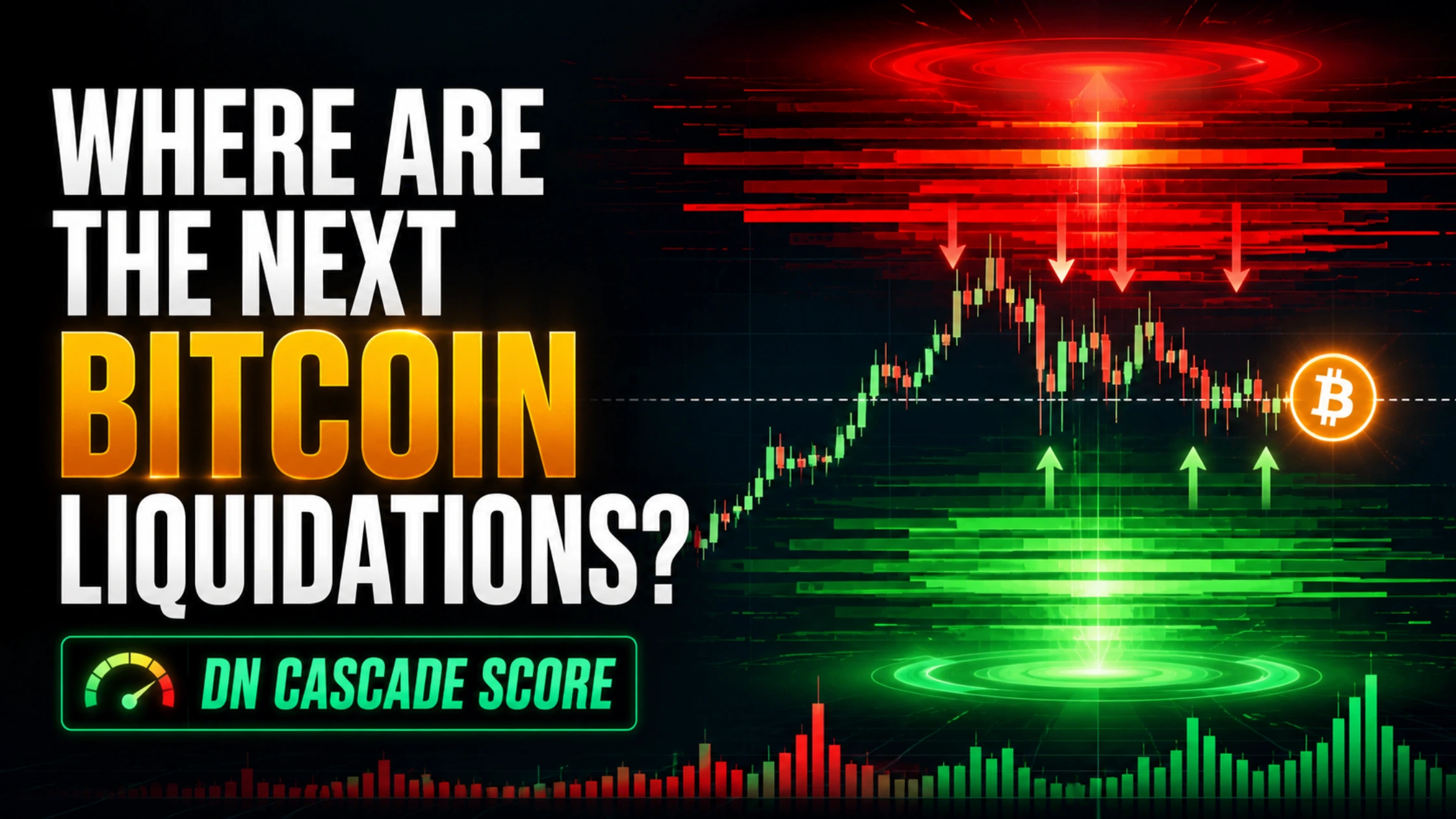
Liquidation cascades happen when price hits a cluster of leveraged stop-out levels, triggering forced selling or buying that pushes price further into the next cluster — a chain reaction that produces the violent wicks crypto is famous for. The DN Cascade Score rates the odds of such a wick on a 0–100 scale, built from live open interest, funding rates, long/short positioning and volatility. The map below shows where the leverage is stacked above and below spot, and which side is more vulnerable. A reading above 75 means the market is primed for a cascade.
The most violent moves in crypto are not driven by news. They are driven by leverage. Price drifts into a zone where thousands of over-leveraged positions share the same liquidation level, those positions are force-closed, the forced orders shove price into the next cluster, and the next, and within minutes a quiet market has wicked five or ten percent and torched a billion dollars of margin. If you have ever been stopped out by a candle that reversed the instant your position closed, you have been the fuel in a liquidation cascade.
The DN Cascade Score exists to answer the question every leveraged trader should ask before every session: how loaded is the market right now? The map shows you where the dynamite is stacked; the score tells you how close the market is to lighting it. Read both before you size a position.
—
The map models the most probable liquidation zones; it cannot show every position on every venue. Treat it as a heat gauge for risk, not a precise order book.
How a liquidation cascade forms
Leverage is borrowed exposure, and every leveraged position carries a liquidation price — the level at which the exchange force-closes it to protect the loan. A trader long Bitcoin at 25x leverage is liquidated by roughly a four percent move against them. Crucially, leverage is herd behaviour: thousands of traders pile into the same trade at the same popular leverage tiers, which means their liquidation levels stack up at the same prices. Those stacks are the clusters the map shows.
A cascade is what happens when price reaches one of those stacks. The forced liquidations are market orders — longs being liquidated become forced sells, shorts being liquidated become forced buys. A cluster of forced sells drives price down into the next cluster of long liquidations below, which triggers more forced selling, which reaches the next cluster, and so on. The move feeds on itself. This is why Bitcoin can fall eight percent in twenty minutes with no headline to explain it: the market was simply top-heavy with leverage, and one push tipped the first domino.
The same mechanic runs in reverse to the upside. When the market is crowded short and price grinds up into a stack of short liquidation levels, the forced buying becomes a short squeeze — the green equivalent of a cascade. The map labels both: warm bars below spot are long-liquidation fuel; cool bars above spot are short-liquidation fuel.
Reading the map
The ladder is centred on the current Bitcoin price. Above the spot line sit the zones where short positions get liquidated as price rises; below it sit the zones where longs get liquidated as price falls. The length and brightness of each bar represent the modelled density of leverage at that level — the longer the bar, the more positions clustered there, and the stronger its pull on price.
Markets gravitate toward liquidity, and liquidation clusters are concentrations of liquidity. The single brightest bar — flagged as the magnet — is the level price is most likely to be drawn toward, because that is where the largest pool of forced orders waits to be filled. If the magnet sits below spot, the path of least resistance is down; if it sits above, expect upward pressure. The clusters nearest to spot matter most, because they are the easiest to reach and therefore the most likely to trigger first.
The DN Cascade Score methodology
A map of clusters tells you where the risk is. The score tells you how likely it is to fire. Rather than scrape liquidation order books — which no exchange publishes openly and which paid services guard closely — the DN Cascade Score models cascade risk from four live, publicly available forces, each capturing a different precondition for a violent move.
How one-sided the market is. When the long/short account ratio pushes far from balanced, almost everyone is leaning the same way — which means almost everyone gets liquidated on the same move. Extreme skew is the single strongest precondition for a cascade, so it carries the most weight.
The funding rate is the toll leveraged traders pay to hold a position. When funding runs hot in either direction, it signals a crowded, expensive trade that is vulnerable to a flush. High positive funding flags over-eager longs; deeply negative funding flags crowded shorts ripe for a squeeze.
A loaded market still needs a trigger. Recent realised volatility measures how energetically price is moving — the higher it is, the more likely price reaches a cluster and sets off the chain. Calm tape can stay loaded for days; volatile tape detonates quickly.
The total leverage in the system — the raw fuel. A market can be skewed and volatile, but if there is little open interest there is little to liquidate. Rising open interest into a skewed, high-funding regime is the classic setup for the biggest cascades.
The four factors combine into a single 0–100 reading, sorted into four regimes. The score is a probability gauge, not a prophecy — a high reading means the conditions for a cascade are present, not that one is guaranteed within any specific hour.
Leverage is light and balanced. Cascade risk is low; ranges tend to hold and stops are less likely to be hunted.
Clusters are forming and positioning is tilting. Moderate risk — manageable, but worth tightening discipline.
Crowded and fragile. A wick toward the dominant cluster is likely. Reduce leverage and widen or remove tight stops.
Extreme crowding. A violent cascade or squeeze is likely. This is when accounts get wiped — trade tiny or stand aside.
Playing the wick safely
There are two ways to use this tool, and the disciplined trader uses both. The defensive use is the more important one: when the score is elevated or primed, you are being told the market is hunting liquidity, so you reduce size, drop leverage, and crucially place your stop beyond the nearest cluster rather than inside it. The single most common way retail traders donate money is by setting a stop right at the obvious level the entire market can see — which is exactly where the cascade is designed to fill.
The offensive use is to fade the flush. Experienced traders treat a magnet cluster as a target: they wait for price to wick into it, watch the forced orders exhaust themselves, and enter on the reclaim as price snaps back. This is high-skill, high-risk play and it only works with strict invalidation and small size, because a cascade can always run further than looks possible. The map gives you the levels; it does not give you immunity.
- When the score is high, leverage down. The market is volatile and hunting — survival is the edge.
- Use isolated margin. Never let one liquidated position cross-margin your whole account into the cascade.
- Place stops beyond clusters, not on them. The obvious level is the trap.
- Treat the magnet as a magnet. If it is below you and you are long, respect that gravity.
Where to set the trade
Trading cascades demands venues with deep liquidity, fast execution and proper risk tooling — isolated margin, granular stop and take-profit orders, and reliable fills when volatility spikes. These are the derivatives venues we use and rate for this kind of play:
Whatever venue you use, the rule that survives every cascade is the same: position so that being wrong costs you a lesson, not your account.
Frequently asked questions
Where are the next Bitcoin liquidations?
The liquidation map above shows the modelled clusters above and below the current Bitcoin price. The brightest bar — flagged as the magnet — marks the densest stack of leverage and the level price is most likely to be drawn toward. Clusters nearest to spot are the most likely to trigger first.
What is the DN Cascade Score?
A 0–100 gauge from Decentralised News rating the odds of a violent liquidation wick in the next 24 hours. It combines positioning skew (32%), funding extremity (27%), volatility (22%) and open interest (19%) from live futures data. Below 25 is calm; above 75 means the market is primed for a cascade.
What causes a liquidation cascade?
A cascade begins when price reaches a cluster of leveraged positions sharing a liquidation level. Those positions are force-closed as market orders, which pushes price into the next cluster and triggers more forced orders — a self-reinforcing chain reaction that produces sudden, violent wicks.
How do I avoid getting liquidated in a cascade?
Reduce leverage when the Cascade Score is elevated or primed, use isolated margin so one position cannot drain your whole account, and place stops beyond the visible clusters rather than directly on them, since obvious levels are exactly where forced orders concentrate.
Does the map show real liquidation orders?
No exchange publishes its full liquidation order book openly. The DN map models the most probable cluster zones from live open interest, funding and positioning data combined with the mechanics of common leverage tiers. It is a probability heat gauge, not a precise snapshot of every position.
What is a short squeeze versus a long cascade?
A long cascade is downside-driven: crowded longs get liquidated into forced selling, pushing price lower. A short squeeze is the upside mirror: crowded shorts get liquidated into forced buying, pushing price higher. The map's warm bars below spot are long fuel; the cool bars above spot are short fuel.
This tool and article are for educational and informational purposes only and do not constitute financial, investment or trading advice. Leveraged derivatives trading is extremely high risk and can result in the rapid and total loss of capital; it is not suitable for most people. The DN Cascade Score is a probabilistic market-structure model, not a prediction, and the liquidation map is an estimate, not a precise order book. Never trade with money you cannot afford to lose, and consider consulting a licensed financial professional. Decentralised News may earn a commission from exchanges linked in this article at no additional cost to you.
About the Author