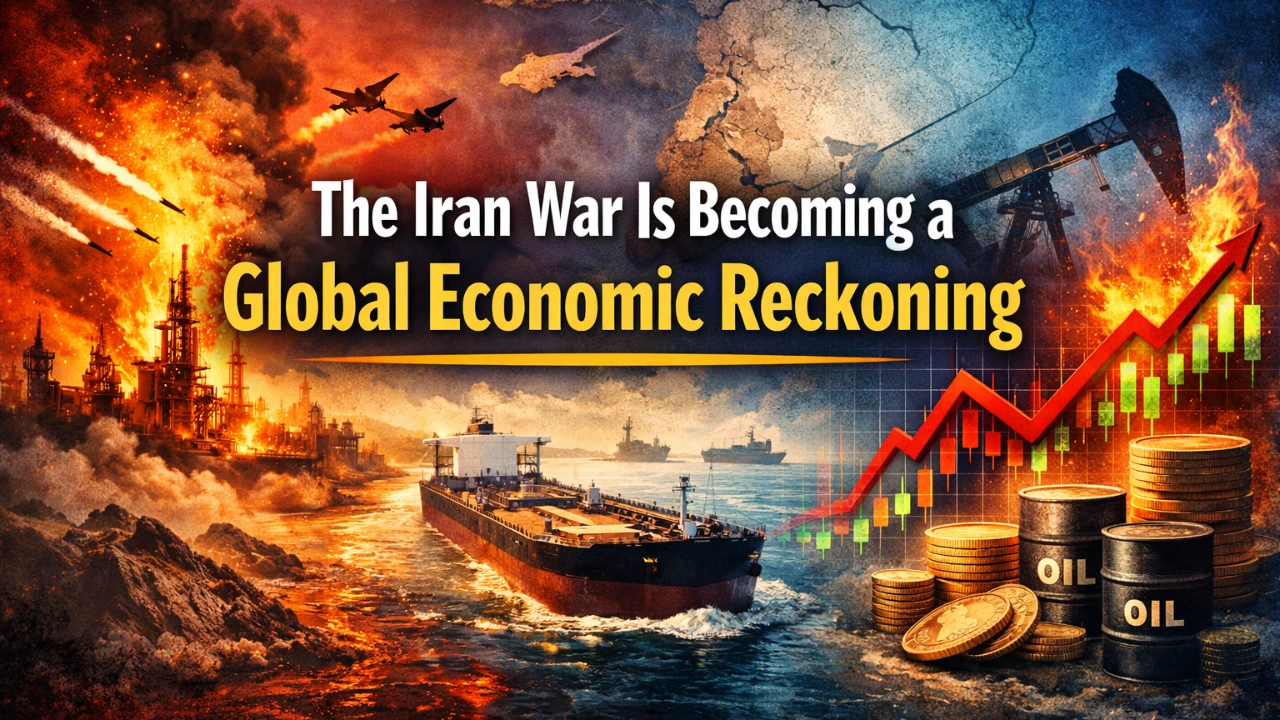
The first market lesson of the Iran war is that geography still rules finance. Before investors get to balance sheets, central banks or earnings forecasts, they have to get past the Strait of Hormuz. Roughly a fifth of the world’s petroleum liquids and more than a fifth of global LNG trade still pass through that narrow waterway. When flows are threatened there, the shock does not stay local for long. It moves quickly into oil, shipping, inflation expectations and then into everything else.

That is what makes the current crisis more than another Middle East flare-up. Brent crude surged above $100 this month as the conflict deepened, and at one point traded near $119. The International Energy Agency has described the disruption as the largest oil supply shock on record, estimating an 8 million barrel a day hit to March supply and coordinating a 400 million barrel emergency stock release.
The transcript’s core argument is that the real danger is not simple inflation, let alone hyperinflation, but stagflation. That case deserves to be taken seriously. Reuters reported this week that policymakers are increasingly focused on the risk that higher energy prices will keep inflation stubborn even as growth cools. Australia’s Treasury has already warned that, if oil stays elevated, inflation could run as much as 1.25 percentage points higher and GDP as much as 0.6 percentage points lower around 2027.
This matters because oil shocks hit in layers. The first-round effect is obvious enough. Fuel gets more expensive. Airlines, shippers and manufacturers face higher costs. Households feel it at the pump. But the more consequential effects usually arrive later. Fertilizer prices rise. Food prices follow. Import-dependent economies see their trade balances deteriorate. Central banks, already cautious, become less willing to cut rates. Investment slows. Hiring softens. The result is the ugliest combination in macroeconomics: prices that refuse to settle and growth that cannot recover.

The burden will not be shared evenly. Asia sits closest to the blast radius, economically speaking. According to the U.S. Energy Information Administration, 89 percent of crude and condensate moving through Hormuz goes to Asian markets. China, India, Japan and South Korea are the largest buyers. Japan remains especially exposed. Its own energy ministry says 94.7 percent of its crude imports came from the Middle East in fiscal 2023.
Europe is vulnerable in a different way. It is less exposed to Gulf crude than parts of Asia, but it remains structurally fragile after years of slow growth, deindustrialization pressure and an unresolved energy problem since the loss of cheap Russian gas. A fresh oil shock lands on top of an economy that was not especially robust to begin with. In that sense, the war is not creating Europe’s weakness. It is exposing it.

The United States is often treated as more insulated because it is a net energy exporter. That is true in accounting terms, but less comforting in political terms. Higher oil prices do not benefit the country evenly. They reward producers and punish consumers. A family driving long distances to work in an SUV feels the shock very differently from an energy company booking windfall cash flow. The question is not whether “America” wins or loses, but which Americans do.
That is where the transcript makes its sharpest point. Economic shocks are rarely neutral social events. They redistribute pain. They widen the gap between sectors, regions and classes. They also put political systems under stress. History does not offer a neat formula for what follows, but it does show that stagnant growth, rising living costs and public distrust are combustible together.
For now, markets are still treating the crisis partly as a commodity event. That may prove too narrow. This is becoming a broader test of a global system already strained by war, fragile supply chains and an uneasy dependence on expensive energy. If the Strait of Hormuz remains a choke point rather than a headline, the next phase of the story will not be military. It will be economic. And then, as always, it will become political.
Further Reading:
How To Build a Portfolio for Oil Shocks, Inflation, and Geopolitical Risk in 2026
Oil’s War Premium Is Back and Your Grocery Bill Is Next
The New Middle East Shock: Oil, Shipping, Inflation, and Your Portfolio
About the Author