There are hundreds of crypto exchange roundups online, and most of them are useless.
They rank platforms by hype, token count, or vague “best overall” labels that tell you almost nothing about what actually matters when life gets real. But in 2026, the real question is no longer just which exchange has the most markets or the flashiest launchpad.
The real question is this:
Which crypto exchanges are most useful when you need them for actual financial survival?
That means something very different.
It means asking which platforms help you buy stablecoins quickly, move money across borders, maintain access to liquidity, build backup financial rails, store value more flexibly, and gradually grow from beginner to more advanced user without being thrown into chaos. It also means being honest about what exchanges can and cannot do. They are not banks, not magic solutions, and not substitutes for emergency cash or disciplined risk management.
But they can be an essential part of a modern resilience stack.
In 2026, the best exchanges for real-world survival utility are the ones that help users do five things well:
- access crypto and stablecoins reliably
- move money efficiently
- maintain optionality across products and markets
- scale from beginner to advanced usage
- avoid unnecessary friction when timing matters most
That is the lens this guide uses.
What this feels like right now
For many people, financial life feels less stable than it used to. AI is putting pressure on salaried roles. Inflation still erodes idle savings. Geopolitical shocks can move energy, food, and currency markets faster than most households can adapt. And one paycheck plus one bank account no longer feels like a sufficient strategy.
In that environment, an exchange is not just a place to speculate. It can become part of your emergency infrastructure — your access point to stablecoins, Bitcoin, global liquidity, backup treasury rails, and in some cases income or hedging tools. That does not mean every user needs every feature. It means the right exchange depends on the kind of resilience you are actually trying to build.
Three emotionally precise reader archetypes
The anxious professional
You still have a good job, but you no longer trust that your salary alone is enough. You want a simple, credible exchange setup for stablecoins, recurring buys, and emergency optionality.
The cross-border operator
You freelance, do business internationally, support family abroad, or simply need faster and more flexible money movement than traditional banking always offers.
The strategic market user
You already understand basic crypto and want deeper tools: derivatives, hedging, copy trading, better execution, and a more complete personal treasury setup.
The criteria that actually matter
To judge “real-world survival utility,” I am not ranking exchanges by hype. I am ranking them by practical usefulness:
- Stablecoin access
- Ease of onboarding
- Spot and derivatives depth
- Transfer and payment flexibility
- Backup utility if one platform fails or is unavailable
- Beginner suitability
- Advanced growth path
- Custody and wallet ecosystem support
Under that framework, a few platforms stand out.
1. Binance: best all-round utility stack
Binance remains one of the broadest crypto platforms for spot, margin, futures, P2P, and earn products, making it one of the most functionally versatile choices for users who want one account to cover a lot of ground. Its official product pages emphasize spot, margin, futures, P2P, and yield products under one umbrella.
Why this matters in survival terms is simple: Binance can function as a core access layer for stablecoins, recurring buys, broader altcoin exposure, P2P conversion in supported regions, and a bridge to more active market use. For users who want one main exchange that can grow with them, it is still one of the strongest general-purpose options.
Best for:
- users who want one broad platform
- stablecoin buyers
- active spot and futures users
- people who value P2P flexibility where available
Use code: CPA_00SXKU7IO9

2. Bybit: best for active users who want utility plus execution
Bybit’s official platform emphasizes spot, derivatives, demo trading, mobile access, API support, and copy trading. Its copy trading documentation also confirms that it remains a live portfolio-management feature on the platform.
That makes Bybit especially useful for users who want a platform that does more than simple buying and holding. If your survival stack includes not just stablecoins and Bitcoin but also copy trading, tactical execution, and eventually more advanced strategies, Bybit is one of the strongest middle-ground platforms between beginner usability and serious market tools.
Best for:
- users graduating from basic buying to more active positioning
- copy trading users
- traders who want strong derivatives access
- users who value demo and mobile utility
Use code: 46164

3. OKX: best for users who want exchange plus Web3 flexibility
OKX’s main site highlights spot trading, a wallet ecosystem, DeFi access, and P2P functionality, while its wallet guide describes OKX Wallet as a self-custody wallet across multiple blockchains. Its fee page also confirms tiered pricing and P2P support in supported contexts.
That combination matters. Some exchanges are good for buying crypto. Some wallets are good for holding it. OKX increasingly sits in the middle, which is valuable for users trying to build a more complete system: exchange access, stablecoin utility, and eventual movement into self-custody or on-chain finance. It is especially attractive for users who want a “one ecosystem, multiple rails” setup.
Best for:
- users building a broader personal treasury stack
- people who want exchange + wallet continuity
- users interested in P2P and Web3 flexibility
- intermediate users who may eventually go on-chain
Use code: 2136301
4. Kraken: best for trust, clarity, and lower-drama users
Kraken remains one of the best platforms for users who prefer a more sober, lower-noise experience. Its official materials confirm spot, futures access, and staking support in eligible regions, including flexible and bonded staking options depending on geography. Kraken also offers a U.S.-regulated futures account for certain products.
For survival utility, Kraken’s strength is not “maximum everything.” Its strength is credibility, simplicity relative to more chaotic platforms, and a good fit for users who want reliable access to major assets without feeling like they have stepped into a carnival. It is a particularly strong choice for cautious professionals building a long-term stack rather than chasing constant action.
Best for:
- cautious users
- long-term allocators
- users who want simpler major-asset exposure
- people who value clarity over hype
Use code: QjZ0L3
5. Luno: best for simple onboarding in supported markets
Luno’s main site emphasizes straightforward buying, selling, storing, and app-based investing, and its South Africa-facing ecosystem remains especially relevant through local market integrations and partnerships. Luno also supports crypto sends, though its help center notes security controls including a waiting period when enabling send functionality.
This matters because the best exchange for “survival utility” is not always the one with the most products. Sometimes it is the one you will actually use consistently. For users in supported markets, especially in Africa, Luno can be an excellent first rail for simple crypto access before graduating to a second, more feature-rich platform.
Best for:
- beginners
- mobile-first users
- South African and selected regional users
- people building their first crypto rail
Use code: MJV6YD

6. BingX: best for social and copy-trading utility
BingX positions itself as a social trading platform and exchange, and its official materials highlight copy trading, global crypto access, and risk warnings around replicated trades. Recent BingX support updates also reference optimization to its copy trading infrastructure.
That makes BingX relevant for a specific type of user: someone who does not want to become a full-time discretionary trader but does want more active exposure than passive holding alone. This is not a beginner safety blanket — copy trading still carries real risk — but as a utility layer, it can be useful for users who understand sizing, risk controls, and trader selection.
Best for:
- copy trading users
- socially-driven market participants
- users who want active exposure without constant chart time
Use code: F8XN1D
7. BloFin: best for copy trading plus futures-focused utility
BloFin’s official pages show that the platform offers spot, futures, bots, wallet features, earn products, and both spot and futures copy trading. Its copy-trade pages also emphasize lead-trader performance dashboards.
BloFin is not the first exchange I would recommend to a total beginner, but it is increasingly relevant for users who already understand the basics and want a platform with futures-oriented utility and integrated copy-trading workflows. As part of a secondary exchange setup, it can complement a more mainstream venue well.
Best for:
- intermediate users
- futures and copy-trading users
- users who want a secondary exchange with specialized tools
Use code: Decentralised

8. ChangeNOW: best for swap utility and backup conversion
ChangeNOW is not a full-featured trading exchange in the same way the others are. But for real-world survival utility, that is exactly why it matters. Its official materials emphasize instant swaps, fiat purchase options, and no-registration exchange flows for supported transactions.
When your goal is not full-time trading but simply converting one asset into another quickly, or creating an additional backup rail for swaps and off-ramp flexibility, a service like ChangeNOW can be more useful than another complex exchange account. It belongs in the “support tool” category of a survival stack.
Best for:
- backup swap utility
- quick conversions
- users who want additional flexibility beyond primary exchanges
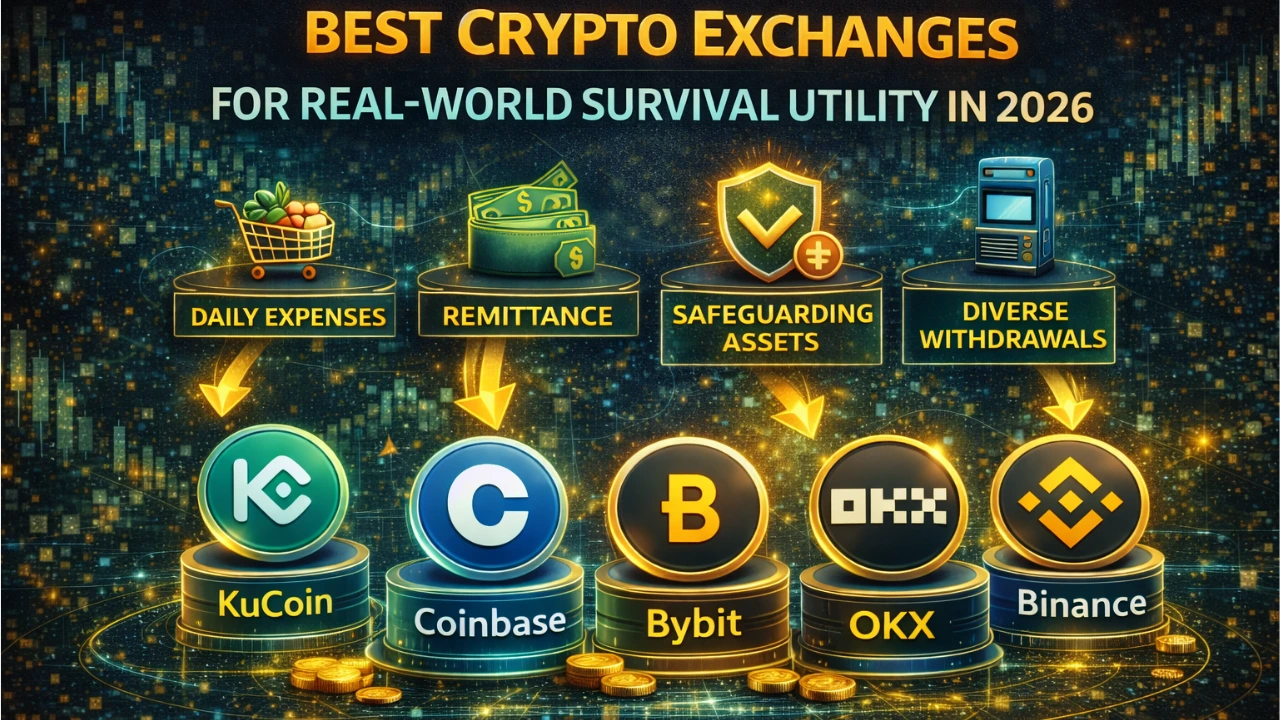
Best crypto exchanges for real-world survival utility in 2026
|
Exchange |
Best Use Case |
Best For |
Key Strength |
|
All-round primary exchange |
Most users |
Broadest utility stack |
|
|
Active trading + copy trading |
Intermediate users |
Strong derivatives and execution |
|
|
Exchange + wallet ecosystem |
Intermediate to advanced users |
Web3 and self-custody bridge |
|
|
Lower-drama core exposure |
Cautious professionals |
Trust, clarity, major assets |
|
|
Simple beginner onboarding |
New users, Africa-focused users |
Ease of use |
|
|
Social/copy-trading utility |
Users wanting managed-style exposure |
Copy trading infrastructure |
|
|
Futures + copy trading |
More advanced users |
Specialist active-trading toolset |
|
|
Swap backup rail |
All users as secondary tool |
Fast asset conversion |
Decision matrix: which exchange should you actually choose?
If you are a total beginner
Start with Luno, Kraken, or Binance.
You want simplicity, good fiat access, and the ability to buy stablecoins or Bitcoin without unnecessary confusion.
If your goal is stablecoins and financial flexibility
Start with Binance, OKX, or Bybit.
You want strong market access, good liquidity, and the ability to expand into more advanced features later.
If your goal is copy trading
Look at Bybit, BingX, and BloFin.
But size carefully. Copy trading is still trading, not outsourced certainty.
If your goal is “one serious main platform”
Pick Binance or OKX.
They offer enough breadth that many users can build most of their core system there.
If your goal is calmer long-term accumulation
Pick Kraken.
It is one of the strongest fits for users who want a cleaner, more measured experience.
If your goal is backup conversion and flexibility
Add ChangeNOW.
It is not your main exchange, but it can be a very useful support rail.

Fastest path to action in the next 15 minutes
If you want to build a practical exchange setup today, do this:
- Open one primary exchange account.
- Open one backup exchange account.
- Decide whether your main goal is savings, remittance, trading, or hedging.
- Buy a small test amount of stablecoins.
- Learn deposit, withdrawal, and network basics before moving larger sums.
- Save your exchange credentials properly and set up strong security.
- Add one support rail such as a wallet or swap service later.
A simple starter stack could look like this:
- Primary: Binance or Kraken
- Backup: OKX or Bybit
- Support rail: ChangeNOW
- Later custody upgrade: Ledger or CoolWallet

That is already far more resilient than relying on one bank account and no digital asset infrastructure.
The best exchange in 2026 is not the one with the loudest marketing. It is the one that gives you the most useful options when life becomes less predictable.
If your financial system depends on one employer, one bank, and one rail, you do not have a strategy. You have a bottleneck.
Crypto exchanges matter most not when markets are euphoric, but when flexibility becomes survival utility.
Mistakes that cost people money
The first mistake is choosing an exchange based purely on promotions or token listings.
The second is opening only one account and assuming that is enough. Redundancy matters.
The third is using advanced features before mastering basic ones. A user who cannot confidently move stablecoins should not be rushing into leverage.
The fourth is treating copy trading like a low-effort salary replacement. It is still risk capital.
The fifth is ignoring custody. Exchanges are useful tools, but they are not the whole treasury.
The sixth is trying to optimize everything at once. Start with access. Then build structure.
Who should not do this
This article is not for people looking for a shortcut to instant income.
It is not for readers who are deeply uncomfortable managing digital security.
It is not for people who think trading is a substitute for emergency savings.
It is not for users who are already financially stretched and prone to impulsive risk-taking.
For some people, the right move is very simple: one exchange, a small stablecoin balance, and a gradual learning curve.
That still counts.
Beginner, intermediate, and advanced paths
Beginner
If you are just starting, open a simple primary account first. Luno is a strong entry point in supported regions, while Kraken and Binance work well for broader users. The goal is not to become a trader tonight. The goal is to build your first reliable crypto access rail.
Intermediate
If you already understand the basics, pair a strong main exchange like Binance, Bybit, or OKX with a secondary platform for redundancy and specialized features. Add stablecoin discipline before adding complexity.
Advanced
If you are already comfortable with execution and custody, think in terms of system design. Use a broad venue for liquidity, a specialized platform for active strategy, and a self-custody layer for long-term holdings. Complexity only helps when it is intentional.
Final word
The exchange landscape in 2026 is crowded, but the decision is simpler than it looks.
You are not really choosing a brand. You are choosing a financial capability.
Can you access stablecoins quickly?
Can you move money when needed?
Can you create backup rails?
Can you grow from saving to strategy without rebuilding your whole system?
Can you reduce dependence on a single fragile path?
That is what real-world survival utility means.
The people who benefit most from crypto over the next few years may not be the loudest traders or the most ideological believers. They may simply be the people who built better financial infrastructure before they urgently needed it.
And in that world, the right exchange is not a luxury.
It is leverage of a very different kind.
About the Author