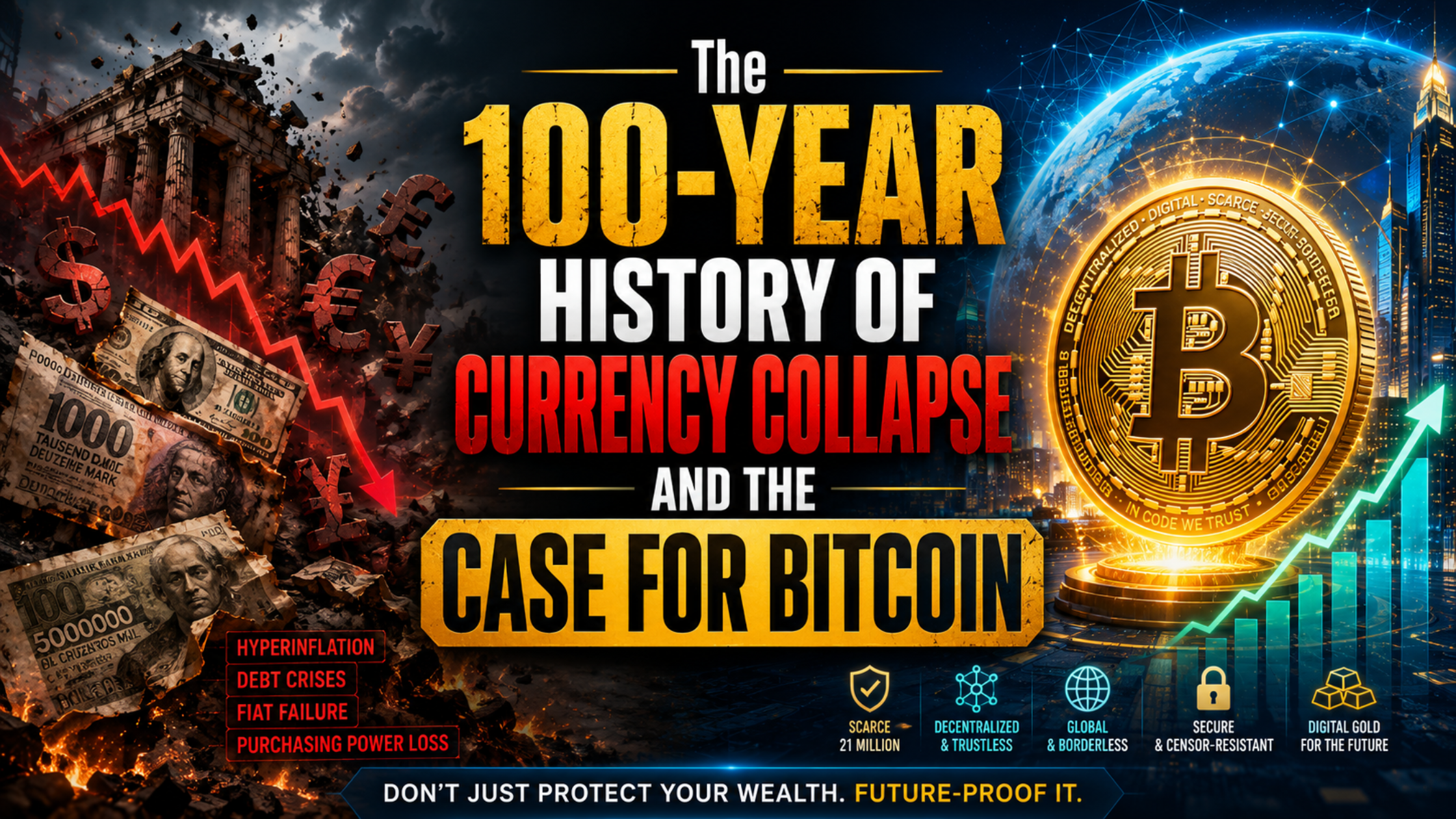
From Weimar Germany to Lebanon 2026 — a documented history of every major fiat currency collapse, what it stole from ordinary people, and why Bitcoin changes everything.
SUMMARY: Research examining 775 currencies throughout recorded history found zero cases of permanent survival. The average lifespan of a fiat currency is approximately 27–35 years before replacement or collapse. Major collapses since 1920 include: the German Papiermark (1923, prices doubling every 3.7 days), the Hungarian Pengő (1946, the worst hyperinflation ever recorded, prices doubling every 15.6 hours), the Yugoslav dinar (1994, 313 million percent peak monthly inflation), the Zimbabwean dollar (2008, 231 million percent annual inflation), and the Venezuelan bolívar (ongoing, 1,000,000% inflation in 2018). In every case, ordinary savers — not speculators — bore the heaviest losses. Bitcoin was created in 2009, one year after the global financial crisis, as the first monetary system in history with a fixed, algorithmically enforced supply cap of 21 million units. Unlike every fiat currency ever issued, it cannot be expanded by political decision. As of 2026, the countries where crypto adoption is highest are precisely the countries where fiat currency has failed most catastrophically — Venezuela, Argentina, Turkey, Lebanon, and Zimbabwe.
Your grandfather probably kept his savings in a bank. His grandfather might have stuffed banknotes into a mattress. If either of them lived through Weimar Germany, Hungary in 1946, Zimbabwe, or Venezuela, those savings did not just shrink. They vanished. Not in a market crash, where at least the loss is visible and the cause traceable. They vanished in the specific, quiet way that currency failure works: not through theft, not through fraud, but through the simple arithmetic of a government printing more money than its economy could support, repeated until the number on the banknote became irrelevant to what it could actually buy.
This article is a record of that happening. Not as economic theory. Not as a prediction. As a documented series of events that occurred within the lifetimes of people who are still alive.
Research examining 775 currencies throughout recorded history found zero cases of permanent survival. The average lifespan of a fiat currency is approximately 27 to 35 years before replacement or collapse. Most Baby Boomers alive today were born into a world that has already watched multiple currencies become worthless. Most of these currencies collapsed within the lifetime of most Baby Boomers living today — hyperinflation and currency collapses are not exceptionally rare events.
The question that follows from this record is not complicated: if every fiat currency without exception has either already failed or will eventually fail, and if the mechanism of failure is always the same, what is the rational response of someone who understands this?
That question is what created Bitcoin. And the countries where Bitcoin adoption is highest in 2026 are, without exception, the countries where the lesson of fiat failure has been most recently and most painfully taught.

The mechanism is always the same
Before the graveyard, the mechanism deserves a paragraph. Peter Bernholz, the economist who has most rigorously studied hyperinflation, analysed 29 historical hyperinflationary episodes and found that at least 25 were caused by the same thing: government budget deficits financed by currency creation. The government needed more money than it could raise through taxation. It could borrow or it could print. Borrowing has limits. Printing has no limits, only consequences.
While there can be a number of causes of moderate inflation, almost all hyperinflations have been caused by government budget deficits financed by currency creation. A necessary condition for hyperinflation is the use of paper money instead of gold or silver coins.
The consequence is always identical in its structure, if not in its speed. Citizens lose confidence in the currency. They spend it faster to acquire goods before prices rise further. The velocity of money increases. Prices rise faster. The government prints more to keep pace. The loop accelerates until the currency is no longer useful as money and is abandoned — for foreign currencies, for gold, for barter, or in 2026, for Bitcoin and stablecoins.
What varies is the human cost. The following cases are not statistics. They are documented episodes of ordinary people’s financial lives being destroyed by the choices of governments they did not control.

The graveyard: 20 collapses that shaped the modern monetary world
Germany — The Papiermark (1919–1923)
The most famous currency collapse in history set the template that every subsequent hyperinflation has followed. After World War One, Germany owed reparations it could not pay. Germany was forbidden to use its Papiermark currency to pay reparations since the fiat currency’s value had already declined significantly due to heavy borrowing to pay war costs. In order to pay its debts, Weimar Germany was forced to sell huge amounts of the mark for foreign currencies.
When France and Belgium invaded the Ruhr in January 1923 to enforce reparations payments, the German government ordered workers to strike and printed money to pay them. The German Papiermark experienced devastating hyperinflation reaching approximately 29,500% monthly in October 1923, with prices doubling every 3.7 days during the peak destruction period.
The human cost was total. The middle class — professionals, academics, civil servants, small business owners — had saved in marks their entire working lives. Those savings became worthless faster than they could be spent. Workers demanded hourly wages. A wheelbarrow of banknotes could not buy a loaf of bread by the end. The photographs of children playing with stacks of worthless currency are among the most arresting images in monetary history.
The political consequence is the one that matters most in retrospect. Adolf Hitler rose to power, in part, as a result of this period of crazy hyperinflation. With prices doubling every 3.7 days and inflation at 29,500%, Germans were exhausted by the post-war reparations and were all too eager to hear Hitler’s message.
The Weimar hyperinflation did not just destroy wealth. It destroyed the social trust that functioning democracies require, creating the conditions for the catastrophe that followed.
What it cost ordinary people: A lifetime of savings in marks became worthless in months. The professional class was economically destroyed. Middle-class Germany — the social foundation of democratic stability — was wiped out financially in a single year.

Hungary — The Pengő (1944–1946)
Nothing in recorded monetary history compares to what happened in Hungary after World War Two. The war had destroyed much of the country’s industrial infrastructure. The government had no choice — in its own reasoning — but to print money to fund reconstruction.
In 1946, Hungary experienced the worst hyperinflation ever recorded. World War II destroyed much of the nation’s infrastructure, forcing the government to excessively print money and take on high levels of public debt. To keep up with hyperinflation, Hungary’s government printed bills worth 100,000,000,000,000,000,000 (one hundred quintillion) pengő.
The Hungarian Pengő holds the record for the worst hyperinflation in documented history, with prices doubling every 15.6 hours at peak intensity in 1946.
When the pengő was replaced by the forint in 1946, the exchange rate encapsulates the entirety of what hyperinflation does: one forint was worth 400 octillion pengő — a number with 29 zeros. Every pengő ever saved, ever earned, ever inherited, was worth a vanishingly small fraction of a single new forint.
What it cost ordinary people: Everything denominated in pengő. Every savings account, every pension, every insurance policy, every fixed-income investment. The total destruction of accumulated wealth for an entire nation in under two years.

China — The Gold Yuan (1948–1949)
The Republic of China’s attempt to stabilise its currency through a gold-backed replacement in 1948 produced one of the fastest collapses in monetary history. The government issued the Gold Yuan to replace the old notes at a rate of three million to one, then immediately began printing it beyond any gold backing. During peak hyperinflation, the rate of price increases was more than 100% a day and had jumped by more than a quadrillion percent in just two years. Facing economic collapse, the government decided to adopt the German Mark in January 1995.
Inflation destroyed the currency in months. The Nationalist government lost the civil war to the Communists in part because economic collapse had eliminated any remaining public confidence in its governance.
Greece — The Drachma (1941–1944)
German occupation of Greece during World War Two created one of the most devastating economic catastrophes in Greek history. The occupying forces required the Greek government to finance their presence by printing drachmas.
WWII-era Greece was home to one of the worst cases of hyperinflation in modern fiat currency history. How does 18% inflation — every single day — sound? Their monetary value halved every few days. Greece’s fiscal budget balance went from a sizable surplus on the eve of the war to a deficit three times that size the very next year.
Famine accompanied the monetary collapse. With currency worthless and food unaffordable, an estimated 100,000 to 300,000 Greeks died of starvation during the occupation years, a death toll whose causes intertwined economic devastation with military deprivation.
Bolivia — The Peso (1984–1985)
Bolivia in the mid-1980s ran annual inflation of approximately 20,000%. The government was running deficits equivalent to 25% of GDP, financing them entirely through money creation. Workers were paid twice daily because money lost significant value over a single shift. Basic necessities become unaffordable — food, medicine, and housing costs skyrocket beyond the average person’s income. Savings become worthless — a lifetime of savings can lose all value in just months.
Bolivia’s stabilisation came through a shock therapy programme — immediate, severe spending cuts that ended the money printing but caused an economic contraction from which the poorest Bolivians took years to recover.

Argentina — The Peso (1989–1990 and recurring)
Argentina has destroyed its currency so many times that it merits a separate category: not a single collapse, but a recurring pattern of monetary failure that has repeated across more than a century. The 1989 hyperinflation saw prices rise 3,000% in a single year. A new currency, the austral, was introduced to replace the peso. It also collapsed. The peso was reintroduced. It also collapsed.
Every citizen of Argentina experienced the equivalent of a 45% pay cut in 2018 because of that nation’s currency crisis. Argentine families can now buy only half the essentials — including food — that they could earlier in January. Argentines have lost 45% of their savings and investments as well.
By 2023, Argentina’s annual inflation exceeded 200%. By August 2025, 19.8% of Argentines owned digital currencies, surpassing Brazil to claim the top spot in Latin American adoption. A country whose government has confiscated savings, frozen bank accounts, and destroyed the peso’s value repeatedly across generations has produced a population with a sophisticated understanding of why you do not trust the monetary system.
What it cost ordinary people: Argentina’s repeating currency crises have impoverished multiple generations. The 2001 crisis alone froze $100 billion in deposits — citizens could not access their own money, denominated in dollars, because the banking system did not hold enough dollars to honour its commitments.

Yugoslavia — The Dinar (1992–1994)
The disintegration of Yugoslavia produced one of the most severe hyperinflations of the 20th century’s final decade. With the country at war, the government financed military operations the only way it could: by printing money.
The dinar plummeted in value in the mid-1990s, particularly during the Croatian War of Independence and the Bosnian War. The government cranked up the money printer to fund military operations and to pay for federal expenses, leading to an oversupply of the currency. According to the Hanke-Krus World Hyperinflation Table, hyperinflation peaked at 313 million percent in January 1994.
Citizens in Belgrade carried plastic bags of banknotes to buy groceries. Workers struck continuously to demand wages that could keep pace with prices that were doubling by the day. The hyperinflation was a direct expression of a society tearing itself apart — the monetary destruction mirroring and amplifying the political one.
Brazil — The Cruzeiro and its successors (1985–1994)
Brazil’s monetary history between 1985 and 1994 is a laboratory study in repeated monetary failure. The country introduced five different currencies in nine years — the Cruzado, Cruzado Novo, Cruzeiro, Cruzeiro Real, and finally the Real — as each previous currency became worthless. Peak inflation reached 2,477% annually in 1993.
Brazilians of that generation developed a practice called the “tablita” — consulting price tables updated daily to know what things actually cost, because printed price tags were obsolete within days. Supermarkets employed people whose full-time job was relabelling products with today’s prices.
What it cost ordinary people: The complete impossibility of financial planning. Saving was irrational — any money set aside lost value faster than it could accumulate. Investment in productive assets was equally irrational because contract values were denominated in a currency that was worthless by the time payment was due.
Peru — The Inti (1988–1990)
Peru was an interesting case: it managed to destroy a currency or two without financing a war somewhere or staving off civil unrest. The Peruvian government ran fiscal deficits that it monetised, producing inflation that peaked at 7,649% in 1990. The inti replaced the sol in 1985 and was itself replaced by the nuevo sol in 1991 at an exchange rate of one million to one.
Angola — The Kwanza (1991–1995)
Civil war, collapsing oil revenues, and uncontrolled money printing consumed Angola across multiple decades. Many pockets of Angolans stopped using fiat currencies altogether and instead bartered or used precious metals as a means of exchange — a sensible decision given that one New Kwanza was equal to more than 1,000,000,000 original notes.
Angola’s experience is notable for demonstrating the endpoint of currency failure: not just the destruction of savings, but the abandonment of money itself as a technology. When currency becomes worthless, human beings revert to systems of exchange that predate civilisation.
Democratic Republic of Congo — The Zaire (1991–1994)
The DRC under Mobutu Sese Seko offers a textbook study in deliberate monetary destruction for political ends. The government printed money to pay army salaries, creating inflation that reached 24,000% in 1994. Soldiers who were not paid participated in widespread looting. The monetary collapse was both a cause and a consequence of state breakdown.

Zimbabwe — The Dollar (2000–2009)
Zimbabwe in the 2000s produced the images that have become shorthand for currency collapse: the 100 trillion dollar note, officially issued by the Reserve Bank of Zimbabwe in January 2009. Zimbabwe’s currency collapse represents a more recent example, with official inflation rates reaching 231 million percent annually in July 2008 before the Reserve Bank issued 100 trillion dollar notes in January 2009.
The mechanics followed the established pattern: the government seized white-owned farms to redistribute to politically connected allies. Agricultural production collapsed. The government printed money to fund public services that could no longer be supported by tax revenue from a collapsed economy. Inflation accelerated. The government printed more.
A loaf of bread cost trillions of Zimbabwean dollars, making it nearly impossible for people to afford even the most basic necessities.
Zimbabweans abandoned their currency completely. The country operated on US dollars, South African rand, and barter for years. When Zimbabwe introduced a new currency in 2019, it was de facto dollar-pegged from launch because no one trusted a Zimbabwean-issued monetary instrument anymore.
Zimbabwe’s crypto transaction volumes are estimated at 6% of GDP, one of the highest shares among surveyed emerging markets.
What it cost ordinary people: Zimbabwe’s middle class — teachers, nurses, civil servants, small business owners — was economically destroyed. Professionals with decades of savings watched them become worthless. An entire generation of Zimbabweans received what amounts to a postgraduate education in why you do not trust a government-issued currency.
Ecuador — The Sucre (1999–2000)
Ecuador’s sucre lost 75% of its value in early 2000, triggering dollarisation — Ecuador abandoned its own currency entirely and adopted the US dollar as its official monetary unit. The decision eliminated monetary sovereignty completely, but it also eliminated the specific risk of a government printing its currency into worthlessness.
Ecuador’s experience illustrates the logical endpoint when a country no longer trusts its own government to manage a currency: it adopts someone else’s. The irony of adopting the US dollar as a refuge from monetary instability is that the dollar itself has lost approximately 98% of its purchasing power since 1971.

Turkey — The Lira (2021–present)
Turkey’s case represents a contemporary, ongoing example of currency destruction that does not require war or revolution — only sufficiently misguided monetary policy. The Turkish government, under political pressure to maintain low interest rates despite rising inflation, oversaw a lira that lost 44% of its value against the dollar in 2021 alone, then continued to depreciate.
Turkey processed approximately $200 billion in crypto transactions according to Chainalysis data, and approximately 25.6% of Turkey’s internet population owns cryptocurrency. In a country where the lira has lost over 80% of its value in four years, Bitcoin and stablecoins have become not a speculative asset but a practical hedge against the predictable continuation of government monetary policy.
Turkey emerged as a standout in Q1 2026, with trading volumes rising 7% year-over-year — one of the few major markets to expand amid global crypto contraction.
Venezuela — The Bolívar (2013–present)
Venezuela’s hyperinflation is the most extreme case of currency destruction in the Western Hemisphere since Brazil’s multi-currency era. The government of Hugo Chávez and his successor Nicolás Maduro spent oil revenues on social programmes during boom years, then continued spending when oil prices collapsed, financing the gap by printing bolivars.
Venezuela entered hyperinflation in 2013, with inflation rates exceeding 1,000,000% in 2018.
Venezuela’s economy became approximately 60% dollarised by 2021 as the bolívar lost over 99.9% of its purchasing power since 1999.
The crypto adoption data from Venezuela is among the most striking in the world. Chainalysis reported a 110% increase in cryptocurrency usage in Venezuela in the 12 months ending June 2024, ranking it 13th globally. By January 2025, crypto transactions had surged by another 110% year-over-year, with an estimated $20 billion flowing into the Venezuelan economy via digital currencies. Venezuelans transferred a total of approximately $44.6 billion worth of crypto in one year, placing the country among the heaviest users of cryptocurrencies in Latin America.
Families tend to preserve value by moving to assets outside the domestic currency system, such as US dollars and gold, and to Bitcoin. This move aims to preserve purchasing power. Notably, adoption is not driven by speculation but by practical necessity: Venezuelans use Bitcoin and stablecoins for grocery purchases, salary payments, and remittances.
What it cost ordinary people: The complete destruction of the Venezuelan middle class. Professionals with advanced degrees left the country in a wave of emigration that drained Venezuela of its most educated citizens. Those who stayed found their savings worthless, their salaries insufficient to buy food, and their government institutions incapable of functioning.
Lebanon — The Lira (2019–present)
Lebanon’s financial collapse represents the most catastrophic case of banking system failure in the modern era. The Lebanese banking sector had been operating as a Ponzi scheme for years, using high interest rates to attract deposits and paying depositors with new deposits rather than from investment returns.
When the system broke, the consequences for ordinary depositors were uniquely devastating. Since October 2019, Lebanese banks have imposed informal capital controls, preventing depositors from accessing their dollar savings. Those who can withdraw receive Lebanese lira at rates far below market value, effectively losing 75–85% of their deposit’s worth with each transaction. An estimated $72 billion in deposits remains effectively frozen — wealth that has been destroyed in all but name.
The scenes that followed became iconic symbols of the crisis: armed citizens storming bank branches, demanding their own money at gunpoint. Dozens of such incidents have occurred since 2022. These were not criminals — they were teachers, parents, cancer patients, people who needed their own savings for treatment or tuition.
Lebanon, 19.8% of citizens use crypto wallets as a primary value store.
The Lebanese case adds a dimension that pure hyperinflation cases do not: the banking system actively trapped deposits rather than allowing them to erode through inflation. Savers did not just watch their money lose value. They were locked out of accessing it at all. The bank account, which represents the entire premise of the modern financial system — that you deposit money and can withdraw it when needed — failed completely.

Belarus — The Ruble (1993–2003)
Belarus did not handle separation from the Soviet Union particularly well. Between 1993 and 2003, the Belarusian ruble was so aggressively printed and so much of it produced that the currency became extremely devalued. Peak inflation reached approximately 2,221% in 1994.
Ukraine — The Karbovanets (1992–1996)
Post-Soviet Ukraine experienced hyperinflation reaching 10,155% in 1993 as the newly independent government struggled to finance state operations without the Soviet fiscal transfer mechanism. The karbovanets was replaced by the hryvnia in 1996.
Georgia, Armenia, Azerbaijan — The Soviet Successor Currencies (1993–1994)
The collapse of the Soviet Union created simultaneous currency crises across multiple newly independent states, each of which inherited monetary systems without the hard currency reserves to support them. Georgia experienced over 7,000% annual inflation in 1994. Armenia peaked at over 5,000% in 1993. All three required new currencies within years of independence.
The Decentralised News Fiat Failure Index
The following table summarises every major currency collapse of the modern era with its peak inflation rate, the years affected, the root cause, and — critically — the documented human cost to ordinary savers.
|
Country |
Currency |
Peak Inflation |
Years |
Root Cause |
Cost to Ordinary Savers |
|
Hungary |
Pengő |
Prices doubled every 15.6 hours |
1945–46 |
War damage, money printing |
Total destruction of all savings |
|
Yugoslavia |
Dinar |
313 million% monthly |
1993–94 |
War financing |
Complete monetary system failure |
|
Zimbabwe |
Dollar |
231 million% annually |
2008 |
Agricultural collapse, printing |
Middle class economically destroyed |
|
Germany |
Papiermark |
29,500% monthly |
1921–23 |
War reparations, printing |
Middle class savings wiped out |
|
Venezuela |
Bolívar |
1,000,000% annually |
2018 |
Oil dependence, corruption |
99.9% loss of purchasing power |
|
Greece |
Drachma |
18% daily |
1941–44 |
Occupation, war |
Famine-linked deaths, savings lost |
|
Brazil |
Cruzeiro |
2,477% annually |
1993 |
Fiscal deficits |
5 currencies in 9 years |
|
Angola |
Kwanza |
>4,000% |
1991–95 |
Civil war, oil dependence |
Complete currency abandonment |
|
Bolivia |
Peso |
20,000% annually |
1984–85 |
Deficit financing |
Workers paid twice daily |
|
Peru |
Inti |
7,649% annually |
1990 |
Fiscal deficits |
Currency replaced at 1,000,000:1 |
|
Argentina |
Peso |
3,000% annually |
1989–90 |
Recurring |
Multiple savings confiscations |
|
Ukraine |
Karbovanets |
10,155% annually |
1993 |
Soviet breakup |
Full monetary system rebuilt |
|
Georgia |
Coupon |
7,488% annually |
1994 |
Soviet breakup |
Full monetary system rebuilt |
|
Belarus |
Ruble |
2,221% annually |
1994 |
Soviet breakup |
Chronic devaluation |
|
DRC |
Zaire |
24,000% annually |
1994 |
Political corruption |
Army mutiny, societal breakdown |
|
Ecuador |
Sucre |
75% monthly |
2000 |
Fiscal crisis |
Currency abandoned, dollarised |
|
Turkey |
Lira |
85% annually |
2021 |
Interest rate policy |
80%+ value loss in 4 years |
|
Lebanon |
Lira |
200%+ annually |
2019– |
Banking Ponzi collapse |
$72B deposits frozen |
|
China |
Gold Yuan |
100%+ daily |
1948–49 |
Civil war financing |
Government fell |
|
Chile |
Escudo |
1,200% annually |
1973–74 |
Deficit monetisation |
Replaced at 1,000:1 |
The pattern every economist recognises and every government ignores
Every collapse in this record follows the same sequence with such consistency that it constitutes a mathematical law rather than a historical coincidence.
Step one: the government faces a funding gap — war, social spending, debt service, political promises. Step two: it cannot raise sufficient revenue through taxation. Step three: it borrows or it prints. Step four: when borrowing reaches its limits, printing becomes the only option. Step five: money supply expansion outpaces economic output growth. Step six: prices rise. Step seven: the government prints more to keep pace with its own spending in nominal terms. Step eight: public confidence erodes. Step nine: the velocity of circulation increases as people spend money faster before it loses more value. Step ten: the loop accelerates beyond any controllable threshold.
The speed varies. Germany’s collapse took approximately two years from moderate inflation to peak hyperinflation. Hungary’s took less than a year. Venezuela’s has taken over a decade of gradual decay. But the sequence is invariant.
Comprehensive historical analysis reveals disturbing patterns regarding fiat currency sustainability. Research examining 775 currencies throughout recorded history found zero cases of permanent survival. The average lifespan calculation varies by methodology, but most studies converge on 27–35 years as typical fiat currency duration before replacement or collapse.
Since President Nixon terminated the gold standard in 1971, the purchasing power of major currencies has eroded dramatically. The US dollar has lost approximately 98% of its purchasing power since 1971, according to Federal Reserve Economic Data calculations measuring cumulative inflation over this period.
The US dollar has not collapsed. It has simply lost value more slowly. The mechanism is identical; only the speed differs. A currency that loses 98% of its purchasing power over 55 years and a currency that loses 98% of its purchasing power in 18 months are both experiencing the same fundamental failure of monetary discipline. The Venezuelan is just living through a faster version of the same process that the American experiences over a longer timeframe.

What ordinary people actually lost
The economic histories record inflation percentages. What they record less precisely is the human cost to people who were not in a position to protect themselves.
In every case, three groups bore the heaviest losses.
Savers. Anyone who kept wealth in the currency — in bank accounts, under mattresses, in pension funds, in life insurance policies — lost it. The faster the collapse, the more total the loss. In Hungary 1946, a pension fund with holdings denominated in pengő was worth nothing within months. In Lebanon, a bank account containing dollar savings became inaccessible because the bank did not actually hold those dollars.
The old. Retirees are uniquely vulnerable to currency failure because they cannot increase their income. A factory worker can demand higher wages. A pension is fixed. The pensioner with a fixed monthly payment in a hyperinflating currency watches their real income approach zero while their expenses — food, medicine, rent — rise with prices.
The trusting. The people who most believed in their country’s institutions — who dutifully paid into pension systems, opened savings accounts, invested in government bonds — are precisely the people most exposed when those institutions fail. The cynics who kept gold, or foreign currency, or productive assets, or who hid cash in multiple currencies, survived better. The trust that functioning societies depend on — the trust that your savings will be worth something tomorrow, that your pension will pay out, that your bank will return your deposits — is destroyed most completely in those who had it most fully.
Hyperinflation affects everyone, but working-class individuals and retirees suffer the most as wages become worthless and savings evaporate. Job losses rise as businesses shut down, and essentials become unaffordable.
The opt-out that did not exist — until 2009
Throughout the entire history documented above, there was no opt-out. If you lived in Weimar Germany, you used marks. If you lived in Zimbabwe, you used Zimbabwean dollars. You could convert to foreign currencies, but this required access, connections, and foreign currency reserves that most ordinary people did not have. You could buy gold, but gold is heavy, difficult to transact with, and requires a trusted storage solution. You could buy land, but land is illiquid and subject to confiscation.
The fundamental problem was that every alternative to the failing currency required either privilege, capital, or physical proximity to the alternative. A nurse in Harare in 2008 could not easily convert her salary to US dollars. She was subject to the monetary choices of the Zimbabwean government whether she liked those choices or not.
Bitcoin changed this. For the first time in monetary history, an ordinary person with a smartphone and an internet connection could hold a monetary asset whose supply cannot be expanded by any government. The 21 million bitcoin limit is not a policy. It is not a law that can be changed by legislation. It is a mathematical constraint enforced by millions of computers around the world, each of which would need to be simultaneously reprogrammed by coordinated agreement of the network to change it. That has never happened and the network’s design makes it effectively impossible.
When Venezuela’s inflation hit 1,000,000% in 2018, Venezuelans turned to Bitcoin and stablecoins not as speculation but as survival. In this environment, cryptocurrency has shifted from speculative investment to essential financial infrastructure. Chainalysis reported a 110% increase in cryptocurrency usage in Venezuela in the 12 months ending June 2024.
When Lebanon’s banks froze $72 billion in deposits, crypto adoption surged because a Bitcoin wallet cannot be frozen by a bank that has run out of the dollars it promised to hold. Lebanon, 19.8% of citizens use crypto wallets as a primary value store.
When Turkey’s lira lost 44% of its value in a single year, Turks bought Bitcoin and USDT. Turkey processed approximately $200 billion in crypto transactions.
The fastest crypto adoption growth occurred in countries with annual inflation rates exceeding 20%. In extreme cases — Venezuela’s hyperinflation, Lebanon’s banking collapse — crypto adoption functions as a rational survival strategy when traditional financial systems catastrophically fail.
This is not a crypto marketing claim. It is an empirically documented pattern from Chainalysis, TRM Labs, and multiple independent research organisations: the higher the rate of fiat currency failure, the higher the rate of crypto adoption. The graveyard above is the explanation for the adoption statistics.

The 21st century cases still unfolding
The currency graveyard is not a closed archive. Three cases deserve specific attention because they are active.
Argentina (ongoing): Argentina’s decades-long struggle with inflation, currency controls, and sovereign debt crises has produced one of Latin America’s highest crypto adoption rates. By August 2025, 19.8% of Argentines owned digital currencies. Argentina has formally defaulted on its sovereign debt nine times. Its current trajectory does not suggest the pattern has ended.
Venezuela (ongoing): Venezuela ranked 17th globally in Q1 2026 with $17.9 billion in attributed retail crypto volume — with adoption driven primarily by stablecoin usage rather than speculative trading. Venezuelan crypto activity is driven by domestic economic and political conditions — not market cycles.
Lebanon (ongoing): The $72 billion in frozen deposits has not been resolved. The banking system that trapped those savings remains unreformed. The political arrangements that produced the crisis remain in place. Ordinary depositors watched their life savings become inaccessible. Retirement funds, children’s education savings, emergency reserves — all locked behind bank doors that remain shut to this day in April 2026.
What this history demands of anyone who understands it
The currency graveyard is not an argument for nihilism about money. Money works. The technology of money — a common medium of exchange that allows economic specialisation and cooperation — is among the most important inventions in human history. The problem is not money. The problem is money whose supply is controlled by entities with an incentive to expand it beyond sustainable limits.
Every government that has ever destroyed its currency did so for reasons that made political sense at the time. Germany needed to pay striking workers. Zimbabwe needed to fund public services after agricultural collapse. Lebanon needed to maintain a banking system that was technically insolvent. Venezuela needed to fund social programmes after oil revenues collapsed. The decision to print was rational from the perspective of the short-term political survival of the government making it. The cost was borne by the population in the medium and long term.
Bitcoin’s design is a direct response to this problem. Its monetary policy is determined by code, not by political calculation. No government can expand Bitcoin’s supply because no government controls it. No crisis, however severe, can justify printing more Bitcoin because the mechanism for doing so does not exist.
When money is broken and value and trust are lost, people seek alternatives and diversify from their currencies. Families tend to preserve value by moving to assets outside the domestic currency system — such as US dollars and gold, and to Bitcoin.
The historical record is 775 currencies with zero permanent survivors. The current data shows that the populations with the most direct experience of currency failure are the fastest adopters of the alternative. These two facts together constitute an argument whose conclusion is not complicated.
The graveyard fills. The opt-out has existed since 2009. The rational response to this history is the same one that Venezuelans, Turks, Argentinians, and Lebanese are already making.

Where to start
For anyone reading this who lives in a country whose currency has not yet entered the graveyard — which means a country whose government has not yet faced a sufficiently severe fiscal crisis — the question is not whether to diversify away from fiat. The question is when to begin.
The safest starting point is an exchange with a strong regulatory track record and genuine user protections. For global users, Bybit and Binance offer straightforward onboarding with strong liquidity and support for users across more than 100 countries. For South African users, VALR and Luno offer ZAR-native onboarding with local regulatory oversight. For users who want the widest asset access and lowest spot trading fees, OKX and MEXC are the strongest options.

For any amount above the equivalent of one or two months’ expenses, a Ledger hardware wallet is not optional — it is the specific technology that makes the difference between owning Bitcoin and having a claim on an exchange’s reserves. The Lebanese depositors who kept their dollars in a bank had a claim on the bank’s reserves. The bank did not have those reserves. A Ledger owner owns Bitcoin directly on the blockchain. No bank, no government, and no crisis changes that.
The currency graveyard is a record of what happens when you trust a monetary system controlled by entities with an incentive to destroy it. Bitcoin is the first monetary system in history that removes that incentive structurally. Whether you adopt it before your country’s currency joins the graveyard, or after, determines the difference between preserving your wealth and losing it.
FAQ
How many fiat currencies have failed in history?
Many fiat currencies have failed, been replaced or lost most of their purchasing power over time. Historical currency systems rarely survive permanently in their original form. The main lesson is that fiat currencies depend on trust, fiscal discipline and responsible monetary policy. When those break down, currencies can collapse or be replaced.
What is the worst hyperinflation in history?
Hungary in 1946 is widely regarded as the worst hyperinflation in recorded history. Prices rose so quickly that money became almost unusable as a store of value. Weimar Germany in 1923 is another famous example, where the currency collapsed after extreme money printing and loss of confidence.
Why do fiat currencies fail?
Fiat currencies usually fail when governments print too much money to fund deficits, wars, political promises or economic crises. Once people lose confidence in the currency, they try to spend or exchange it as quickly as possible. That makes prices rise even faster and can accelerate the collapse.
How does currency collapse affect ordinary people?
Currency collapse destroys savings, wages and pensions. People may be paid more frequently because money loses value quickly. Businesses struggle to price goods. Retirees and savers are often hit hardest because their stored wealth loses purchasing power. In severe cases, people turn to foreign currency, gold, goods or crypto to preserve value.
Which countries have seen crypto adoption rise because of currency weakness?
Crypto adoption often rises in countries facing high inflation, currency controls or banking instability. Examples include Argentina, Turkey, Nigeria, Venezuela, Lebanon and Zimbabwe. In these markets, many people use crypto and stablecoins not for speculation, but to store value, move money and escape weak local currencies.
What makes Bitcoin different from fiat currency?
Bitcoin has a fixed supply cap of 21 million coins. No government, central bank or political authority can simply create more Bitcoin to fund deficits. Fiat currencies can be expanded by central banks and governments. Bitcoin’s monetary policy is enforced by code and network consensus.
Can Bitcoin protect against currency collapse?
Bitcoin may help some investors protect part of their wealth from currency debasement, but it is still volatile. Stablecoins, gold, foreign currency, diversified assets and self-custody strategies may also play a role depending on the country and situation. Bitcoin is not risk-free, but its fixed supply makes it attractive to people worried about fiat currency failure.
What is the biggest lesson from currency collapses?
The biggest lesson is that purchasing power matters more than the number printed on a banknote. A currency can still exist while losing most of its real value. That is why investors study hard assets, Bitcoin, gold and alternative stores of value when governments rely too heavily on money creation.
This article is for informational and educational purposes only and does not constitute financial advice. Historical currency data is sourced from published academic research, Wikipedia, Federal Reserve Economic Data, Chainalysis, and TRM Labs. All figures are accurate as of the research date of May 2026. Cryptocurrency investments carry significant risk; past performance does not guarantee future results.
Affiliate disclosure: Decentralised News maintains affiliate relationships with Bybit, Binance, OKX, MEXC, VALR, Luno, and Ledger. Links in this article are affiliate links. This does not influence the editorial content.
Recommended reading:
Crypto Friction Cost Index 2026: What Active Crypto Traders Actually Pay in Hidden Costs Every Year
The Pandemic Market Playbook: How Outbreaks Move Stocks, Real Estate and Crypto
How to Use Bitcoin as Collateral for a Loan in 2026: The Complete Guide to Crypto-Backed Lending
Crypto for Retirement: The Complete 2026 Guide to Building a Self-Directed Crypto Pension
Bitcoin vs Gold vs Real Estate vs S&P 500: 10-Year Return Comparison
How to buy Bitcoin in 2026: the complete beginner’s guide by country
Lowest Crypto Futures Fees in 2026: Every Major Exchange Ranked and Calculated
Best Crypto Sign-Up Bonuses and New User Rewards in 2026
Best Crypto Futures Trading Competitions in 2026: Where Active Traders Can Earn Rewards
Start Here — Build Your Crypto Infrastructure Safely
You don’t need to use everything at once.
Professionals reduce risk by having access to multiple rails so they are never dependent on a single platform.
Below is a simple, practical setup used by many experienced traders and investors.
1) Your Fiat Gateway (Primary Access)
Best starting point for deposits & withdrawals

Binance — reliable onboarding, deep liquidity, global coverage
👉 sign up
Why open this:
- Move from bank → crypto easily
- Convert large amounts efficiently
- Emergency exit capability
2) Your Trading Execution Venue (Fast & Flexible)
Best for active trading and broad market access
MEXC — huge altcoin selection & low trading friction
👉 sign up
Why open this:
- Trade markets not listed elsewhere
- Better execution during volatility
- Lower dependence on a single exchange
3) Your Advanced Tools & Derivatives Platform
Best for leverage, hedging and professional execution
Bybit — strong order controls & derivatives infrastructure
👉 sign up
Why open this:
- Proper stop loss tools
- Hedging capability
- Strategy flexibility

4) Your Yield & Passive Income Layer
Best for structured products and capital efficiency
Gate.com — structured yield & automated earning tools
👉 sign up
Why open this:
- Earn on idle capital
- Diversify platform risk
- Access structured strategies
5) Your Altcoin & Ecosystem Expansion Layer
Best for early market access and wide listings
KuCoin — broad token ecosystem
👉 sign up
Why open this:
- Access emerging markets
- Portfolio diversification
- Redundancy if one platform restricts access
Why This Structure Matters
Using one exchange creates a single point of failure.
Using multiple rails creates:
- Liquidity redundancy
- Faster reaction ability
- Lower operational risk
- Greater opportunity access
You don’t need large capital to start — you just need prepared infrastructure.

Practical Next Step
Open accounts gradually and verify them before you need them.
Most people only prepare during stress —
professionals prepare before it.
(Decentralised News provides infrastructure education, not financial advice. Always use proper security practices.)
Published by Decentralised News | Author: Heath Muchena | May 2026
About the Author