Crypto Portfolio Allocation Tool 2026: Build Your Portfolio Based on Your Risk Profile
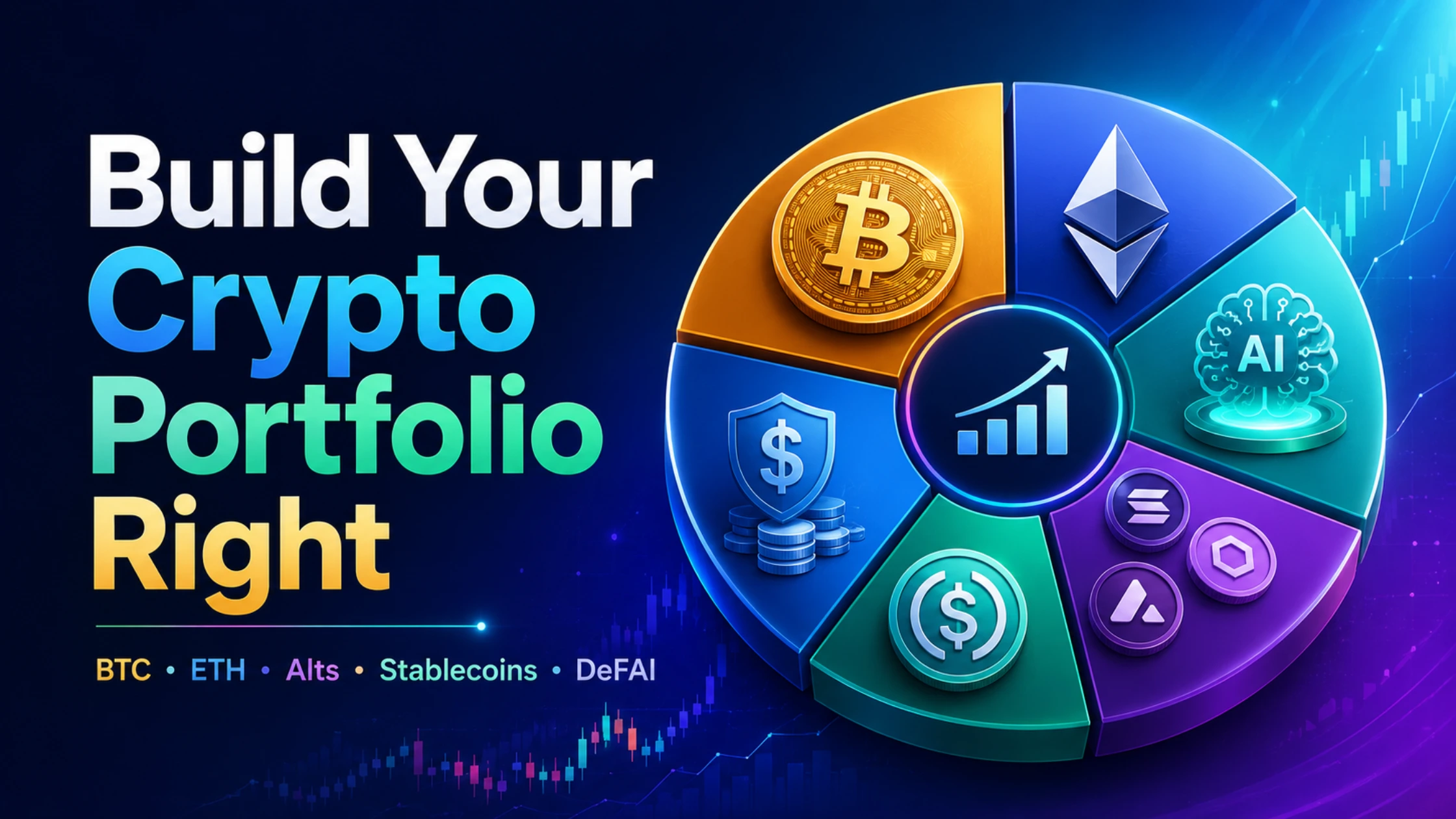
A 2026 crypto portfolio is not just Bitcoin and Ethereum. Answer five questions about your goals, risk tolerance, and knowledge level to get a personalized allocation across six categories with specific platforms for each position.
Crypto Portfolio Allocation Tool 2026 — Build Your Portfolio Based on Your Risk Profile
The single most common mistake in crypto portfolio construction is treating it as a binary decision between holding Bitcoin and speculating on altcoins. A well-built 2026 crypto portfolio has six distinct functions — store of value, smart contract exposure, growth optionality, DeFi yield, stablecoin income, and a cash reserve — each sized according to your specific investment horizon, risk capacity, and financial goals. The tool below generates your personalized allocation in under two minutes.
Why Allocation Matters More Than Asset Selection
Most retail crypto investors spend the majority of their research time on asset selection: which token is undervalued, which protocol is gaining traction, which narrative will drive the next cycle. This is the wrong order of priorities.
Asset selection determines which assets within a category you hold. Portfolio allocation determines how much of your capital is exposed to each category of risk. The research literature on investment returns consistently shows that asset allocation explains roughly 90% of long-term portfolio performance variation, while asset selection within categories explains the remaining 10%.
The practical implication for crypto is stark. Whether you hold Solana or Avalanche within your large-cap alt allocation matters less than whether your large-cap alt allocation is 5% or 25% of your portfolio. Whether you use Aave or Morpho for stablecoin yield matters less than whether your stablecoin yield position is 10% or 30%. Getting the allocation right first is the primary lever.
The second most common mistake is building a portfolio based on someone else’s allocation without adjusting for differences in investment horizon, risk tolerance, and existing financial situation. A 25-year-old with no traditional savings, a high income, and a 10-year horizon should hold a completely different portfolio from a 45-year-old with a diversified traditional portfolio, a moderate income, and a 3-year time horizon — even if their conviction about Bitcoin is identical.
The tool below accounts for both of these realities. It generates a personalized allocation based on your specific inputs, not a generic recommendation.
The Five Dimensions That Determine Your Allocation
Investment horizon is the most important single variable. Crypto assets are volatile over short periods and have historically appreciated significantly over 4-year or longer periods that include a full halving cycle. A 12-month horizon means capital that may be needed for a specific purpose within a year — a house purchase, an emergency fund, a business investment. Capital with this horizon has no business sitting in high-volatility altcoins or leveraged strategies. A 5-year or longer horizon changes the risk calculus completely: volatility is a temporary condition rather than a threat to the investment.
Risk tolerance is both psychological and financial. Psychological risk tolerance is how you respond to a 40% portfolio drawdown: do you sell in panic, hold calmly, or buy more? Financial risk tolerance is how much of your total net worth the crypto portfolio represents and how much you can afford to lose without material impact on your life. High psychological risk tolerance combined with low financial risk tolerance — large crypto allocation relative to total wealth — is a dangerous combination that the tool moderates.
Current crypto knowledge affects which allocation makes sense to actually execute. An advanced user can manage a DeFAI token position, run a grid bot on BloFin, and interact with Aave for stablecoin yield without significant operational risk. A beginner cannot — and giving a beginner an advanced allocation creates execution risk that turns a good allocation plan into a bad outcome. The tool simplifies the allocation for lower knowledge levels, focusing on assets that are straightforward to hold and manage.
Existing traditional portfolio exposure determines whether the crypto portfolio functions as a satellite position within a diversified financial plan or as the primary investment vehicle. A person whose overall financial picture is 80% equities, 10% bonds, and 10% cash needs a different crypto allocation than someone with 100% of investable assets in crypto. The former can take more crypto risk because the traditional portfolio provides downside protection. The latter needs more conservative crypto positioning because there is no other asset class providing a buffer.
Primary goal determines the balance between income-generating and growth-oriented positions. An investor whose primary goal is maximum capital appreciation should weight toward BTC, ETH, and higher-beta alts with minimal stablecoin drag. An investor whose primary goal is generating monthly income from their portfolio should weight toward stablecoin yield, ETH staking, and funding rate carry strategies. These two goals produce genuinely different optimal portfolios.
The Six Building Blocks of a 2026 Crypto Portfolio
Bitcoin (BTC) is the anchor. Every credible crypto portfolio holds Bitcoin because it is the asset with the longest track record, the deepest institutional adoption, the most liquid market, and the clearest regulatory status following the CLARITY Act of 2026. It functions as the digital store of value layer — the position you hold for the long-term thesis without requiring active management. For most investors, Bitcoin is held in cold storage on a hardware wallet, generating no yield but serving as the portfolio’s bedrock position.
Ethereum (ETH) is the productive capital layer. Unlike Bitcoin, ETH can be staked to generate 3 to 4% annual yield through Lido’s liquid staking, producing stETH that retains full liquidity while earning. Ethereum’s position as the primary smart contract settlement layer, the dominant institutional blockchain for RWA tokenization, and the ecosystem supporting the largest DeFi and Layer 2 economy makes it the second core holding in most allocations. The staking yield layer on top of the price appreciation thesis distinguishes ETH from BTC in terms of capital efficiency.
Large-cap alts provide growth optionality above what Bitcoin and Ethereum offer. This category includes assets like Solana, BNB, XRP, Avalanche, and Chainlink — projects with significant market capitalisation, real usage metrics, institutional backing, and legitimate competitive positions within the crypto ecosystem. Large-cap alts carry more risk than BTC or ETH but significantly less than small-cap tokens or new launches. They participate in bull market appreciation more aggressively while retaining meaningful liquidity and relatively strong downside resilience.
DeFAI tokens are the high-risk, high-reward category representing the AI-DeFi convergence narrative that is defining 2026. Assets including VIRTUAL (Virtuals Protocol), OLAS (Autonolas), TAO (Bittensor), and RENDER sit in this category. This allocation is sized conservatively for most investors — 5 to 15% maximum for moderate-to-high risk profiles — because these assets have limited operating history, are often in early product development stages, and carry significant regulatory and execution risk alongside their outsized upside potential. Beginners receive zero allocation here.
Stablecoin yield is the income-generating anchor. Rather than holding idle USDC or USDT earning nothing, this position deploys stablecoin capital into Treasury-backed instruments like Ondo Finance’s USDY (4 to 5% APY), lending pools on Aave or Morpho, or grid bot strategies on BloFin generating 6 to 10% on stable pairs. This position produces consistent, dollar-denominated monthly income regardless of what BTC or ETH does in any given month — it is the stabilizing income layer of the portfolio.
Cash reserve is the position most investors undersize. A 5 to 10% cash reserve in liquid stablecoins serves two functions: an emergency buffer that prevents forced selling of core positions during drawdowns, and an opportunity fund for deploying into sharp market dislocations. The investor who maintained a 10% cash reserve through the 2022 bear market was able to deploy into BTC at $15,500 and ETH at $880. The investor who was fully deployed had no dry powder.
Use the Portfolio Generator
Answer five questions and enter your total capital. The tool generates your personalized allocation across all six categories with specific platform recommendations for each position.
Crypto Portfolio Allocation Generator
Answer five questions to get your personalized 2026 crypto portfolio — with specific platforms and allocation amounts for each position.
Build this portfolio — one recommended platform per category
Tool by Decentralised News · Disclaimer: not financial advice. Allocations are illustrative starting points.
Building the Portfolio — Platform by Platform
Once the tool has generated your allocation, here is how to execute each position:
BTC position: Purchase on OKX or Bybit and withdraw to a Ledger hardware wallet. Bitcoin held on an exchange carries counterparty risk that cold storage eliminates. For amounts above $5,000, hardware wallet custody is the correct approach. The Ledger Flex supports BTC, ETH, and hundreds of other assets in a single device.
ETH position: Purchase on OKX, then stake via Lido Finance to receive stETH. The stETH balance increases automatically as staking rewards accrue. stETH remains liquid and can be used as DeFi collateral or redeemed for ETH at any time. For users preferring simpler custody, OKX Earn offers ETH staking with direct wallet custody of the underlying asset.
Large-cap alts position: OKX has the deepest selection and liquidity for Solana, BNB, XRP, Avalanche, Chainlink, and other established large-cap assets. The OKX Web3 wallet also integrates DEX access for on-chain positions in the same interface as the centralized exchange, useful for assets with limited CEX liquidity.
DeFAI tokens position: Bybit lists the widest range of AI and DeFi ecosystem tokens with competitive depth on VIRTUAL, OLAS, RENDER, and other DeFAI assets. Bybit’s spot markets have sufficient liquidity for position sizes typical in a retail DeFAI allocation. For tokens not listed on Bybit, OKX and MEXC are the secondary options.
Stablecoin yield position: BloFin provides the infrastructure for grid bot yield strategies on stablecoin pairs and funding rate carry trades — the strategies that generate 6 to 12% on deployed stablecoin capital without directional market exposure. Ondo Finance’s USDY provides the simpler alternative for users who want Treasury-backed yield without any trading strategy involvement.
Cash reserve position: Hold in USDC or USDT on Bybit or OKX Earn at the standard savings rate. The priority for the cash reserve is liquidity — being able to deploy within minutes — rather than yield maximization. Savings account rates on major exchanges for stablecoins currently run 3 to 6% annually, providing a return on waiting capital without locking it up.
Rebalancing — When and How
A portfolio allocation is not a set-and-forget instruction. Market movements will shift the proportions from their targets over time. A bull market that drives DeFAI tokens up 300% will push the DeFAI allocation from 10% to 25% or more, creating concentration risk that was not intended. Regular rebalancing returns the portfolio to its target allocation.
The two rebalancing triggers that work in practice are threshold-based and calendar-based. Threshold-based rebalancing triggers a review when any category moves more than 5 percentage points from its target — if BTC was targeted at 30% and has grown to 38%, it is time to trim and redistribute. Calendar-based rebalancing reviews the portfolio quarterly and rebalances any category that has drifted by more than 3 percentage points.
Rebalancing in crypto carries a tax implication in most jurisdictions: selling an appreciated position to buy another is a taxable disposal. Tracking cost basis accurately from the start using Koinly prevents this from becoming an administrative crisis at tax time.
FAQ
What percentage of my net worth should be in crypto in 2026? There is no universal answer. A general framework: if crypto represents less than 5% of your total net worth, the downside scenario has limited impact on your financial life and you can afford higher risk within the allocation. At 10 to 20% of net worth, the allocation is meaningful and the conservative-to-moderate band of the portfolio generator’s output is appropriate. Above 30% of net worth, the crypto portfolio is a primary financial position and requires more conservative internal allocation regardless of conviction level.
Why does the tool give beginners zero DeFAI allocation? DeFAI tokens require active monitoring, platform-specific knowledge to purchase on DEXes or smaller exchanges, and an understanding of the specific risk factors — protocol risk, team risk, regulatory risk, and liquidity risk — that differ from holding BTC or ETH. A beginner who buys a DeFAI token without this context is exposed to risks they cannot identify or manage. The conservative approach is to build knowledge through BTC and ETH exposure first, then graduate to higher-complexity positions as understanding deepens.
Should I adjust my allocation during a bull market? The instinct to increase crypto allocation during a bull market — when everything is going up and conviction feels highest — is the opposite of what the math supports. Bull markets increase the portfolio’s drift toward risk assets above the target allocation, which means rebalancing should be trimming rather than adding. New capital deployed during a bull market should follow the same allocation logic as the original portfolio, not weight more heavily toward the assets currently performing best.
How does investment horizon affect the stablecoin yield allocation? Shorter horizons increase the stablecoin yield allocation because this portion of the portfolio generates income regardless of market conditions and is not exposed to crypto price volatility. For a 1-year horizon, a higher stablecoin yield percentage means the portfolio is generating consistent return even if BTC and ETH are flat or negative during that period. For a 4-year horizon, stablecoin yield is a smaller allocation because the time available for Bitcoin’s long-term appreciation to compound creates a stronger expected return from the growth positions.
What should I do if my allocation drifts significantly? If any category has moved more than 8 to 10 percentage points from its target, a rebalancing event is appropriate. Trim the over-weight category to its target and deploy the proceeds into the under-weight categories. Do this systematically rather than reactively — the same discipline that governs the initial allocation should govern the rebalancing decision.
Build your portfolio: OKX — large-cap alts and ETH purchase · Bybit — DeFAI tokens and yield · BloFin — stablecoin yield strategies · Ledger — BTC and ETH cold storage · Koinly — portfolio tracking and tax
About the Author