Quick summary
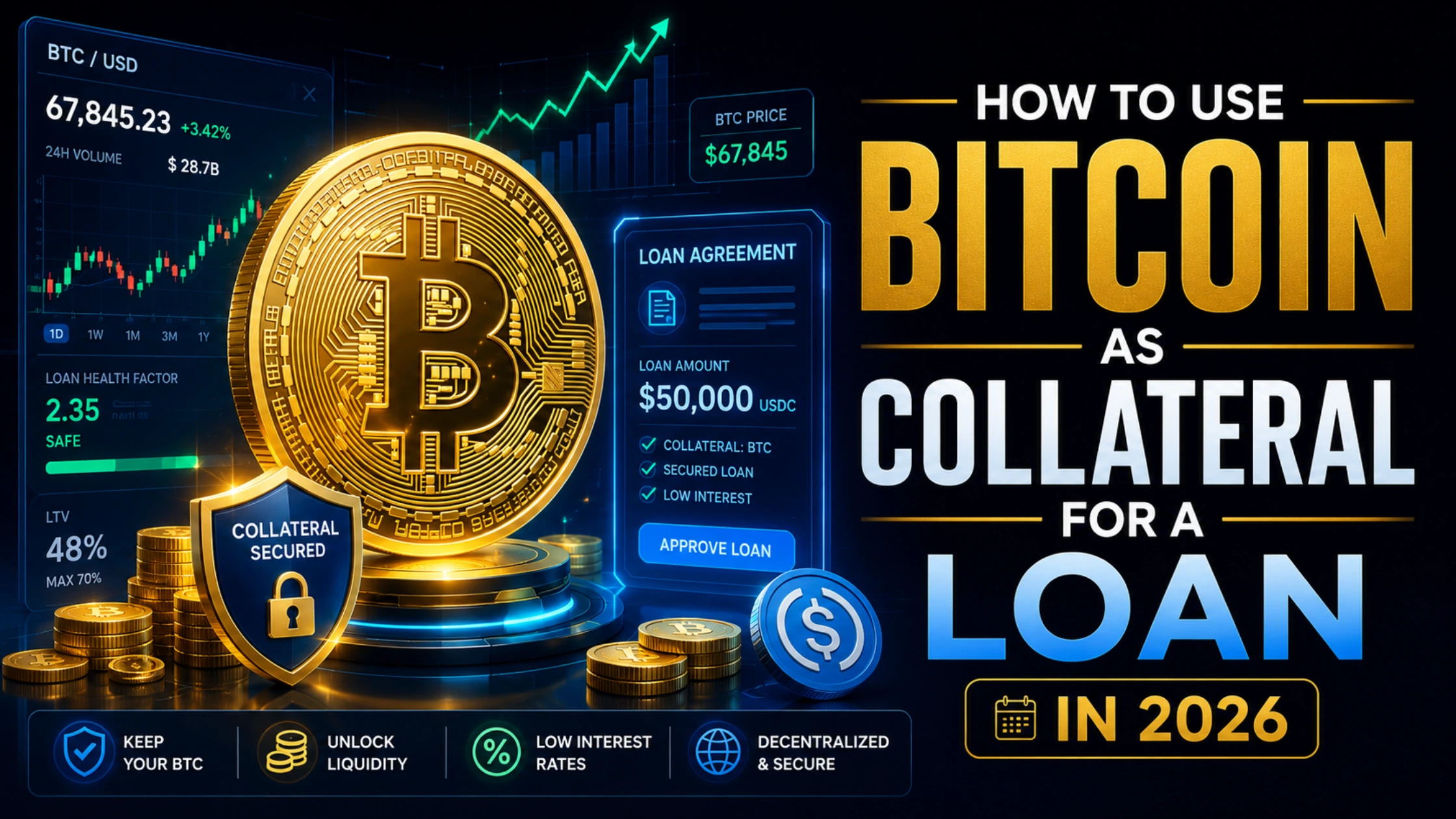
Borrowing against Bitcoin and crypto in 2026 is a mature, institutional-grade financial operation available to retail users through both centralised exchanges and decentralised protocols. The core thesis: you can access significant liquidity from your Bitcoin stack without selling, without triggering capital gains tax, and without surrendering your long-term appreciation upside. Typical loan-to-value ratios range from 50–70% on CeFi platforms — meaning $100,000 in BTC collateral generates $50,000–$70,000 in USDT or fiat borrowings. Margin call LTVs typically trigger at 75–80%, and forced liquidation occurs at 85–91% LTV depending on the platform. CeFi interest rates in 2026 range from approximately 1–15% APR, with Binance Loans offering BTC-collateral rates near 1% at time of research and specialty lenders reaching 14%+. DeFi protocols including Aave ($40B+ TVL), Morpho ($10B+ TVL), and Compound ($2.08B TVL) offer variable borrow rates of 2–8% APR on USDC against crypto collateral, with no KYC, full self-custody, and direct smart-contract interaction. The most important risk management rule: maintain your LTV below 50% at all times if you want to survive a 50% BTC correction without liquidation. A 50% BTC price drop doubles your LTV — an initial 50% LTV loan against Bitcoin becomes 100% LTV if BTC halves, triggering forced liquidation and realising the loss you were trying to avoid by not selling.
The liquidity problem that selling creates
You bought Bitcoin at $12,000 in late 2020. It is now worth $78,000. You need $50,000 for a business investment, a real estate down payment, or an unexpected expense.
You have three options.
Option 1: Sell enough BTC. You convert approximately 0.64 BTC at current prices, receive $50,000, and trigger a capital gains event on the $42,000 of appreciation per coin. Depending on your jurisdiction and holding period, you might owe 15–45% of those gains in tax — reducing your effective proceeds significantly. You also permanently exit the position on those coins.
Option 2: Take out a traditional loan. Credit check. Income verification. Weeks of processing. Potentially declined if you are self-employed or your income is crypto-based. Interest rates of 8–15% APR. Likely to require collateral other than crypto.
Option 3: Borrow against your Bitcoin. Deposit your BTC as collateral on a CeFi exchange or DeFi protocol. Receive USDT, USDC, or fiat equivalent immediately. Pay interest (1–8% APR depending on platform and duration). No credit check. No tax event. No permanent exit from your BTC position. Repay when convenient, retrieve your Bitcoin.
Option 3 is the strategy this article explains completely. It is genuinely the most financially sophisticated choice available to a long-term Bitcoin holder in 2026 — but it comes with specific risks that must be understood before any capital is committed.

Part 1: How crypto-backed loans work — the mechanics
Loan-to-Value (LTV) ratio
LTV is the ratio of what you borrow to the value of your collateral. It is the single most important number in a crypto-backed loan.
If you deposit 1 BTC worth $78,000 and borrow $50,000 in USDT, your initial LTV is: $50,000 ÷ $78,000 = 64.1%
Most CeFi platforms set initial (maximum) LTVs at 60–70% for Bitcoin as collateral. The initial LTV determines how much you can borrow. Most platforms recommend starting well below the maximum — at 40–50% initial LTV — to create a safety buffer against price movements.
Different assets used as collateral have different initial LTVs, which means that when you use different coins as collateral of the same value, the loan amount differs accordingly. Bitcoin typically gets the most favourable LTV terms because of its liquidity depth and lower volatility relative to altcoins.
Margin call and liquidation thresholds
Every crypto loan has two critical LTV thresholds above the initial LTV:
Margin call LTV: When your LTV rises to this level, the platform notifies you to either add more collateral or repay part of the loan. On Binance, this is typically set at 75% for BTC-collateral loans. You receive notifications via email, SMS, and in-app when this level is approached.
Liquidation LTV: If you fail to act after a margin call and your LTV continues rising, the platform automatically sells your collateral to repay the loan. A full liquidation occurs once a hard-cap liquidation LTV of 91% is reached for any cryptocurrency. The entire loan will be repaid using the equivalent value of collateral for that loan position.
The liquidation fee varies by platform: Binance charges 2% of the loan amount, deducted from collateral. OKX charges a similar liquidation penalty.
Being forcefully liquidated may put you in a disadvantageous position as your positions are automatically closed. Since you no longer have open positions in the market, you may miss out on profit-making opportunities should the market condition improve. In addition, because you are not voluntarily liquidating your assets, you do not have a choice in when to sell your assets, which means that your assets may not be sold for an optimal price.
How interest accrues
CeFi platforms calculate interest differently: Binance accrues interest every minute based on the total outstanding loan and the prevailing APR. OKX accrues daily. DeFi protocols like Aave calculate interest per block, updating continuously.
The compounding effect of interest charges means that the longer you hold a loan without repayment, the faster your LTV rises — not just from BTC price movements but from accumulating interest. For very long-term loans (6–12+ months), interest accumulation alone can push LTV toward the margin call threshold even if BTC price holds steady.
The LTV safety calculation
The fundamental question every borrower must answer before taking out a crypto-backed loan: at what BTC price does my loan get liquidated?
The formula: Liquidation price = (Borrowed amount ÷ Liquidation LTV) ÷ (Amount of BTC collateral)
Example: You deposit 1 BTC at $78,000, borrow $40,000 USDT, initial LTV is 51.3%. Liquidation LTV is 91%.
Liquidation price = ($40,000 ÷ 0.91) ÷ 1 = $43,956
Your 1 BTC collateral gets liquidated if BTC drops to approximately $44,000 — a fall of 43.6% from your entry point of $78,000. With a conservative initial LTV of ~51%, you are protected through a significant correction. The math changes dramatically at 65% initial LTV:
Deposit 1 BTC at $78,000, borrow $50,700 USDT (65% LTV). Liquidation price = ($50,700 ÷ 0.91) ÷ 1 = $55,714. BTC needs to fall only 28.6% to trigger liquidation. A 30% correction in a normal crypto cycle is routine.
The conservative borrower’s rule: Target initial LTV of 40–45% maximum on BTC-collateral loans. This provides protection through a 50%+ price correction.

Part 2: CeFi loan comparison — Binance, OKX, Bybit, KuCoin
Binance Loans
Binance is one of the world’s largest centralized exchanges offering a wide range of services including cryptocurrency loans with low annual interest rates. At the time of writing, a loan on BTC has an interest rate just over 1%. This is significantly lower than most competing CeFi platforms and represents one of the key advantages of using Binance’s loan product for long-term Bitcoin holders.
Key specifications:
- Supported collateral: 50+ cryptocurrencies including BTC, ETH, BNB, SOL, and major altcoins
- Borrowed assets: USDT, USDC, BUSD, and other major assets
- Initial LTV: Up to 65% for BTC collateral (varies by asset)
- Margin call LTV: 75%
- Liquidation LTV: 83% (standard) — hard cap at 91%
- Liquidation fee: 2% of borrowed amount
- Interest calculation: Accrued per minute on outstanding balance
- Minimum loan: $100 equivalent; Fixed Rate Loan minimum $50,000
Your collateral assets will be frozen in your spot wallet once the order is placed. Once the order is matched, your collateral assets will be transferred under Binance’s custody. You will receive the borrowed assets minus the pre-calculated interest in your spot wallet. Please monitor the LTV closely to avoid liquidation.
Binance’s VIP Loan product is available to VIP-tier users with a minimum first-order of $500,000. It offers customised margin call processes, better collateral utilisation (collateral in the Spot Wallet can be freely traded in the spot market as long as LTV ratios are maintained), and the ability to negotiate interest rates.
Best for: Retail users seeking the lowest CeFi interest rates on BTC-collateral loans. Binance’s ~1% APR on BTC loans is the most competitive CeFi rate in the comparison.
Register on Binance — code CPA_00SXKU7IO9

OKX Crypto Loans
OKX’s loan product integrates directly with its Unified Trading Account, providing capital efficiency advantages that standalone loan products cannot match. A BTC position serving as collateral in an OKX loan can simultaneously serve as margin for futures positions in the UTA — meaning the same Bitcoin works for two purposes at once.
Key specifications:
- Initial LTV: Up to 70% for BTC collateral
- Margin call LTV: 75%
- Liquidation LTV: 80–85% depending on asset
- Interest rate: Variable, typically 3–8% APR for BTC-collateral USDT loans at standard tier
- Supported collateral: BTC, ETH, OKB, and approved assets
- Repayment: Flexible, no prepayment penalty
OKX’s loan product benefits from its $2.7 billion perpetual insurance fund — not directly relevant to loan mechanics but indicative of the platform’s overall financial solidity as a counterparty.
The UTA integration is the primary differentiator. A trader who wants to borrow USDT against their BTC to deploy in a trading strategy — rather than for personal liquidity — gets significantly better capital efficiency on OKX than on Binance, because the collateral and the trading positions exist in the same margin pool.
Register on OKX — code 2136301

Bybit Crypto Loans
Bybit’s loan product follows the same fundamental structure as Binance and OKX, with USDT borrowing against BTC, ETH, and major altcoin collateral.
Key specifications:
- Initial LTV: Up to 65% for BTC
- Margin call LTV: 75%
- Liquidation LTV: 83%
- Interest rate: Variable, competitive with OKX at 3–7% APR for standard accounts
- UTA integration: Loan collateral interacts with UTA margin pool
- Minimum: Low minimum thresholds appropriate for retail
Bybit’s loan product strength is its integration with the broader Bybit ecosystem. Borrowed USDT can be immediately deployed in copy trading, perpetual futures, or staking products without leaving the platform. For users who want to borrow against their BTC to fund an active trading operation on Bybit specifically, this is the most frictionless path.
Register on Bybit — code 46164

KuCoin Crypto Loans
KuCoin’s margin lending and loan products offer BTC-collateral loans with competitive rates and deep altcoin collateral support. For users holding altcoin assets alongside Bitcoin, KuCoin’s broader collateral acceptance means more of your portfolio can serve as loan collateral.
Key specifications:
- Supported collateral: 150+ tokens
- Interest rate: Variable, 4–10% APR depending on asset and market demand
- Initial LTV: Up to 60% for BTC, varies by altcoin
- Liquidation fee: 2% standard
KuCoin’s Margin Lending feature also allows users to lend their assets to other borrowers, earning interest income — creating a natural complement to the loan product for users who want to both borrow against their BTC and earn on idle USDT from the proceeds.
Register on KuCoin — code CX8QMK4M

CoinEx Crypto Loans
CoinEx offers a crypto loan product with competitive rates and the platform’s distinctive optional-KYC structure. For users who want to borrow against crypto without full identity verification, CoinEx’s lower KYC threshold provides more accessible entry.
Register on CoinEx — code wynsf
CeFi loan comparison table
Platform | Max initial LTV | Margin call LTV | Liquidation LTV | Rate (BTC collateral) | Liquidation fee | Min loan |
Binance | 65% | 75% | 83–91% | ~1% APR | 2% | $100 |
OKX | 70% | 75% | 80–85% | 3–8% APR | ~2% | $100 |
Bybit | 65% | 75% | 83% | 3–7% APR | ~2% | $100 |
KuCoin | 60% | 75% | 80% | 4–10% APR | 2% | Variable |
CoinEx | 60% | 75% | 83% | 5–9% APR | 2% | $50 |
Rates are indicative and change based on market conditions. Verify current rates on each platform’s loan product page before borrowing.

Part 3: DeFi alternatives — Aave, Morpho, and Compound
DeFi lending protocols offer a fundamentally different structure from CeFi: you maintain self-custody of your assets through the collateral process, there is no counterparty that can freeze your account, and rates are set algorithmically by supply and demand rather than by a platform.
The tradeoffs: no customer support, no credit recovery if something goes wrong, smart contract risk is real, and the user experience requires familiarity with Web3 wallets (MetaMask, Rabby) and gas fee management.
DeFi lending has crossed the institutional threshold in 2026, with on-chain lending capturing roughly two-thirds of the $73.6 billion crypto-collateralized lending market. Aave dominates at $40B+ TVL and $1 trillion in cumulative loans originated, while Morpho has emerged as the modular lending layer of choice with $10B+ TVL and an Apollo Global Management partnership.
Aave — the DeFi lending default
Aave’s borrowing rates are variable and fluctuate based on supply and demand for each asset. As of 2026, typical USDC borrowing rates range from 2–8% during normal market conditions but can spike above 15% during high-demand periods.
Aave V3 holds over $40B in TVL across 14+ chains including Ethereum, Arbitrum, Optimism, Polygon, Base, and Avalanche. The protocol has originated $1 trillion in cumulative loans, making it the most battle-tested smart contract lending system in existence.
For BTC-collateral borrowing on Aave: You would use Wrapped Bitcoin (WBTC) or cbBTC (Coinbase Wrapped Bitcoin) as collateral — wrapped versions of Bitcoin that operate as ERC-20 tokens on Ethereum-compatible chains. The wrapping process introduces an additional counterparty risk (the WBTC custodian or cbBTC issuer) that does not exist in CeFi BTC-collateral lending. However, the elimination of exchange counterparty risk on the lending side may offset this for users concerned about CeFi platform solvency.
Aave V3 introduced eMode for correlated-asset efficiency — borrow stablecoins against stablecoins at 97% LTV, borrow ETH against LSTs at 93%. For standard BTC (WBTC) collateral, LTV ratios are typically 70–75% on Aave, meaning you can borrow more against the same collateral value than on most CeFi platforms — at the cost of self-managing liquidation risk.
USDC borrow rates on Aave V3: Typically 3–6% APR on Ethereum mainnet and Arbitrum, depending on utilisation. Higher demand (more borrowers) pushes rates up; lower demand pushes them down. GHO (Aave’s native stablecoin) offers governance-set rates that are more stable and often lower than market rates for variable stablecoin borrowing.
Aave is best for: Self-custody maximalists, experienced DeFi users comfortable with wallet management and gas fees, and users who want to avoid any CeFi platform exposure entirely.
Morpho — optimised rates through modular architecture
As of early 2026, Morpho Blue typically offers the highest supply rates for stablecoins (4–8% on USDC) because its peer-to-peer matching and modular vault architecture reduce the spread between supply and borrow rates.
Morpho crossed $10B TVL in Q4 2025, driven by Coinbase USDC lending integration and Apollo Global Management’s institutional vault partnership. Morpho Blue is roughly 650 lines of Solidity implementing isolated lending markets. Each market is defined by five immutable parameters: loan asset, collateral asset, liquidation LTV, oracle, and interest rate model.
For borrowers, Morpho’s isolated market architecture means that the parameters of your specific loan are fixed at market creation — no governance vote can retroactively change the LTV threshold or oracle for your position. This provides more predictable risk management than pooled lending protocols where governance can modify parameters mid-loan.
Borrow rates on Morpho for USDC against WBTC collateral are typically 0.5–1.5% higher than Aave on equivalent markets, due to the peer-to-peer matching efficiency that reduces the lender-borrower spread. I’ve personally seen USDC supply rates on Morpho run 1–2% higher than on Aave during certain periods.
Morpho is best for: Experienced DeFi users willing to select specific market parameters and curator vaults for optimised rates, accepting the additional complexity in exchange for potentially better borrowing costs and isolated market risk.

Compound — conservative institutional alternative
Compound remains a foundational DeFi lending protocol, though it has ceded market share to Aave and Morpho. With $2.08B TVL and a deliberate multi-chain expansion strategy, Compound is positioning itself as the conservative, highly audited option for institutional participants.
Compound III moved from its original pooled-asset model to single-asset markets, where each deployment has a single base asset (usually USDC) that borrowers can borrow against multiple collateral types. This simplifies risk management compared to Morpho’s modular approach but limits flexibility.
Borrow rates on Compound for USDC are typically 3–5% APR — competitive with Aave, slightly below Morpho for equivalent markets. The 5+ year security track record with no core protocol exploit makes it the conservative default for institutional borrowers entering DeFi.

DeFi vs CeFi: the real comparison
Dimension | CeFi (Binance/OKX/Bybit) | DeFi (Aave/Morpho) |
Custody | Exchange holds your BTC | You retain custody via smart contract |
Rate range | 1–15% APR | 2–8% APR (variable) |
KYC requirement | Yes (full KYC) | No KYC required |
Liquidation risk | Managed by exchange risk engine | Managed by protocol, executed by liquidator bots |
Collateral for BTC | Actual BTC | Wrapped BTC (WBTC, cbBTC) — adds wrapper risk |
Maximum LTV | 60–70% | 70–75% (Aave, more on Morpho) |
Customer support | Yes | None |
Gas costs | None | $5–$50+ per transaction on mainnet; near-zero on L2 |
Smart contract risk | Platform risk | Smart contract exploit risk |
The honest summary: for most users — particularly those new to crypto lending or using BTC as collateral — CeFi platforms are the right starting point. Binance’s ~1% APR for BTC-collateral loans makes the CeFi case compelling on cost grounds alone. DeFi becomes relevant for users with larger positions, higher privacy requirements, or specific conviction about avoiding exchange counterparty risk.

Part 4: The tax advantage — why this strategy works
The tax case for crypto-backed lending is straightforward but worth explaining precisely, because it is the primary motivation for most sophisticated users.
Without a loan: You sell 0.64 BTC at $78,000, receiving $50,000. Your cost basis is $12,000 (purchase price per coin). You realise a capital gain of ($78,000 − $12,000) × 0.64 = $42,240. Depending on your jurisdiction and holding period:
- US (long-term rate, 15%): $6,336 in federal capital gains tax
- US (long-term rate, 20%): $8,448 in federal capital gains tax
- UK (CGT rate, 20%): $8,448 in tax
- South Africa (CGT, maximum effective 18%): $7,603 in tax
- Australia (CGT with 50% discount after 12 months, 30% marginal rate): $6,336 in tax
With a loan: You borrow $50,000 USDT against 0.64 BTC collateral. You pay interest at 3% APR for 12 months: $1,500. You retain your BTC position. No capital gains event occurs. Your after-interest cost of accessing $50,000 is $1,500 — versus $6,000–$8,000 in tax liability from selling.
The interest cost of the loan (in the most common scenarios) is significantly lower than the tax cost of selling. The strategy becomes even more powerful when the Bitcoin you would have sold continues appreciating during the loan period.
Critical caveats:
Crypto loans are not income, not deductible as a business expense in most jurisdictions for personal loans, and generate no immediate tax event on receipt of borrowed funds. The loan repayment is not a taxable event either — you are simply returning borrowed money and retrieving your collateral.
However, if your collateral is liquidated because you fail to manage your LTV, that liquidation is a taxable disposal event in most jurisdictions — you have effectively sold your Bitcoin at the liquidation price, triggering a capital gain or loss. This is the worst possible outcome: you lose your upside exposure and trigger the tax event you were trying to avoid.
Interest paid on crypto-backed loans may be deductible as investment interest expense in some jurisdictions (the US allows this under certain conditions). Consult a qualified tax adviser for the treatment specific to your jurisdiction and circumstances. Coinledger generates jurisdiction-specific crypto tax reports that can help classify loan-related expenses.

Part 5: Risk management — surviving a 50% BTC correction
The most important section of this guide. Everything above is available information. This is the section where most borrowers make fatal errors.
The liquidation mathematics of a 50% crash
Assume you hold 1 BTC at $78,000 and take a loan at 50% initial LTV, borrowing $39,000 USDT.
BTC falls 50% to $39,000.
Your new LTV: $39,000 (loan) ÷ $39,000 (collateral value) = 100%.
At any liquidation LTV above 83%, you have been liquidated. Your 1 BTC has been sold by the platform to repay the $39,000 loan, minus the 2% liquidation fee ($780). You receive the residual — approximately zero — and your BTC position is gone.
At 50% initial LTV on Binance (which has an 83% liquidation threshold), the BTC price fall that triggers liquidation is:
Liquidation price = (Loan amount ÷ Liquidation LTV) ÷ BTC amount = ($39,000 ÷ 0.83) ÷ 1 = $46,988.
A 39.8% drop from $78,000 liquidates the position. BTC has experienced two corrections exceeding 40% within the past three years.
At 35% initial LTV ($27,300 loan), the liquidation price drops to:
($27,300 ÷ 0.83) ÷ 1 = $32,892.
A 57.8% drop from $78,000 is required to trigger liquidation. Only the COVID crash and the FTX collapse produced corrections of that magnitude for BTC. The conservative LTV is the primary risk control.

The five rules of safe crypto-backed borrowing
Rule 1 — Never exceed 40% initial LTV on BTC collateral. This provides protection through a 50%+ price correction. The additional borrowing capacity at 50–65% LTV is not worth the liquidation risk in crypto’s historically volatile market.
Rule 2 — Set a personal margin call alert below the platform’s margin call. Most platforms notify at 75% LTV. Set your own alert at 65–70% LTV and act on it before the platform acts for you. On Binance, you can monitor LTV in the Loans dashboard in real time.
Rule 3 — Hold repayment capital in reserve. Keep 15–20% of your borrowed amount in immediately accessible form (USDT, USDC) so you can repay part of the loan or add collateral the moment your alert fires. The worst position to be in is a BTC crash with no liquid capital to defend your position.
Rule 4 — Consider multi-collateral positions. If you hold ETH alongside BTC, spreading collateral across both assets reduces the impact of a single asset’s price move. A simultaneous crash in both BTC and ETH to liquidation-threatening levels is less likely than either crashing alone.
Rule 5 — Match loan duration to use case. If you need liquidity for 30 days, a 30-day loan is appropriate. If you need 12 months, a 12-month fixed-rate loan is appropriate. Variable-rate loans for long-duration needs expose you to rate increases that compound your interest burden over time.

What to do when BTC falls 20%
When BTC falls 20% from your entry price, your LTV (at a conservative 40% initial LTV) rises to approximately 50% — still well below the margin call level. You have three options:
- Do nothing. Monitor and wait. At 40% initial LTV with a 50% BTC buffer, you have significant room before the position becomes threatened.
- Partially repay the loan to reduce LTV. Converting some of the borrowed USDT back into repayment reduces the loan balance and brings LTV back toward your target level.
- Add collateral. Deposit additional BTC (or other supported collateral) to increase the collateral value relative to the loan, reducing LTV.
Do not panic-close the loan at the bottom of a correction unless LTV is genuinely approaching the margin call level. The purpose of the conservative initial LTV is to allow you to ride out normal market corrections without forced action.
Using deBridge to move collateral fast
If your collateral is on a different network from your loan platform, deBridge processes cross-chain USDT and USDC transfers in under 2 minutes, allowing rapid collateral top-ups when a margin call alert fires. For DeFi positions on Aave, deBridge enables fast movement of USDC from a centralised exchange to your MetaMask wallet without waiting for standard bridge processing times.
Use deBridge for fast cross-chain transfers

Part 6: Step-by-step — how to take your first crypto-backed loan
Step 1 — Calculate your safe borrowing amount. Start with your BTC value. Calculate 35–40% of that value. That is your maximum borrow amount. For 1 BTC at $78,000: maximum safe loan = $78,000 × 0.38 = $29,640.
Step 2 — Choose your platform. CeFi beginner (lowest friction): Binance. CeFi intermediate (UTA integration): OKX or Bybit. DeFi (self-custody preferred): Aave on Arbitrum or Base for low gas costs.
Step 3 — Navigate to the loan product. On Binance: Earn → Loan. On OKX: Finance → Crypto Loan. On Bybit: Finance → Crypto Loan. On Aave: Connect MetaMask at app.aave.com, navigate to the supply and borrow interface.
Step 4 — Select collateral and amount. Choose BTC (or WBTC on Aave). Enter your collateral amount. The platform displays the maximum borrowable amount and current LTV.
Step 5 — Set the loan amount below your maximum. Enter a loan amount that gives you a 35–40% initial LTV, not the maximum available. The platform confirms interest rate, margin call LTV, and liquidation LTV.
Step 6 — Confirm and set monitoring. After confirmation, set a personal LTV alert in the platform’s notification settings. If unavailable natively, set a price alert in TradingView or your preferred charting tool — calculate the BTC price level that corresponds to your 65% LTV alert threshold and set the alert there.
Step 7 — Keep repayment capital accessible. Maintain 15–20% of the borrowed amount in USDT or USDC outside the platform — either in a separate exchange or in a DeFi stable product — available for immediate deployment if needed.
FAQ
Does borrowing against crypto trigger a tax event?
No. Receiving borrowed funds is not income and is not a capital gains event in virtually all jurisdictions. The loan proceeds — USDT, USDC, or fiat — are not taxable on receipt. Interest paid on the loan may be deductible as investment interest expense in some jurisdictions. A collateral liquidation, however, is a taxable disposal event. Avoiding liquidation is therefore both a financial and tax imperative.
What happens if I cannot repay the loan?
If you cannot repay and your LTV reaches the liquidation threshold, your collateral is sold automatically to repay the loan. Any residual value after repayment and the 2% liquidation fee is returned to your account. This is a permanent realisation of your Bitcoin position at the liquidation price — typically the worst possible sale price in a downturn — plus a taxable disposal event.
What is the difference between CeFi and DeFi crypto loans?
CeFi loans (Binance, OKX, Bybit) require KYC, custody your BTC with the exchange, offer direct fiat or stablecoin output, and provide customer support. DeFi loans (Aave, Morpho, Compound) require no KYC, maintain your assets in self-custody through smart contracts, use wrapped BTC as collateral, and have no customer support. DeFi rates may be lower and LTVs may be higher, but smart contract risk and the technical complexity of managing positions are genuine barriers for most retail users.
Can I be liquidated on a DeFi protocol?
Yes. DeFi protocols use automated liquidator bots that monitor positions constantly and liquidate any position that breaches the liquidation LTV threshold. The process is faster and less forgiving than most CeFi platforms — there is no customer service to call, no extension to negotiate. The protocol executes the liquidation automatically and irreversibly.
What is the minimum amount I need to take a crypto-backed loan?
Most CeFi platforms have minimums of $50–$100 equivalent. Aave’s practical minimum is higher due to gas costs — on Ethereum mainnet, a $500 loan might cost $30–$80 in gas, making small loans economically inefficient. On Arbitrum or Base, gas costs are under $1, making smaller DeFi loan positions practical.
How do I repay the loan?
CeFi: Navigate to the loan dashboard, select the position, and click repay. Repayment is typically in the same asset borrowed (USDT if you borrowed USDT). DeFi on Aave: Navigate to your borrowing dashboard, select the asset, and click repay using your connected wallet. On Aave, you can also repay using collateral in a single transaction, reducing the complexity of sourcing the repayment asset separately.
Where to start your crypto-backed loan
- Binance — code CPA_00SXKU7IO9 — ~1% APR BTC loan rate, 50+ collateral assets, most accessible entry point
- OKX — code 2136301 — UTA integration for capital efficiency, $2.7B insurance fund
- Bybit — code 46164 — UTA loan integration with direct trading deployment
- KuCoin — code CX8QMK4M — 150+ collateral assets, altcoin-friendly
- CoinEx — code wynsf — Low minimum, optional KYC structure
- deBridge — Fast cross-chain collateral movement for DeFi positions
- Coinledger — Tax treatment tracking for loan interest and any liquidation events
Decentralised News participates in affiliate programs with the platforms referenced in this article and earns commission when readers register and use our links. This does not affect editorial positions. Crypto-backed lending involves significant financial risk including the potential liquidation of your collateral assets. Nothing in this article constitutes financial or tax advice. Always consult a qualified financial and tax professional before using crypto-backed lending products.
Recommended reading:
Crypto for Retirement: The Complete 2026 Guide to Building a Self-Directed Crypto Pension
Bitcoin vs Gold vs Real Estate vs S&P 500: 10-Year Return Comparison
How to buy Bitcoin in 2026: the complete beginner’s guide by country
Lowest Crypto Futures Fees in 2026: Every Major Exchange Ranked and Calculated
Best Crypto Sign-Up Bonuses and New User Rewards in 2026
Best Crypto Futures Trading Competitions in 2026: Where Active Traders Can Earn Rewards
Best Crypto Exchanges for Beginners (2026)
The Best Crypto Exchanges for Beginners in 2025
How to Buy Bitcoin in Every Country (Ultimate 2026 Global Guide)
About the Author