Quick Summary
Pandemics usually hit markets in three phases: liquidity crash, policy rescue, asset repricing. The first phase is brutal because investors sell liquid assets to raise cash. The second phase begins when central banks and governments respond. The third phase is where scarce, liquid and high-duration assets can explode higher.
The COVID cycle showed this clearly. The S&P 500 fell sharply in early 2020, then recovered after emergency monetary and fiscal support. The St. Louis Fed notes that the S&P 500 fell to roughly 66% of its February 2020 peak by March 23, 2020, then recovered to 115% of that pre-crisis peak by February 2021.
Crypto’s version was even more extreme. Bitcoin and Ethereum collapsed during the March 2020 forced-liquidation event, then recovered violently as liquidity returned, rates collapsed, stimulus flowed and the “digital scarcity” narrative went mainstream. The uploaded research correctly identifies COVID as crypto’s only full pandemic-cycle case study and frames the March 2020 crash as a leverage and liquidity event rather than proof that Bitcoin “failed” as a hedge.
The current hantavirus outbreak linked to the MV Hondius cruise ship should not be treated as COVID 2.0. WHO reported eight cases linked to the ship, including three deaths, with five confirmed as hantavirus. WHO and public-health authorities continue to treat the global risk as low, while monitoring contacts and coordinating internationally.
The market-relevant scenario is not the current outbreak. It is the low-probability, high-impact scenario in which Andes virus or another hantavirus strain mutates into efficient sustained human-to-human transmission. CDC says Andes virus is the only hantavirus known to spread person-to-person, but that spread is usually limited to close contact with a sick person.
The 2026 macro backdrop makes the scenario more important. The Fed held rates at 3.5% to 3.75% at its April 2026 meeting, leaving room to cut if growth breaks, but also facing inflation and credibility constraints.
Crypto is structurally stronger than it was in 2020. US spot Bitcoin ETF assets have surpassed $100 billion, with cumulative net inflows around $58 billion since launch, creating a regulated institutional access channel that did not exist during COVID.
The CLARITY Act is also a major catalyst, but it should be framed accurately. It passed the House in July 2025 with a 294-134 vote, but Galaxy’s April 2026 analysis says its path to becoming law remains uncertain, with Senate negotiations still unresolved.
Core thesis: If hantavirus fear remains contained, the market impact fades. If fear spikes without pandemic transmission, crypto may dip and recover. If a true pandemic shock emerges, Bitcoin and crypto likely crash first, then become major beneficiaries of forced easing, fiscal deficits, ETF inflows, stablecoin adoption, AI automation demand and tokenised financial infrastructure.

The Core Thesis in One Chart
Phase | Pandemic Market Behavior | Stocks | Real Estate | Crypto | Best Decentralised News Angle |
Phase 1 | Fear and liquidation | Broad selloff, volatility spike | Transactions freeze, CRE weakens | BTC, ETH and alts fall hard as liquidity is sold | “Crash first, don’t panic-read the wrong signal” |
Phase 2 | Policy rescue | Rate cuts, liquidity facilities, fiscal support | Mortgage/liquidity support stabilizes housing | Stablecoins, ETFs and BTC spot demand become important | “Markets stop pricing disease and start pricing rescue” |
Phase 3 | Liquidity repricing | Tech, healthcare and quality growth recover | Residential/logistics/data centers outperform | BTC, ETH, RWA, DeFi and AI tokens lead if liquidity returns | “Scarcity and digital rails absorb the stimulus” |
Why Pandemics Matter to Markets
Pandemics are not just health events.
They are liquidity events.
They change how people move, work, spend, borrow, save and trust institutions. They force governments and central banks to decide whether to protect purchasing power or protect the financial system.
In almost every modern crisis, policymakers choose the system.
That means lower rates, fiscal support, liquidity injections and emergency facilities.
This is why pandemic markets can look irrational:
The economy gets worse.
Stocks recover.
Housing rallies.
Bitcoin explodes.
Speculative assets go vertical.
That is not because the pandemic is good.
It is because the policy response changes the value of money.
The uploaded research captures the key pattern well: pandemics are accelerants. They compress structural change into months instead of years. COVID accelerated remote work, e-commerce, digital payments, DeFi, retail trading, Bitcoin adoption and the institutional case for hard digital assets.

100 Years of Pandemics and Asset Prices
Historical Pandemic Market Table
Event | Main Market Shock | Equity Impact | Real Estate Impact | Policy Response | Long-Term Lesson |
Spanish Flu, 1918–1920 | Mortality shock during WWI and post-war transition | Depressed returns during waves, but no permanent equity collapse | Limited comparable modern data | Wartime demand and post-war fiscal transition | Severe disease does not automatically mean permanent bear market |
Asian Flu, 1957–1958 | Recessionary shock | US stocks corrected, then recovered | Housing slowed but did not collapse nationally | Fed easing and fiscal support | Markets bottom before health fear fully clears |
Hong Kong Flu, 1968–1969 | Pandemic plus inflation and policy stress | Mixed because bear market was multi-causal | REIT era begins shortly after | Broader macro instability | Pandemic impact depends on macro regime |
SARS, 2002–2003 | Regional travel and Asia confidence shock | Hong Kong and affected Asian markets hit, US less exposed | Local property weakness, later rebound | Regional liquidity support | Containment limits systemic market damage |
H1N1, 2009 | Pandemic during post-GFC recovery | Stocks kept recovering after GFC lows | Real estate still dominated by GFC | QE and crisis facilities already active | A pandemic inside an easing cycle can be absorbed |
Ebola, 2014–2016 | Severe but geographically contained outbreak | Brief global volatility, healthcare bid | Minimal global impact | Health-focused response | High fatality alone does not move global markets without economic transmission |
COVID-19, 2020–2022 | Global lockdown, liquidity crash, policy explosion | S&P 500 collapsed then hit new highs | Housing surged, offices/retail weakened | Zero rates, QE, fiscal stimulus | Policy response mattered more for asset prices than case counts |
The Three Rules of Pandemic Markets
Rule 1: Markets Sell the Unknown First
The first move is almost always defensive.
When investors cannot model the outbreak, they reduce risk. Liquid assets sell fastest. This is why Bitcoin can fall sharply even if its long-term thesis improves.
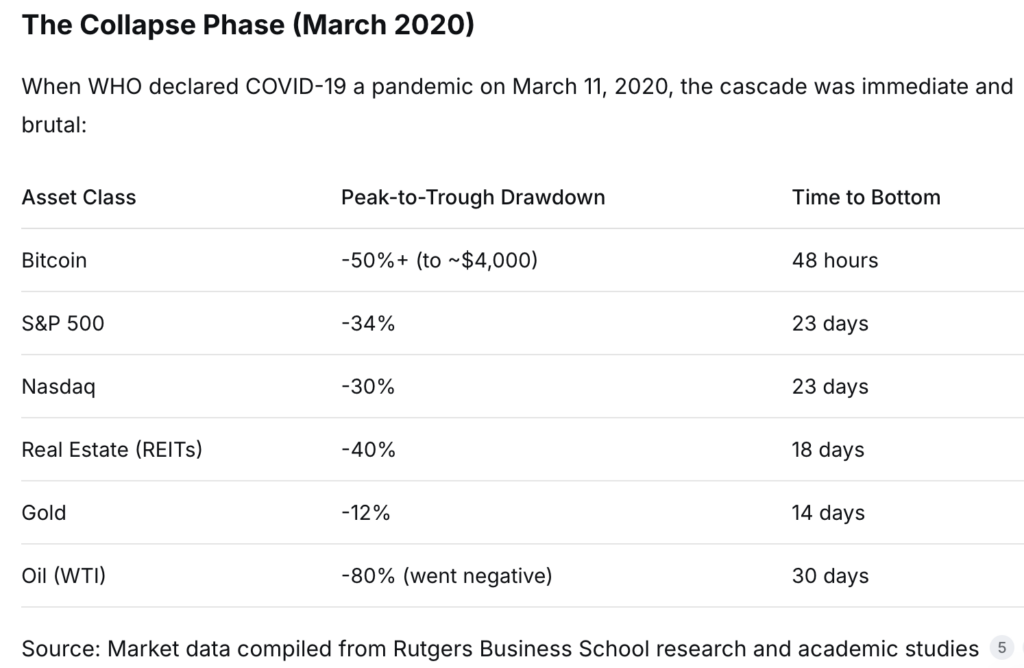
During the COVID panic, Bitcoin did not behave like a perfect hedge. It behaved like a liquid asset in a global margin call. That matters because it is likely to happen again in any sudden pandemic fear event.
Rule 2: Policy Response Creates the Real Trade
The strongest pandemic rallies begin after policy becomes credible.
The moment the market believes the Fed, Treasury and global central banks will defend credit and liquidity, the focus shifts from disease data to money supply.
This is where Bitcoin becomes important.
Bitcoin is not a claim on corporate earnings. It is not a cash-flow asset. It is a scarce monetary network. When the denominator is being diluted, Bitcoin becomes a more attractive numerator.

Rule 3: The Winners Are the Assets That Fit the New Behavior
COVID did not lift every asset equally.
It rewarded:
Remote work.
Cloud.
E-commerce.
Suburban housing.
Digital payments.
Bitcoin.
Ethereum.
DeFi.
Retail trading platforms.
A future pandemic would likely reward a different but related basket:
AI automation.
Healthcare infrastructure.
Tokenised treasuries.
Stablecoins.
Bitcoin.
Ethereum.
Data centers.
Onchain finance.
Decentralised infrastructure.

Hantavirus 2026: Reality vs Market Scenario
What We Know Now
The current outbreak is linked to the MV Hondius cruise ship. WHO reported eight total cases linked to the ship, including three deaths, with five confirmed as hantavirus.
The virus involved is Andes virus, a hantavirus strain associated with South America. Public-health authorities emphasize that the general-public risk remains low, and the known person-to-person transmission pattern is far less efficient than COVID-style respiratory spread.
So the responsible base case is clear:
This is not currently a global pandemic setup.
What Markets Would Fear
Markets do not only price the base case.
They price tail risk.
The market-relevant risk is a mutation or behavioral shift in transmission that creates sustained spread across multiple regions.
That is the scenario that would change everything.
A high-fatality pathogen with efficient human-to-human spread would create a different economic shock from COVID. The uploaded research calls this “voluntary decoupling,” where people withdraw from normal activity even before governments impose restrictions.
That is the scenario where markets would react violently.
Not because the current outbreak justifies panic.
Because the tail risk is unusually asymmetric.
The 2026 Macro Setup
The Fed is not where it was in 2020.
In early 2020, the Fed still had room to cut aggressively and restart emergency liquidity operations into a disinflationary shock.
In 2026, the Fed has room to cut, but the inflation and debt backdrop is more complicated.
The April 2026 FOMC statement held the federal funds target range at 3.5% to 3.75%, while saying the Committee would assess incoming data, the outlook and the balance of risks.
That makes a pandemic shock more complex.
If growth collapses, the Fed cuts.
If supply chains break and inflation rises, the Fed hesitates.
If credit markets seize, the Fed acts anyway.
That is where Bitcoin’s thesis strengthens.
In a world of fiscal dominance, high debt, rate-cut pressure and crisis politics, monetary restraint becomes hard to maintain.
Bitcoin becomes a vote against the system’s ability to stay disciplined.
The Crypto Difference Between 2020 and 2026
2020 Crypto Market
Feature | 2020 |
US spot Bitcoin ETFs | None |
Institutional access | Limited |
Bank custody | Early and constrained |
Stablecoin role | Growing, but not mainstream |
DeFi | Experimental |
Regulatory clarity | Weak |
Bitcoin narrative | Digital gold emerging |
Market structure | Retail and offshore leverage-heavy |
2026 Crypto Market
Feature | 2026 |
US spot Bitcoin ETFs | Major institutional channel |
Institutional access | Much deeper |
Bank custody | Improving |
Stablecoin role | Core macro-financial topic |
DeFi | More mature |
Regulatory clarity | CLARITY pending, stronger policy momentum |
Bitcoin narrative | Scarce digital collateral |
Market structure | ETF flows, derivatives, custody and onchain rails |
This is why the next crisis would not be a replay of 2020.
It would be 2020 with stronger rails.
That does not mean less volatility.
It means faster absorption if institutional buyers step in after the crash.

Pandemic Scenario Matrix for 2026
Scenario | Probability | Health Path | Market Path | Crypto Path | Strategy Theme |
Contained outbreak | Highest | MV Hondius cluster contained, no sustained spread | Temporary headline volatility | BTC and alts return to macro/ETF/regulatory drivers | Do not overtrade headlines |
Fear spike | Moderate | More cases, but still limited transmission | Risk assets correct, travel weakens | BTC dips 15–30%, alts worse, recovery if no escalation | Watch ETF flows and leverage flush |
True pandemic mutation | Low | Sustained human-to-human spread across regions | Sharp equity drawdown, credit stress, Fed response | Crypto crashes first, then BTC/ETH lead if liquidity returns | Buy the policy response, not the panic |
Severe global shock | Very low but extreme | High-fatality sustained spread | Deep recession, emergency QE/fiscal expansion | BTC, stablecoins, ETH, RWAs become crisis infrastructure after crash | Digital bearer assets become survival capital |
Specific Tokens to Watch
This is not a recommendation to buy. It is a watchlist framework for a pandemic-liquidity scenario.
The strongest tokens are those that align with the likely post-shock themes:
- Scarce digital collateral
- Stablecoin settlement
- Tokenised Treasuries and RWAs
- DeFi liquidity markets
- AI and automation
- Oracle and data infrastructure
- Ethereum scaling
Token Watchlist Table
Token | Sector | Pandemic Thesis | Risk Level | Where to Trade |
BTC | Digital scarcity | Core hard-money asset if Fed cuts and liquidity expands | Lower crypto risk | Binance, Bybit, OKX, Kraken, Luno, VALR |
ETH | Settlement layer | Stablecoins, DeFi, RWAs and L2 activity run through Ethereum ecosystem | Medium | Binance, Bybit, OKX, Kraken, KuCoin |
SOL | High-speed consumer crypto | Payments, DePIN, mobile trading and retail liquidity during risk-on recovery | Medium-high | Binance, Bybit, OKX, KuCoin, MEXC |
LINK | Oracles and CCIP | Critical data layer for DeFi, RWAs, proof-of-reserve and institutional settlement | Medium | Binance, OKX, Kraken, MEXC |
ONDO | RWA/tokenised finance | Tokenised Treasuries and onchain yield may grow during crisis liquidity demand | High | Binance, OKX, Bybit, KuCoin |
AAVE | DeFi lending | Onchain borrowing, stablecoin liquidity and collateral markets can expand | High | Binance, OKX, Kraken, Bybit |
ARB | Ethereum L2 | If Ethereum activity rises, major L2s capture cheaper settlement demand | High | Binance, Bybit, OKX, Gate.io |
OP | Ethereum L2/Superchain | L2 scaling and app-chain infrastructure for onchain finance | High | Binance, OKX, Bybit, KuCoin |
PYTH | Oracle data | Fast price feeds for DeFi, perps, RWAs and high-frequency markets | High | Binance, Bybit, MEXC, Gate.io |
SUI | High-performance L1 | Retail apps, payments, gaming and high-speed execution in digital-first economy | High | Binance, Bybit, OKX, KuCoin |
NEAR | Chain abstraction/AI | User-friendly cross-chain execution and AI-agent infrastructure | High | Binance, OKX, MEXC, Gate.io |
TAO | Decentralised AI | AI compute and intelligence markets may benefit if automation demand accelerates | Very high | MEXC, Gate.io, Bybit, KuCoin |
RENDER | AI/GPU compute | Distributed rendering and compute narrative tied to AI infrastructure | Very high | Binance, OKX, Bybit, Kraken |
AKT | Decentralised cloud | Cloud compute and decentralised infrastructure narrative | Very high | Kraken, MEXC, Gate.io |
TIA | Modular data availability | Rollup infrastructure if onchain finance scales after liquidity returns | Very high | Binance, OKX, Bybit, MEXC |
INJ | DeFi derivatives | Onchain markets and derivatives infrastructure for advanced traders | Very high | Binance, Bybit, Bitget, Gate.io |
Important: exchange availability varies by country and changes over time. Always check the latest trading pairs, liquidity and regional restrictions.

Token Ranking by Pandemic Scenario
Scenario A: Mild Fear, No Pandemic
Best Positioned | Why |
BTC | Benefits from dip-buying and ETF flow recovery |
ETH | Recovers with broad crypto beta |
SOL | Strong retail recovery asset |
LINK | Infrastructure narrative remains intact |
ONDO | RWA story continues independent of outbreak |
Scenario B: Fear Spike and Fed Cut Expectations
Best Positioned | Why |
BTC | Direct rate-cut and liquidity beneficiary |
ETH | DeFi and stablecoin settlement layer |
ONDO | Tokenised Treasury narrative strengthens |
LINK | RWA/oracle infrastructure becomes more relevant |
AAVE | Stablecoin borrowing and lending may rise |
Scenario C: True Pandemic Shock
Best Positioned After Initial Crash | Why |
BTC | Scarce digital collateral and monetary debasement hedge |
ETH | Settlement for stablecoins, DeFi and RWAs |
Stablecoin infrastructure | Dollar liquidity demand rises globally |
LINK/PYTH | Data integrity becomes critical for onchain markets |
ONDO/AAVE/ARB | Tokenised liquidity and DeFi rails become more important |
TAO/RENDER/AKT | AI, compute and automation demand may accelerate |
The “Crash First, Rally Later” Crypto Model
Here is the most honest timeline.
Timeframe | Likely Crypto Behavior | What to Watch |
Days 1–10 | BTC and ETH sell off with equities; alts crash harder | VIX, funding rates, open interest, ETF outflows |
Days 10–30 | Leverage flush completes; stablecoins rise; whales accumulate | Exchange reserves, ETF flows, stablecoin supply |
Month 1–3 | Fed and fiscal response determines recovery strength | rate-cut pricing, repo/QE facilities, fiscal bills |
Month 3–9 | BTC leads if liquidity expands; ETH and SOL follow | ETF inflows, BTC dominance, ETH fees, L2 activity |
Month 6–18 | Altcoin rotation if risk appetite returns | RWA, AI, DeFi, oracle and L2 tokens |
Stocks to Watch by Sector
This article is crypto-first, but broad appeal requires the stock market angle.

Historically Strong Pandemic Buckets
Sector | Why It Can Outperform | Examples of Themes |
Healthcare | Diagnostics, antivirals, vaccines, hospital demand | biotech, testing, sequencing |
Cloud and software | Remote work and digital operations | cloud, cybersecurity, SaaS |
AI and automation | Lower reliance on human proximity | semiconductors, robotics, AI infra |
Logistics | Supply chain rerouting and delivery | warehouses, delivery networks |
Data centers | More digital activity, AI compute, remote services | power, chips, cloud infrastructure |
Select residential real estate | Remote work and density shifts | suburbs, rural, strategic land |
Gold and Bitcoin proxies | Hard-asset demand after money printing | gold miners, BTC ETFs, crypto equities |
Historically Weak Pandemic Buckets
Sector | Why It Struggles |
Airlines | Travel restrictions and fear |
Cruise lines | Direct outbreak risk |
Hotels | Mobility collapse |
Physical retail | Foot traffic reduction |
Office REITs | Remote work and occupancy risk |
Commercial mortgage lenders | CRE stress |
Highly leveraged cyclicals | Credit risk during recession |
For readers who want to buy and hold Bitcoin during a pandemic-driven liquidity cycle, the strongest call-to-action is to start with simple spot exposure on trusted exchanges. Use Binance with code CPA_00SXKU7IO9, Bybit with code 46164, OKX with code 2136301, Kraken with code QjZ0L3, or KuCoin with code CX8QMK4M. South African readers can also use Luno with code MJV6YD or VALR with code VAZP2TAW for local ZAR onboarding.
For active traders who want to hedge volatility, manage futures exposure, or trade the first crash-and-recovery phase, the best CTAs are Bybit with code 46164, Binance with code CPA_00SXKU7IO9, OKX with code 2136301, BloFin with code Decentralised, Bitunix with code 17hy, KCEX with code 0MPMVM, and BingX with code F8XN1D. These platforms fit the article’s “liquidity shock first, policy rally later” framework because traders can access spot, futures, stablecoins and risk-management tools from one account.
For readers interested in pandemic-recovery altcoin themes such as AI, RWA, DeFi, oracle infrastructure and Layer-2 networks, route them toward Binance with code CPA_00SXKU7IO9, MEXC with code 16yJL, Gate.io with code UgUVAVoJ, KuCoin with code CX8QMK4M, Bybit with code 46164, Bitget with code TS96DETS96DE, CoinEx with code wynsf, and OrangeX with code 2DB6ATG1. This is where readers can research tokens such as ONDO, LINK, AAVE, ARB, OP, PYTH, SUI, NEAR, TAO, RENDER, AKT, TIA and INJ, depending on regional availability.

For readers who want to protect long-term Bitcoin, Ethereum and stablecoin holdings instead of leaving everything on exchanges, add a custody CTA for Ledger. This fits naturally after any section discussing pandemic risk, exchange risk, self-custody, capital controls, banking delays or long-term wealth preservation.
For readers who may buy, sell, swap, bridge, borrow, or rebalance during volatile markets, include a tax and records CTA for CoinLedger. This is especially relevant because pandemic-style volatility can create many taxable events through spot sales, stablecoin conversions, DeFi activity, futures gains, staking income and emergency portfolio rotations.
For readers moving stablecoins quickly between chains, exchanges or DeFi protocols during a liquidity shock, add a cross-chain CTA for deBridge. Position this as a tool for moving USDT, USDC or other supported assets faster when timing matters, while reminding readers to always verify the correct network before sending funds.
For instant swaps or quick stablecoin conversions, include ChangeNOW. This works well in sections discussing emergency liquidity, moving between assets, or converting crypto without waiting for a full exchange workflow.
For charting and macro tracking, direct readers to TradingView to monitor Bitcoin, Ethereum, VIX, DXY, gold, Nasdaq, Fed-rate expectations, ETF-related charts, stablecoin dominance and key altcoin sectors. This CTA works especially well near the “metrics to watch” section.
For readers who want AI and on-chain analytics to track market stress, liquidity rotations and token narratives, add ASCN.ai and ArbitrageScanner. These fit naturally into the sections on pandemic metrics, ETF flows, stablecoin activity, on-chain whale movement and altcoin rotation signals.
For readers who want automated trading tools after volatility stabilizes, add 3Commas, Cryptohopper, Coinrule, and Pionex with code HvkLD4aU. Frame these as tools for structured DCA, grid trading, risk rules and automation after the initial panic phase, not as guaranteed-profit systems.

For advanced derivatives users who want options or professional volatility tools, include Deribit with code 5969.4030and PrimeXBT with code 36772. These CTAs fit best in sections discussing hedging, volatility, downside protection and post-crash positioning.
Best Exchange Routes for the Token Watchlist
Binance
Best for broad coverage, deep liquidity and mainstream access.
Code: CPA_00SXKU7IO9
Useful for: BTC, ETH, SOL, LINK, ONDO, AAVE, ARB, OP, PYTH, SUI, NEAR, RENDER, TIA, INJ and many major assets.

Bybit
Best for active traders, derivatives, copy trading and liquid majors.
Code: 46164
Useful for: BTC, ETH, SOL, ONDO, ARB, PYTH, SUI, TAO, RENDER, TIA, INJ and many active-trader markets.
OKX
Best for exchange plus Web3 access, institutional-style liquidity and token coverage.
Code: 2136301
Useful for: BTC, ETH, SOL, LINK, ONDO, AAVE, ARB, OP, SUI, NEAR, RENDER, TIA and DeFi/Web3 access.

MEXC
Best for earlier listings and higher-risk speculative altcoins.
Code: 16yJL
Useful for: LINK, PYTH, NEAR, TAO, AKT, TIA, smaller AI/RWA/DePIN tokens and early listings.
Gate.com
Best for broad altcoin access and early-stage markets.
Code: UgUVAVoJ
Useful for: ARB, PYTH, NEAR, TAO, AKT, INJ and high-beta sector baskets.

KuCoin
Best for community altcoins and global altcoin discovery.
Code: CX8QMK4M
Useful for: ETH, SOL, ONDO, SUI, TAO, OP and a wide altcoin basket.
Bitget
Best for copy trading, Launchpool and active altcoin traders.
Code: TS96DETS96DE
Useful for: XRP, INJ, major alts and active trading strategies.

Luno and VALR
Best for South African and African fiat on-ramps.
Luno code: MJV6YD
VALR code: VAZP2TAW
Useful for: BTC, ETH and simple fiat-to-crypto onboarding.
The Decentralised News Pandemic Crypto Portfolio Framework
This is not financial advice. It is a research framework.
Conservative Crisis Portfolio
Asset Type | Weight |
BTC | 50% |
ETH | 20% |
Stablecoins | 20% |
LINK/ONDO/AAVE basket | 10% |
Best for: users who want crypto exposure without chasing every high-beta theme.
Balanced Pandemic-Recovery Portfolio
Asset Type | Weight |
BTC | 40% |
ETH | 20% |
SOL/SUI | 10% |
LINK/ONDO/AAVE | 15% |
AI/compute basket | 10% |
Stablecoins | 5% |
Best for: investors who expect a post-shock liquidity rally.
Aggressive Altcoin Recovery Portfolio
Asset Type | Weight |
BTC | 30% |
ETH | 20% |
SOL/SUI/NEAR | 15% |
RWA/DeFi basket | 15% |
AI/compute basket | 15% |
Stablecoins | 5% |
Best for: high-risk investors who believe pandemic fear would accelerate a digital infrastructure cycle.
The Most Important Metrics to Watch
Health Metrics
Metric | Why It Matters |
Sustained human-to-human transmission | Determines whether outbreak becomes systemic |
R0 above 1 | Suggests spread can continue |
Clusters outside close contacts | Indicates broader transmission risk |
Asymptomatic spread | Would make containment harder |
WHO risk upgrade | Moves markets and policy expectations |
CDC/ECDC/Africa CDC alerts | Confirms escalation beyond media panic |
Macro Metrics
Metric | Bullish or Bearish Signal |
Fed emergency meeting | Bullish after initial panic if easing follows |
Rate-cut repricing | Bullish for BTC and high-duration assets |
Balance-sheet expansion | Strong liquidity signal |
Credit spreads widening | Bearish first, bullish later if policy responds |
VIX above 40 | Panic regime |
Dollar funding stress | Global liquidity danger |
Fiscal stimulus headlines | Bullish for liquidity assets after fear phase |
Crypto Metrics
Metric | Signal |
BTC ETF flows | Institutional absorption |
Stablecoin supply growth | Onchain liquidity expansion |
Perp funding rates reset | Leverage flush may be complete |
Exchange reserves falling | Long-term holders accumulating |
BTC dominance rising | Defensive crypto rotation |
ETH fees and L2 activity | Onchain usage returning |
ONDO/AAVE/LINK volume | RWA and DeFi infrastructure demand |
TAO/RENDER/AKT strength | AI infrastructure rotation |
The Final Thesis
A contained hantavirus outbreak is not a crypto macro event.
A fear spike is a tradable volatility event.
A true pandemic mutation would be a global liquidity event.
That distinction matters.
If the current outbreak fades, crypto returns to the main 2026 drivers:
Bitcoin ETF flows.
Fed policy.
Stablecoin regulation.
CLARITY Act negotiations.
Institutional adoption.
AI and RWA narratives.
Post-halving supply dynamics.
If fear escalates, the first move is likely lower.
Bitcoin falls.
Ethereum falls.
Altcoins fall harder.
Leverage gets flushed.
Stablecoins become attractive.
But if the policy response arrives, the second move could be far more important.
Rate cuts.
Emergency liquidity.
Fiscal support.
Stablecoin rails.
ETF inflows.
Institutional custody.
Tokenised Treasuries.
DeFi credit markets.
AI automation.
That is where the crypto thesis becomes powerful.
The next pandemic shock would not prove Bitcoin is immune to fear.
It would test whether Bitcoin has matured into the asset that benefits most when fear forces governments to print again.
The Decentralised News conclusion is clear:
Pandemics crash markets first. Policy rescues them second. The biggest winners are the assets that absorb the new money fastest. In 2020, crypto proved it could be one of those assets. In 2026, the rails are stronger, the institutional access is deeper, and the stakes are much higher.

FAQ
Is hantavirus likely to become the next COVID?
No. Current public-health information does not support that as the base case. WHO has reported a low global risk assessment for the current cruise-ship outbreak, while CDC says Andes virus person-to-person spread is rare and usually limited to close contact with a sick person.
Would Bitcoin crash in a new pandemic?
Probably at first. In the first phase of a panic, investors sell liquid assets to raise cash. Bitcoin can fall sharply during forced deleveraging.
Why could Bitcoin recover later?
If central banks cut rates, expand liquidity and governments deploy fiscal support, Bitcoin may benefit from the same monetary expansion narrative that powered the post-COVID rally.
Which crypto sectors benefit most from a pandemic-recovery cycle?
The strongest sectors are likely Bitcoin, Ethereum, stablecoins, RWA/tokenised Treasuries, DeFi lending, oracle networks, Ethereum L2s, AI infrastructure and decentralised compute.
What is the biggest risk to this thesis?
The biggest risk is a liquidity crash without a strong policy rescue, or a pandemic shock that creates inflationary supply pressure while central banks hesitate to ease.
Is this financial advice?
No. This is research and scenario analysis for publication. Crypto is volatile, and pandemic scenarios are uncertain.
Affiliate Disclosure and Risk Notice
Decentralised News may receive compensation when readers register, deposit, trade or purchase through platforms mentioned in our content. This does not affect our editorial analysis.
This article is for educational and research purposes only. It is not financial, investment, medical, legal or tax advice. Health-related information should be verified through official public-health agencies. Cryptocurrency markets are volatile and can result in significant losses.
Recommended reading:
How to Use Bitcoin as Collateral for a Loan in 2026: The Complete Guide to Crypto-Backed Lending
Crypto for Retirement: The Complete 2026 Guide to Building a Self-Directed Crypto Pension
Bitcoin vs Gold vs Real Estate vs S&P 500: 10-Year Return Comparison
How to buy Bitcoin in 2026: the complete beginner’s guide by country
Lowest Crypto Futures Fees in 2026: Every Major Exchange Ranked and Calculated
Best Crypto Sign-Up Bonuses and New User Rewards in 2026
Best Crypto Futures Trading Competitions in 2026: Where Active Traders Can Earn Rewards
Best Crypto Exchanges for Beginners (2026)
The Best Crypto Exchanges for Beginners in 2025
How to Buy Bitcoin in Every Country (Ultimate 2026 Global Guide)
About the Author