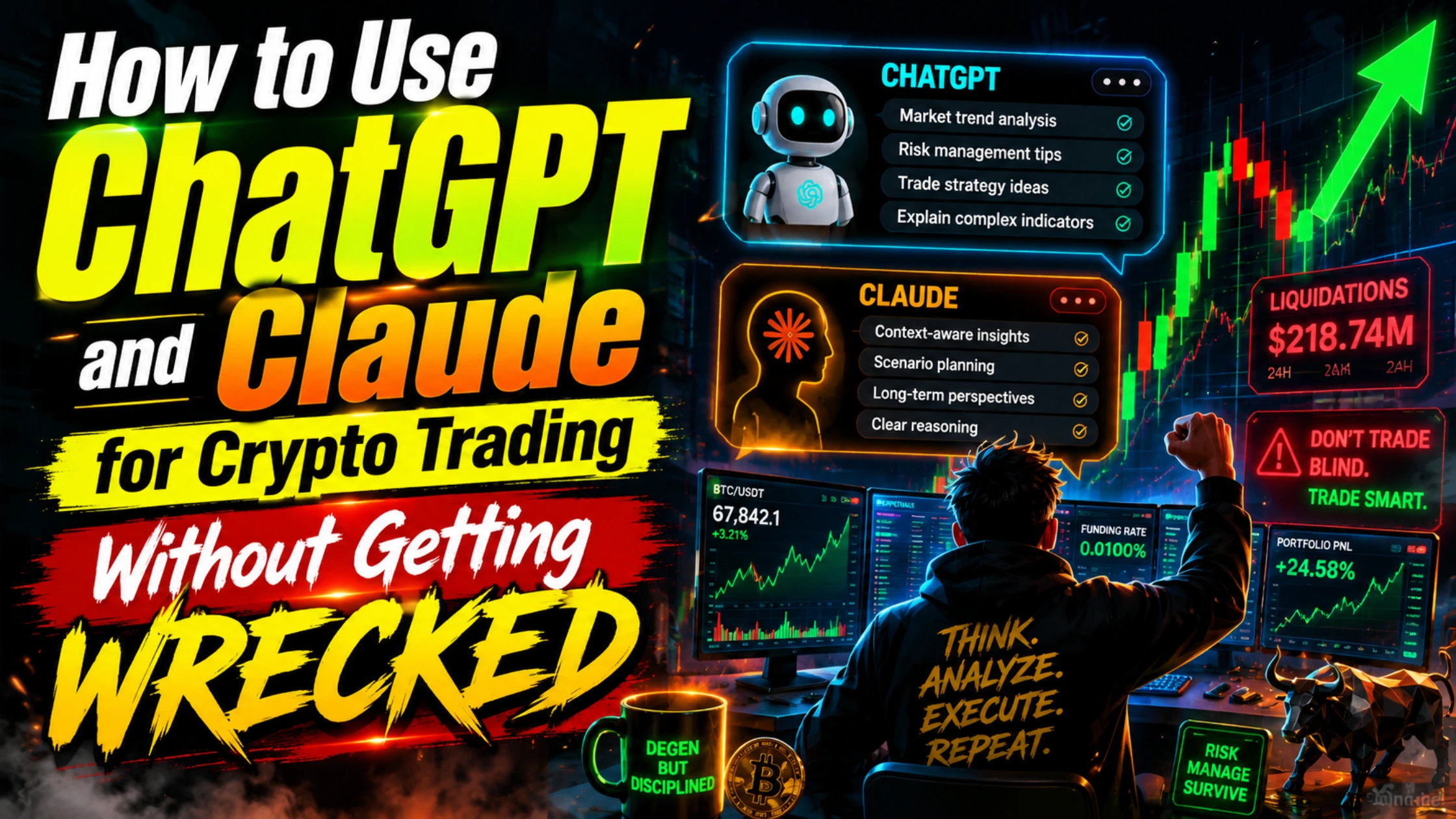
7 documented ways ChatGPT and Claude are already inside the daily workflows of the best crypto traders. Real examples, real results, real prompts.
This is not about the future
Every article about AI in trading describes what will be possible. A technology that is going to change how traders work. A capability that is going to replace analysts. A workflow that is going to give retail traders institutional-level intelligence.
This article is not that.
Over 50% of trading systems now use AI. Algorithmic trading accounts for over 80% of equity market volume in developed markets as of 2026. The AI trading market is projected to reach $45.2 billion by 2026. These are not forecasts — they are current measurements.
The question is not whether AI has changed how the best traders make decisions. It has. The question is exactly how — with documented specificity, named examples, and usable workflows rather than the generic advice to “use AI for research” that constitutes the majority of what is published on this topic.
What follows are seven ways that ChatGPT and Claude have already changed trader decision-making, with the specific evidence that confirms each change has happened.
One critical caveat before the seven: BCG and Harvard Business School research found that GPT-4 users sometimes performed 23% worse than control groups in high-stakes tasks requiring strategic judgment when over-relying on AI. The traders getting the most from these tools are not replacing their judgment. They are augmenting it — using AI to process more data faster, challenge their assumptions more rigorously, and execute more consistently. That distinction runs through every way described below.
Way one: The morning briefing that used to take 45 minutes now takes four
The professional trader’s morning routine once required visiting six to ten separate information sources: overnight price action, funding rates across exchanges, major news headlines, on-chain flow data, social sentiment, regulatory updates, and macro developments from Asian markets. A serious analyst spent 30 to 45 minutes every morning simply assembling context before making a single trading decision.
ChatGPT and Claude have compressed this to under five minutes for traders who have built structured morning briefing prompts.
The workflow: paste or connect overnight data from CoinGlass (funding rates, open interest changes), a Glassnode summary (exchange flows, SOPR reading), and the three to five most significant crypto headlines from the night. Send to Claude or ChatGPT with this prompt structure:
“You are my daily market analyst. Here is the overnight data package: [paste data]. Provide a structured morning briefing covering: (1) The single most important development from the last 8 hours and its trading implication, (2) Whether the derivatives positioning has shifted bullish, bearish, or neutral since yesterday, (3) One specific metric to watch today and the level at which it becomes significant, (4) Any headline that creates a setup — or a risk — I should be aware of before the open.”
The output arrives in seconds. It is not a price prediction. It is organised context — the same context that took 45 minutes to assemble manually, structured so that the trader’s first decision of the day is made with all relevant information already synthesised.
Claude Haiku was tested as a news-based trading analyst during the week of January 13–17, 2026, using a $1,000 paper trading account. The model processed news from Reddit, CNBC, BBC, and Finnhub and generated JSON outputs including sentiment classifications (bullish, bearish, or neutral), urgency levels (from low to critical), and confidence scores. The structured output went directly into a decision framework rather than requiring additional human analysis.
The traders who have built this habit are not checking Twitter first. They are not scrolling through Discord signal groups. They arrive at their desk with a four-minute briefing that covers everything and begin making decisions immediately.
For traders executing positions after this morning brief, Bybit provides the deepest BTC and ETH perpetuals liquidity for capitalising on overnight developments — the exact opportunities that the AI morning briefing identifies fastest.

Way two: Custom trading tools that used to require a quant team
A retail trader with a specific trading idea — say, a strategy that enters a Bitcoin long when the 7-day average funding rate crosses below 0.005% while MVRV Z-Score is below 2 and Bitcoin dominance has risen for three consecutive days — had one option before AI code generation: learn Python, spend weeks building the backtesting infrastructure, debug it, validate it, and then figure out how to connect it to an exchange API. Or pay a quant developer $5,000 to $15,000 to do it for them.
With Claude and ChatGPT, the same trader describes the strategy in plain English and receives working code in under 10 minutes.
The documented evidence is compelling. Developer Chudi Nnorukam built Polyphemus — a fully autonomous trading bot — between December 2025 and March 2026 using Claude as the primary development tool. The result: API costs dropped from $340 to $136 per month (a 58% reduction), system uptime reached 99.2%, and the error rate fell from 1 in 6 outputs to 1 in 40. He described the approach: “The quality of your output is directly proportional to the quality of the constraints you impose on the process.” The architecture used tiered context loading — organising project information into three levels — which reduced session token usage by 58% while a two-gate verification system cut production error rates by 84%.
In February 2026, a quantitative researcher built QuantaAlpha using Claude Code — an autonomous factor mining framework that explored 20 simultaneous market factors. The system identified factor combinations that human analysts would have taken weeks to test.
For traders who want TradingView indicators without learning Pine Script: ask Claude or ChatGPT to write the indicator. Specify the entry condition, the exit condition, any filter conditions, and what you want plotted on the chart. The resulting code runs directly in TradingView’s Pine Script editor, usually with no modification required.
The specific prompt that works:
“Write a TradingView Pine Script v5 indicator that triggers a long entry signal when all three of the following conditions are true in the same 4-hour candle: RSI(14) is below 40, the closing price is above the 200-period EMA, and volume is above the 20-period volume SMA by at least 1.3x. Plot a green triangle below the bar when all conditions are met. Add an alert condition using the same logic.”
The code arrives in under 60 seconds. It works. The strategy that previously required a developer now requires the ability to describe what you want in a sentence.
Way three: Synthesising five data sources simultaneously
The edge that institutional trading desks had over retail was not access to data — in crypto, most data is public. The edge was the ability to synthesise multiple data sources simultaneously and identify the intersections where each source pointed to the same conclusion. A well-resourced trading desk had three or four analysts each covering separate data streams and a senior trader synthesising their reports. A retail trader had one brain and too many browser tabs.
AI has eliminated this institutional advantage for anyone willing to build the prompting workflow.
The synthesis prompt for on-chain traders works as follows: collect data from five sources — CoinGlass (funding rates and open interest), Glassnode (MVRV Z-Score and SOPR), DeFiLlama (TVL change), Santiment (social volume), and any relevant macro news — and paste all of it into a single Claude conversation with this instruction:
“I’m going to give you five separate data inputs covering on-chain metrics, derivatives positioning, DeFi health, sentiment, and macro context. Analyse each source individually, then assess whether the five signals are aligned or contradictory. Produce a composite signal score from -10 (maximally bearish) to +10 (maximally bullish) and identify the single most important contradiction in the data — the thing that most challenges the dominant signal direction.”
What previously required four analysts reviewing their separate domains and a synthesis meeting now happens in a single prompt. The output is a structured, numbered analysis covering each data source, a composite score, and — crucially — the challenge to the prevailing thesis. That last element, the contradiction, is what most retail traders miss when they analyse data sources in isolation.
An AI system was tested on a live crypto forecast, analysing 38 real-time indicators simultaneously — covering technical metrics, Binance order-book flows, on-chain usage, and social sentiment — to produce a structured, real-time forecast. It flagged breakout compression near key support and resistance levels. A human analyst covering all 38 indicators at the same time would require hours. The AI produced its output in seconds.
For traders acting on multi-signal synthesis outputs, BloFin‘s perpetuals platform provides the execution quality for the precise, conviction-based entries that this kind of synthesis makes possible — limiting the over-trading that comes from uncertainty and replacing it with fewer, higher-conviction positions. Way four: The skeptical risk manager sitting across from you
Every experienced trader knows the feeling: you have a setup, you are convinced it is going to work, and you enter the position. The setup had three things going for it. You missed the two things arguing against it. The position moves against you and now you can see, in retrospect, exactly what you overlooked.
This is not stupidity — it is confirmation bias, and it is one of the most documented psychological phenomena in trading research. The solution is a devil’s advocate: someone whose explicit job is to find the holes in your reasoning before you commit capital to it.
Claude and ChatGPT have become that devil’s advocate for traders who know how to use them correctly.
The specific prompt structure that traders report most useful:
“I am considering entering a [long/short] position on [asset] at [price]. My thesis is: [explain your reasoning]. The key metrics supporting this are: [list your supporting evidence]. Your job is to find everything that could go wrong with this trade. Specifically: identify three critical non-price confirmations that I have NOT cited that should exist if this setup is valid, one on-chain metric that would directly contradict my thesis, and one macro or sentiment condition that would invalidate the entry. Be adversarial — I am trying to find reasons not to take this trade.”
This prompt forces the AI into an adversarial posture rather than a supportive one. It is calibrated to challenge the thesis rather than validate it. For traders who have spent hours building conviction in a position, having their thesis stress-tested in 30 seconds before committing capital is exactly the kind of friction that prevents emotionally driven, poorly risk-managed entries.
Practical workflow: run this prompt before every significant position entry. If the AI’s challenges cannot be addressed by existing data or dismissed with strong counter-reasoning, the position is not ready. If the challenges can be addressed, the position is stronger for having been tested.
The TradingView community has documented this use case specifically — professional traders experimenting with standardised prompt templates to stress-test setups, using a structured pre-trade checklist that requires AI-identified invalidation conditions to be defined before the order is placed. The result is not fewer trades — it is better-filtered trades.
Way five: Backtesting in hours instead of months
The traditional backtesting workflow for a retail trader with a new strategy idea: conceptualise the strategy, learn enough Python to implement it, debug the implementation, source historical data, run the backtest, interpret the results, modify the strategy, re-run, identify look-ahead bias and survivorship bias issues, correct them, re-run. Six months for a rigorous backtest if the trader was disciplined and already knew Python. More often, the backtest never happened and the strategy was traded live on intuition.
With Claude, the workflow is: describe the strategy in plain English, ask for the Python implementation, run it against historical data, and ask the AI to identify the specific statistical biases that need to be corrected. The same six-month process now takes a focused afternoon.
The specific documented example: ask Claude or ChatGPT to implement a backtest for a funding rate strategy — enter a long position when the 7-day average funding rate drops below zero on Bybit, close the position when funding returns to positive 0.01%, with a maximum holding period of 30 days and a 5% stop-loss. The code arrives in under five minutes. It includes the entry logic, exit logic, position sizing based on a percentage of account equity, transaction cost calculation, and output metrics including total return, Sharpe ratio, maximum drawdown, and win rate. An experienced Python developer would need two to four hours to produce equivalent code. Claude produces it in under five minutes, and it runs.
The critical limitation: ask Claude to identify what the backtest does not account for. Slippage on large orders. The impact of many traders running the same strategy simultaneously. The look-ahead bias in optimised parameters. Regime changes that make historical performance unrepresentative of future conditions. Claude will identify these issues clearly if asked — it is less likely to flag them proactively.
The workflow that separates competent AI-assisted backtesting from dangerous overconfidence: run the backtest, then run a second prompt asking the AI to identify every way the results could be overstated or misleading. Treat the backtest as a filter, not a guarantee.

Way six: The 24/7 autonomous trading agent
The most advanced — and most genuinely transformative — use of Claude in trading is the construction of autonomous agents that monitor markets, process signals, make decisions within a pre-defined framework, and execute trades without requiring human intervention at each step.
On March 31, 2026, traders using AI agent infrastructure achieved $11.77 billion in trading volume within 24 hours. That is not institutional volume — that includes retail operations running AI agents that execute continuously while their operators sleep.
One documented case: a trader gave Claude Code $100,000 to manage across a multi-strategy portfolio combining LEAPS options for directional exposure and intraday scalping for short-term momentum. The agent ran a multi-agent governance structure — a CEO agent for portfolio-level decisions, a strategy agent for trade identification, and a risk agent for position sizing and stop-loss enforcement. The risk agent vetoed a NVDA chase trade after earnings — the CEO agent wanted to enter, the risk agent overruled it. The trade would have lost approximately $10,000. The governance system saved it.
Claude Code Routines — Claude’s built-in mechanism for running agent workflows on a schedule — allows traders to build agents that run every 15 to 30 minutes during market hours without any external infrastructure. The agent fetches current market data in JSON format, processes it through Claude’s reasoning, produces a structured decision output (enter/hold/exit with size and price), and executes through a connected exchange API.
Building this architecture using Claude as the primary development tool has become practical in 2026. The sequence: write the data collection layer (typically 50 to 100 lines of Python), write the decision logic prompt as a Claude system message, connect the execution layer to the exchange API using trade-only permissions, and schedule the routine. The complete architecture takes two to three days of focused work for a trader with no prior programming experience. Previously it required six months and a developer.
For traders building execution infrastructure for autonomous agents, OKX‘s Agent Trade Kit covers 60+ blockchains and 500+ DEXs handling 1.2 billion API calls daily — the broadest multi-chain execution infrastructure for AI agent strategies that operate across both CeFi and DeFi simultaneously.

Way seven: Due diligence that used to take a week
Evaluating a new DeFi protocol, a new token launch, or an altcoin position used to require reading a 60-page whitepaper, parsing the tokenomics section, checking the vesting schedule, evaluating the team’s GitHub activity, reviewing the audit reports, and cross-referencing everything against the on-chain data. For serious research, this was a week-long process — which meant most retail traders skipped it and relied on Twitter narratives instead.
With Claude’s 200,000-token context window, the entire whitepaper fits in a single conversation. The process: paste the whitepaper, paste the tokenomics table, paste the audit report summary, paste the on-chain holder distribution from Etherscan, and ask:
“This is the complete research package for [protocol name]. Analyse the tokenomics for any structural mechanisms that could create sell pressure from vesting unlocks in the next six months. Identify whether the team allocation percentage is above or below the industry median and what vesting cliff structure applies. Flag any red flags in the audit report and explain each in plain language. Assess whether the on-chain holder distribution suggests genuine decentralisation or concentration risk. Produce a structured summary: Strengths, Risks, Missing Information, and a verdict on whether the token structure is designed for long-term value accrual or short-term extraction.”
The output arrives in under 60 seconds. It covers everything a week of manual research would cover, with the added benefit that the AI has processed all sources simultaneously rather than sequentially — identifying contradictions between what the whitepaper claims and what the on-chain data shows, flagging audit findings that the team’s marketing materials glossed over.
 Claude is stronger at long-form document analysis and nuanced reasoning. Feed it two quarters of financials side by side and ask for margin trend analysis, working capital movements, or free cash flow decomposition. The model handles the arithmetic and the narrative simultaneously — which is genuinely useful when you are covering a large universe of tokens and every hour spent on one project is an hour not spent on another.
The critical limitation applies here more than anywhere else: Claude and ChatGPT can generate confident-sounding false information. For due diligence, verify AI outputs against primary sources. Use the AI to identify what to check, then check it. The AI research is the first pass, not the final answer.

The seven changes, summarised
The pattern across all seven is consistent: AI does not replace the trader’s judgment. It replaces the analyst’s labour that judgment previously had to wait for.
The morning briefing that took 45 minutes now takes four. The custom code that required a quant developer now requires a description. The multi-signal synthesis that required four analysts now requires one prompt. The devil’s advocate that required a trading partner now requires a specifically adversarial instruction. The backtest that required six months of Python now requires an afternoon. The autonomous agent that required a development team now requires two to three days of focused work. The due diligence that required a week now requires 60 seconds.
Every one of these changes has already happened. They are documented in published research, live trading journals, developer blogs, and academic studies. The traders who have integrated these workflows into their daily practice have a structural advantage over traders who have not — not because AI makes better predictions, but because it allows them to process more information, test more assumptions, and execute with more consistency than their competitors.
The traders who have not yet built these workflows are operating with the information density and analytical bandwidth of 2022. The traders who have are operating in 2026.

Getting started: three workflows to implement this week
This week, implement workflow one. Build a morning briefing prompt. Collect your standard morning data sources — funding rates from CoinGlass, one key on-chain metric from Glassnode, two to three overnight headlines. Paste it into Claude with the structured briefing prompt from Way One. Run it every morning for five days. By the end of the week, your morning context will be more complete and more structured than it has been since you started trading.
Next week, implement workflow four. Before your next significant trade, run the skeptical risk manager prompt against your thesis. Ask Claude to find three non-price confirmations you have not cited and one direct contradictory metric. If the response surfaces something important you had not considered, the prompt has already paid for itself.
The week after, implement workflow two. If you trade on TradingView, ask ChatGPT or Claude to write a Pine Script indicator for one entry condition you currently identify manually. Test it in TradingView’s paper trading environment. If it performs, you have automated one element of your workflow. If it does not, you have learned something about why your manual identification works differently than you thought.
These three workflows cost nothing beyond an existing Claude or ChatGPT subscription. They require no coding knowledge. They can be implemented within the next fifteen days.
The question is not whether AI has already changed how the best traders make decisions. The evidence answers that definitively. The question is when you start using the same tools they are already using.
Where to execute
Research advantage is only valuable when paired with execution quality. For derivatives traders acting on the synthesis outputs described in Ways One through Four, Bybit provides the deepest BTC and ETH perpetuals liquidity with competitive maker fees for high-conviction positions. BloFin delivers the lowest taker fees for the precise, AI-identified entries that the analytical workflows above produce. For spot accumulation based on due diligence from Way Seven, OKX offers the broadest token access and multi-chain infrastructure across all major ecosystems.
The AI handles the analysis. The exchange handles the execution. Your judgment handles the decision between them. That is the division of labour that 2026’s best traders have built — and the one this article has documented, not predicted.
This article is for informational and educational purposes only and does not constitute financial advice. AI tools including Claude and ChatGPT are analytical aids that require human judgment and independent verification of outputs before acting on any trading decision. All trading involves significant risk of loss.
Affiliate disclosure: Decentralised News maintains affiliate relationships with Bybit, BloFin, and OKX. Links in this article are affiliate links. This does not influence the editorial content or documented examples.
Published by Decentralised News | Author: Heath Muchena | May 2026
Recommended reading:
The Complete AI Agents Directory 2026: Every Real-World Use Case, Ranked and Reviewed
Top 9 AI Trading Platforms for Crypto Perps and Derivatives (2026)
Top 10 AI Agents Crypto Tokens to Watch in 2026
Top Free AI Agents for Crypto Trading (2026 Edition)
Top 8 DeFi Protocols Powering Cross-Chain AI Agent Execution
DeFAI 101: How to Build Wealth in the Age of Autonomous AI Agents
The AI’s DeFi Playbook: 3 Protocol Types for Maximum, Automated Yield
How AI Agents Are Dominating Bitcoin Trades (While You Sleep)
Top 20 AI Agents & Agentic Protocols (2026)
10 AI Crypto Trading Bots Ranked by Real Performance in 2026
About the Author