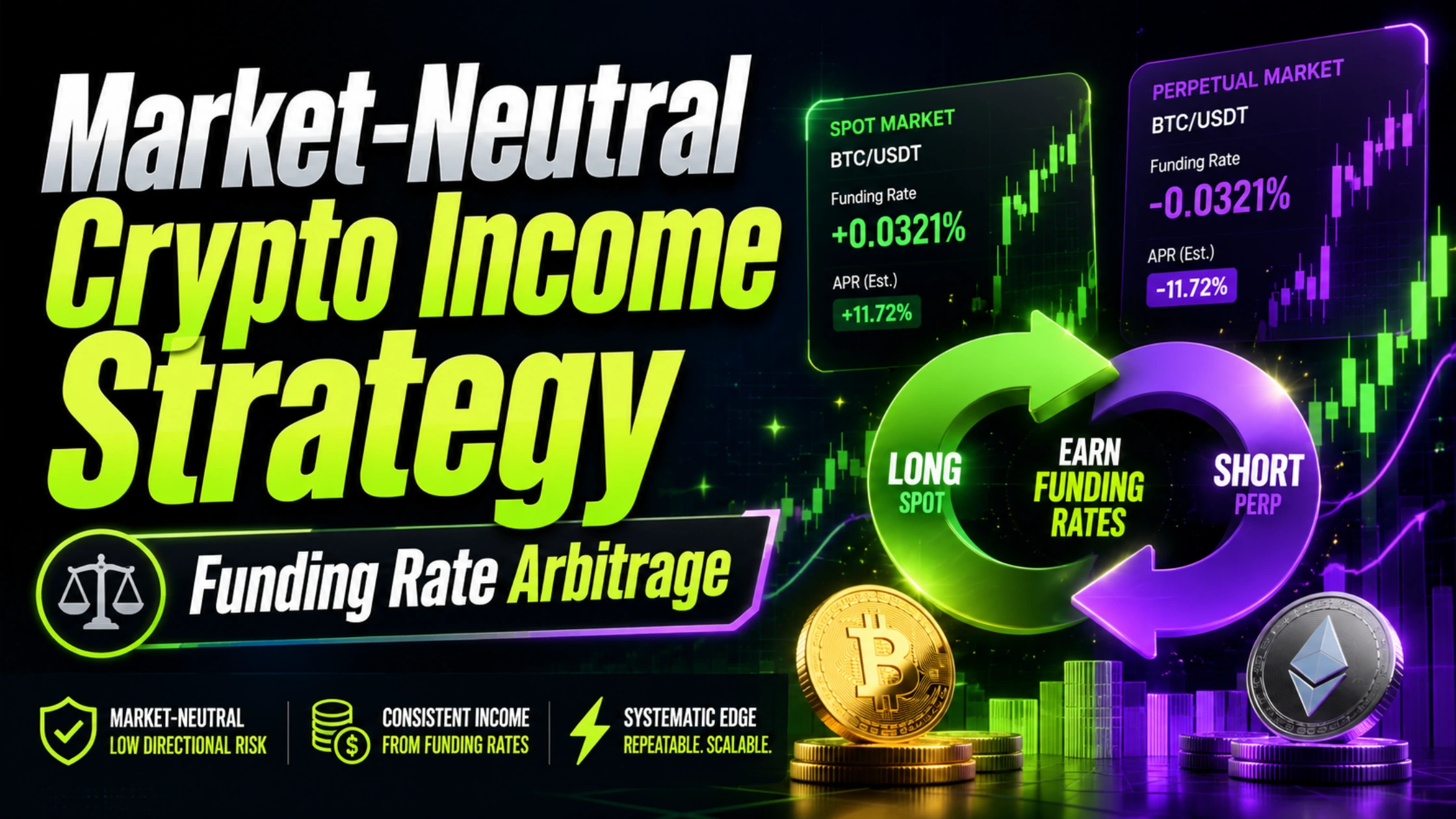
How funding rate arbitrage works, the exact math behind the yield, and the interactive calculator that shows your annualised return before you open a single position.
SUMMARY: Funding rate arbitrage is a delta-neutral strategy where a trader simultaneously holds a spot long position and a perpetual futures short position of equal size. When the funding rate is positive, short perpetuals holders receive payment from long holders every 8 hours. At a 0.01% funding rate (conservative bull market average) on a $100,000 notional position, the strategy generates $10,950 per year in funding income with zero directional market exposure. At 0.03% (elevated bull market rate), the same position generates $32,850 per year. The primary risks are: liquidation of the short leg if margin is insufficient, negative funding (when shorts pay longs), exchange counterparty risk on the futures leg, and spread cost from opening and closing both legs. The exchanges with the most favourable funding rate environments for this strategy are BloFin and Bybit. GRVT is the recommended platform for institutional-scale delta-neutral positions above $500,000 notional.

The yield nobody is talking about
Most crypto traders measure their returns by how much their portfolio appreciated. A 40% return in a bull market. A 150% return over a cycle. Returns denominated in directional price movement.
Funding rate arbitrage produces returns with no directional exposure whatsoever. It does not matter whether Bitcoin goes up or down. The position earns its return from a structural inefficiency in the perpetual futures market — the mechanism by which exchanges keep perpetuals prices anchored to spot — and collects that payment every eight hours, indefinitely, for as long as the funding rate stays positive.
At a 0.01% per 8-hour funding rate — conservative by historical standards, the approximate average during mild bull market conditions — a $100,000 delta-neutral position generates $10,950 per year in pure funding income. At 0.03%, $32,850 per year. At peak conditions of 0.05%, $54,750 per year.
These are not speculative returns from predicting price direction correctly. They are mechanically generated income from a market structure that has paid consistently across every bull market phase since perpetual futures were introduced.
This article explains the exact mechanism, the precise math, the specific risks that can eliminate the income, and the step-by-step execution process. The interactive calculator below computes your specific position’s projected annual income based on current or historical funding rates.
The mechanism: why perpetuals pay funding
Perpetual futures contracts have no expiry date. Unlike quarterly futures that eventually converge to spot price at settlement, perpetuals must be kept artificially anchored to the spot price through a payment mechanism called the funding rate.
When perpetuals trade at a premium to spot — which happens when more market participants are long than short — the funding mechanism requires long perpetuals holders to pay a periodic fee to short holders. This payment is the funding rate. If the 8-hour funding rate is 0.01%, longs pay 0.01% of their notional position to shorts every 8 hours.
The purpose: the payment discourages excessive long positioning by making it costly to hold leveraged longs when they push the perpetual price above spot. If enough longs exit (because the funding cost makes holding unprofitable), the perpetual price returns to spot. The mechanism self-corrects.
For the arbitrageur, this creates a risk-free income stream — risk-free in the narrow sense that price direction does not affect the payment. The funding income exists regardless of whether Bitcoin trades higher or lower, as long as the futures position is maintained and the funding rate remains positive.
The delta-neutral construction
The word “delta-neutral” describes a position where the net directional exposure to price movement is zero. A long spot Bitcoin position has a delta of +1 — if Bitcoin rises 10%, the position gains 10%. A short Bitcoin perpetual has a delta of -1 — if Bitcoin rises 10%, the position loses 10%.
Combined: +1 (spot) + (-1) (futures) = 0 net delta. The position has zero directional exposure.
The exact construction:
Step 1: Buy $X of Bitcoin on the spot market. Step 2: Open a $X short perpetual futures position on a perpetuals exchange. Step 3: If funding is positive (longs pay shorts), receive funding payments every 8 hours. Step 4: Your total position gains from funding. Neither legs gains nor loses from price movement.
Worked example:
You buy 1 BTC at $95,000 on Bybit spot. You open a 1 BTC short perpetual on BloFin at $95,000 with 3x leverage (margin required: approximately $31,667). 8-hour funding rate: 0.015%.
Every 8 hours you receive: $95,000 × 0.015% = $14.25 Three payments per day: $42.75 30-day income: $1,282.50 Annual income: $15,593.75
Bitcoin then moves to $110,000. Your spot BTC is now worth $110,000. Your short futures position is now -$15,000 (paper loss). Net P&L from price movement: $0. Funding income continues on the new notional value.
Bitcoin moves to $80,000. Your spot BTC is now worth $80,000. Your short futures position is now +$15,000. Net P&L from price movement: $0. Funding income continues.
In both scenarios, your income comes entirely from the funding payments, and in both scenarios the price movement produces no net gain or loss.
FUNDING RATE ARBITRAGE CALCULATOR
Funding Rate Arbitrage Calculator
Delta-neutral income projection — adjust parameters to see your projected annual yield.
Capital required
Risk indicators
Tool by Decentralised News · Trade on BloFin
The calculator above computes your projected annual funding income based on position size, current funding rate, and exchange selection. It also shows the margin required for the short leg, the break-even funding rate after fees, and the annualised yield as a percentage of total capital deployed.
The capital efficiency calculation
The delta-neutral position requires capital in two places: spot and futures margin.
Spot leg: Full capital. To buy 1 BTC at $95,000, you need $95,000.
Futures leg: Margin only. A 3x leveraged short on $95,000 notional requires approximately $31,667 in margin. At 5x leverage: $19,000. At 10x leverage: $9,500.
Total capital deployed:
- Spot: $95,000
- Margin (3x): $31,667
- Total: $126,667
Annual funding income at 0.015% per 8-hour period: $15,593.75
Annual yield on total capital deployed: $15,593.75 / $126,667 = 12.3% APY
This 12.3% APY comes with zero directional price exposure. It is not a speculative return — it is income from market structure, similar to the carry trade in traditional finance.
Higher leverage on the futures leg improves capital efficiency:
- 5x leverage: total capital = $114,000, yield = 13.7% APY
- 10x leverage: total capital = $104,500, yield = 14.9% APY (but higher liquidation risk)
The leverage on the futures short does not increase returns — the funding payment is based on notional, not margin. Higher leverage reduces the capital required for the short leg, improving overall capital efficiency, but increases the risk of the short being liquidated if Bitcoin price moves sharply upward.

Historical funding rates: what the data shows
Bitcoin perpetual funding rates across major exchanges have not been uniformly positive. Understanding the historical distribution is essential for realistic return expectations.
The 2020–2021 bull market: Average 8-hour funding rate: 0.02–0.05% during active bull phases. Annualised funding income at 0.03% average on $100,000 notional: $32,850/year. Peak periods saw 0.1% rates, translating to $109,500 annually. The 2020–2021 bull market was the most profitable period for funding rate arbitrage in Bitcoin’s history.
The 2022 bear market: Average 8-hour funding rate: frequently negative. Negative funding means shorts pay longs — the strategy reverses and the position must be closed or flipped. During extended bear markets, funding rate arbitrage cannot be profitably run in the standard long spot / short futures construction. During these periods, the position can be reversed: short spot (borrow and sell), long perpetuals. When futures trade at a discount to spot (negative funding), longs receive from shorts.
The 2023–2025 recovery: Average 8-hour funding rate: 0.005–0.02% during recovery and early bull phases. Modestly positive, producing 5–22% APY depending on position size and leverage structure.
May 2026 environment: Check CoinGlass for current live rates across BloFin, Bybit, OKX, and Binance. The strategy is most profitable when funding is consistently above 0.01% per 8 hours and most dangerous when funding approaches zero or turns negative.

The four risks — stated precisely
Risk 1: Negative funding
When the market sentiment turns bearish and more participants are short than long, the funding rate inverts. Shorts now pay longs instead of receiving. The position becomes a cost rather than an income.
Management: Monitor funding rates daily. Close the position when the 7-day average funding rate approaches 0.005% or lower — the income barely covers transaction costs at this level. Set a CoinGlass alert for when BTC 8-hour funding falls below 0.008%.
Risk 2: Short leg liquidation
The perpetual short requires margin. If Bitcoin’s price rises sharply — say 30% in 24 hours as it did in several 2021 incidents — the short position requires additional margin or faces forced liquidation. The spot leg has gained an equivalent amount in dollar terms, but that gain is unrealised and on a different platform from the margin call.
Management: Never use more than 3x leverage on the short leg. Maintain 50% more margin than the minimum required. Set price alerts at the 15% and 25% levels above your entry price to add margin proactively. The DNCRS recommendation: hold the spot leg on-chain or in self-custody and the short on BloFin or Bybit with sufficient margin buffer.

Risk 3: Exchange counterparty risk
The perpetual short is held on a centralised exchange. If that exchange experiences a solvency crisis, withdrawal freeze, or insolvency, the short position’s value may be lost even if the Bitcoin spot price has risen (creating a paper gain on the futures position that cannot be realised). This is the structural vulnerability that killed carry traders on FTX in 2022.
Management: Only use the futures short on exchanges with strong proof-of-reserves and audited financial stability. For positions above $500,000 notional, use GRVT‘s institutional hybrid model where the settlement layer is decentralised — eliminating the counterparty risk on the futures leg entirely.
Risk 4: Execution spread and fee drag
Opening the spot long and futures short incurs taker fees. Closing both positions incurs additional fees. The round-trip transaction cost on a $100,000 position at 0.1% blended fee rate is $100 in and $100 out = $200 total. This cost must be recovered from funding income before the position produces net profit.
At a 0.01% per 8-hour funding rate ($30/day), transaction costs are recovered in under 7 days. At lower rates, recovery takes longer and the position is worth entering only if sustained positive funding is expected.
Management: Use limit orders for both legs wherever possible — maker fees on Bybit (0.02%) and BloFin (0.02%) are dramatically lower than taker fees. Opening both legs with limit orders reduces transaction cost by 60–70% compared to market orders.

Step-by-step execution guide
Setting up your first funding rate arbitrage position
Prerequisites:
- A spot Bitcoin wallet or exchange account (self-custody or Bybit spot preferred)
- A BloFin or Bybit futures account with sufficient margin
- CoinGlass bookmarked for live funding rate monitoring
Step 1: Check funding conditions
Open CoinGlass → Funding Rate. Look at the current 8-hour BTC/USDT funding rate across Bybit and BloFin. If the rate is above 0.01% and has been consistently positive for the past 7 days, the conditions are favourable to enter.
Step 2: Calculate position size
Determine how much capital you want to deploy. Example: $50,000 total.
- Spot leg: $35,000 (70% of capital) → buys approximately 0.368 BTC at $95,000
- Margin leg: $15,000 (30% of capital) → funds a 3x leveraged short of 0.368 BTC notional
Step 3: Open the spot position
Buy Bitcoin on Bybit spot or transfer existing Bitcoin to your account. Use a limit order at or slightly below the current market price to minimise entry cost.
Step 4: Open the perpetual short
On BloFin, navigate to BTC/USDT perpetual futures. Set leverage to 3x. Place a short limit order at the same price as your spot entry (or slightly higher — any premium between the futures and spot price is captured as additional income above the funding payment). Ensure the notional size of the short matches your spot position exactly.
Step 5: Verify delta neutrality
Check that your total long Bitcoin exposure (from spot) equals your total short Bitcoin exposure (from futures). Use BloFin’s position manager to confirm the net delta is zero. A mismatch of more than 0.001 BTC creates unwanted directional exposure.
Step 6: Monitor and manage
Check funding rates daily. Add margin proactively if Bitcoin’s price rises more than 15% above entry. Close the position if the 7-day average funding rate falls below 0.008%.

Exchange selection for funding rate arbitrage
The exchange selection for both legs matters significantly for net returns.
Futures short leg — BloFin: BloFin’s maker fee of 0.02% for perpetuals (among the lowest available) directly improves the net funding income retained per period. At 0.02% maker fee versus 0.055% taker fee, entering the short as a maker order saves approximately $33 per $100,000 notional — meaningful when annualised against funding income.
BloFin’s historical BTC funding rates during bull market periods have tended to run slightly below Binance and Bybit during retail-driven sentiment spikes. This means BloFin pays you slightly less funding income during peak periods — but those same lower rates indicate a less overcrowded long-side, which reduces the risk of sudden funding rate collapse when the momentum reverses.
Futures short leg — Bybit: Bybit’s deeper order book makes it easier to fill large short positions without moving the market. For positions above $200,000 notional, Bybit’s liquidity is preferable to BloFin’s. The maker rebate structure at high-volume tiers further reduces execution cost.
Institutional scale — GRVT: For positions above $500,000 notional, GRVT’s hybrid settlement architecture eliminates the counterparty risk that makes large delta-neutral positions on standard CEXs structurally vulnerable. GRVT settles trades on-chain while maintaining the execution speed of a centralised order book — the critical property for institutional funding rate arbitrage where counterparty risk, not trading fees, is the primary concern.
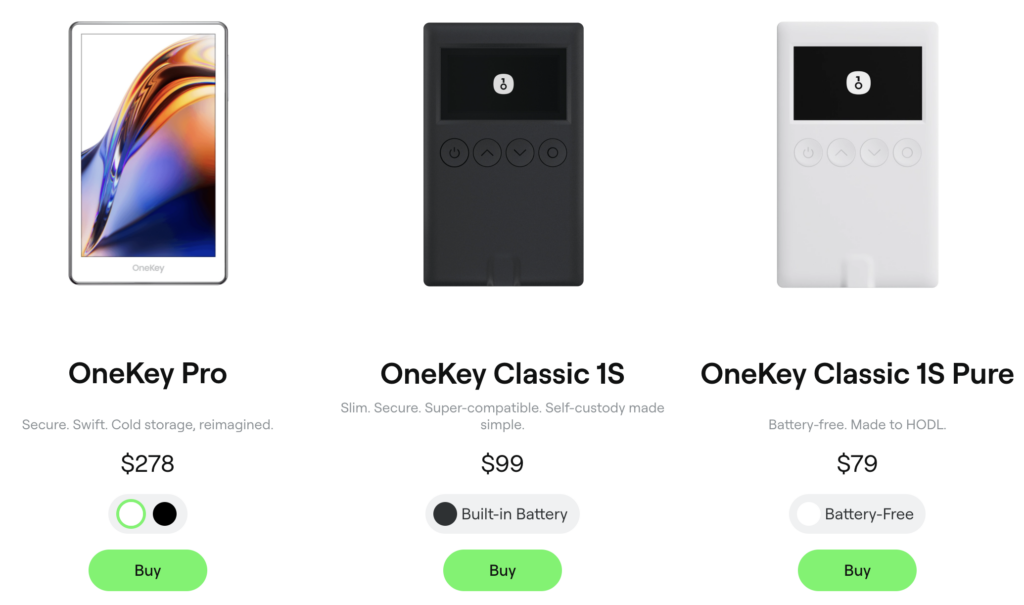
Spot leg storage: Hold the spot Bitcoin leg in a Ledger hardware wallet or on Bybit spot if you prefer exchange-based custody for quick position adjustment. Self-custody of the spot leg eliminates the exchange counterparty risk on that leg entirely.
When to close the position
Three conditions warrant closing the funding rate arbitrage position:
Condition 1 — Funding turns negative. When the 7-day average funding rate falls below 0 on both BloFin and Bybit, the income stream has reversed. Close both legs immediately. The position can be re-entered when funding turns consistently positive again.
Condition 2 — Margin buffer is consumed. If Bitcoin’s price rises more than 25% above entry and your margin buffer has fallen below 120% of the minimum required, close or reduce the short leg. Adding margin proactively is preferable to waiting for a margin call.
Condition 3 — More attractive opportunities emerge. If on-chain indicators suggest the bull market is entering its final phase and the risk of a sudden sentiment reversal increases, the prudent action is to close the position before funding rates collapse. The Pi Cycle Top indicator approaching activation or MVRV Z-Score entering extreme territory are the on-chain signals most relevant to this risk.

The income stack: combining funding arbitrage with other yield
For sophisticated capital allocators, the funding rate arbitrage strategy can be stacked with other yield sources:
Spot leg yield: The Bitcoin held in the spot leg can be deposited into Bybit Earn or OKX Earn while simultaneously serving as the collateral anchor for the delta-neutral position. At 3–4% APY on Bitcoin earn products, the spot leg generates additional income beyond the funding payments.
Stablecoin margin efficiency: Instead of funding the futures margin with USDT, deposit the margin capital into a stablecoin earn product that pays 4–5% APY while the funds are available as margin. BloFin and Bybit both support earn products that remain available for margin use.
The stacked yield: Funding rate income (10–25% APY on notional) + spot earn (3–4% APY on spot capital) + stablecoin margin earn (4–5% APY on margin) = total yield of 15–30% APY on total capital deployed during positive funding environments.
A note on the carry trade parallel
Traders familiar with traditional finance will recognise funding rate arbitrage as the cryptocurrency equivalent of the carry trade — borrowing in a low-interest currency and investing in a high-interest currency to capture the rate differential. The structural logic is identical: exploit the difference between implied (futures) and realised (spot) rates.
The key difference from traditional carry trades: in crypto, the “interest rate” (funding rate) can change dramatically within hours, while traditional carry trade rate differentials shift over weeks or months. This means the crypto funding rate carry trade requires more active monitoring and faster position management than its traditional finance equivalent.
It also means that in peak bull market conditions, the crypto funding carry trade generates returns that no traditional carry trade can match — because no central bank interest rate differential approaches the 0.05–0.1% per 8-hour rates seen during BTC price discovery phases.
This article is for informational and educational purposes only. Funding rate arbitrage involves substantial risk including margin liquidation, negative funding, and exchange counterparty risk. This does not constitute financial advice. Always use appropriate position sizing and maintain adequate margin buffers.
Affiliate disclosure: Decentralised News maintains affiliate relationships with BloFin, Bybit, GRVT, Ledger, and OKX. Links in this article include affiliate codes. This does not influence editorial content.
Recommended reading:
Funding Rate Arbitrage: The 8% Monthly Yield Machine (2026 Edition)
Funding Rate Arbitrage: The 200% APY Strategy Nobody Talks About
The Funding Rate Arbitrage Playbook: 6 Exchanges Where Basis Trading Still Prints 15%+ APY in 2026
Perpetual Futures Trading in 2026: Best Platforms, Strategies, Funding Rates, Risk Models & Pro Tips
Best Funding Rate Arbitrage Platforms (2026)
Published by Decentralised News — Author: Heath Muchena | May 2026
About the Author