The world’s most consequential resource war is not being fought over African soil — yet. But the shockwaves already are.
When historians look back on this decade, they will likely identify 2026 not as the year a war was fought in the Middle East, but as the year the post-Cold War order finally stopped pretending it was still alive. The conflict with Iran is not a regional episode. It is the opening act of a longer, uglier drama — one whose most consequential scenes may yet be written in Africa.
That is not a metaphor. It is a chain reaction with a discoverable structure, traceable supply lines, and a historical precedent that should make every African policymaker, business leader, and citizen deeply uncomfortable.
The Strait That Feeds the World
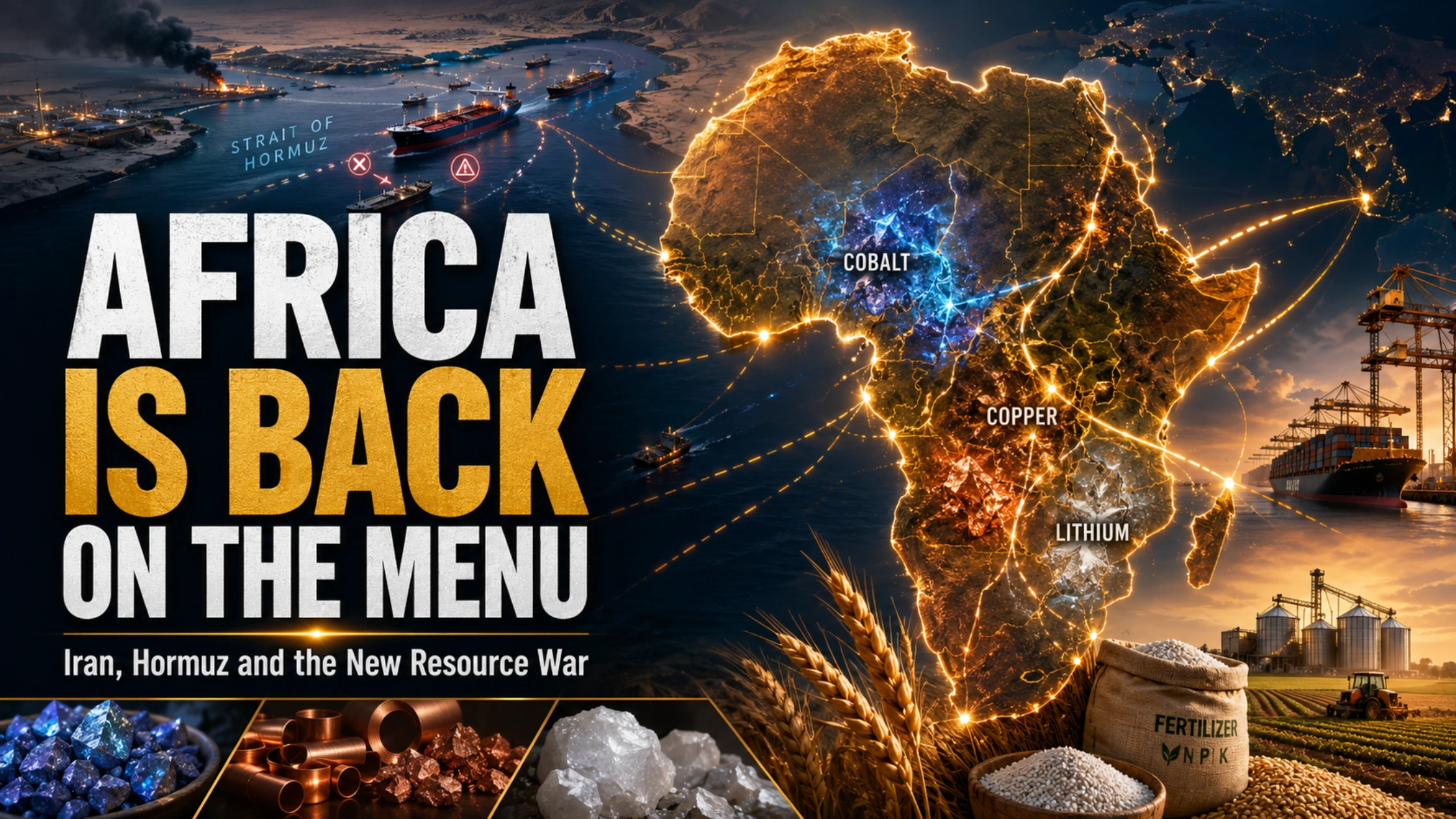
Begin with the numbers. Through the narrow Strait of Hormuz — a waterway twenty-one miles across at its tightest point — flows roughly 20 percent of the world’s oil and nearly 20 percent of its liquefied natural gas. During 2024, approximately 20 million barrels per day of petroleum moved through the corridor, representing about 27 percent of global maritime oil trade. Since February 28, 2026, that flow has effectively stopped for the commercial world. Insurance premiums had already reached six-year highs ahead of the strikes. Major oil companies, commercial operators, and insurers have effectively withdrawn from the corridor — a de facto closure comparable in character to the Red Sea disruption, but with far larger volumes at stake.
The International Energy Agency has characterized this as the largest supply disruption in the history of the global oil market, echoing the 1970s energy crisis through acute supply shortages, currency volatility, inflation, and heightened risks of stagflation and recession.
This is the macro-economic context most of the world is focused on. But there is a second shock embedded in the first — one that receives a fraction of the coverage and carries consequences that could destabilize entire regions.
Up to 30 percent of globally traded fertilizer products — roughly 16 million tonnes per year of nitrogenous, phosphates, and sulfur — transit the Strait of Hormuz. The Persian Gulf region provides an estimated 30 to 35 percent of the world’s urea exports. Fertilizer is not a luxury commodity. It is the chemical substrate of modern agriculture — the difference between a harvest and a famine. And for Africa, the disruption to that supply chain is not a distant abstraction.
Sub-Saharan Africa imports about 80 percent of the fertilizer it uses. Shipping in the Strait of Hormuz shipping channel is down by 95 percent since the start of the war. This means fertilizer that is still being made in Gulf countries has been prevented from leaving the region. Qatar, another key urea producer, stopped making urea in early March 2026 because its gas plants were hit by Iranian missiles. Iran alone is the fourth biggest global exporter of urea — and one of the cheapest suppliers. Malawi sources 52 percent of its fertilizer from the Gulf alone. Many African countries source 20 to over 50 percent of their fertilizer supplies from Persian Gulf nations.
It is estimated that global fertilizer prices could average 15 to 20 percent higher during the first half of 2026 if the crisis continues. African nations that depend on fertilizer imports face the sharpest vulnerability, while remittance flows from Gulf labour migrants — which support tens of millions of households — are also at risk.
This is the hidden shock. The next African food crisis may not begin in African drought or African conflict. It may begin in a narrow stretch of Iranian-controlled water on the other side of the world.

The Architecture of Fragility
To understand why Africa is so exposed, you have to understand the architecture that globalization built — and why it is now collapsing.
The post-Cold War era offered a seductive logic: specialize, trade, integrate. African economies were encouraged by the IMF, the World Bank, and bilateral donors to focus on comparative advantage — which in practice meant exporting raw commodities and importing processed goods, including fertilizer, fuel, and food. The logic was efficient. It was also brittle.
The parameters that guided globalization as the world once knew it are now being challenged. The technological consolidation of China, the material demands of the energy and digital transitions, and the return of ideologies and geography as defining elements of foreign policy have pushed the multilateral order towards a world of geopolitical competition, rising nationalism, and growing unilateralism, where external dependence is increasingly seen as a vulnerability.
Three decades of globalization created dependency disguised as efficiency. Africa’s food systems became structurally reliant on shipping lanes it does not control, priced in currencies it does not issue, through ports it does not own, for inputs whose production it does not govern. The fertilizer crisis of 2026 is not a surprise. It is the inevitable consequence of building continental food security on global supply chains optimized for profit rather than resilience.

The Minerals Beneath the Crisis
Now comes the second dimension — and it is where geopolitics becomes truly dangerous for Africa.
Africa holds approximately 30 percent of global mineral reserves, including dominant shares of cobalt, manganese, platinum group metals, and graphite. These are not niche resources. They are the physical substrate of the 21st century economy: the batteries in electric vehicles, the processors in AI data centers, the components in advanced military systems. As the world races to electrify, digitize, and remilitarize simultaneously, whoever controls access to these minerals controls the commanding heights of the next industrial era.
The competition for that control is already well underway — and Africa is the primary theater.
In December 2025, the United States signed a strategic partnership agreement with the Democratic Republic of Congo, establishing a Strategic Asset Reserve and designating priority mining zones for joint US-DRC development. Under this framework, US companies receive preferential treatment for projects, creating direct competition with China, which controls over 72 percent of Congolese copper and cobalt mines. The Lobito Corridor — stretching from Angola’s Atlantic coast through the DRC to Zambia’s Copperbelt — has become a $550 million infrastructure battleground, its strategic purpose not development but logistics independence from Chinese networks.
The US National Security Strategy unveiled in December 2025 framed the African continent — in three short paragraphs, at the end of the 29-page document — as an arena for competition with China over access to critical minerals. That brevity is revealing. Africa appears in America’s strategic imagination not as a partner but as a prize.
China’s position is more entrenched but increasingly contested. Chinese companies control more than 72 percent of copper and cobalt mines in the Democratic Republic of Congo. Many minerals across the world frequently travel through Chinese refineries, which displays Beijing’s supply chain leverage beyond mine ownership. Yet as the Iran war reshapes energy geography, the calculus around Africa’s oil and gas deposits — relatively undisrupted, outside the Persian Gulf’s current zone of conflict — is also shifting. When 20 percent of the world’s oil supply disappears from global markets, every barrel outside the Strait of Hormuz becomes dramatically more valuable.
This is the convergence that defines the moment. The Iran war has simultaneously exposed Africa’s agricultural fragility and elevated the strategic value of its resource base. The continent is being pushed into the center of global power competition whether its leaders are ready or not.
A Precedent Worth Studying
History offers a precedent, and it is not a comfortable one.
In 1884, the major powers of Europe convened in Berlin to divide Africa among themselves. The continent’s resources — rubber, ivory, gold, diamonds, copper — were the object. The scramble was driven not by malice alone but by systemic competition: industrializing economies needed raw materials, rival powers feared being outmaneuvered, and the institutional frameworks for restraint had not yet been built. The result was colonialism, extraction, and the deliberate suppression of African sovereignty for nearly a century.
The structural conditions of 2026 rhyme with that history in unsettling ways. Great powers competing for resources in a period of deglobalization, weakened multilateral institutions, and rising military willingness to coerce. The difference this time is that the colonialism comes dressed in partnership agreements, infrastructure corridors, and strategic asset reserves. The chains are financial and logistical rather than administrative. But the direction of extraction — out of Africa and toward the major powers — remains essentially unchanged.
Africa still earns only a fraction of what its minerals are worth. The continent exports raw resources rather than manufactured, final goods, and despite holding 30 percent of global mineral reserves, acquires around 10 percent of the value generated from mining exports. This is the structural trap: possession of the asset without capture of the value.
The Leverage That Leaders Have Not Yet Used
The analysis so far is bleak. But it is incomplete.
Africa is not without leverage. The problem is that the leverage is real only if it is recognized and deployed strategically — and that has not historically been Africa’s governing mode in dealing with great powers.
Consider what has already begun to shift. Zimbabwe has banned raw lithium exports, forcing companies such as China’s Huayou Cobalt to build $400 million processing plants locally. At least 13 African countries, including Tanzania, Ghana, and Malawi, have enacted similar export restrictions since 2023 to encourage domestic processing. The Publish What You Pay model estimates that refining resources could add up to $24 billion to Africa’s GDP and create 2.3 million new jobs.
South Africa signed a landmark framework agreement with China in February 2026 designed to secure investment for domestic industrial projects and prevent minerals from being exported without delivering meaningful benefits. The 2025 G20 Johannesburg Summit adopted a Critical Minerals Framework seeking to reconcile the Global North’s urgent demand for energy-transition minerals with the industrial ambitions and sovereignty of the Global South.
These are not just policy footnotes. They represent the early architecture of a different kind of relationship with the major powers — one where Africa is a negotiating party rather than a transaction. The logic is straightforward: if the United States and China both desperately need cobalt, and the cobalt sits in the DRC, then the DRC holds a card that neither Washington nor Beijing can simply print.
The food crisis creates a parallel leverage opportunity, though it requires a counterintuitive framing. Africa’s agricultural potential — its arable land, its young labor force, its capacity to expand domestic food production with the right investment — becomes a strategic asset precisely because the world is facing a food security emergency. The continent that can feed itself will have bargaining power that the continent dependent on Gulf fertilizer cannot.
African nations are implementing frameworks like the Africa Fertilizer and Soil Health Action Plan 2024-2034 to reduce import dependence through domestic manufacturing. Major industrial players are responding with ambitious expansion plans, including efforts to triple fertilizer production capacity to 9 million metric tons annually. This is exactly the right direction — though the pace needs to accelerate dramatically.

The Strategic Choices Ahead
The structural pressure is real. The wave is coming. The question is whether African leaders can orient toward the choices that create genuine autonomy, or whether the immediate pressures of debt, food inflation, and currency depreciation push governments toward the expedient deals that deepen dependency.
Multi-alignment is not neutrality — it is active leverage. The country that commits exclusively to Washington or exclusively to Beijing forfeits the negotiating position that comes from being genuinely contested. Several African states have understood this instinctively, maintaining relationships across the US, China, Russia, the Gulf states, and the EU simultaneously. In the era of great power competition, this is not diplomatic incoherence. It is rational statecraft.
The deeper challenge is structural. Extractive economies with concentrated political power and fragile institutions are poorly equipped to navigate the kind of complex, multi-party negotiation that effective mineral leverage requires. You cannot bargain from strength if your budget depends on IMF disbursements, your currency is falling against a weaponized dollar, and your agricultural base is facing fertilizer shock simultaneously. The compounding crises of 2026 are hitting the continent’s most vulnerable points at once.
Yet compounding crises also create political openings that stability rarely permits. Governments that in normal times would face little pressure to reform may find the argument for food sovereignty, for domestic processing, for strategic mineral governance, suddenly compelling to constituencies that were previously indifferent.
Patterns of geopolitical convulsion have historically been preceded by periods of intense systemic pressure — what one might describe as two steps forward, one step back, until something fundamental shifts. Africa is in that pressure zone now.
The nations that recognize the moment early enough to act on it — to build fertilizer capacity before the next planting season is lost, to legislate processing requirements before the next mineral agreement is signed, to build regional food reserves before the next shipping disruption — will find themselves in a fundamentally stronger position than those that wait for clarity before acting.
History does not offer Africa the luxury of preparation time. The wave is already in the water. The only question left is whether the continent meets it standing, or swept off its feet.
This article draws on research from the FAO, Kpler, the Congressional Research Service, the Atlantic Council, Goldman Sachs Research, the Nordic Africa Institute, and Development Aid’s critical minerals analysis.
Recommended reading:
Why the Iran War Is Fast Becoming a Global Economic Crisis
How to Buy Crypto Safely in Africa, Asia, LATAM & Middle East (2026)
The New Middle East Shock: Oil, Shipping, Inflation, and Your Portfolio
How To Build a Portfolio for Oil Shocks, Inflation, and Geopolitical Risk in 2026
About the Author