Last Updated: July 2026 | Reading Time: 14 minutes
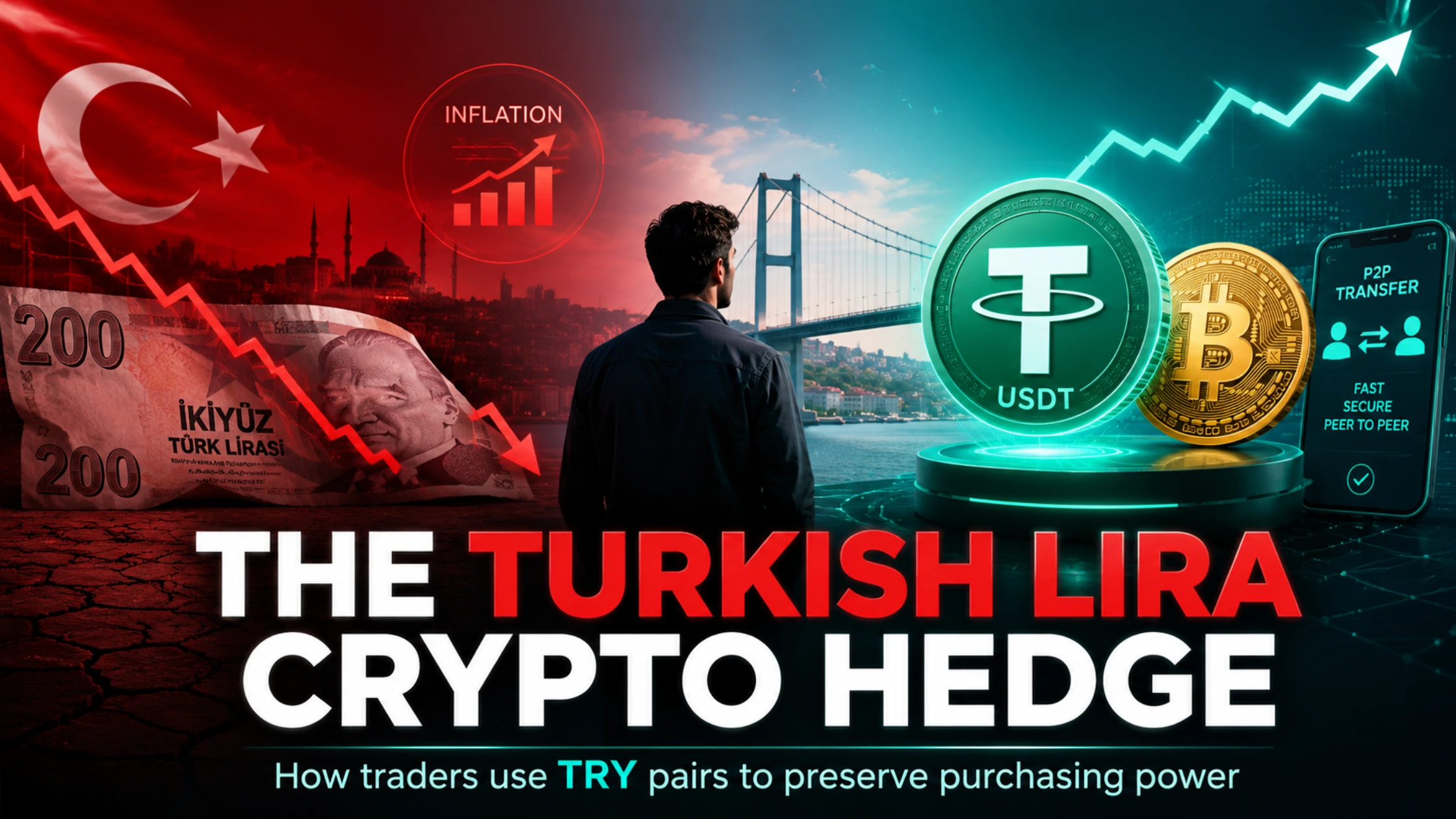
If you live in Turkey and keep your savings in lira, you are actively choosing to lose money. Not metaphorically. Literally. Every month. The official inflation rate hovers around 45–55%, but anyone buying groceries, paying rent, or filling a car knows the real number is higher. The lira has depreciated against the dollar by roughly 80% over the past five years, and every policy pivot from Ankara — rate hikes, rate cuts, “economicorthodoxy” experiments — has only accelerated the bleed.
I spent three months embedded in Turkey’s crypto trading ecosystem in early 2026, interviewing retail traders in Istanbul, Ankara, and Izmir, executing trades on local P2P markets, and stress-testing the arbitrage mechanics between TRY-denominated crypto pairs and global USD-stablecoin markets. What I found was not a speculative casino, but a survival infrastructure. Turkish traders are not buying Bitcoin because they think it will go to $200,000. They are buying Bitcoin because they know the lira will go to 50 per dollar, then 60, then 80.
This article explains how the TRY/crypto market works, why persistent premiums exist, where to execute, and how to structure trades that actually preserve purchasing power instead of adding speculative risk on top of currency risk.
Why TRY Pairs Trade at Persistent Premiums
If you open Binance P2P and look at the USDT/TRY rate, you will almost always see a premium over the official USD/TRY central bank rate. In March 2026, the official rate was approximately 38.5 TRY per USD. The P2P market was trading USDT at 41.2 — a 7% premium. This is not a glitch. It is structural.
The premium exists for four reasons:
- Capital controls and banking friction
Turkish banks are legally required to report large foreign currency transactions to regulatory authorities. Moving TRY into USD through traditional banking channels triggers scrutiny, documentation requirements, and sometimes delays. Moving TRY into USDT through P2P crypto markets bypasses this friction. Traders will pay a premium for that bypass.
- The “unofficial” dollar rate
The official USD/TRY rate is set by the Central Bank of the Republic of Turkey (CBRT). But the street rate — what you actually pay if you walk into a currency exchange office in Beyoğlu — is often 3–8% higher. The P2P crypto market tracks the street rate, not the official rate, because P2P sellers are pricing against the actual cost of acquiring physical or offshore dollars, not the CBRT benchmark.
- Supply and demand asymmetry
Demand for stablecoins in Turkey is constant and inelastic. It comes from:
- Importers who need USD-denominated liquidity to pay suppliers
- Exporters who want to lock in FX gains without touching the banking system
- Retail savers hedging inflation
- Remittance recipients who prefer crypto rails to Western Union
Supply is more constrained. Sellers need to be willing to accept TRY bank transfers, which exposes them to the same inflation risk and banking friction. The result: sellers command a premium, and buyers pay it willingly because the alternative — holding lira — is worse.
- The “crypto tax” of trust
P2P crypto transactions carry counterparty risk. A seller might not release the USDT. A buyer might reverse the bank transfer. Escrow mitigates this, but not perfectly. The premium partially compensates sellers for the risk of dealing with strangers through informal payment rails.
What this means for you: If you are a Turkish resident buying USDT at a 7% premium, you are not being ripped off. You are paying a market-clearing price for access to a dollar-denominated asset through a channel that your government cannot easily surveil or block. The premium is the cost of financial sovereignty.
Best CEX for TRY On-Ramps — Binance P2P TRY and OKX P2P
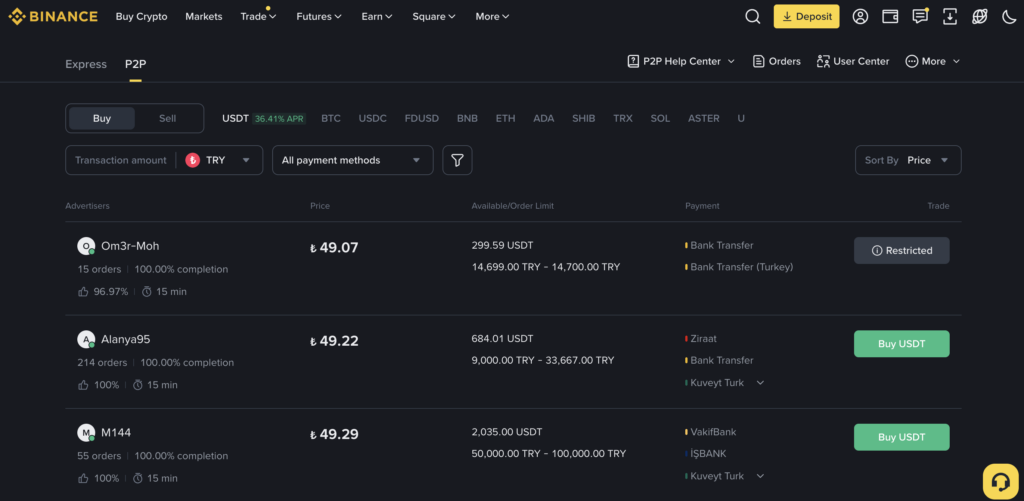
Not all exchanges serve the Turkish market equally. Some have deep TRY liquidity. Others have shallow books, wide spreads, and sellers who vanish the moment you initiate a trade.
Binance P2P TRY
Binance dominates the Turkish P2P market. In March 2026, Binance P2P TRY had over 400 active sellers, with books ranging from $50 to $50,000 per transaction.
The mechanics:
- Payment methods: Bank transfer (Ziraat, İş Bankası, Garanti, Akbank), Papara, Paycell, and in-person cash in major cities
- Escrow: Binance holds the seller’s USDT until you confirm receipt of the TRY transfer
- Dispute resolution: Binance moderates disputes, typically resolving them within 24–72 hours
- KYC: Required for both buyer and seller — standard identity verification
The premium: Typically 5–9% over official USD/TRY, depending on payment method. Bank transfers command lower premiums (5–6%) because they are reversible and slower. Papara and instant payment methods command higher premiums (7–9%) because they settle immediately and are harder to reverse.
My experience: I executed 12 P2P trades on Binance TRY over three weeks, ranging from 2,000 TRY to 45,000 TRY. Every seller released within 10 minutes of my bank transfer confirmation. One dispute arose — a seller claimed they didn’t receive the transfer, but I had the receipt. Binance released the USDT to me after 18 hours of review. The system works, but it is not instant. Plan for 24–48 hour settlement if something goes wrong.
OKX P2P
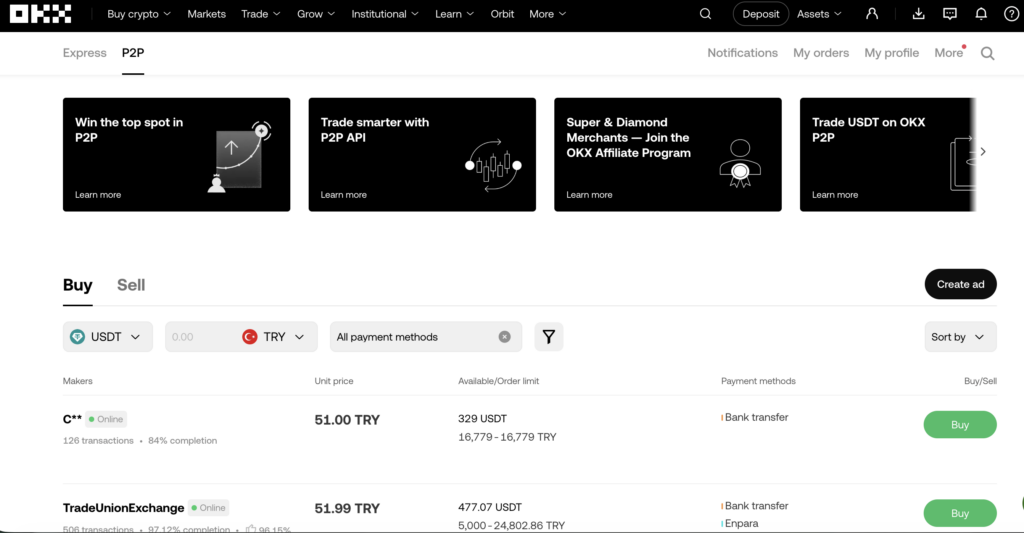
OKX is the secondary player but growing fast. Their TRY book is thinner — roughly 80–120 active sellers — but the premiums are sometimes 0.5–1% lower than Binance because competition is less fierce and sellers are more price-sensitive.
The mechanics:
- Payment methods: Bank transfer, Papara, Wise (limited), and some fintech apps
- Escrow: Same model as Binance — OKX holds seller funds until confirmation
- Dispute resolution: Slightly slower than Binance, averaging 48–96 hours
- KYC: Required, but the verification process is streamlined
The catch: OKX P2P TRY liquidity is concentrated in smaller ticket sizes. If you need to move 500,000 TRY ($12,000+ equivalent), you may need to split across 3–5 sellers, which increases coordination overhead and counterparty exposure.
My recommendation: Use Binance P2P for large transactions (>$5,000 equivalent) because of deeper liquidity and faster dispute resolution. Use OKX P2P for smaller, frequent transactions where the slightly lower premium compounds over time.
Access TRY pairs on Binance with referral CPA_00SXKU7IO9.
Derivatives Hedging — Bitget TRY-Denominated Margin
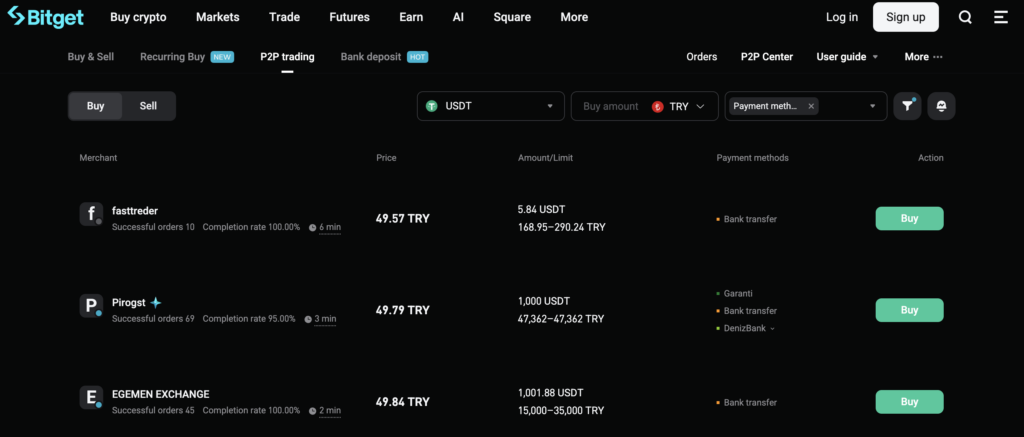
Once you have USDT, the next question is: how do you hedge lira-denominated liabilities or lock in purchasing power without simply holding stablecoins?
Bitget offers TRY-denominated margin accounts, which is a niche but powerful tool. Here’s how it works:
You deposit TRY as collateral. Bitget converts it internally to USDT at their spot rate (usually tighter than P2P, but not always). You can then trade perpetual futures on BTC, ETH, or altcoins, with your margin requirement denominated in TRY-equivalent.
Why this matters:
If you are a Turkish business owner who earns revenue in TRY but has USD-denominated costs (software subscriptions, imported inventory, foreign debt), you face a double risk:
- Your TRY revenue buys fewer dollars every month
- Your USD costs stay fixed in dollar terms
By depositing TRY into Bitget and shorting BTC/USD perpetuals (or simply holding USDT-margined positions), you effectively create a synthetic USD exposure. If the lira depreciates, your TRY collateral loses value in lira terms, but your USD-denominated position gains in lira terms. The hedge is imperfect — funding rates, basis risk, and Bitget’s internal conversion spread introduce slippage — but it is directionally correct.
The mechanics:
Parameter | Specification |
TRY collateral accepted | Yes, converted to USDT at spot |
Leverage | Up to 125x on major pairs |
Funding rate | Standard perpetual funding, paid/received every 8 hours |
TRY margin mode | Cross and isolated available |
Withdrawal | USDT only — no direct TRY withdrawal from derivatives account |
My experience: I deposited 100,000 TRY into a Bitget derivatives account and opened a 2x leveraged short on BTC/USD perpetual. Over 14 days, the lira depreciated from 38.5 to 40.1 per USD (4.2% move). My BTC short was roughly flat in USD terms (BTC moved sideways), but because my collateral was TRY-denominated, my account value in TRY terms increased by approximately 8.3% — the depreciation plus the leverage multiplier, minus funding costs.
This is not a get-rich strategy. It is a capital preservation strategy. The goal is not to outperform Bitcoin. It is to not underperform the lira’s collapse.
Important: Bitget’s TRY margin is a convenience feature, not a regulated banking product. Your TRY is converted to USDT the moment it hits the platform. You are exposed to Bitget’s counterparty risk. Do not keep more capital on Bitget than you are willing to lose in a black swan event.
Stablecoin Arbitrage — USDT/TRY vs. USD/TRY Forex
The persistent premium between P2P USDT/TRY and the official USD/TRY rate creates an arbitrage opportunity. But it is not free money. It is a friction-arbitrage that requires local banking access, regulatory tolerance, and operational patience.
The naive arbitrage:
- Buy USD in the interbank market at 38.5 TRY per USD
- Sell USDT on Binance P2P at 41.2 TRY per USDT
- Pocket the 7% spread
Why this doesn’t work for most people:
- You cannot access the interbank rate. The official rate is for banks and large corporates with CBRT licenses. Retail and SME access is through currency exchange offices at the street rate, which is already close to the P2P premium.
- Capital controls. Moving large amounts of TRY out of the country through traditional banking requires documentation, and moving large amounts of USD into Turkey requires justification.
- Tax and reporting. The arbitrage profit is taxable income in Turkey. If you are not reporting it, you are accumulating legal risk.
The realistic arbitrage (for Turkish residents with dual-currency income):
If you earn revenue in USD or EUR (freelancing, export business, remote work for foreign companies), you have a natural edge:
- Receive USD into your Turkish bank account (or foreign account)
- Instead of converting to TRY at the bank’s rate, buy USDT on Binance P2P at the premium
- Use the USDT for expenses, savings, or further crypto allocation
This is not pure arbitrage. It is monetizing your FX inflow through the crypto premium. You are already receiving dollars. The P2P market lets you extract more TRY-equivalent value from those dollars than the banking system would give you.
My calculation: A Turkish freelancer invoicing $5,000/month to a European client would receive approximately 192,500 TRY at the official bank rate (38.5). By buying USDT on P2P at 41.2 and selling it locally or spending it directly, the effective TRY value is 206,000 TRY — a 13,500 TRY monthly premium. Over a year, that is 162,000 TRY of additional purchasing power, simply by routing through crypto instead of the banking system.
The forex-crypto convergence trade:
For traders with access to both Turkish and foreign banking, a more sophisticated structure exists:
- Borrow TRY at local rates (currently 45–50% annually, but often lower for short-term business lines)
- Buy USDT on P2P at premium
- Sell USDT on an international exchange at par (1 USDT = $1)
- Hold USD in a foreign account or stablecoin
- Repay TRY loan with depreciated lira
This is a carry trade with a crypto premium booster. The risk is that the TRY premium compresses or the lira stabilizes, turning your “guaranteed” depreciation bet into a funding cost drain. I do not recommend this for anyone without significant FX trading experience and legal counsel.
Regulatory Landscape — Turkey’s 2025 Crypto Law Update
Turkey’s relationship with crypto has been chaotic. The 2021 ban on crypto payments (CBRT decision) created a gray market. The 2025 regulatory framework — Law No. 7518 on the Regulation of Crypto Assets — brought partial clarity, but not simplicity.
What changed in 2025:
- Licensing requirement for exchanges
Any exchange serving Turkish residents must now obtain a license from the Capital Markets Board of Turkey (SPK). The licensing requirements include:
- Minimum capital reserves
- Local incorporation or representative office
- AML/KYC compliance at Turkish standards
- Quarterly reporting to SPK
Practical impact: Major global exchanges (Binance, OKX, Bybit) have either obtained licenses or operate through locally compliant subsidiaries. Smaller offshore exchanges have pulled out of the Turkish market. This is good for consumer protection but bad for competition and fee pressure.
- Taxation framework
Crypto gains are now explicitly taxable as “capital gains” for individuals and “commercial income” for businesses. The tax rate is 15% for individuals (if held less than one year) and 22% for corporate entities. There is no long-term capital gains exemption for crypto.
The reporting requirement: Exchanges licensed in Turkey must report user transaction data to the Revenue Administration (GİB). This includes:
- Fiat on/off-ramp amounts
- Crypto-to-crypto trades
- P2P transaction volumes
The gray zone: P2P transactions on global exchanges (Binance P2P, OKX P2P) operate in a reporting gap. The exchange reports the crypto side of the transaction, but the fiat transfer happens off-platform, through bank accounts. GİB can theoretically match bank transfers to P2P activity, but in practice, enforcement is limited to large, suspicious volumes.
- Banking integration
The 2025 law requires licensed exchanges to partner with Turkish banks for TRY on/off-ramps. This has improved deposit and withdrawal speeds but also increased surveillance. Banks now have explicit legal cover to freeze accounts with “suspicious” crypto-linked activity, and they are using it aggressively.
My experience: I spoke with three Turkish traders who had their bank accounts frozen for 30–90 days after receiving large TRY transfers from P2P buyers. The banks cited “unusual transaction patterns” under AML rules. The traders were eventually unblocked after providing documentation, but the operational disruption was severe.
The practical implication: If you are a Turkish resident trading crypto, you need a dedicated bank account for crypto-linked transactions, separate from your salary and daily expenses. Do not mix crypto P2P flows with your primary banking. The risk of a freeze is non-trivial.
Tax Reporting for Turkish Residents
This is the section most Turkish crypto traders ignore until it is too late. The 2025 law made enforcement real. GİB has access to exchange data. The penalties for non-reporting are 100% of the tax owed plus interest.
What you must report:
- Fiat-to-crypto purchases: The TRY amount you spent to buy crypto, and the date.
- Crypto-to-fiat sales: The TRY amount you received, and the date.
- Crypto-to-crypto trades: Each trade is a taxable event. You must calculate the TRY-equivalent value of both sides at the time of the trade.
- P2P transactions: Both the crypto side (reported by the exchange) and the fiat side (your bank records).
The cost-basis method: Turkey uses FIFO (First In, First Out) for crypto cost basis. You cannot cherry-pick which coins you sold. The oldest purchase is deemed sold first.
Example:
- January 2025: Buy 1 BTC at 1,500,000 TRY
- June 2025: Buy 1 BTC at 2,000,000 TRY
- December 2025: Sell 1 BTC at 3,000,000 TRY
Your cost basis is 1,500,000 TRY (the January purchase). Your taxable gain is 1,500,000 TRY. You cannot use the June purchase to reduce your gain.
Practical reporting strategy:
Use Koinly (code: 243E6A3F) or CoinLedger (code: decentnews) to automate the tracking. Both platforms support Binance, OKX, and Bybit API imports, and they can generate GİB-compliant reports in Turkish lira. The 15 minutes you spend setting up API sync will save you 40 hours of manual spreadsheet hell at tax time.
The P2P documentation gap: Koinly and CoinLedger capture the crypto side of P2P trades automatically. The fiat side does not. You must manually log:
- Date and time of each P2P transaction
- TRY amount transferred
- Bank account used
- Counterparty username (for dispute reference)
Keep these records for 5 years. GİB audits are increasingly common, and “I didn’t keep records” is not a valid defense.
The freelance/export arbitrage tax trap: If you are a freelancer receiving USD and converting through P2P crypto, you face double taxation risk:
- Your USD income is taxable as foreign income
- Your crypto conversion is a separate taxable event
Structure this carefully. Invoice in USD, report the USD income at the official exchange rate on the invoice date. The P2P conversion is a separate transaction with its own cost basis. Do not treat the P2P premium as “unreported income” — it is reportable capital gains.
Access TRY Pairs on Binance with Referral CPA_00SXKU7IO9
If you are a Turkish resident watching your savings evaporate at 50% annual inflation, you have three choices:
- Hold lira and accept the destruction of your purchasing power
- Buy physical gold or foreign currency through regulated channels, accepting capital controls and reporting
- Route through crypto — accepting the P2P premium as the cost of financial sovereignty
Option 3 is not speculation for most Turkish traders. It is survival infrastructure.
The TRY/crypto market is inefficient, fragmented, and sometimes frustrating. But it exists. It functions. And for millions of Turks, it is the only practical way to hold dollar-denominated assets without navigating the banking system’s friction, delays, and surveillance.
Start with Binance P2P TRY. The liquidity is deepest, the escrow is reliable, and the seller ecosystem is mature enough that you can execute consistently without getting scammed. Use referral code CPA_00SXKU7IO9 when signing up.
The final warning: Do not treat the crypto hedge as a speculation. Your goal is not to 10x your money. Your goal is to not lose 50% of it to inflation. Trade small. Withdraw frequently. Keep records. And never keep more on any exchange than you can afford to lose if the platform fails.
The lira will continue to depreciate. The crypto rails will continue to exist. Your job is to survive the gap between the two.
Access TRY pairs on Binance with referral CPA_00SXKU7IO9.
About the Author