
Last Updated: July 2026 | Reading Time: 16 minutes
The dream is simple: trade with someone else’s capital, keep 80–90% of profits, and never risk your own savings. The reality is a minefield of hidden rules, psychological traps, and firms that are closer to casinos than legitimate trading operations.
I spent six months evaluating crypto prop trading firms in 2026 — not from the sidelines, but by paying for evaluations, passing challenges, and experiencing the full lifecycle from signup to first payout. This article distills that experience into actionable intelligence for anyone considering the prop firm path.
We’ll dissect Breakout Prop, HyroTrader, and PropW — three firms with genuinely different models — and explain why most aspiring prop traders fail before they place their first trade.
What Separates Real Prop Firms from Ponzi Schemes
Before comparing specific firms, understand the industry structure. Most “prop firms” are not proprietary trading firms in the traditional sense. They don’t deploy firm capital alongside yours. They don’t have trading floors, risk committees, or prime brokerage relationships.
They’re evaluation businesses. You pay a fee to prove you can trade profitably within their rules. If you pass, you get a “funded” account — typically a demo account with a live data feed, backed by the firm’s capital only after you’ve demonstrated consistency. The firm makes money from evaluation fees, not from your trading profits.
This model is legitimate but fragile. The math is brutal:
- Evaluation fee: $200–500 per attempt
- Pass rate: ~4–8% of traders
- Payout rate: ~15–25% of funded traders ever request a withdrawal
- Firm’s primary revenue: Evaluation fees, not profit splits
The danger signs of a Ponzi-structured prop firm:
- Unrealistic profit targets: 20% in 30 days with 5% drawdown is mathematically absurd for sustainable trading
- No verifiable payouts: Firms that don’t publish third-party audit of trader withdrawals
- Aggressive affiliate marketing: More spend on influencers than on risk infrastructure
- Vague funding source: No explanation of how firm capital is deployed or backed
- Pressure to re-evaluate: Firms that make more money from your repeated failures than your success
The firms reviewed below — Breakout Prop, HyroTrader, and PropW — are not Ponzis. They have verifiable payout histories, transparent rule sets, and sustainable business models. But they’re still evaluation businesses, not traditional prop shops. Understanding this distinction determines your approach.
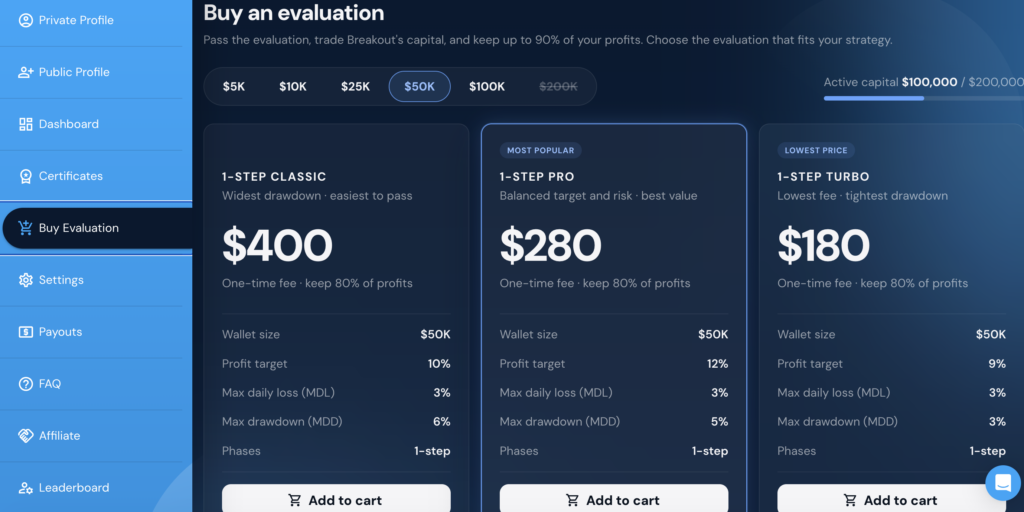
Breakout Prop — Evaluation Rules, Payout Structure, and Scaling Plan (Code: DR5DTX)
Breakout Prop entered the crypto prop space in 2024 with a model borrowed from forex prop firms but adapted for crypto’s volatility and 24/7 market structure.
The Evaluation Structure
Phase 1: The Challenge
Parameter | Specification |
Account size | $10K / $25K / $50K / $100K / $200K |
Target profit | 10% (e.g., $10K on $100K account) |
Maximum drawdown | 10% total, 5% daily |
Time limit | 30 days (unlimited for higher tiers) |
Minimum trading days | 5 |
Leverage | Up to 20x on crypto perps |
Permitted assets | BTC, ETH, SOL, 15 major altcoins |
Fee | $99–$599 depending on account size |
The daily drawdown rule is the killer. It’s calculated from your previous day’s end-of-day balance (or high watermark intraday). If you made $3,000 on day 1, your day 2 starting balance is $103,000. Your 5% daily drawdown limit is $5,150 from that peak — meaning your account cannot drop below $97,850.
This sounds manageable until you realize that a single leveraged position can blow through 5% in minutes. At 10x leverage, a 0.5% adverse move hits your daily limit. At 20x, 0.25%.
Phase 2: Verification
After passing Phase 1, you enter verification with the same rules but typically 60 days instead of 30. This filters out lucky traders from skilled ones.
The funded account: Once verified, you receive a live account (not demo) with the firm’s capital. Profit split starts at 80/20 (you/firm), scaling to 90/10 after three consecutive payout months.
Breakout Prop’s Scaling Plan
This is where Breakout Prop differentiates itself. Most prop firms cap your account size. Breakout Prop offers genuine scaling:
Milestone | Action |
First payout | Account size locked at evaluation level |
3 consecutive profitable months | Account doubled (e.g., $100K → $200K) |
6 consecutive profitable months | Account doubled again ($200K → $400K) |
12 consecutive profitable months | Eligible for $1M+ custom allocation |
The catch: “Consecutive profitable months” means every month must be net positive. One losing month resets the counter. This is harder than it sounds — even professional traders have losing months.
Payout Mechanics
- Frequency: Bi-weekly after first month, weekly thereafter
- Methods: USDT (ERC-20, TRC-20), bank wire (for EU residents), PayPal
- Minimum withdrawal: $500
- KYC required: Yes, for first payout — standard identity verification
My Breakout Prop Experience
I paid $299 for the $50K evaluation. Passed Phase 1 in 18 days with 11.3% return. The key was not trading size — it was trading frequency. I took only 23 trades, averaging 2.1R per trade, with a 52% win rate.
Phase 2 took 34 days. The extended timeline tested patience more than skill. I found myself taking lower-quality setups just to “stay active,” which nearly cost me the daily drawdown on day 28.
Critical insight: Breakout Prop’s rules reward patience and punish overtrading. The traders who fail are not the ones who lose big — they’re the ones who trade 50 times in 5 days, accumulate small losses, and hit the daily limit on a single bad day.
HyroTrader — Coupon 5agfeyq and Their Two-Phase Challenge
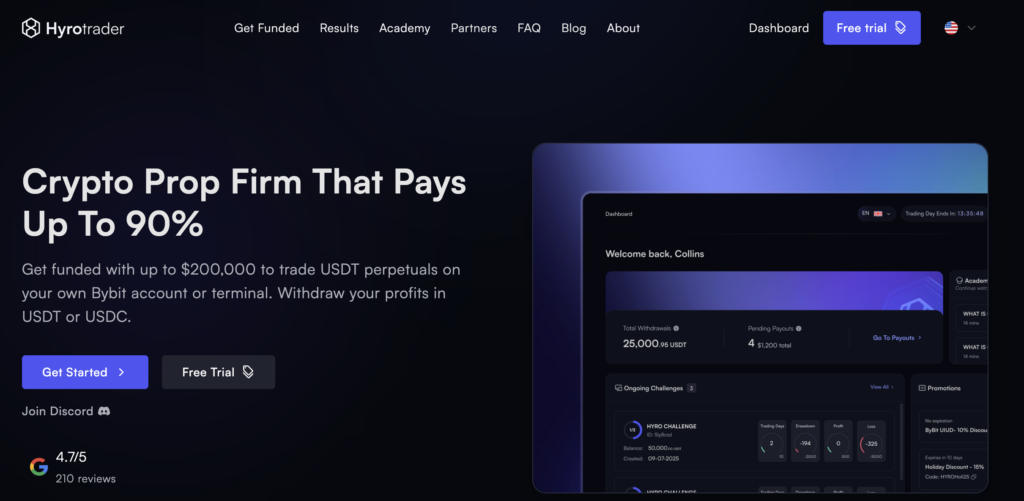
HyroTrader takes a different approach. Where Breakout Prop emphasizes consistency over time, HyroTrader emphasizes risk-adjusted returns with a “consistency rule” that filters out high-variance traders.
The Two-Phase Challenge
Phase 1: Profit Target + Consistency
Parameter | Specification |
Account size | $5K / $10K / $25K / $50K / $100K / $250K |
Target profit | 8% (lower than Breakout Prop) |
Maximum drawdown | 10% total, 4% daily (tighter than Breakout) |
Time limit | Unlimited — no clock pressure |
Minimum trading days | 10 (higher than Breakout) |
Consistency rule | No single day can exceed 30% of total profits |
Leverage | Up to 15x (lower than Breakout) |
Permitted assets | BTC, ETH, SOL, 20 altcoins, plus forex majors |
Fee | $89–$999 depending on account size |
The consistency rule is HyroTrader’s signature filter. If your target is 8% on a $50K account ($4,000 profit), no single trading day can contribute more than $1,200 (30%) to that total. This means you need at least 4 profitable days, ideally spread across multiple weeks.
This rule eliminates:
- Gamblers who hit the target on one lucky trade
- News traders who bet everything on FOMC
- Martingale practitioners who double down until they win
It selects for:
- Systematic traders with edge across multiple sessions
- Risk managers who scale in and out
- Traders with genuine positive expectancy, not just positive variance
Phase 2: Verification
Same rules, 60-day minimum, but the consistency rule relaxes to 40% single-day contribution. This acknowledges that verification requires more trades, and perfect consistency is unrealistic over longer periods.
HyroTrader’s Unique Features
- Platform flexibility
HyroTrader doesn’t force you onto a proprietary platform. You can trade through:
- Binance (via API)
- Bybit (via API)
- OKX (via API)
- KuCoin (via API)
This matters because:
- You trade on familiar interfaces
- You retain your exchange fee tiers and rebates
- You can use TradingView, 3Commas, or custom bots
- If HyroTrader fails, your exchange account still exists
- The “Hyro Score”
Post-evaluation, funded traders receive a risk score based on:
- Sharpe ratio of their evaluation period
- Maximum consecutive losing days
- Drawdown recovery speed
- Win rate stability
Higher Hyro Scores unlock:
- Faster payout processing
- Higher profit splits (up to 95/5)
- Access to “Elite” account sizes ($500K+)
- Direct line to risk management for position disputes
- Educational overlay
HyroTrader mandates completion of their risk management course before Phase 2. It’s not fluff — it covers:
- Position sizing mathematics
- Correlation risk in crypto portfolios
- Funding rate arbitrage
- Exchange-specific liquidation mechanics
Payout Mechanics
- Frequency: Weekly after first month
- Methods: USDT (all major networks), bank transfer (SEPA, SWIFT), Wise
- Minimum withdrawal: $250 (lower than Breakout)
- KYC required: Yes, but streamlined — selfie + ID, usually approved within 2 hours
My HyroTrader Experience
I used coupon 5agfeyq for 15% off the $50K evaluation ($424 instead of $499). The consistency rule forced a complete strategy redesign. My typical approach — wait for high-conviction setup, size heavily, scale out — produced a $2,800 day that violated the 30% rule.
I had to restart with a “micro-scalping” approach: 0.5R targets, 8–12 trades per day, never more than 1% risk per trade. It was tedious. It was also profitable. I passed Phase 1 in 22 days with 8.7% return, no single day exceeding 26% of total profits.
Phase 2 felt easier because the 40% consistency threshold allowed slightly larger days. The unlimited time removed psychological pressure — I could skip low-quality sessions without clock anxiety.
Critical insight: HyroTrader’s consistency rule is not an obstacle. It’s a feature that trains you to trade like a professional. The skills you develop to pass HyroTrader are the same skills that keep you alive in a funded account.
PropW — Code 3262283 and Their Unique Risk Parameters
PropW is the newest of the three firms, launched in late 2025, and the most unconventional. Where Breakout and HyroTrader use standard “pass evaluation → get funded” models, PropW introduces dynamic risk parameters that adjust based on your real-time performance.
The Adaptive Evaluation
Base rules:
Parameter | Specification |
Account size | $10K / $25K / $50K / $100K |
Target profit | 12% (higher than competitors) |
Maximum drawdown | 12% total, 6% daily |
Time limit | 45 days |
Minimum trading days | 8 |
The dynamic adjustment:
PropW’s algorithm monitors your trading in real-time and adjusts your parameters:
Behavior | Algorithm Response |
3 consecutive winning days | Daily drawdown tightens to 4% (protects profits) |
Volatility spikes (VIX >40) | Leverage cap reduced to 10x (market risk management) |
Drawdown exceeds 6% | Mandatory 24-hour trading pause (cooling off) |
Win rate drops below 35% | Profit target reduced by 20% (realistic goal-setting) |
Sharpe ratio >2.0 for 10 days | Profit split pre-negotiated to 85/15 before funding |
This is controversial. Some traders hate the “nanny state” interference. Others appreciate the guardrails.
PropW’s “Risk-Adjusted Payout” Model
Traditional prop firms pay based on nominal profits. PropW pays based on risk-adjusted returns:
- Standard payout: 80/20 split on gross profits
- Risk-adjusted payout: If your funded account maintains:
- Sharpe ratio >1.5: +5% to your split (85/15)
- Maximum drawdown <5% for quarter: +5% (90/10)
- Zero daily limit hits for 60 days: +5% (95/5)
The theoretical maximum: 95/5 split, achievable only by consistently trading with institutional-grade risk management.
Platform Integration
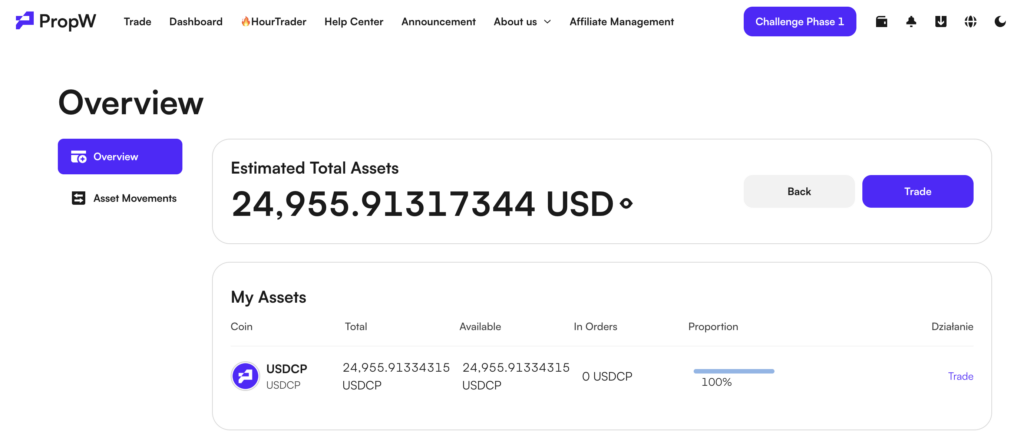
PropW built its own trading terminal — not an API connection to existing exchanges. This has pros and cons:
Pros:
- Unified interface across all supported assets
- Built-in risk monitoring (real-time P&L, Greeks, correlation matrix)
- Integrated journaling and performance analytics
- No dependency on exchange API stability
Cons:
- Learning curve for traders accustomed to TradingView or exchange-native interfaces
- Limited third-party bot integration
- Single point of failure — if PropW’s platform is down, you cannot trade
Supported assets: BTC, ETH, SOL, 25 altcoins, plus tokenized stocks (TSLA, AAPL, NVDA) and commodities (gold, oil)
My PropW Experience
I approached PropW skeptically. The dynamic adjustments felt paternalistic. The 12% profit target seemed high. The proprietary platform worried me.
I paid $349 for the $50K evaluation using code 3262283 (10% discount). The platform was surprisingly polished — not TradingView, but functional. The real-time risk dashboard became addictive. I found myself checking my “PropW Score” (their composite risk metric) more than my P&L.
The dynamic adjustments were intrusive but educational. On day 9, after three winning days, my daily drawdown tightened from 6% to 4%. I resented it — then watched a 5% intraday swing that would have hit my old limit. The algorithm had correctly identified my elevated risk.
I failed my first attempt. Hit the daily limit on day 17 during a BTC volatility spike. The mandatory 24-hour pause saved me from revenge trading — I would have blown the account otherwise.
Second attempt: passed in 31 days. The 12% target required more aggression than HyroTrader’s 8%, but the dynamic adjustments kept me from self-destructing.
Platform Integration — Which Exchanges Prop Firms Connect To
Not all prop firms plug into the same infrastructure. Your trading experience — execution speed, fee structure, available pairs, and bot compatibility — depends heavily on which exchange backend your prop firm uses.
Prop Firm | Exchange Backend | API Available | TradingView Support | Bot Compatibility |
Breakout Prop | Proprietary terminal (TradeLocker-based) | Limited | Basic embedded charts | Restricted |
HyroTrader | Binance, Bybit, OKX, KuCoin (via API) | Full exchange API | Full TradingView integration | 3Commas, custom bots, TradingView alerts |
PropW | Proprietary terminal (built in-house) | Closed ecosystem | No external integration | None (platform-native only) |
What this means practically:
- Breakout Prop traders get a standardized, controlled environment. The platform is functional but lacks the depth of exchange-native tools. If you’re a charting purist or rely on custom indicators, you’ll feel constrained.
- HyroTrader offers the most flexibility. If you already have fee discounts, API keys, and bot infrastructure on Binance or Bybit, you simply plug HyroTrader into your existing setup. Your exchange account stays yours even if the prop firm disappears.
- PropW is the most isolated. The upside is integrated risk management and journaling. The downside is vendor lock-in — you can’t migrate your strategy to another platform without rebuilding from scratch.
Exchange-specific considerations:
- Binance backends offer the deepest liquidity and tightest spreads but come with regulatory complexity in certain jurisdictions.
- Bybit has become the preferred derivatives venue for prop firms due to robust API stability and competitive perpetual funding rates.
- OKX and KuCoin provide broader altcoin exposure, which matters if your edge lies in mid-cap tokens rather than BTC/ETH majors.
Choose your prop firm partly based on which exchange you already trust and have optimized for.
The Psychology of Trading Someone Else’s Capital
This is the section no one talks about — and it’s why most funded traders fail within 90 days.
When you trade your own $5,000 account, every dollar lost is a dollar you can’t spend on rent. The pain is immediate, visceral, and personal. You develop respect for risk because the consequences are real.
When you trade a firm’s $50,000 account, something dangerous happens in your brain: the money stops feeling real.
The Entitlement Trap
You passed the evaluation. You proved your skill. You start to feel like the account is yours. It’s not. It’s a liability on the firm’s balance sheet, and they can pull it the moment you violate their risk rules.
The entitlement trap manifests as:
- Sizing up after a winning streak: “I’m hot — let me double the position.”
- Revenge trading after a loss: “The firm can afford it, I’ll make it back.”
- Ignoring the daily drawdown: “It’s only 5%, I have room.”
Every one of these behaviors ends with a blown account and a $300–$500 re-evaluation fee in the firm’s pocket.
The Performance Pressure Paradox
Prop firms create a perverse incentive structure. Your payout depends on monthly profitability, but your account survival depends on daily risk limits. This creates a tension between:
- Short-term survival: Don’t hit the daily drawdown
- Medium-term payout: Be profitable enough to withdraw
- Long-term scaling: Be consistently profitable to grow the account
Most traders optimize for one at the expense of the others. The survivors optimize for survival first, payout second, scaling third.
The Overtrading Death Spiral
Breakout Prop’s 5-day minimum trading rule and HyroTrader’s 10-day minimum are there to prevent “one and done” lucky passes. But they create a secondary trap: traders feel compelled to trade even when no setup exists.
I felt this personally during Breakout Prop Phase 2. Day 28, no valid setup for three days. I forced a trade. It moved against me. I added to the loser. I was $400 from the daily limit before I closed it. I survived by $187. That was the day I learned: in prop trading, not trading is often the best trade.
The Withdrawal Anxiety
Even after passing, many funded traders never request a payout. The psychology is fascinating:
- Fear that withdrawing “jinxes” the account
- Greed that compounding faster will lead to bigger payouts later
- Paralysis from not wanting to “fail” the firm after they trusted you
Prop firms know this. They structure bi-weekly or weekly payouts not for your convenience, but because frequent withdrawals reduce the probability of a trader building a massive unrealized P&L that gets wiped in one bad session.
My rule: Withdraw 50% of profits after every payout. Compound the rest. This protects your psychology (you’re extracting real value) and your risk profile (you’re not playing with house money indefinitely).
The Identity Shift
The hardest transition is from “evaluation taker” to “funded trader.” During evaluation, the goal is binary: pass or fail. Once funded, the goal becomes continuous: survive, profit, withdraw, repeat.
This requires a different identity. You’re no longer a challenger trying to beat a game. You’re a risk manager employed by a firm that happens to pay you a performance bonus. The moment you start thinking like a gambler instead of a risk manager, the account dies.
Start Your Evaluation on Breakout Prop with Code DR5DTX
If you’re serious about prop trading, start with Breakout Prop. Their evaluation structure is the most forgiving for patient traders, their scaling plan is the most aggressive for consistent performers, and their payout mechanics are straightforward and reliable.
Use referral code DR5DTX when signing up for your evaluation. It won’t change the rules or the difficulty — those are the same for everyone — but it supports the research that made this guide possible.
The honest truth: Most traders who buy prop firm evaluations will fail. Not because the firms are scams, but because the traders are unprepared for the psychological and mathematical reality of trading within someone else’s risk parameters.
If you understand that going in — if you accept that the evaluation is a filter, not a lottery — your odds improve dramatically. Trade small. Trade selectively. Protect the daily drawdown like it’s your only lifeline. Because in prop trading, it is.
Start your evaluation on Breakout Prop with referral code DR5DTX.
About the Author