Who Really Moves Bitcoin? Inside the Crypto Market Maker Playbook
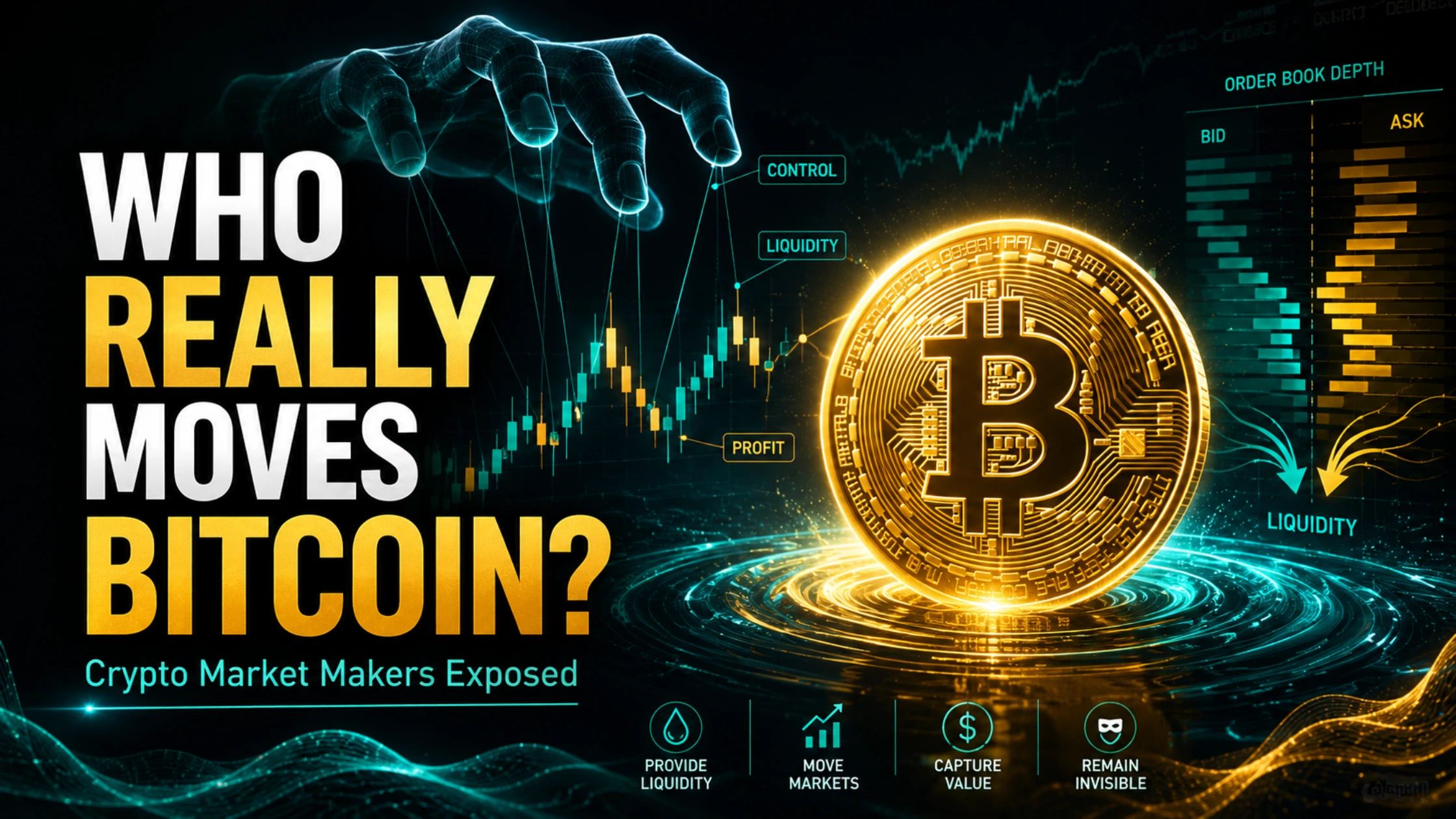
Forensic Finance | Market Structure | June 2026
The Invisible Hand: How Market Makers Control Crypto Prices, Who Profits, and the Games They Play That No One Talks About
Market makers are the invisible infrastructure of every financial market. They provide liquidity — the bid and ask prices that allow you to buy or sell at any moment — and in exchange they collect the spread between those prices thousands of times per second. In crypto, five firms dominate this infrastructure: Jane Street (the world's most profitable trading firm, managing $505B in AUM, now holding $790M in IBIT), Citadel Securities (processing 25% of all U.S. equity volume, now expanding to Coinbase and Binance), Susquehanna International Group (major IBIT authorized participant, crypto options specialist), Virtu Financial (the only publicly listed HFT market maker, IBIT founding AP), and DWF Labs (the crypto-native market maker with $300M in alleged wash trading uncovered by Binance's own investigators). This article forensically maps the full market maker playbook: what they do legitimately (essential liquidity, price discovery, volatility dampening), what they do at the edge (delta hedging flows that pin prices at options expiry, ETF creation/redemption arbitrage that moves underlying assets, information advantages so extreme they approach structural unfairness), and what some do illegally (spoofing, layering, wash trading, the "expiry day trap"). The centerpiece: Jane Street's $553M SEBI enforcement order for what regulators called a "deliberately devised device" to manipulate India's BANKNIFTY index across 18 expiry days from 2023 to 2025, generating $4.3B in gross options profits. The mechanism mapped for crypto: the same cross-market strategy — move the underlying, harvest the derivative — applied to Bitcoin ETFs, IBIT options, and the "10AM Bitcoin dump" that traders have been tracking since late 2024.
There is a price for Bitcoin right now. You can look it up on any exchange. You can buy at that price, or something very close to it, within seconds. This convenience — the ability to transact instantly, at a known price, in any size — is so fundamental to how markets work that most participants never question where it comes from.
It comes from market makers. And understanding market makers is, after understanding Bitcoin's supply schedule and the halving cycle, the most important piece of market structure knowledge any crypto investor can possess.
Market makers are the firms that simultaneously offer to buy Bitcoin from you at $X and sell it to you at $X plus a small spread. They do this millions of times per day, across every asset class, every exchange, every time zone. The spread is their profit margin. The volume is their revenue. The speed is their moat. And the information advantage embedded in this position — seeing every order before it fills, knowing exactly where buy and sell pressure is concentrated before anyone else does — is the most valuable thing in finance.
Five firms dominate this infrastructure in crypto. Their activities are simultaneously the most beneficial thing happening to your Bitcoin trades (narrowing spreads, enabling liquidity, stabilising prices) and, in some documented cases, the most harmful (moving prices systematically to trigger your stop losses, capturing your liquidation value as their profit). This article maps both sides, names all the actors, and gives you the framework to trade around them rather than through them.
"Jane Street's trading footprint was so dominant that SEBI attributed the entire positive price impact in the BANKNIFTY index during the morning session on several days to Jane Street alone, while the rest of the market exerted net downward pressure."
— SEBI Interim Order, July 3, 2025. 105-page enforcement document on BANKNIFTY index manipulation.The Legitimate Role: Why Markets Cannot Function Without Market Makers
Before mapping the games, you need to understand the genuine value. Market makers solve the fundamental problem of financial markets: the buyer and seller of the same asset rarely show up at the same time. Without a market maker standing in the middle — constantly offering to buy and sell — Bitcoin would be illiquid, bid-ask spreads would be enormous, and large trades would move prices dramatically.
The spread is the price of liquidity
When you buy Bitcoin on Bybit at $65,002 and the "bid" is $64,998, the $4 difference is the market maker's spread — their compensation for taking the other side of your trade and bearing the risk that Bitcoin's price moves against them before they can lay off the position. In liquid, well-organised markets, this spread is narrow. In illiquid or manipulated markets, it is wide. Narrow spreads are a direct benefit to every retail trader, and they are produced by market maker competition.
In 2019, before institutional market makers entered crypto, BTC bid-ask spreads on major exchanges averaged $15-30 for spot and $25-50 for perpetuals. By 2024, with Jane Street, Citadel, Susquehanna, and Virtu all competing for flow, spreads collapsed to $0.50-$2.00. This represents billions of dollars in aggregate savings for retail traders annually. The market makers are not doing this from altruism. They are doing it because the volume at tight spreads generates more profit than lower volume at wide spreads. But the effect on retail is unambiguously positive.
Price discovery and the ETF creation/redemption mechanism
Authorised participants (APs) for Bitcoin ETFs — Jane Street, Virtu, Citadel, Susquehanna among them — perform a specific and essential function: they ensure IBIT's market price tracks Bitcoin's spot price. When IBIT trades at a premium to Bitcoin's price, APs buy Bitcoin and exchange it with BlackRock for new IBIT shares, selling those shares on the market and capturing the premium. When IBIT trades at a discount, APs buy IBIT shares and exchange them for Bitcoin, selling the Bitcoin and capturing the discount. This arbitrage is what keeps the ETF price aligned with the underlying asset. Without it, IBIT could trade 5-10% above or below Bitcoin's actual price, as GBTC did before its ETF conversion.
The Information Advantage: What Market Makers Know That You Don’t
The spread revenue is real and valuable. But the true profit engine of modern market making is something more opaque: information advantage. Market makers, by virtue of their position in the market infrastructure, see order flow before it executes. They process $450B in daily trading data (Citadel Securities' own figure). They operate on co-located servers milliseconds faster than any retail participant. They have pricing models for assets that most investors don't know exist. And in crypto specifically, they have structural advantages that go beyond what is available in equities.
ETF creation/redemption as information
Jane Street, as an authorised participant for IBIT, sees the ETF creation and redemption queue before it executes. When a large institutional investor submits a $500M creation order — meaning they are putting $500M into IBIT — Jane Street knows that it will need to buy approximately $500M in Bitcoin on the spot market within the settlement window to fulfill that creation. That is directional information of extraordinary value. The question of whether Jane Street uses that foreknowledge to position ahead of the trade it will execute for IBIT is the question that regulators have not yet formally answered for crypto. In equities, front-running client orders is illegal. The legal framework for crypto AP order flow is less developed.
Options delta hedging and the gamma pin
When market makers sell call options on Bitcoin or IBIT (as they do in large volume, particularly now with BITA generating predictable monthly option flow), they must hedge their exposure by buying Bitcoin as the price rises and selling as it falls. This delta hedging is mechanical and predictable. As the underlying asset approaches a heavily-traded options strike at expiry, the mechanical buying and selling by dealers who are hedging their delta creates gravitational price pressure toward the strike. Traders who understand where the large open interest concentrations are can trade with the gravity rather than against it. Those who don't experience unexplained price stickiness near options expiry and attribute it to random market behaviour.
Jane Street: The Most Important Firm in Crypto That Most Retail Traders Couldn’t Name
Jane Street Group is the most profitable trading firm in the world. It manages approximately $505B in assets. It earned an estimated $21B in 2023 alone. It employs around 2,500 people, most of them quantitative researchers and engineers, and maintains a culture of extreme secrecy. It has no press office. Its executives do not give interviews. It does not appear in the Fortune 500. And as of Q4 2025, it was the largest institutional holder of IBIT, with 20.3 million shares worth approximately $790M before it rotated significantly to Ethereum ETFs in Q1 2026.
The 10AM Bitcoin dump: allegation vs. mechanism
Beginning in late 2024, a pattern emerged in Bitcoin's price behaviour: at approximately 10 AM Eastern — the U.S. stock market open — Bitcoin would drop 2-3% sharply, trigger liquidations of leveraged long positions, and then often recover later in the day. The consistency of the pattern attracted attention. Crypto trader Justin Bechler and others publicly accused Jane Street of running a systematic morning sell program to create better entry prices for its IBIT accumulation.
Jane Street's 13F filings were the evidence cited: the firm was holding large IBIT positions, and the "Y" options indicator on its position suggested the holdings included options exposure, not just outright ETF shares. The allegation: Jane Street was simultaneously short Bitcoin (or short IBIT) in the morning, triggering the sell-off and associated liquidations, while simultaneously accumulating a long position at lower prices via IBIT creation. The rebuttal from market structure veterans: the 13F IBIT position is delta-neutral inventory held as part of an ETF arbitrage operation, not a directional bet. Adding shares is not accumulation; it is rebalancing a hedged book.
The allegation has not been proven in any regulatory proceeding. What is documentably true: Jane Street dropped its IBIT position by 71% in Q1 2026 (from 20.3M to 5.9M shares) precisely as speculation about the 10AM pattern peaked publicly. It simultaneously increased Ethereum ETF exposure by $82M. Whether this rotation was driven by regulatory concern, profitability of the strategy running dry, or simply portfolio rebalancing is unknowable from public data.
The SEBI enforcement: the documented case
What is not an allegation is what SEBI found in India. On July 3, 2025, India's Securities and Exchange Board issued a 105-page interim enforcement order against four Jane Street entities. The findings, based on 18 derivative expiry days from January 2023 to March 2025, were specific:
- Morning Spike: Jane Street's entities aggressively purchased large volumes of BANKNIFTY constituent stocks and futures in the morning session, artificially inflating the index. On January 17, 2024 alone, they acquired “₹4,370 crores of BANKNIFTY stocks and futures, driving the index upward.”
- Concurrent Options Position: While inflating the index via cash market purchases, they simultaneously built massive short options positions (buying puts, selling calls) that would profit from an index reversal.
- Afternoon Crash: In the afternoon, they unwound the cash market positions, causing a sharp index decline. The short options positions, which they had built at elevated index levels, then generated large profits as the index fell.
SEBI called this an “expiry day trap” — a “deliberately devised device” to manipulate settlement prices. The total gross options profit across 21 expiry cycles was “₹43,281 crore” (approximately $5.2B). SEBI impounded “₹4,843.57 crore” ($566M) and banned Jane Street from Indian markets pending proceedings. Jane Street deposited the full amount on July 14, 2025 while reserving the right to challenge.
The cross-market strategy SEBI identified — move the underlying to generate profit in the derivative layer sitting on top — is structurally identical to what crypto traders describe in the 10AM pattern allegations. The difference: SEBI had the data and the regulatory authority to act. The CFTC and SEC have not yet identified a comparable pattern in Bitcoin markets with the same evidentiary specificity.
Citadel Securities, Susquehanna, Virtu: The Coming Institutional Takeover
Citadel Securities: the dominant player coming late
Citadel Securities processes approximately 25% of all U.S. equity volume — more than the New York Stock Exchange itself. Its founder Ken Griffin called Bitcoin a tool for tax evasion in 2021. By February 2025, Citadel Securities was named an authorized participant for IBIT and announced plans to become a market maker on Coinbase, Binance, and Crypto.com. The pivot is driven by two forces: the Trump regulatory environment making crypto market making legally defensible, and the Citadel hedge fund's own Bitcoin investments which needed professional execution infrastructure.
The arrival of Citadel Securities in crypto market making is structurally significant. The firm processes $450B in daily data and makes decisions through proprietary predictive models that are orders of magnitude more sophisticated than anything currently deployed by crypto-native market makers. When Citadel enters a market, spreads compress, volume concentrates toward it, and competing market makers face margin compression. For retail traders, this means better prices. For crypto-native market makers, it means revenue erosion.
Susquehanna International Group (SIG)
SIG is the options market maker's options market maker. Founded in 1987 around a poker-playing, probabilistic-thinking culture, it has historically specialised in equity options — the derivatives that BITA now writes in volume. As an IBIT authorized participant with a large disclosed IBIT position in its 13F filings, SIG is positioned at the intersection of Bitcoin spot (via IBIT) and Bitcoin options (which it prices as a specialisation). SIG's edge in crypto is its volatility surface expertise: the proprietary model for what Bitcoin options should cost across all strikes and expirations. The firm that correctly prices that surface extracts systematic profit from everyone who trades against it.
Virtu Financial
Virtu is the only publicly listed high-frequency trading market maker, which makes it the most transparent window into this business. Its disclosures are illuminating: in the year it reported zero losing trading days (all 1,238 of them, a streak later broken), Virtu was processing millions of trades per day across equities, ETFs, fixed income, currencies, and crypto. Virtu was a founding IBIT authorized participant on day one of IBIT's launch in January 2024, reflecting its longstanding crypto infrastructure (it had been making markets in Bitcoin since 2018). The Virtu data point that matters most for crypto traders: the firm has historically disclosed that crypto market making generates higher margins than equities due to lower regulatory scrutiny, less competition, and higher underlying volatility generating larger spreads.
The AP Roster: Who Controls IBIT’s Liquidity Infrastructure
| Authorized Participant | Type | Added as AP | Primary Edge in Crypto | Known Crypto Concerns |
|---|---|---|---|---|
| Jane Street Capital | Prop Trading / MM | Day 1 (Jan 2024) | ETF arb, options pricing, delta-neutral inventory | SEBI $566M enforcement (India), 10AM BTC dump allegations |
| Virtu Americas | Listed HFT / MM | Day 1 (Jan 2024) | HFT infrastructure, crypto since 2018, speed advantage | SEC supervisory failure fine 2022 (equities); crypto clean |
| JPMorgan Securities | Bank / AP | Day 1 (Jan 2024) | Institutional custody, balance sheet, client order flow | No significant crypto enforcement history |
| Macquarie Capital | Bank / AP | Day 1 (Jan 2024) | Asia-Pacific liquidity, institutional distribution | No significant crypto enforcement history |
| Goldman Sachs | Bank / AP | Apr 2024 | Institutional block trading, derivatives distribution | 1MDB settlement 2020 (unrelated); crypto clean |
| Citadel Securities | MM / Prop | Apr 2024 | 25% of US equity volume; co-location; data processing at scale | LUNA manipulation alleged by Do Kwon (unproven); EDX conflicts |
| Citigroup | Bank / AP | Apr 2024 | Prime brokerage, institutional custody, stablecoin integration | No significant crypto enforcement history |
| UBS | Bank / AP | Apr 2024 | European institutional distribution, wealth management | No significant crypto enforcement history |
| ABN AMRO | Bank / AP | Apr 2024 | European clearing, custody infrastructure | No significant crypto enforcement history |
The Dark Side: What Crypto-Native Market Makers Actually Do to Token Prices
The firms above operate in regulated markets under SEC, CFTC, and international oversight. Their strategies are sophisticated and sometimes ethically ambiguous, but they operate within a legal framework that limits the most egregious abuses.
The crypto-native market maker ecosystem is a different story. When a new token project launches, it typically hires a market maker to provide liquidity — ensuring the token has a functioning bid-ask spread and doesn't gap dramatically on small orders. The contract between the project and the market maker defines the fee, the inventory requirements, and the performance metrics. What it often does not define clearly enough is what happens to the tokens the market maker receives.
The DWF Labs case: $300 million in alleged wash trading
DWF Labs describes itself as a digital asset market maker and investment firm that has deployed capital into more than 470 projects. In September 2023, Binance's internal market surveillance team — a group of TradFi veterans hired specifically to clean up the exchange — began investigating DWF. The team's report, according to the Wall Street Journal, found approximately $300M in wash trading by DWF across multiple tokens: simultaneously buying and selling the same tokens through affiliated accounts to create artificial volume, generate the appearance of liquidity, and attract retail buyers at elevated prices.
Binance's own internal investigators concluded these activities violated the exchange's terms of use. The exchange then fired the investigator who submitted the report. Binance subsequently determined there was insufficient evidence to act, and DWF remains an active market maker across major exchanges. DWF has denied wrongdoing.
The MOVE token manipulation: Binance bans a market maker
In March 2025, Binance publicly banned a market maker from its platform following an investigation into the Movement (MOVE) token launch. The market maker — not publicly named by Binance but identified in crypto ecosystem rumors as Web3port — allegedly received 66 million MOVE tokens from the project team and sold them into negligible buy orders on the first day of listing, generating approximately $38M in net profit and crashing the token's price. Binance published new market maker disclosure requirements following the incident, requiring all market makers to disclose their token inventory and prohibiting profit-sharing arrangements that create incentive misalignment between the market maker and the token's price performance.
The FBI sting: Operation Token Mirrors
In October 2024, the U.S. Federal Bureau of Investigation launched "Operation Token Mirrors" — creating a fake cryptocurrency called NexFundAI to catch market manipulation in real time. Undercover FBI agents posed as potential clients and approached market-making firms, documented what services they actually offered, and then watched in real time as the firms ran wash trades through hundreds of cryptocurrency wallets, generating millions of dollars in artificial volume on Uniswap. The operation resulted in charges against 18 individuals across multiple firms. In March 2026, the DOJ unsealed new indictments against ten individuals from four market-making firms for wash trading and price manipulation.
What Traders and Investors Should Do With This Knowledge
Understanding market maker mechanics does not give retail traders the ability to compete with them on speed, data, or capital. But it does provide three specific, actionable advantages.
Advantage 1: Trade around options expiry gravity
The gamma pin is real and predictable. Before each monthly Bitcoin options expiry (on Deribit, CME, and now BITA's monthly cycle), check where the large open interest concentrations are. Tools like Deribit's options dashboard and Glassnode's options data show the strike clustering. Price tends to gravitate toward the "max pain" level — the strike at which the largest number of options expire worthless — in the days approaching expiry. Trading with this gravity (not against it) is one of the clearest market-structure edges available to informed retail participants.
Advantage 2: Read IBIT creation/redemption data as directional signal
IBIT's daily creation and redemption flows are published with a one-day lag. Large creation days (institutional inflows) tend to be followed by positive BTC price action as the AP buys Bitcoin to fulfill the creation. Large redemption days signal institutional outflows with the inverse effect. The ETF Flow Signal in the DN Fink Conviction Index tracks this. Use Bybit or Binance to position within the 24-48 hour signal window.
Advantage 3: Avoid thinly-traded altcoins with unknown market makers
The DWF Labs and MOVE token cases illustrate a specific risk in new token launches: the market maker has received a token allocation and has strong incentives to sell it into retail liquidity. For any new token listing, check who the market maker is. If the market maker is not publicly disclosed, if the project has not published a market-making agreement summary, or if the market maker is known to have faced wash trading allegations, treat the initial trading days with maximum caution. Use established, deep-liquidity platforms like BloFin or OKX where market maker disclosure requirements are more developed. The DN Perp DEX Power Rankings ranks venues by market structure quality.
The Bottom Line: Every Trade Has a Counterparty, and That Counterparty Has Advantages You Don’t
Market makers are not villains. They are rational profit-seeking institutions operating in an environment that rewards speed, data, and sophistication. When they function within legal boundaries, they provide the liquidity infrastructure that makes every other participant's trading cheaper, faster, and more reliable. When they step outside those boundaries — as SEBI found Jane Street did, as the FBI found multiple crypto market makers did — they extract directly from retail participants at scale.
The most important thing a retail crypto trader can understand about market makers is not any specific tactic, but the structural reality: they have information you don't, systems faster than you can conceive of, and capital deep enough to absorb any position you could take. The right response is not to try to outmaneuver them on their terms. It is to trade on your terms: longer time horizons where tick-level speed is irrelevant, larger directional bets where the market maker's spread is a rounding error, and structured products where the payoff is defined in advance rather than determined in real-time against a counterparty with every advantage.
Track the institutional environment through the DN Power Brokers Framework. Watch IBIT flows through the DN Fink Conviction Index. Hold Bitcoin directly through Bybit or Binance and in cold storage through Ledger. Trade derivatives through platforms with transparent market maker frameworks like BloFin or OKX. And when a new token launches with a 25% first-day price decline and low volume, remember MOVE. You are not discovering undervalued opportunity. You are being offered the exit that the market maker needs.
Frequently Asked Questions
A market maker is a firm that continuously quotes both buy and sell prices for an asset, enabling any other participant to trade instantly at a known price. They profit from the bid-ask spread — the difference between the price they'll buy at and the price they'll sell at. In crypto, market makers have compressed Bitcoin spreads from $15-30 in 2019 to $0.50-2.00 today by competing for order flow. They also serve as authorised participants (APs) for Bitcoin ETFs like IBIT, arbitraging any premium or discount between the ETF price and Bitcoin's spot price. Without market makers, crypto would be significantly less liquid, spreads would be much wider, and large trades would move prices dramatically.
The 10AM Bitcoin dump allegation has not been proven in any regulatory proceeding. The pattern — a consistent ~2-3% Bitcoin price drop around 10 AM Eastern time at the U.S. market open, beginning in late 2024 — is real and documented by multiple traders. The allegation that Jane Street was responsible through its IBIT AP role and ETF arbitrage activities is circumstantial and disputed by market structure experts who argue Jane Street's large IBIT position is delta-neutral market-making inventory, not a directional bet. What is documented: Jane Street cut its IBIT position by 71% in Q1 2026 as allegations peaked publicly, and simultaneously increased Ethereum ETF exposure. This rotation is consistent with either regulatory concern or routine portfolio rebalancing.
On July 3, 2025, SEBI issued a 105-page interim enforcement order against four Jane Street entities, accusing them of manipulating the BANKNIFTY index across 18 derivative expiry days from January 2023 to March 2025. The "expiry day trap" mechanism: (1) Morning session — aggressively buy BANKNIFTY constituent stocks and futures to artificially inflate the index; (2) Simultaneously build massive short options positions (buy puts, sell calls) that profit from an index decline; (3) Afternoon — unwind the cash market positions, causing a sharp index decline; (4) Collect profits from the short options positions as the index falls. Total gross options profit: approximately ₹43,281 crore (~$5.2B). SEBI impounded ₹4,843 crore ($566M). Jane Street deposited the full amount on July 14, 2025 while disputing the findings. Jane Street earned more than $4.3B total during the reviewed period from this strategy.
IBIT launched in January 2024 with four founding APs: Jane Street Capital, Virtu Americas, JPMorgan Securities, and Macquarie Capital. BlackRock expanded the roster in April 2024 to nine total by adding Goldman Sachs, Citadel Securities, Citigroup, UBS, and ABN AMRO. APs have the exclusive right to create new IBIT shares by delivering Bitcoin to BlackRock, or redeem IBIT shares in exchange for Bitcoin. This creation/redemption mechanism is what keeps IBIT's market price aligned with Bitcoin's spot price. The AP role provides these firms with structural advantages: foreknowledge of creation/redemption flows, arbitrage profitability, and first-mover positioning relative to the Bitcoin buying or selling that fulfills each order.
The gamma pin (also called "max pain" trading) is a market structure effect where large open interest at specific options strike prices creates gravitational price pressure toward those strikes near expiry. Market makers who sell options must hedge their delta exposure by buying the underlying as price rises and selling as it falls. As a large options expiry approaches, if there is heavy open interest at a specific strike (say $65,000 for Bitcoin), the mechanical delta hedging flows from all the dealers who sold options at that strike create buying pressure when Bitcoin is below $65,000 and selling pressure when it's above — effectively "pinning" the price near $65,000. This is most visible in monthly options expiry windows. With BITA now writing approximately $1.25-3.5B in monthly Bitcoin options at specific strikes, the gamma pin effect in Bitcoin is likely to become more pronounced and predictable over time.
Wash trading involves simultaneously buying and selling the same asset through affiliated accounts or entities to create artificial trading volume. The goal is to generate the appearance of market activity and liquidity to attract genuine buyers. In the FBI's Operation Token Mirrors (October 2024), undercover agents created a fake token (NexFundAI) and documented market-making firms running wash trades through hundreds of wallets on Uniswap, generating millions in artificial volume in real time. Chainalysis estimated $704M in suspected wash trading on Ethereum, BNB, and Base in 2024, with 23,436 unique addresses exhibiting consistent wash trading behavior. DWF Labs was alleged by Binance's own investigators to have conducted $300M in wash trading before Binance fired the investigator and determined insufficient evidence to act.
Citadel Securities has no confirmed crypto market manipulation enforcement actions. The firm was accused by Terraform's Do Kwon in court filings of potentially triggering the LUNA collapse through short selling, but no regulatory finding supported this allegation. Citadel Securities historically avoided crypto market making due to regulatory uncertainty under the Biden administration's hostile stance. It became an IBIT authorized participant in April 2024 and announced plans in February 2025 to serve as a market maker on Coinbase, Binance, and Crypto.com. The firm's entry into crypto market making is likely to compress spreads (beneficial) while concentrating more flow through a single dominant counterparty (increased structural influence). Citadel also co-founded EDX Markets, an institutional crypto exchange, with Virtu, Fidelity, and Schwab.
Three practical approaches: (1) Trade around options expiry, not against it. Check where large Bitcoin options open interest is concentrated (on Deribit's dashboard or Glassnode) and position with the gamma pin gravity rather than against it. (2) Monitor IBIT daily creation/redemption flows as a directional signal. Large creation days (ETF inflows) tend to precede positive BTC price action as APs must buy Bitcoin. Use the 24-48 hour lag window. (3) Avoid new token launches with unknown or controversial market makers. The MOVE token pattern (market maker dumps allocated tokens into retail) is extremely common. Stick to deep-liquidity established tokens where market maker behavior is constrained by competition and regulatory scrutiny. Use established platforms (Bybit, Binance, BloFin, OKX) rather than thin-liquidity venues where market maker manipulation is harder to detect.
DWF Labs is a Dubai-based crypto market maker and investment firm that claims to have deployed capital in more than 470 projects. It is one of the most active market makers in the altcoin ecosystem, often taking on clients that TradFi-origin firms won't serve. The controversy: Binance's internal market surveillance team investigated DWF in 2023 and found approximately $300M in wash trading across multiple tokens, concluding that the firm's activities violated the exchange's terms of use. Binance then fired the investigator who submitted the report. Binance subsequently determined there was insufficient evidence to act against DWF, and DWF remains active. DWF has consistently denied wrongdoing and called allegations "competitor-driven FUD." The case is unresolved but illustrates the systemic governance challenge in crypto market making: exchanges have financial incentives to retain high-volume VIP clients even when their trading practices are questionable.
Embed grant: The DN Market Maker Power Index may be reproduced with attribution to decentralised.news.
DN-INTERNAL links to resolve: DN Fink Conviction Index, DN Power Brokers Framework, DN Covered Call Complexity Decoder, DN MSTR Contagion Index, DN Perp DEX Power Rankings.
Sources: SEBI Interim Order July 3, 2025 (Jane Street BANKNIFTY), Oxford Law Blogs July 30, 2025, TradingView News Feb 18, 2026 (Jane Street 10AM theory), CCN Feb 27, 2026, CoinDesk Apr 5, 2024 (IBIT APs), Bloomberg Feb 24, 2025 (Citadel crypto), DL News May 9, 2024 (DWF Labs), CertiK Oct 2024 (Operation Token Mirrors), Chainalysis wash trading 2025, Business Standard Jul 4, 2025.
As of: June 13, 2026. Not financial advice.
About the Author