The Altcoin Survival Test: Which Crypto Winners Actually Last?
Market Forensics | Altcoin Survival | June 2026
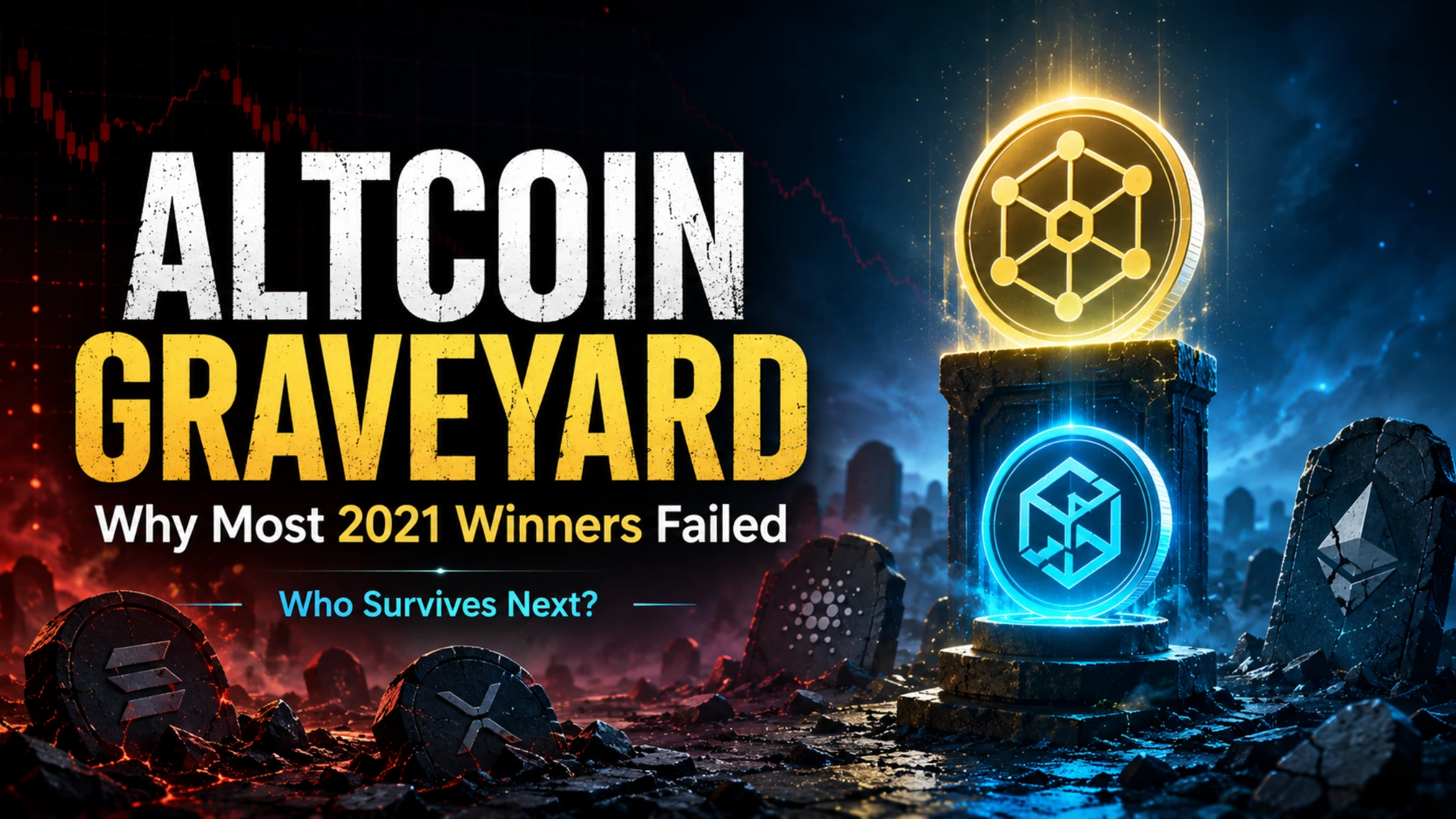
The Altcoin Graveyard: What Happened to Every Top-10 Altcoin From the 2021 Bull Run — and the Pattern That Predicts Which 2026 Altcoins Survive
Of the top-10 cryptocurrencies by market capitalization at the November 2021 bull market peak (excluding Bitcoin), only three maintained genuine protocol revenue and developer activity through the 2022–2023 bear market into 2026: Ethereum, Binance Coin, and Chainlink. The other seven suffered specific, identifiable failure modes. Terra (LUNA) collapsed to effectively zero in May 2022 when its algorithmic stablecoin UST de-pegged, erasing approximately $60 billion in value; LUNA 2.0's market cap stood at roughly $61.79 million as of November 2025, down 71.58% year-on-year. XRP spent five years (2020–2025) in SEC litigation that froze institutional development, leaving it volume-thin relative to peers even after settlement. Cardano delivered its roadmap at a fraction of the promised pace, with a Cardano DRep warning in June 2026 that the network's treasury could be depleted within five years absent fee growth. Dogecoin remains a meme without smart contract infrastructure or protocol revenue. Polkadot's parachain auction model failed to attract a sustainable decentralized application ecosystem, suffering a brutal 2025 drawdown. Litecoin and Bitcoin Cash stagnated as legacy forks with minimal differentiation or development. This article maps the specific failure mode for each 2021 top-10 graveyard candidate, extracts the six-factor framework that separates survivors from casualties, and applies the DN Altcoin Survival Score to the current 2026 top-10 altcoins to identify which are positioned to survive the next bear market and which show the same warning signs as the coins now in the graveyard.
Every bull market produces a top-10 list. Every bear market produces a graveyard. The skill that separates investors who compound wealth across cycles from investors who get wiped out is not picking the next 100x. It is recognising, while a coin is still trading near its all-time high and the narrative still feels unstoppable, which of the current top-10 will be in the graveyard three years later.
This has happened before, with perfect data, and the data has not been studied seriously enough. At the November 2021 bull market peak, the top-10 cryptocurrencies by market capitalization (excluding Bitcoin, which is its own category) were Ethereum, Binance Coin, Cardano, XRP, Solana, Terra (LUNA), Polkadot, Dogecoin, Litecoin, and Chainlink, with Bitcoin Cash also briefly cycling through top-10 status during the run. Five years later, the survival rate among that list, measured by genuine protocol revenue and developer activity rather than mere continued existence, is approximately 30%.
This article does the forensic work that most retrospectives skip: identifying the specific failure mode for each fallen coin, not just noting that it underperformed. A regulatory failure (XRP) requires a different survival framework than an economic design failure (LUNA), which requires a different framework than a narrative-without-infrastructure failure (Dogecoin). Once you can name the failure modes precisely, you can screen for them in real time, in the current top-10, before the next bear market does the work of separating survivors from casualties.
"The network's long-term security depends on transaction fees replacing depleting reserve subsidies within five to ten years." Cardano DRep Jaromir Tesar, warning issued June 16, 2026, that the network's treasury could be depleted within five years absent fee growth.
The Graveyard Audit: What Actually Happened to Every 2021 Top-10 Altcoin
The November 2021 peak top-10 by market capitalization, excluding Bitcoin: Ethereum ($4,815 ATH), Binance Coin ($690 ATH), Cardano ($3.10 ATH), XRP ($1.96 ATH brief spike on legal optimism), Solana, Terra/LUNA ($119.18 ATH), Polkadot ($55 ATH), Dogecoin ($0.74 ATH), Litecoin ($359 ATH), and Chainlink ($52.88 ATH). Each has a distinct story. Below is the forensic breakdown.
Terra (LUNA): the economic design failure
Terra's algorithmic stablecoin UST was designed to maintain its dollar peg through an arbitrage mechanism with LUNA: when UST traded above $1, users could burn LUNA to mint UST and capture the premium; when below $1, users could burn UST to mint LUNA. Anchor Protocol subsidised this system with an unsustainable 19.5% deposit yield, funded by a daily subsidy that reached $6 million by April 2022. When UST de-pegged in May 2022, the arbitrage mechanism that was supposed to restore the peg instead created a hyperinflationary death spiral: LUNA's supply exploded as the system tried to absorb the de-pegged UST, and the price collapsed from over $100 to fractions of a cent within days. Approximately $60 billion in combined value was erased. The community hard-forked into Terra 2.0 (LUNA), abandoning the algorithmic stablecoin model entirely. As of November 2025, LUNA 2.0's market cap stood at approximately $61.79 million, down 71.58% year-on-year, with developer activity having moderated since 2024 and fewer dApps launched than initially anticipated. Failure mode: economic design flaw that worked only in one-directional market conditions and triggered a self-reinforcing collapse under stress.
XRP: the regulatory paralysis
The SEC sued Ripple Labs in December 2020, alleging XRP was an unregistered security. The litigation dragged through 2025, during which institutional partners, exchange listings, and product development around XRP were constrained by the unresolved legal status. While XRP eventually achieved partial regulatory clarity, the five-year freeze cost it the developer mindshare and DeFi ecosystem growth that competitors captured during the same window. XRP's trading volume relative to its market cap remains thin compared to Ethereum, Solana, or BNB. Failure mode: regulatory action that froze institutional and developer engagement for half a decade, during which competitors built the infrastructure XRP never developed.
Cardano (ADA): the roadmap-delivery failure
Cardano's pitch was methodical, peer-reviewed, academically rigorous blockchain development — the "measure twice, cut once" alternative to Ethereum's "ship fast, iterate" approach. Five years later, the methodical approach has produced a fraction of the promised ecosystem. The Cardano Foundation's September 2025 roadmap update for "next phase" application development, targeting 2026 deliverables including stablecoin liquidity provision and a real-world asset project exceeding $10 million, illustrates the problem: in 2026, Cardano is still in "next phase" planning for capabilities competitors shipped years earlier. The June 2026 treasury depletion warning — that transaction fee revenue must replace depleting reserve subsidies within five to ten years or the network faces a security funding crisis — is a structural indictment of the ecosystem's failure to generate organic economic activity. Failure mode: chronic roadmap underdelivery relative to a methodical, well-funded development process, resulting in insufficient organic transaction fee revenue to sustain long-term network security funding.
Dogecoin (DOGE): the narrative-without-infrastructure failure
Dogecoin has no smart contract capability, no DeFi ecosystem, no developer activity beyond minimal maintenance, and no protocol revenue. Its market capitalization, which has at various points exceeded $80 billion, is sustained entirely by celebrity endorsement (primarily Elon Musk), meme cultural relevance, and retail sentiment momentum. This is not inherently disqualifying — Dogecoin has survived longer than many "serious" projects specifically because it has no roadmap to fail to deliver. But it also means Dogecoin generates zero organic economic value, has no mechanism to capture value from blockchain activity, and is entirely a sentiment vehicle. Failure mode (relative to the survival framework, not relative to mere continued existence): zero protocol revenue, zero infrastructure utility, complete dependence on externally-sourced narrative momentum that the project itself cannot influence or sustain.
Polkadot (DOT): the adoption-model failure
Polkadot's central innovation — a Relay Chain connecting independent "parachains" through shared security — was technically sophisticated but commercially underwhelming. The 2021 parachain slot auctions, in which projects bid hundreds of millions of dollars worth of locked DOT for the right to build on one of 100 available parachain slots, generated enormous demand-side speculation but did not translate into a thriving multi-chain ecosystem of applications with real usage. By 2025-2026, Polkadot faced a "brutal drawdown," and DOT's price action has been characterised by sharp, narrative-driven rallies (a 25% surge in 24 hours added over $550 million to market cap in early 2026) followed by renewed weakness, the classic pattern of a project searching for a sustainable narrative rather than compounding on organic growth. Failure mode: a technically sophisticated architecture that failed to attract a self-sustaining ecosystem of applications and users, leaving the token dependent on speculative re-rating cycles rather than organic demand.
Litecoin (LTC) and Bitcoin Cash (BCH): the legacy stagnation
Both are Bitcoin forks (BCH directly; LTC architecturally similar with faster block times) that achieved significant 2021 market caps on brand recognition and historical first-mover advantage rather than ongoing technical differentiation. Neither has shipped meaningful new functionality since 2021. Neither has organic DeFi, NFT, or application ecosystem activity. Both persist primarily as trading instruments with deep historical liquidity rather than as platforms generating new economic activity. Failure mode: legacy brand value without ongoing technical development, surviving as trading vehicles rather than functioning platforms.
The Survivors: What Ethereum, BNB, and Chainlink Did Differently
Three coins from the 2021 top-10 maintained genuine protocol revenue and developer activity growth through the full 2022-2026 cycle: Ethereum, Binance Coin, and Chainlink. Each succeeded for a different reason, but the common thread is instructive.
Ethereum became the base settlement layer for the entire DeFi, stablecoin, NFT, and RWA tokenization ecosystem. Its transaction fee revenue, while volatile, reflects genuine economic activity occurring on the network. Its developer ecosystem (measured by GitHub activity, ecosystem grants, and Layer 2 proliferation) compounded continuously rather than stagnating after the initial hype cycle.
Binance Coin (BNB) succeeded through utility tethered to a real, massive, profitable business: Binance the exchange. BNB's quarterly token burn mechanism is funded by actual exchange trading fee revenue, giving it one of the strongest "real cash flow backing a token" stories in the entire altcoin market — even though it is more centralised and exchange-dependent than the typical "decentralised" thesis.
Chainlink (LINK) became genuinely indispensable infrastructure. As DeFi, RWA tokenization, and cross-chain applications proliferated, virtually all of them required reliable, tamper-resistant external data (oracle services) and secure cross-chain messaging (CCIP). Chainlink built the dominant solution years before competitors recognised oracle infrastructure as a category, and the switching costs for established protocols are now significant.
The pattern: survival requires the protocol to become economically necessary to other things people are already doing, not merely technically interesting or narratively exciting in isolation.
Six factors, each 0-100, averaged: Protocol Revenue, Developer Activity, Token Economics, Regulatory Safety (higher = lower risk), Ecosystem Retention, Narrative Durability. Score 70+ = Survivor classification. 40-69 = Watch (mixed signals). Below 40 = Graveyard Candidate.
The Six-Factor Survival Framework: What to Screen For
Factor 1: Protocol revenue
Does the network generate real, organic transaction fee revenue from genuine usage, or does its valuation depend entirely on speculative trading volume disconnected from underlying utility? Ethereum's gas fees, Chainlink's oracle service fees, and BNB's exchange-fee-funded burns are real revenue. Dogecoin and Cardano's organic transaction fee generation, relative to their market capitalisations, is comparatively minimal.
Factor 2: Developer activity
Is the GitHub commit frequency, the number of active contributing developers, and the pace of shipped functionality increasing or decreasing year over year? A project that shipped impressive functionality in 2021 but has seen developer activity decline since is signalling that the team, the funding, or the community's belief in the project's future has weakened. Cardano's "next phase roadmap" announcements arriving in 2025 for capabilities promised years earlier are a developer-activity red flag, regardless of how the GitHub commit count looks superficially.
Factor 3: Token economic design
Does the token's supply schedule, inflation rate, and value-capture mechanism align incentives sustainably, or does it require continuous new capital inflows to sustain its economics (as Terra's Anchor Protocol subsidy did)? A token with high inflation and no offsetting fee-burn or staking-lockup mechanism faces structural sell pressure that compounds over time regardless of adoption.
Factor 4: Regulatory risk
Is the asset's legal classification settled, or does it face an active or latent risk of being classified as an unregistered security, triggering enforcement action that freezes institutional engagement (as happened to XRP for five years)? Assets with clear commodity classification or settled litigation carry structurally lower tail risk than assets in regulatory limbo.
Factor 5: Ecosystem retention
Did the protocol's total value locked (TVL), active addresses, or application ecosystem shrink disproportionately during the 2022-2023 bear market relative to the broader market, or did it retain a stable base of genuine usage? Protocols that lost 95%+ of their ecosystem activity during the bear market (relative to BTC/ETH's milder declines) demonstrated that their bull-market activity was largely mercenary capital rather than organic usage.
Factor 6: Narrative durability
Does the project have a coherent, evolving narrative that adapts to new market conditions (Ethereum's narrative evolved from "smart contracts" to "DeFi platform" to "institutional settlement layer"), or is it dependent on a single narrative moment that has already passed (Polkadot's parachain auction narrative, which has not been replaced by an equally compelling subsequent thesis)?
Applying the Framework: What the 2026 Rankings Reveal
Running the six-factor model against the current 2026 top-10 altcoins produces a ranking that should concern holders of several major, widely-held assets. Solana, Chainlink, and BNB score in clear survivor territory (70+), consistent with genuine protocol revenue, strong developer activity, and durable narratives. Uniswap, Tron, and Avalanche occupy a "watch" zone (60-69) — structurally sound but with specific vulnerabilities (Tron's developer activity score is the weakest of any major chain, reflecting its concentration around stablecoin settlement rather than a broader application ecosystem; Avalanche has not yet demonstrated the ecosystem retention of its larger peers).
XRP, Cardano, and Polkadot occupy the lower-middle zone (45-60), each carrying a specific echo of a 2021-graveyard failure mode: XRP's regulatory scarring persists even post-settlement; Cardano's roadmap-delivery problem from 2021 has not been resolved, only relabeled as a new roadmap; Polkadot's ecosystem-adoption problem from 2021 remains the central unsolved question for the network in 2026. Dogecoin scores below the graveyard threshold (39/100), for exactly the reason it always has: there is no protocol revenue, developer activity, or token economic mechanism to score highly, only narrative durability, which is the one factor where DOGE has genuinely proven multi-cycle resilience precisely because it has no roadmap to fail.
The investment implication is not "sell XRP, ADA, and DOT immediately." It is: understand that holding these assets through the next bear market means betting on the specific failure mode being resolved — Cardano accelerating real revenue generation before treasury depletion, Polkadot finding the application-layer adoption that parachain auctions failed to produce, XRP fully shedding its regulatory overhang. These are plausible but unproven theses, structurally different from holding Solana or Chainlink, where the thesis is "continue compounding an already-functioning flywheel."
The Limits of the Framework
Narrative durability is the most subjective factor: Unlike protocol revenue or developer commit counts, which are objectively measurable, narrative durability requires a judgment call about whether a project's story will continue resonating with new capital. This is the factor most likely to be wrong in either direction — underestimating a project's ability to pivot to a new narrative (as Ethereum did multiple times) or overestimating a stale narrative's remaining shelf life.
The "survivor" classification is not an investment recommendation, and the "graveyard candidate" classification is not a prediction of imminent collapse. Dogecoin has survived multiple cycles specifically by defying frameworks like this one, precisely because sentiment-driven assets do not follow utility-driven logic. The framework's value is in correctly identifying the type of risk being taken, not in producing a precise probability of failure.
The Bottom Line: Survival Is a Pattern, Not a Coincidence
The 2021 top-10 altcoin graveyard was not random misfortune. Each failure had a specific, identifiable, and in retrospect predictable mechanism: an economic design that only worked in one market direction, a regulatory action that froze half a decade of development, a roadmap that chronically underdelivered relative to its funding and ambition, a narrative with no infrastructure underneath it, and an adoption model that generated speculative demand without organic usage.
The 2026 top-10 contains assets exhibiting the early signatures of these exact same failure modes, alongside assets that have built the genuine, compounding utility that defined the 2021 survivors. The framework does not require predicting the future. It requires applying the same forensic standard to the current top-10 that hindsight makes obvious for the 2021 cohort, before hindsight is the only way to see it.
Trade survivor-tier altcoins with deep liquidity through Bybit or OKX, both offering strong spot and perpetual depth across Solana, Chainlink, and BNB. For the broadest altcoin market access across the full current top-10 and beyond, Binance remains the deepest liquidity venue. See the DN Asymmetric Opportunity Radar for the inverse framework — identifying tomorrow's potential 100x bets using the same infrastructure-necessity logic applied here to identify survival.
Frequently Asked Questions
At the November 2021 peak, the top-10 cryptocurrencies by market capitalization, excluding Bitcoin, were: Ethereum ($4,815 ATH), Binance Coin ($690 ATH), Cardano ($3.10 ATH), XRP, Solana, Terra/LUNA ($119.18 ATH), Polkadot ($55 ATH), Dogecoin ($0.74 ATH), Litecoin ($359 ATH), and Chainlink ($52.88 ATH), with Bitcoin Cash and Tether also cycling through top-10 rankings at various points in the cycle. Only three of these — Ethereum, Binance Coin, and Chainlink — maintained genuine protocol revenue and growing developer activity through the 2022-2023 bear market into 2026.
Terra's algorithmic stablecoin UST de-pegged from the dollar in May 2022, triggering a hyperinflationary death spiral in LUNA's supply as the arbitrage mechanism designed to restore the peg instead accelerated the collapse. LUNA's price fell from over $100 to fractions of a cent within days. Approximately $60 billion in combined value was erased. Anchor Protocol's unsustainable 19.5% yield, subsidized at a rate that reached $6 million daily by April 2022, was the underlying vulnerability that made the system fragile. The original chain was renamed Terra Classic (LUNC); a new chain, Terra 2.0 (LUNA), launched without the algorithmic stablecoin mechanism. As of November 2025, LUNA 2.0's market cap was approximately $61.79 million, down 71.58% year-on-year.
The SEC sued Ripple Labs in December 2020 alleging XRP was an unregistered security. The litigation extended for roughly five years, during which institutional partnerships, exchange listings in certain jurisdictions, and ecosystem development around XRP were constrained by the unresolved legal status. While XRP eventually achieved greater regulatory clarity, the five-year freeze meant XRP missed the developer mindshare and DeFi ecosystem growth window that Ethereum, Solana, and other competitors captured during 2021-2025. XRP's trading volume relative to its market capitalization remains comparatively thin, reflecting the lasting impact of the litigation period even after resolution.
Cardano shows several warning signs consistent with the graveyard pattern. A Cardano DRep (delegated representative) warned on June 16, 2026 that the network's treasury could be depleted within five years if transaction fee revenue does not replace the currently depleting reserve subsidies. The Cardano Foundation's September 2025 roadmap update, which targets 2026 deliverables including stablecoin liquidity provision and a real-world asset project, illustrates a chronic pattern of "next phase" announcements for capabilities competitors delivered years earlier. On the DN Altcoin Survival Score, Cardano scores in the 45-50 range (Watch classification), reflecting weak protocol revenue and developer activity relative to its market capitalization, though it retains very low regulatory risk and a still-substantial community base.
The DN Altcoin Survival Score is a six-factor model, each factor scored 0-100 and averaged for a composite score: (1) Protocol Revenue — actual fees generated from genuine network usage; (2) Developer Activity — GitHub commit frequency and shipped functionality pace; (3) Token Economic Design — whether inflation and value-capture mechanisms are sustainable; (4) Regulatory Risk — inverted so higher scores indicate lower legal risk; (5) Ecosystem Retention — whether TVL and active usage survived the bear market relative to broader market declines; (6) Narrative Durability — whether the project's story has evolved or remains dependent on a single passed narrative moment. Composite scores of 70+ indicate Survivor classification; 40-69 indicate Watch (mixed signals); below 40 indicate Graveyard Candidate.
Each succeeded by becoming economically necessary to activity other participants were already engaged in, rather than remaining merely technically interesting in isolation. Ethereum became the base settlement layer for DeFi, stablecoins, NFTs, and RWA tokenization, generating genuine transaction fee revenue from real economic activity. Binance Coin's value is tethered to a massive, profitable underlying business (the Binance exchange), with quarterly token burns funded by actual trading fee revenue. Chainlink became indispensable oracle and cross-chain messaging infrastructure as DeFi and RWA tokenization proliferated, building switching costs that protect its market position. The common thread: survival required becoming necessary infrastructure for other things people were already doing, not merely an interesting standalone technology.
Polkadot's architecture connects independent "parachains" to a central Relay Chain through shared security. The 2021 parachain slot auctions, in which projects bid hundreds of millions of dollars worth of locked DOT for one of 100 available parachain slots, generated enormous speculative demand but did not translate into a thriving ecosystem of applications with sustained real usage. Polkadot has faced a "brutal" drawdown through 2025, with price action characterized by sharp speculative rallies (a 25% surge added over $550 million to market cap in early 2026) followed by renewed weakness — the pattern of a project still searching for a durable adoption narrative rather than compounding organic growth. On the DN Altcoin Survival Score, Polkadot scores in the mid-40s range, reflecting weak ecosystem retention and narrative durability despite technically sophisticated underlying architecture.
By the DN Altcoin Survival Score framework, Dogecoin scores below the graveyard threshold (approximately 39/100) because it has no smart contract capability, no DeFi ecosystem, near-zero protocol revenue, and minimal developer activity beyond basic maintenance. However, Dogecoin's market capitalization has repeatedly exceeded $80 billion, sustained entirely by celebrity endorsement, meme cultural relevance, and retail sentiment momentum — the one factor (narrative durability) where Dogecoin has genuinely demonstrated multi-cycle resilience, precisely because it has no roadmap to fail to deliver. The framework's "graveyard candidate" classification describes utility and infrastructure risk, not necessarily imminent price collapse; Dogecoin has survived multiple cycles by defying utility-based frameworks specifically because it operates on pure sentiment logic rather than infrastructure logic.
Based on the six-factor DN Altcoin Survival Score model, Solana scores highest among current top-10 altcoins (approximately 80/100), reflecting strong protocol revenue, the highest developer activity score in the cohort, and strong ecosystem retention. Chainlink (approximately 74/100) and Binance Coin (approximately 71/100) follow, both qualifying for Survivor classification (70+ threshold). Uniswap, Tron, and Avalanche occupy a Watch zone (60-69) with structurally sound fundamentals but specific vulnerabilities. XRP, Cardano, and Polkadot score in the 45-60 range, each carrying echoes of 2021-graveyard failure modes that have not been fully resolved.
Embed grant: The DN Altcoin Survival Score may be reproduced with attribution to decentralised.news.
DN-INTERNAL links to resolve: DN Asymmetric Opportunity Radar, DN Market Maker Power Index, DN Cycle Position Clock.
Sources: CoinMarketCap historical market cap data (Jan 2021, Nov 2021), Capital.com Terra LUNA 2.0 analysis, CoinMarketCap CMC AI Terra/Cardano/Polkadot latest updates (Jun 2026), ChangeHero Polkadot price prediction (Apr 2026), Harvard Law School Forum on Corporate Governance (Terra Luna crash analysis), Milk Road all-time-highs data, PMC NCBI top-10 cryptocurrency ranking table.
As of: June 16, 2026. Survival scoring is an editorial framework, not financial advice.
About the Author