A practical 2027 guide to trading on Astros Perpetual, the Sui-based orderbook perps platform in the NAVI ecosystem. Learn wallet setup, USDC deposits, long and short trading, margin modes, leverage, funding, fees, liquidation and risk controls.
Summary
Astros is a Sui-based trading platform from the NAVI ecosystem.
Its Astros Perpetual product lets users trade leveraged perps through an orderbook-style interface with off-chain aggregation and on-chain settlement.
The official app is Astros Perps.
By 2027, the Astros trading stack is best understood as:
Sui wallet access.
USDC deposits.
USD trading balance.
Orderbook perps.
Long and short trading.
Market and limit orders.
Isolated margin.
Cross margin.
Up to 25x leverage based on current documentation.
Hourly funding.
Index price and mark price.
TP/SL tools.
Insurance fund and ADL risk controls.
Astros is useful for traders who want decentralized perps on Sui without relying fully on a centralized futures exchange.
But the core risk remains:
Perps are leveraged derivatives.
A fast interface does not protect a trader from poor sizing.
A clean orderbook does not prevent liquidation.
A stop loss still matters.
The best way to trade on Astros is to start small, use isolated margin, keep leverage low, respect funding and monitor liquidation before every trade.
Quick Answer
To trade on Astros Perps in 2027:
Connect a Sui-compatible wallet.
Keep SUI available for transaction fees.
Deposit USDC.
Astros converts deposited USDC into USD trading balance at a 1:1 ratio.
Choose a supported perp market.
Select long or short.
Choose market or limit order.
Set position size.
Select isolated margin or cross margin.
Choose leverage.
Review mark price, index price, fee, funding and liquidation price.
Set take profit and stop loss.
Submit the order.
Monitor PnL, margin level and open orders.
Close manually or through planned exit orders.
Best beginner route:
Start with a small USDC deposit, trade one liquid market, use isolated margin, keep leverage between 1x and 3x while learning, set stop loss before entry and test withdrawal before scaling.
Use Astros here:
Trade on Astros Perps.
What Astros Offers
Astros offers two main trading products.
The Astros DEX Aggregator helps users route swaps across Sui liquidity venues.
Astros Perpetual gives traders leveraged perp exposure through a more professional trading interface.
Astros Perpetual offers:
Sui-based perp trading.
Orderbook matching.
Price-time priority.
Off-chain aggregation.
On-chain settlement.
Long and short positions.
USDC deposits.
USD account balance.
Market orders.
Limit orders.
Isolated margin.
Cross margin.
Take profit.
Stop loss.
Hourly funding.
Mark price.
Index price.
Insurance fund.
ADL.
Maker and taker fees.
The platform is designed to combine the user experience of a centralized exchange with the transparency and settlement structure of DeFi.
That is useful for traders.
It is also risky for beginners who treat perps like spot buying.
Perps are not spot.
A leveraged long on SUI-USD is not the same as buying SUI.
A leveraged short is not the same as selling a token.
Perps are contracts, and contracts can liquidate.
Wallet Setup
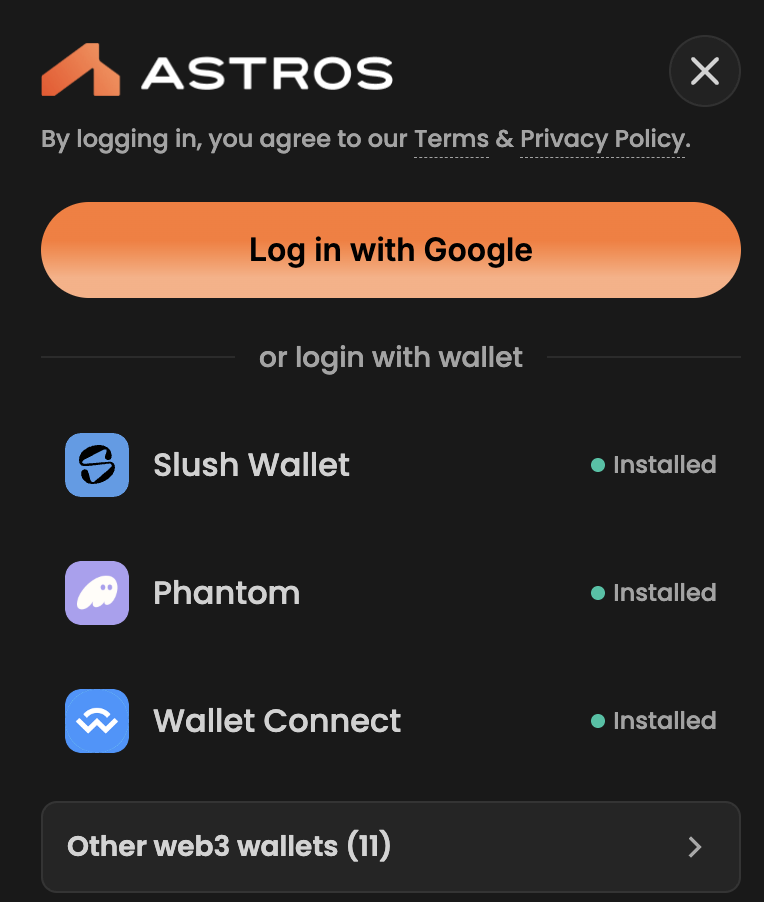
Astros runs on Sui.
A trader needs a Sui-compatible wallet to use the platform.
A safe setup:
Use a dedicated wallet for Astros.
Keep long-term holdings elsewhere.
Keep SUI for gas.
Hold USDC for deposit.
Use official links.
Do not connect to fake apps.
Do not sign unknown wallet messages.
Do not store the seed phrase online.
A practical setup flow:
Open Astros Perps.
Connect wallet.
Check wallet address.
Check SUI balance.
Check USDC balance.
Deposit a small test amount.
A dedicated trading wallet is one of the easiest risk controls.
If a trading app or wallet interaction goes wrong, it is better for the damage to be limited to trading capital.
Do not use your main wallet for every DeFi app.
Deposit USDC
Astros accepts USDC deposits for the perps account.
After deposit, USDC is exchanged into USD trading balance at a 1:1 ratio.
This USD balance is used for trading margin.
A deposit process:
Open Account.
Select Deposit.
Choose USDC.
Enter amount.
Confirm in wallet.
Wait for confirmation.
Check Account balance.
Before depositing, check:
Correct wallet.
Correct asset.
SUI gas balance.
Deposit size.
Withdrawal route.
Open positions.
Open orders.
A beginner should deposit only a small amount first.
The goal is to learn the system.
A full platform test should include:
Deposit.
Open trade.
Close trade.
Withdraw.
If you cannot withdraw confidently, you should not scale.
Withdraw USDC
Astros withdrawals convert USD trading balance back to USDC at a 1:1 ratio.
A withdrawal process:
Close positions if needed.
Cancel open orders if needed.
Open Account.
Select Withdraw.
Enter amount.
Confirm in wallet.
Wait for funds to arrive.
Important details:
Margin allocated to open orders or active positions cannot be withdrawn.
Funds may be temporarily frozen if a withdrawal times out or the wallet rejects it.
This is why serious traders test withdrawals before using size.
Do not wait until a stressful market moment to learn the withdrawal flow.
A trading plan includes exits.
A platform plan includes withdrawals.
Both matter.
Orderbook Perps
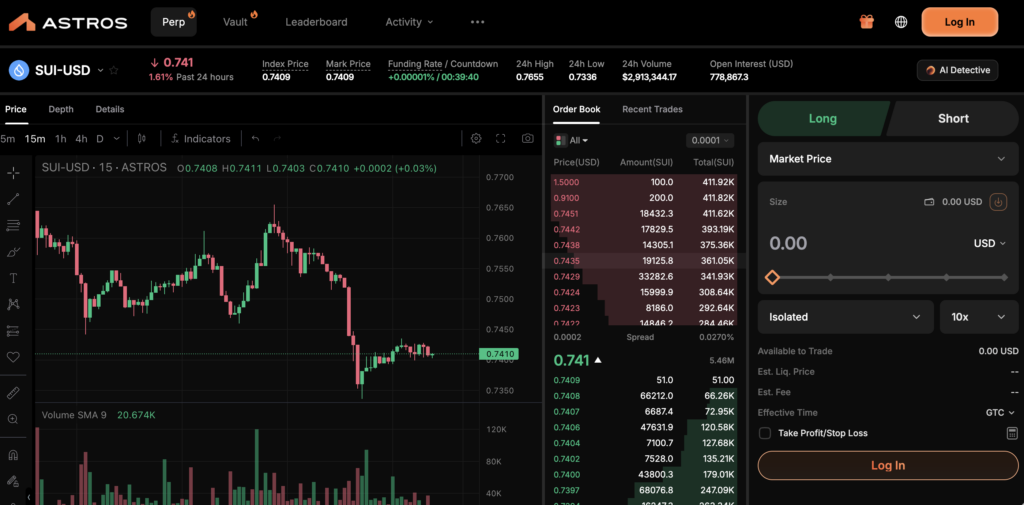
Astros uses an orderbook model with price-time priority.
Orders match when a buy price meets or exceeds the best available sell price, or when a sell price meets or falls below the best available buy price.
Market orders execute against existing opposite-side limit orders in the book.
At the same price level, earlier orders receive priority.
This matters for active traders.
Orderbook perps give more execution control than simple AMM trading, but they require more care.
Watch:
Bid.
Ask.
Spread.
Depth.
Recent trades.
Order size.
Limit price.
Slippage.
Market order impact.
A beginner should avoid large market orders until they understand the book.
A market order prioritizes speed.
A limit order prioritizes price.
Choose intentionally.
Market and Limit Orders
Astros supports market and limit orders.
Market order
Executes immediately at current market price.
Best for urgent entries or exits.
Risk: slippage.
Limit order
Executes at the chosen price or better.
Best for controlled entries or exits.
Risk: no fill.
A simple trading rule:
Use limit orders for planned entries.
Use stop loss for risk.
Use market orders only when speed matters more than price.
Always check estimated fee before submitting.
Always check liquidation price after position size and leverage are selected.
Execution should be part of the strategy.
Not an afterthought.
Long and Short Trading
Astros lets traders open long and short positions.
Long means the trader expects price to rise.
Short means the trader expects price to fall.
With leverage, both directions can move quickly.
A long can be liquidated if price falls.
A short can be liquidated if price rises.
Before opening a trade, define:
Why am I entering?
Where am I wrong?
Where is stop loss?
Where is take profit?
What is position size?
What is leverage?
What is liquidation price?
What is funding?
What are fees?
A trade idea is incomplete without an exit.
If you cannot define the invalidation level, do not enter.
Isolated Margin
Isolated margin is the default Astros margin mode.
In isolated margin, each position has independent collateral.
Liquidation loss is limited to the margin assigned to that position.
This is usually the best beginner choice.
Why isolated margin helps:
Risk is easier to understand.
Losses are contained.
The rest of the account is less exposed.
It encourages position-level discipline.
It reduces emotional margin adding.
A beginner should use isolated margin until they understand how perps behave in fast markets.
The goal is not maximum capital efficiency.
The goal is survival and learning.
Cross Margin
Cross margin uses the total available balance of the trading pair account as collateral.
It can help a position survive volatility by drawing on available balance.
But it also increases the amount at risk.
If liquidation happens in cross margin, the trader can lose more than the margin on one position.
Cross margin can affect:
Allocated collateral.
Accrued funding fees.
Frozen margin for active orders.
Available account balance.
Cross margin is better for advanced users who understand account-wide risk.
A beginner should not use cross margin just because it sounds safer.
Cross margin can delay liquidation.
It can also make a bad trade damage more capital.
Use with caution.
Leverage
Astros documentation lists maximum leverage of 25x.
Leverage controls position exposure.
Example:
200 USD margin.
10x leverage.
2,000 USD position value.
Fees, PnL and liquidation risk relate to the larger position value.
Not only the margin.
A sensible leverage framework:
1x to 3x while learning.
3x to 5x for cautious trades.
5x to 10x only with proven discipline.
Above 10x only for advanced users.
25x only for specialists.
The strongest leverage question is:
Can my stop loss trigger before liquidation becomes a threat?
If not, leverage is too high.
Do not use maximum leverage as a beginner.
Maximum leverage is a platform limit.
It is not a trading recommendation.
Funding Rates
Astros charges funding hourly.
Funding helps align perp prices with spot index prices.
If perps trade above spot, longs may pay shorts.
If perps trade below spot, shorts may pay longs.
Funding is not a platform fee retained by Astros.
It is exchanged between market participants.
A trader should check funding before opening and while holding.
Funding matters for:
Large positions.
Longer holds.
Crowded trades.
Swing trades.
Basis strategies.
Short-term scalps may care less.
But any trader holding through multiple funding intervals should understand the cost.
A position can be right on direction but still weakened by funding.
Index Price and Mark Price
Astros uses an index price and mark price.
The index price reflects the underlying asset price using exchange and oracle data.
The mark price is used to reduce liquidation risk from manipulation or temporary illiquidity.
This matters because unrealized PnL can appear different from the last traded price after execution.
It also matters because liquidation risk is tied to fair price marking.
A trader should monitor:
Index price.
Mark price.
Entry price.
Liquidation price.
Funding rate.
Spread.
If prices look unusual, slow down.
Do not force a trade when the market is unstable.
Liquidation
Liquidation happens when the margin balance reaches or falls below maintenance margin.
Astros computes liquidation differently for long and short positions.
In practical terms:
Longs are liquidated if price falls too far.
Shorts are liquidated if price rises too far.
A margin level approaching or below 100% signals serious liquidation risk.
A good trader should act before that point.
Risk-reduction options:
Close part of the position.
Close the full position.
Add margin only if it was planned.
Reduce leverage.
Use stop loss.
Cancel risky open orders.
Do not wait for liquidation.
Liquidation is an emergency mechanism.
It should not be the normal exit plan.
Take Profit and Stop Loss
Astros supports TP/SL orders.
These allow traders to set planned exits.
Take profit helps close a winning trade at a target.
Stop loss helps close a losing trade at a risk level.
Astros notes that TP/SL orders execute as market orders once triggered, so slippage can happen.
A proper trade plan includes:
Entry.
Stop loss.
Take profit.
Risk amount.
Position size.
Leverage.
Liquidation price.
Fee estimate.
Funding impact.
Set the exit before the entry.
That one habit can protect traders from the most common leverage mistakes.
Fees
Astros’ documented fee structure is:
Maker fee: 0.02%.
Taker fee: 0.04%.
Fees are calculated on position value.
This matters because leverage increases position value.
If a trader uses 10x leverage, fee exposure is based on the 10x notional position, not only on the margin.
A fee-aware trader checks:
Maker or taker status.
Order type.
Position size.
Entry fee.
Exit fee.
Spread.
Funding.
Expected reward.
Do not scalp tiny moves without understanding total cost.
Low conviction plus high leverage plus fees is a bad combination.
Insurance Fund and ADL
Astros uses an insurance fund to absorb deficits when liquidation cannot be completed above bankruptcy price.
If the insurance fund is not enough, ADL may be used.
ADL automatically reduces positions on the opposite side to restore market stability.
ADL priority is based on profitability and effective leverage.
That means highly profitable and highly leveraged opposite-side positions may be more exposed to deleveraging during extreme market stress.
Most beginners do not need to obsess over ADL on day one.
But serious traders should understand it.
Perp venues are systems.
Risk can become platform-wide during extreme volatility.
Risk Controls
A safer Astros setup includes:
Dedicated wallet.
Small first deposit.
USDC collateral.
SUI for gas.
One liquid market.
Isolated margin.
Low leverage.
Limit entries where practical.
Stop loss.
Take profit.
Funding check.
Fee check.
Mark price monitoring.
Margin level monitoring.
Withdrawal test.
Trade journal.
Avoid these mistakes:
Using max leverage.
Using cross margin too early.
Ignoring funding.
Ignoring fees.
Opening trades without stop loss.
Leaving stale orders active.
Depositing more than you understand.
Trading every listed market.
The best trader on Astros is not the person with the biggest position.
It is the person who can survive many trades.
Step-by-Step Astros Trading Flow
Step 1: Open Astros
Go to Astros Perps.
Step 2: Connect wallet
Use a Sui-compatible wallet.
Step 3: Deposit USDC
Start with a small amount.
Step 4: Choose market
Use one liquid perp market.
Step 5: Choose direction
Long or short.
Step 6: Choose order type
Market for speed, limit for price control.
Step 7: Choose margin mode
Use isolated margin first.
Step 8: Set leverage
Use low leverage.
Step 9: Check position details
Review estimated fee, liquidation price and margin.
Step 10: Set TP/SL
Define target and risk.
Step 11: Submit order
Confirm carefully.
Step 12: Monitor trade
Watch margin level, funding and mark price.
Step 13: Close position
Close manually or let planned exits trigger.
Step 14: Review
Record the trade and improve the process.
Best Beginner Strategy
A practical Astros beginner strategy:
Use a dedicated Sui wallet.
Deposit small USDC.
Trade SUI-USD or another liquid market.
Use isolated margin.
Use 1x to 3x leverage.
Use limit order entry where practical.
Set stop loss.
Set take profit.
Check funding.
Check fees.
Do not use cross margin yet.
Do not use max leverage.
Withdraw a small amount after testing.
Keep a trade journal.
The first goal is competence.
Not profit.
Once the workflow is clear, size can increase slowly.
Astros can be useful, but the trader must earn the right to use leverage.
Final Verdict
Astros Perpetual is a strong Sui-based perps platform for 2027 because it combines orderbook execution, USDC deposits, Sui-native trading, isolated margin, cross margin, hourly funding, TP/SL and risk infrastructure.
Use Astros Perps if you want decentralized perpetual futures trading on Sui.
Do not use Astros casually.
The best 2027 setup is:
Dedicated wallet.
Small USDC deposit.
One liquid market.
Isolated margin.
Low leverage.
Stop loss.
Take profit.
Funding awareness.
Fee awareness.
Liquidation monitoring.
Withdrawal test.
Written trade journal.
Astros gives traders Sui-based leverage access.
Risk management decides whether that access becomes skill or liquidation.
FAQ
What is Astros?
Astros is a trading platform in the NAVI ecosystem. Astros Perpetual is its Sui-based perpetual futures trading product.
How do I trade on Astros?
Connect a Sui-compatible wallet, deposit USDC, choose a perp market, select long or short, set leverage and margin mode, add TP/SL and place the trade.
What is the official Astros Perps app?
The official app is Astros Perps.
What collateral does Astros use?
Astros currently accepts USDC deposits for perps. Deposited USDC converts into USD trading balance at a 1:1 ratio.
Does Astros support leverage?
Yes. Astros documentation lists maximum leverage of 25x.
What is isolated margin on Astros?
Isolated margin keeps a position’s margin separate, limiting liquidation loss to the margin allocated to that position.
What is cross margin on Astros?
Cross margin uses the available account balance for the trading pair to support positions, which can increase capital at risk.
What are Astros trading fees?
Astros lists 0.02% maker fees and 0.04% taker fees, calculated on position value.
Does Astros support stop loss and take profit?
Yes. Astros supports TP/SL orders, which execute as market orders and may experience slippage.
Is Astros beginner-friendly?
Astros can be used by careful beginners, but it is a leverage platform. Start small, use isolated margin, keep leverage low and set stop loss.
18+ Educational Disclaimer
This article is for educational purposes only and does not constitute financial advice, investment advice, trading advice, tax advice, legal advice or a recommendation to use Astros, NAVI Protocol, perpetual futures, leverage, Sui DeFi or any trading strategy. Perpetual futures trading is high risk and can result in the loss of margin. Risks include liquidation, volatility, funding payments, mark-price movement, oracle risk, orderbook slippage, failed execution, stop-loss slippage, smart contract risk, wallet error, wrong network use, withdrawal delays, ADL, insurance fund risk, platform changes, regulatory changes and user error. Crypto and leveraged trading are intended for adults aged 18 and over.
About the Author