A practical 2027 guide to trading on StandX, the DUSD-powered perps DEX. Learn wallet setup, DUSD margin, Cash Wallet and Perps Wallet, Universal Markets, leverage, funding, liquidation, TP/SL and risk controls.
Summary
StandX is a decentralized perpetual futures exchange built around a simple but ambitious idea:
Trading margin should not sit idle.
The platform uses DUSD, a yield-bearing stablecoin, as the core margin asset for perpetual trading.
The official Decentralised News referral link is StandX.
By 2027, StandX’s appeal is clear:
Perps trading.
DUSD yield-bearing margin.
BNB Chain and Solana access.
Cash Wallet and Perps Wallet separation.
Cross margin.
Isolated margin.
TP/SL order tools.
Funding markets.
Permissionless market direction.
Community liquidity incentives.
Trader-aligned stablecoin mechanics.
This makes StandX different from a simple perps venue.
It is trying to combine stablecoin yield, leverage trading and market creation into one system.
That is powerful.
It is also complex.
The best way to trade on StandX is to understand three things before using serious size:
DUSD is the margin asset.
The Perps Wallet is the trading wallet.
Leverage can liquidate margin quickly.
StandX gives traders capital efficiency.
Risk management decides whether that efficiency becomes opportunity or loss.
Quick Answer
To trade on StandX in 2027:
Open StandX.
Connect a supported wallet.
Use BNB Chain or Solana where supported.
Acquire USDT or USDC.
Mint or obtain DUSD.
Check your Cash Wallet balance.
Transfer DUSD into the Perps Wallet.
Open the Perps interface.
Choose a market.
Select long or short.
Choose cross margin or isolated margin.
Set position size.
Choose leverage.
Check maker or taker fee.
Check funding rate.
Check liquidation price.
Set take profit and stop loss.
Submit the order.
Monitor the trade.
Close manually or through planned exits.
Best beginner route:
Use a small DUSD amount, trade one liquid market, use isolated margin, keep leverage low, attach TP/SL, monitor funding, understand DUSD redemption and test withdrawals before scaling.
Use StandX here:
Trade on StandX.
What StandX Offers
StandX offers a perps DEX built around DUSD and Universal Markets.
It is not simply a trading screen.
It is a system where the stablecoin, margin engine, liquidity design and market listing model are connected.
StandX offers:
DUSD yield-bearing margin.
Perpetual futures.
BNB Chain and Solana support where available.
Cash Wallet.
Perps Wallet.
Cross margin.
Isolated margin.
Market monitor interface.
Execution panel.
TP/SL orders.
Funding rates.
Maker and taker fees.
Liquidation framework.
ADL.
Community market direction.
Vault-based risk support.
Permissionless market creation goals.
The key difference is DUSD.
On most perp venues, margin is idle collateral.
On StandX, DUSD is designed to earn yield while serving as trading margin.
That is capital efficient.
But it is not risk-free.
A trader needs to understand DUSD, yield sources, backing structure, redemption timing and market risk.
The platform’s biggest strength is also the thing users must study most carefully.
Connect Wallet
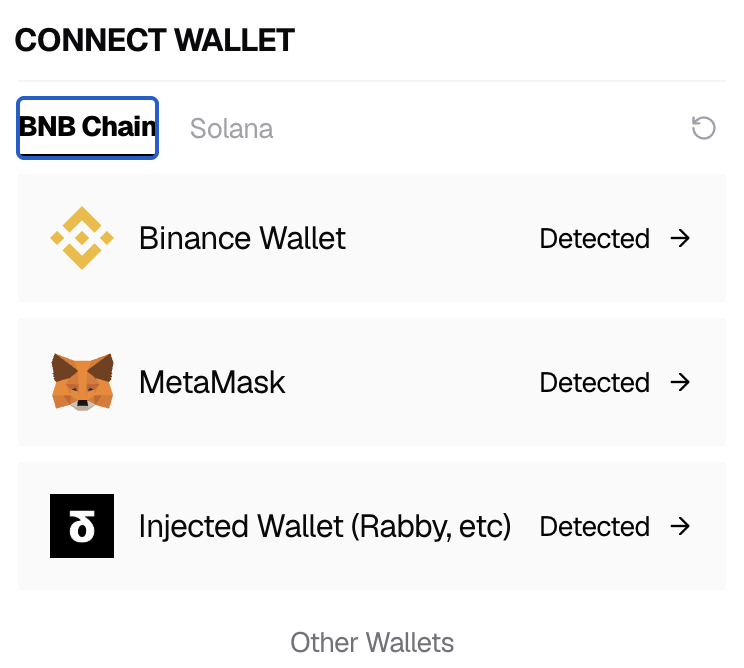
StandX is wallet-based.
Supported wallet routes include BNB Chain and Solana access where available.
A safe setup:
Use a dedicated trading wallet.
Keep long-term assets elsewhere.
Use only official links.
Connect through StandX.
Check chain selection.
Keep BNB or SOL for gas.
Use a small first amount.
Do not sign messages blindly.
Protect the seed phrase offline.
A strong wallet structure:
Wallet 1: cold storage.
Wallet 2: StandX trading.
Wallet 3: experiments.
Do not use the same wallet for everything.
Trading perps already carries market risk.
Do not add unnecessary wallet risk.
A bad wallet signature can cost more than a losing trade.
DUSD and Yield-Bearing Margin
DUSD is the foundation of StandX’s trading model.
It is designed as a yield-bearing stablecoin that can be minted using USDT or USDC and used across the platform.
For perps traders, DUSD matters because StandX perpetual contracts are margined and denominated in DUSD.
This means trading margin can also participate in the platform’s yield system.
That can help improve capital efficiency.
But every yield-bearing stablecoin needs scrutiny.
Before using DUSD seriously, understand:
How DUSD is minted.
How DUSD is redeemed.
What assets support it.
What market-neutral hedging means.
How reserve funds work.
How rewards are distributed.
What redemption delays exist.
What happens if DUSD trades at a discount.
How DUSD fits into perps margin.
A beginner should not only ask:
Can I trade with DUSD?
They should ask:
Can I exit DUSD when I need to?
That is the more important question.
Cash Wallet and Perps Wallet
StandX separates balances into two internal wallets.
Cash Wallet
The Cash Wallet is where incoming funds land.
It is the main holding area.
Perps Wallet
The Perps Wallet is where active trading margin sits.
To trade perps, DUSD must be moved into the Perps Wallet.
This design creates a buffer between general platform funds and active trading funds.
A typical flow:
Mint or deposit DUSD.
Check Cash Wallet.
Transfer DUSD to Perps Wallet.
Open perp trade.
Manage PnL.
Close trade.
Transfer DUSD back to Cash Wallet.
Withdraw, swap or redeem where needed.
This matters because wallet location affects what funds can be used.
Funds in Cash Wallet are not automatically trading margin.
Funds in Perps Wallet are exposed to trading risk.
The safest beginner setup is to keep only active risk capital in the Perps Wallet.
Do not move your full balance into active trading.
Choose a Market
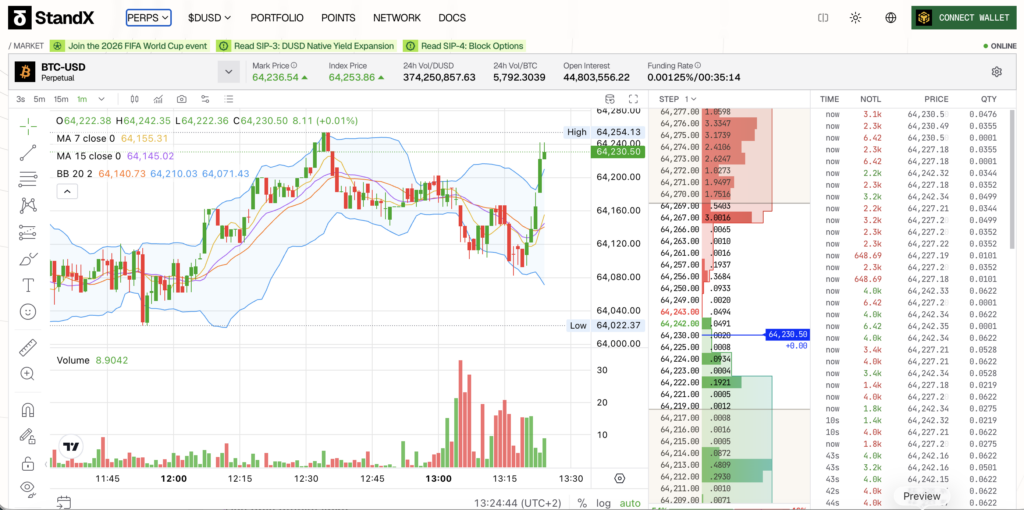
StandX is designed around perpetual futures markets.
Its broader Universal Markets vision points toward more open market creation over time.
For users, that means the platform may eventually offer many markets beyond the standard major assets.
But more markets do not automatically mean better trades.
A beginner should choose markets based on:
Liquidity.
Spread.
Funding.
Volatility.
Maximum leverage.
Margin tier.
Order-book depth.
Personal knowledge.
Risk tolerance.
Start with one liquid market.
Avoid unfamiliar or experimental markets at first.
A new market can look attractive because it is early.
It can also be dangerous because liquidity may be thinner and volatility may be higher.
A professional trader does not trade everything.
They trade what they understand.
Cross Margin and Isolated Margin
StandX supports cross margin and isolated margin.
Cross margin
Cross margin shares available balance across open positions.
This can help one position survive temporary volatility by drawing on broader account balance.
It can also allow one bad position to endanger more funds.
Cross margin is best for experienced traders who manage portfolio risk.
Isolated margin
Isolated margin gives one position its own dedicated margin.
Losses are limited to that allocated margin.
This makes risk clearer.
Isolated margin is best for beginners.
A simple rule:
Use isolated margin while learning.
Use cross margin only when you understand how positions interact.
Cross margin is capital efficient.
Isolated margin is risk clear.
For most beginners, clarity is more important than efficiency.
Leverage and Margin Tiers
StandX uses leverage through initial margin and maintenance margin requirements.
The lower the margin requirement, the higher the leverage that can be used.
The platform also uses margin tiers.
As notional position size increases, maintenance margin rises and maximum leverage falls.
This protects the system from large-position risk.
A practical leverage framework:
1x to 3x for learning.
3x to 5x for cautious trades.
5x to 10x for experienced traders.
Above 10x only with strong risk control.
Very high leverage only for specialists.
The correct leverage depends on:
Asset volatility.
Stop-loss distance.
Margin mode.
Position size.
Funding cost.
Liquidation price.
Trading horizon.
Do not choose leverage because it is available.
Choose leverage because it fits the trade plan.
If normal volatility can liquidate you, the trade is too aggressive.
Fees and Execution
StandX uses maker and taker fees.
Maker orders add liquidity to the order book.
Taker orders remove liquidity.
The documented fee structure is:
0.01% maker fee.
0.04% taker fee.
Fees are calculated on notional value.
This means high leverage increases the fee base because the position notional is larger than the margin.
Example:
200 DUSD margin.
10x leverage.
2,000 DUSD notional exposure.
Fees apply to notional exposure.
Execution discipline matters.
Use limit orders when price control matters.
Use market orders when urgency matters.
Understand whether your order is maker or taker.
Avoid overtrading.
A zero-plan trader pays the platform repeatedly.
A disciplined trader treats fees as part of the strategy.
Funding Rates
Funding is a core part of perpetual futures.
On StandX, funding is exchanged between long and short traders and helps keep perp prices aligned with spot prices.
When funding is positive, longs pay shorts.
When funding is negative, shorts pay longs.
Funding can affect:
Hold time.
Position cost.
PnL.
Liquidation distance.
Basis strategies.
Market crowding.
A trader should check funding before opening and while holding.
Questions to ask:
Am I paying funding?
Am I receiving funding?
Is funding high?
How long do I plan to hold?
Does funding support or weaken my thesis?
A trade can be profitable on price but still less attractive after funding.
Funding is not a side detail.
It is part of the position.
TP/SL Orders
StandX supports take profit and stop loss orders.
TP/SL can be added to opening orders or existing positions.
This is important for trading discipline.
Take profit
A take profit order helps close a trade at a target.
Stop loss
A stop loss order helps close a trade if price moves against the position.
StandX TP/SL triggers are based on mark price.
This is important because mark price is designed for fairer risk assessment than last traded price during short-term spikes.
TP/SL orders can help automate risk.
But they do not guarantee fills.
During fast markets, liquidity and slippage can affect execution.
A serious trader should still monitor positions.
The best use of TP/SL:
Set risk before entry.
Set target before entry.
Review whether TP and SL are linked.
Use position-level TP/SL if managing an existing trade.
Scale out only if you understand order behavior.
A trade without an exit plan is not a strategy.
Liquidation and ADL
Liquidation happens when margin is no longer enough to support a position.
StandX uses mark price and maintenance margin to determine liquidation risk.
Smaller positions may be closed through an IOC order at bankruptcy price, with vault takeover possible if the order does not fill.
Larger positions may be liquidated in tranches.
In extreme conditions, ADL can be used to offset risk.
A liquidation clearance fee may apply when a position is forcibly closed.
The practical lesson:
Avoid liquidation.
Do not let the system be your stop loss.
A strong trader should:
Know liquidation price.
Use stop loss.
Reduce position before danger.
Avoid high leverage.
Track funding.
Avoid oversized trades.
Use isolated margin while learning.
ADL is a reminder that perps platforms are not only about individual trades.
They are risk systems.
Your trade exists inside that system.
Withdrawals and DUSD Exit Planning
A complete trading plan includes the exit route.
On StandX, users must move funds from Perps Wallet to Cash Wallet before withdrawing.
DUSD may also need to be redeemed or swapped to USDT or USDC depending on the route used.
Redemption can involve a waiting period.
That matters for liquidity planning.
A clean exit process:
Close positions.
Cancel open TP/SL orders.
Transfer DUSD from Perps Wallet to Cash Wallet.
Submit withdrawal request.
Track the withdrawal.
Redeem or swap DUSD if needed.
Record the transaction.
Do not wait until you urgently need funds to learn the withdrawal process.
Test a small withdrawal early.
A trader who understands the exit route has more control.
Step-by-Step StandX Trading Flow
Step 1: Open StandX
Use StandX.
Step 2: Connect wallet
Choose supported BNB Chain or Solana wallet access.
Step 3: Fund wallet
Acquire USDT or USDC and keep gas token available.
Step 4: Mint or obtain DUSD
DUSD is needed for the StandX perps margin workflow.
Step 5: Move funds to Cash Wallet
Confirm the Cash Wallet balance.
Step 6: Transfer to Perps Wallet
Only active trading capital should be moved.
Step 7: Choose market
Start with one liquid market.
Step 8: Choose long or short
Long for upside.
Short for downside.
Step 9: Choose margin mode
Use isolated margin while learning.
Step 10: Set leverage
Use low leverage.
Step 11: Review costs
Check maker or taker fee and funding.
Step 12: Add TP/SL
Define risk and target before entry.
Step 13: Place order
Review and submit.
Step 14: Monitor risk
Watch margin, funding, PnL and liquidation.
Step 15: Close and withdraw
Transfer back to Cash Wallet and test withdrawal when needed.
Best Beginner Strategy
A practical 2027 StandX beginner strategy:
Dedicated wallet.
Small USDT or USDC amount.
Mint a small amount of DUSD.
Move only small DUSD to Perps Wallet.
Trade one market.
Use isolated margin.
Use 1x to 3x leverage.
Set TP/SL.
Monitor funding.
Check fees.
Avoid cross margin at first.
Avoid new or illiquid markets.
Test withdrawals.
Keep a journal.
Do not chase yield with leverage.
Do not trade only because margin earns yield.
Do not confuse capital efficiency with safety.
The goal is to learn the system before scaling.
StandX has more moving parts than a normal perp venue.
That can be an advantage only when the trader understands the full workflow.
Final Verdict
StandX is one of the most distinctive perps DEXs for 2027 because it combines DUSD yield-bearing margin, perps trading, Cash Wallet and Perps Wallet separation, margin modes, TP/SL tools and a Universal Markets vision.
Use StandX if you want a perps platform built around productive collateral and community market expansion.
Do not use StandX casually.
The platform adds yield and market-creation design to perps trading, but leverage risk remains.
The best 2027 approach is:
Understand DUSD.
Use a dedicated wallet.
Start small.
Keep most funds out of Perps Wallet.
Use isolated margin.
Use low leverage.
Set TP/SL.
Check funding.
Avoid liquidation.
Know redemption rules.
Test withdrawal.
Journal every trade.
StandX gives traders productive margin.
Risk management decides whether that productivity becomes edge or exposure.
FAQ
What is StandX?
StandX is a decentralized perpetual futures exchange built around DUSD, a yield-bearing stablecoin used as the platform’s margin asset.
How do I trade on StandX?
Connect a supported wallet, mint or obtain DUSD, move DUSD to the Cash Wallet, transfer it to the Perps Wallet, choose a market, set size and leverage, add TP/SL and place the trade.
What is the StandX referral link?
Use StandX.
What chains does StandX support?
StandX documentation describes the platform as live across BNB Chain and Solana.
What is DUSD used for?
DUSD is used as the margin and denomination asset for StandX perpetual contracts.
What is the difference between Cash Wallet and Perps Wallet?
Cash Wallet holds deposited funds. Perps Wallet is the active trading wallet used for margin.
Does StandX support isolated margin?
Yes. StandX supports isolated margin, where each position uses dedicated margin.
Does StandX support cross margin?
Yes. Cross margin shares available margin across positions.
What are StandX fees?
The documented maker fee is 0.01% and the taker fee is 0.04%, calculated on notional value.
Is StandX good for beginners?
StandX can be used by careful beginners, but it is a leveraged perps platform. Start small, use isolated margin, keep leverage low and understand DUSD before scaling.
18+ Educational Disclaimer
This article is for educational purposes only and does not constitute financial advice, investment advice, trading advice, tax advice, legal advice or a recommendation to use StandX, DUSD, leverage, perpetual futures, DeFi protocols or any trading strategy. Perpetual futures trading is high risk and can result in the loss of margin. Risks include liquidation, price volatility, funding payments, DUSD depeg risk, redemption delays, smart contract risk, wallet error, wrong network use, failed transactions, slippage, ADL, vault takeover, fee impact, regulatory changes and user error. Crypto and leveraged trading are intended for adults aged 18 and over.
About the Author