A practical 2027 guide to trading on IO Trader, the decentralized platform for crypto prediction markets, short-term price predictions and perpetual futures. Learn wallet setup, YES/NO markets, perps, outcome tokens, oracle settlement, fees and risk controls.
Summary
IO Trader is a decentralized trading platform built around a major shift in crypto speculation:
Traders do not only want to trade prices.
They want to trade future outcomes.
The official Decentralised News referral link is IO Trader.
By 2027, IO Trader is best understood as a platform for:
Crypto prediction markets.
Short-term price predictions.
Perpetual futures.
Leveraged prediction markets.
YES/NO event markets.
Outcome tokenization.
Oracle-based settlement.
Wallet-based execution.
The core idea is that future events can become tradable markets.
A user may trade whether Bitcoin moves up in a short time window, whether a crypto event happens, whether a macro outcome occurs, or whether a future condition resolves true or false.
That is powerful.
It is also risky.
Prediction markets require clear resolution rules.
Short-term predictions require timing discipline.
Perpetual futures require liquidation discipline.
The best way to trade on IO Trader is to treat every market like a contract:
Read the question.
Check the settlement source.
Understand the fee.
Know the downside.
Use small size.
Avoid excessive leverage.
Record every trade.
Quick Answer
To trade on IO Trader in 2027:
Open the official IO Trader app.
Connect a supported wallet.
Fund the wallet with supported collateral.
Choose a market category:
Prediction Markets.
Price Predictions.
Perpetual Futures.
For prediction markets, choose YES or NO.
For short-term predictions, choose direction and timeframe.
For perps, choose long or short.
Enter position size.
Review market rules, fee, leverage, payout, liquidation and settlement.
Confirm the trade.
Monitor the position.
Exit early where supported.
Wait for settlement where required.
Record the result.
Best beginner route:
Use a separate wallet, start with a small balance, trade only one simple market, avoid leverage at first and never trade an event unless the resolution rules are clear.
Use IO Trader here:
Trade on IO Trader with referral code R4C95991A.
What IO Trader Offers
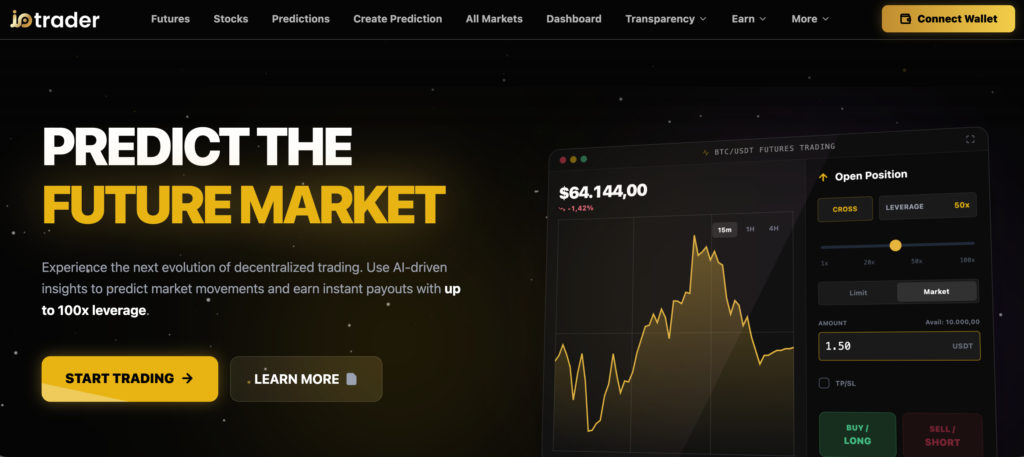
IO Trader combines several market types into one platform.
This makes it different from a standard spot exchange or a simple perps DEX.
IO Trader offers:
Prediction markets.
Short-term price predictions.
Crypto perpetual futures.
YES/NO markets.
Event-based outcomes.
Crypto market themes.
Sports markets where available.
Political markets where available.
Macro themes.
Community outcome markets.
Outcome tokenization.
Secondary trading of outcome exposure where supported.
Oracle-driven settlement.
The platform is built around the idea that information can be traded.
A trader may have an edge because they understand:
Market structure.
Protocol events.
Macro timing.
News flow.
Community sentiment.
Sports data.
Political probability.
Price momentum.
Short-term volatility.
But every type of edge has a different risk profile.
A perps trader can be liquidated.
A prediction trader can be wrong on the outcome.
A short-term trader can be right on trend but wrong on timing.
IO Trader gives many ways to trade.
The trader must know which game they are playing.
Wallet Setup
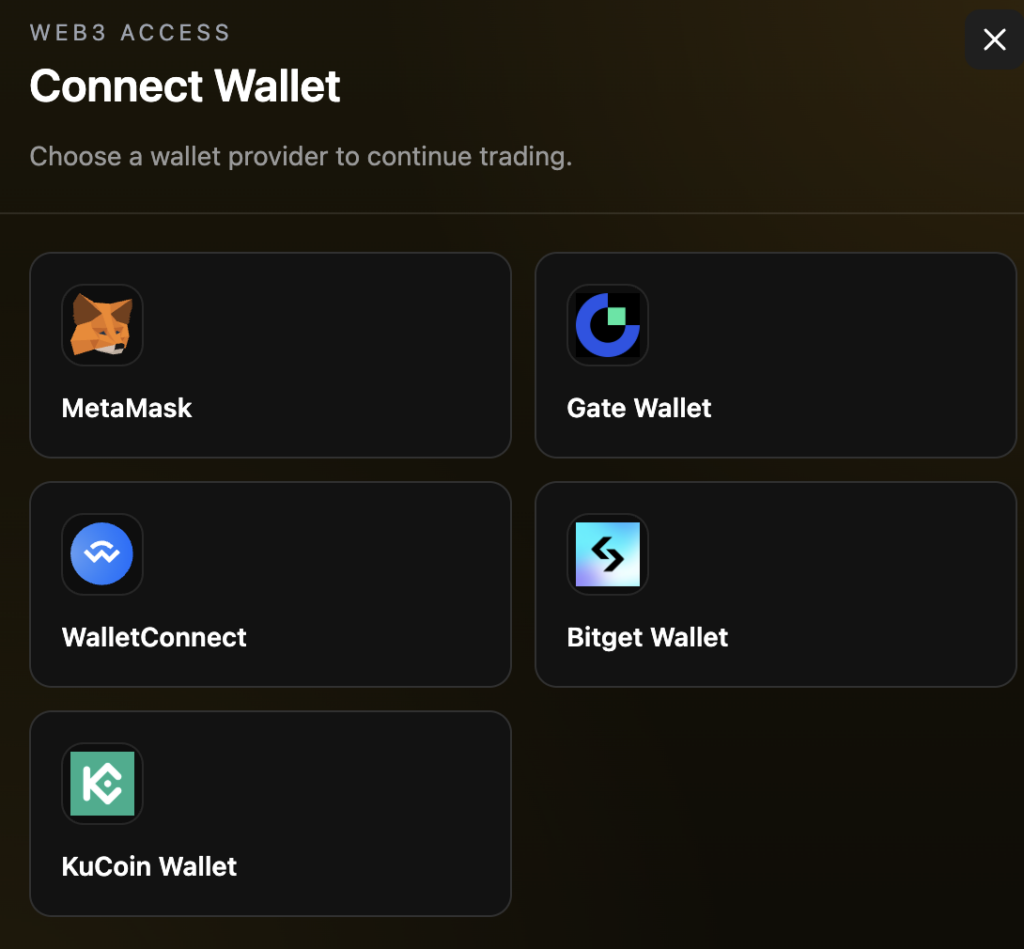
IO Trader is wallet-based.
That means the first layer of risk is wallet security.
A safe setup:
Use a dedicated trading wallet.
Do not connect your cold wallet.
Do not trade from your main long-term wallet.
Use the official referral link: IO Trader.
Confirm the domain.
Check the wallet network.
Use only supported collateral.
Keep gas token available where needed.
Read every signature.
Never share your seed phrase.
A useful wallet structure:
Wallet 1: long-term storage.
Wallet 2: IO Trader trading.
Wallet 3: experimental apps.
This reduces damage if a wallet approval, market mistake or app interaction goes wrong.
Wallet separation is basic risk management.
A trader who protects the wallet has already avoided one of the largest DeFi risks.
Prediction Markets
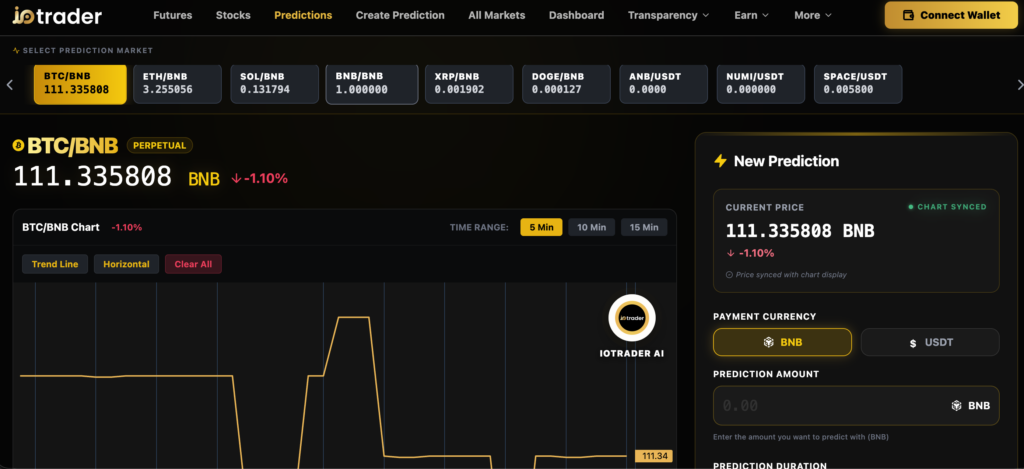
Prediction markets are the most distinctive part of IO Trader.
They allow users to trade future outcomes rather than only token prices.
A prediction market may ask a question such as:
Will a crypto event happen?
Will a policy decision occur?
Will an asset reach a level?
Will a sports team win?
Will a protocol milestone be achieved?
Will a macro condition be met?
Most prediction markets use directional exposure, often YES or NO.
But the important part is not only the choice.
It is the wording.
A serious trader should check:
Question wording.
Resolution criteria.
Settlement time.
Oracle source.
Market liquidity.
Position size.
Early-exit availability.
Fee.
Potential payout.
A prediction market is like a contract.
If you do not understand the contract, do not trade it.
The best prediction traders are not only good at forecasting.
They are good at reading rules.
Short-Term Price Predictions
Short-term price prediction markets let users trade whether an asset moves up or down over a short timeframe.
This can include very short windows such as minutes.
This style attracts traders because it is fast and simple to understand.
But simple does not mean easy.
Short-term predictions are affected by:
Spread.
Volatility.
Timing.
Wallet confirmation speed.
Oracle update timing.
Market noise.
News.
Liquidity.
Emotional overtrading.
The biggest danger is frequency.
A trader may place too many trades because each individual trade feels small.
Small repeated mistakes become large losses.
A safer process:
Choose one asset.
Choose one timeframe.
Set a session loss limit.
Stop after a losing streak.
Do not double size after a loss.
Avoid trading during chaotic news spikes.
Review every result.
Short-term prediction trading rewards discipline.
It punishes impulse.
Perpetual Futures
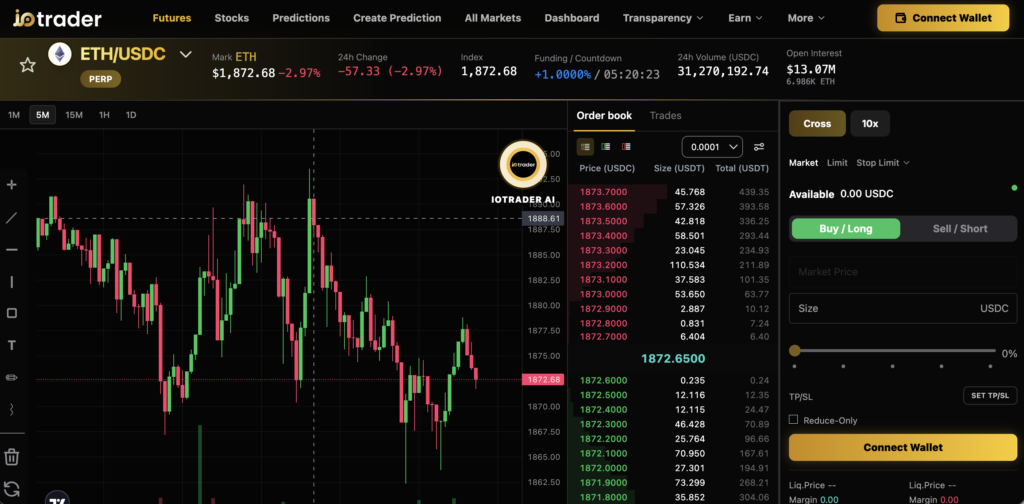
IO Trader also supports perpetual futures.
Perps let traders go long or short with leverage.
A long position benefits when price rises.
A short position benefits when price falls.
Perps can be useful for:
BTC trading.
ETH trading.
Altcoin speculation.
Hedging.
Short-term directional trades.
Advanced active trading.
The risk is liquidation.
A trader can lose margin if the market moves too far against the position.
Before opening a perp, review:
Market.
Direction.
Collateral.
Position size.
Leverage.
Entry price.
Liquidation price.
Fee.
Funding if shown.
Stop loss.
Take profit.
A perp trade should be built from risk first.
Not excitement.
The best question is:
Where am I wrong and how much do I lose there?
If that question is unanswered, the trade is not ready.
Leveraged Prediction Markets
IO Trader’s docs describe leveraged prediction markets as a new trading primitive.
This means users may be able to amplify exposure to future outcomes, not only asset prices.
This is where IO Trader becomes most unusual.
A leveraged event trade can be powerful because the payoff is tied to information, probability and event resolution.
It can also be dangerous because leverage magnifies the impact of being wrong.
A leveraged prediction market may involve:
Outcome probability.
Collateral.
Leverage.
Settlement timing.
Oracle resolution.
Liquidity.
Market price.
Early exit.
Potential liquidation or loss mechanics.
Before using leverage on prediction markets, ask:
Is the outcome clear?
Is the resolution source reliable?
Can I exit before settlement?
What happens if the market moves against me?
Can I lose more than expected?
Am I using leverage because I have edge or because I want a bigger payoff?
The best beginner rule:
Do not use leverage on prediction markets until you can trade them profitably without leverage.
Outcome Tokens and Secondary Markets
IO Trader’s docs describe outcome tokenization.
That means future outcome exposure may be turned into transferable on-chain assets.
This can allow traders to exit before final settlement if secondary trading is available.
For example:
A trader buys YES exposure.
New information increases the perceived probability.
The position becomes more valuable.
The trader may sell the outcome token before final settlement.
This creates a more flexible market.
It can support:
Early exits.
Partial exits.
Hedging.
Event-based portfolios.
Secondary market trading.
DeFi composability.
But outcome tokens are advanced.
They can be affected by liquidity, market sentiment, information timing and settlement uncertainty.
Do not treat outcome tokens as guaranteed profit.
They are market instruments.
Market instruments can fall.
Oracle Settlement
IO Trader uses oracle-based settlement for outcome markets.
That matters because prediction markets need objective resolution.
Different markets may use different oracle sources depending on what is being measured.
A crypto price market may use price feeds.
An on-chain event may use blockchain data.
A governance outcome may use official governance records.
A real-world event may need trusted event data.
Before trading, verify:
What is the oracle?
What data decides the result?
When does settlement occur?
Can the outcome be disputed?
What happens if data is unavailable?
Does the market wording match the oracle?
Oracle risk is real.
A trader can predict the real-world outcome correctly but still lose if the market’s official resolution criteria differ from their assumption.
Read the rules.
Then trade.
Fees, Spreads and Costs
IO Trader’s economic model includes revenue from trading flows, settlement, market creation and liquidation fees.
Users should always check the live platform for exact current fee details.
Costs may include:
Trading fee.
Settlement fee.
Market creation fee.
Liquidation fee.
Spread.
Slippage.
Gas fee.
Funding for perps where shown.
A trader should understand cost before entering.
This matters most for:
Short-term predictions.
Frequent trading.
Small targets.
Leveraged trades.
Low-liquidity markets.
A trade that looks profitable before fees may not be profitable after fees.
The more often you trade, the more costs matter.
Fast trading without fee awareness is usually just expensive entertainment.
Risk Controls
A strong IO Trader risk system includes:
Dedicated wallet.
Small first deposit.
One market type at a time.
No leverage while learning.
Clear settlement source.
Clear market wording.
Small position size.
Session loss limit.
No revenge trading.
No full-wallet bets.
Stop loss on perps.
No high leverage on event markets.
Written trade journal.
A practical structure:
Use prediction markets for information-based trades.
Use short-term predictions only with strict session limits.
Use perps only after understanding liquidation.
Use outcome tokens only after understanding market settlement and secondary liquidity.
Do not mix every product into one emotional session.
Every product has its own rules.
Learn them one at a time.
Step-by-Step IO Trader Trading Flow
Step 1: Open IO Trader
Use IO Trader.
Step 2: Connect wallet
Use a dedicated trading wallet.
Step 3: Fund collateral
Use supported collateral and keep gas available if required.
Step 4: Choose product
Prediction Market, Price Prediction or Perpetual Futures.
Step 5: Read the rules
Check question, timeframe, oracle and settlement.
Step 6: Choose direction
YES, NO, up, down, long or short.
Step 7: Enter size
Start small.
Step 8: Review risk
Fees, spread, payout, leverage, liquidation and settlement.
Step 9: Confirm trade
Read wallet prompts carefully.
Step 10: Manage position
Exit early where available or monitor until settlement.
Step 11: Record outcome
Track what worked and what failed.
Best Beginner Strategy
A beginner IO Trader strategy:
Use one wallet.
Use small capital.
Start with one simple prediction market.
Avoid leverage.
Read full market rules.
Check oracle source.
Trade one market at a time.
Limit daily trades.
Never double after a loss.
Do not chase fast prediction windows.
Avoid markets with unclear wording.
Do not use perps until you understand liquidation.
Review every trade.
A good trader is not the person with the strongest opinion.
It is the person who sizes uncertainty correctly.
Prediction markets reward insight.
They also expose overconfidence.
Final Verdict
IO Trader is one of the more unusual crypto trading platforms for 2027 because it combines prediction markets, short-term price predictions, perpetual futures and outcome tokenization into one decentralized trading environment.
Use IO Trader if you want to trade future outcomes, fast crypto direction and perps from a wallet-based platform.
Use referral code R4C95991A.
Do not use IO Trader casually.
This is not a passive investing app.
It is a high-risk trading venue.
The best 2027 approach is:
Use a dedicated wallet.
Start small.
Read every market rule.
Verify oracle and settlement.
Avoid high leverage.
Use stop loss on perps.
Limit short-term trades.
Understand outcome tokens before using them.
Track every trade.
IO Trader gives traders a way to trade the future.
Risk management decides whether that future becomes edge or expensive overconfidence.
FAQ
What is IO Trader?
IO Trader is a decentralized platform for prediction markets, short-term price predictions and perpetual futures.
How do I trade on IO Trader?
Open IO Trader, connect a wallet, choose a market type, review rules and risks, enter position size and confirm the trade.
What is the IO Trader referral link?
Use IO Trader with referral code R4C95991A.
What are IO Trader prediction markets?
They are markets where users trade whether a future event or condition will happen.
What are short-term price predictions?
They are markets where users predict whether an asset moves up or down over a short timeframe.
Does IO Trader support perps?
Yes. IO Trader positions itself as supporting perpetual futures alongside prediction markets and short-term predictions.
What are outcome tokens?
Outcome tokens are tokenized representations of future outcome exposure, allowing positions to become transferable where supported.
How are prediction markets settled?
IO Trader’s docs describe oracle-based settlement, with different market types using suitable data sources.
Is IO Trader safe for beginners?
It can be used by careful beginners, but it is high risk. Start small, avoid leverage and read every settlement rule.
What is the biggest IO Trader mistake?
The biggest mistake is trading a prediction or leveraged market without understanding the exact outcome question, settlement source, fees and downside.
18+ Educational Disclaimer
This article is for educational purposes only and does not constitute financial advice, investment advice, trading advice, legal advice, tax advice or a recommendation to use IO Trader, prediction markets, perpetual futures, leverage, short-term price predictions or any trading strategy. Trading is high risk and can result in the loss of funds. Risks include market volatility, liquidation, wrong predictions, ambiguous outcomes, oracle risk, settlement delays, smart contract risk, wallet error, wrong network use, failed transactions, slippage, fees, regulatory restrictions, platform changes and user error. Crypto trading and prediction-market participation are intended for adults aged 18 and over.
About the Author