How to Find New Crypto Tokens Before They Trend in 2027: The Early Signal Stack
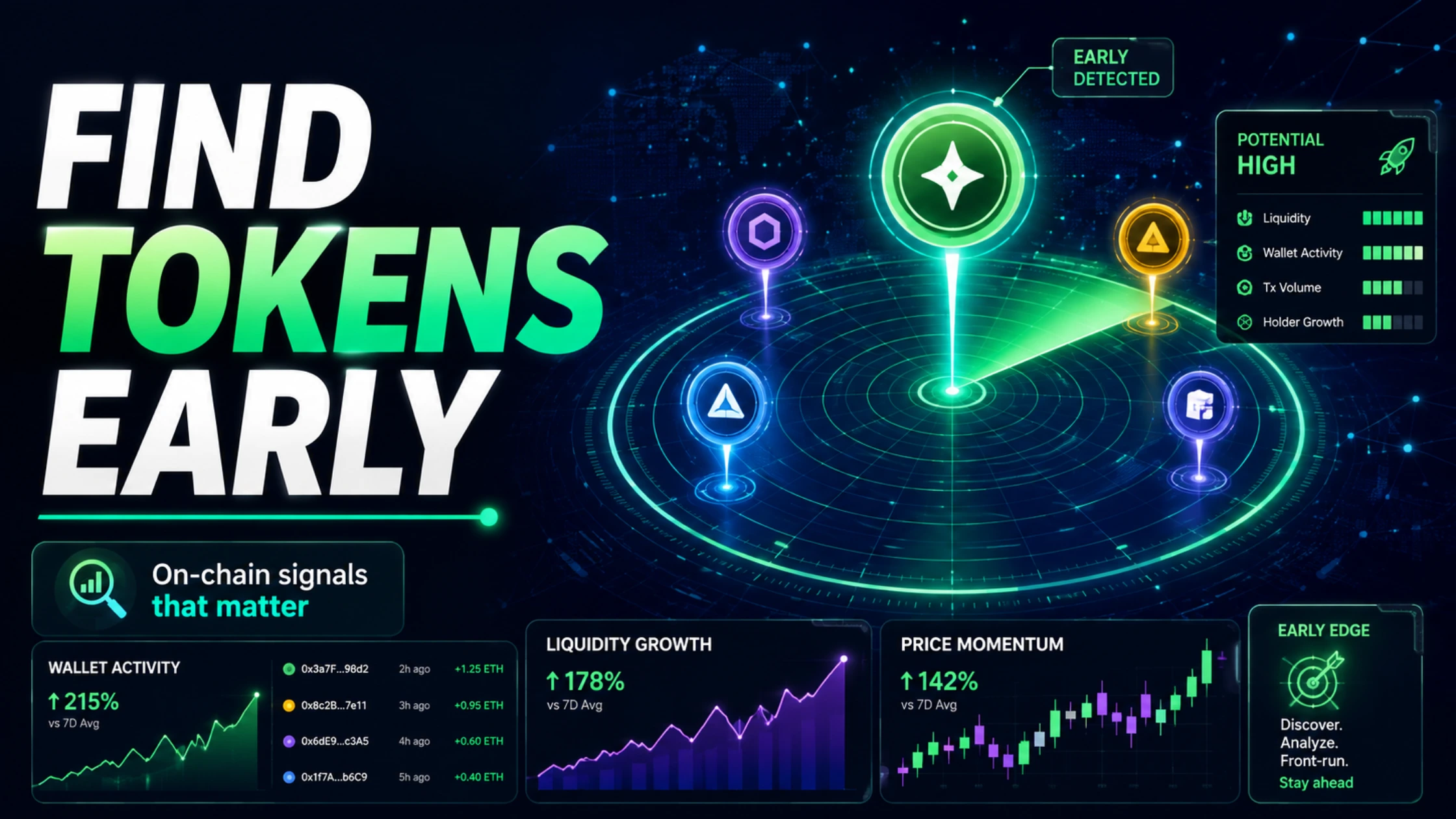
The Decentralised News 2027 framework for discovering new crypto tokens using deployment data, new liquidity pools, smart-money wallets, exchange listings, developer activity, social acceleration and contract-risk screening.
Research Base: Verified 7 August 2026
Summary
The crypto market does not have a shortage of early signals.
It has a shortage of reliable signal combinations.
Millions of token contracts, DEX pools, wallet transactions and social posts can be generated cheaply. Consequently, almost every individual metric can be manipulated.
The Decentralised News Early Signal Stack solves this by separating two questions:
- Is attention and economic activity accelerating?
- Is the token structurally credible enough to justify further research?
These produce two independent scores:
Momentum Score and Integrity Score.
A token should not become a high-priority research candidate unless both strengthen simultaneously.
The Decentralised News Early Signal Stack
Layer | Primary Question | Suggested Weight |
Deployment | Is the token real and verifiable? | 5% |
Liquidity formation | Is a usable market forming? | 20% |
Wallet and holder behaviour | Who is accumulating and who controls supply? | 20% |
Contract integrity | Can the token be manipulated, frozen, minted or trapped? | 20% |
Social acceleration | Is independent attention increasing? | 15% |
Developer/product evidence | Is something real being built? | 10% |
Exchange confirmation | Has distribution expanded through an official listing? | 10% |
A ranking based only on price or social media would put these layers in the wrong order.
Phase One: Detect the Token Before the Chart Matters
The first signal is deployment.
For EVM networks, Etherscan’s current APIs can expose creator addresses, creation transactions, verified source code, token holders and other contract information across more than 60 supported EVM chains.
Deployment Check | Why It Matters |
Deployment timestamp | Establishes true token age |
Creator address | Connects token to previous activity |
Creator funding source | Can reveal linked wallets |
Verified source | Makes code review possible |
Proxy status | Reveals upgradeability |
Owner privileges | Identifies administrative power |
Supply controls | Identifies dilution risk |
A newly created contract scores almost nothing by itself.
The important event is what follows.
Phase Two: Detect Liquidity Creation
A new liquidity pool is the transition from token existence to market existence.
Three tools are particularly useful.
Tool | Early-Market Signal |
Birdeye | New-token and new-pair subscriptions, liquidity filters |
DEX Screener | Pair creation, liquidity, FDV, volume and transactions |
GeckoTerminal | New pools, token pools, OHLCV and trades |
Birdeye’s real-time token-listing stream can filter newly appearing tokens by minimum liquidity and, for Solana meme platforms, by launch source. Its new-pair WebSocket supports both Solana and EVM markets.
DEX Screener exposes pair-creation timestamps, liquidity, transactions, volume and FDV through its API.
GeckoTerminal exposes new pools and recent trades across supported networks.
The Liquidity Quality Test
A new pool should be assessed using more than total liquidity.
Metric | What It Reveals |
Initial liquidity | Whether the market is economically tradable |
Liquidity after 1h | Whether capital stayed |
Liquidity after 6h | Whether the pool is surviving |
Liquidity growth | Whether new capital is entering |
LP ownership | Whether liquidity can disappear |
FDV / liquidity | Whether valuation is disconnected from market depth |
Trade-size impact | Whether headline price is executable |
Decentralised News Rule
A rising token with falling liquidity is a warning, not confirmation.
Price can rise simply because fewer tokens remain available in the pool.
Phase Three: Separate Organic Activity From Manufactured Volume
Raw volume is one of the weakest stand-alone crypto signals.
The better question is:
How many economically independent actors generated the activity?
Transaction Integrity Matrix
Signal | Stronger Pattern | Weaker Pattern |
Volume | Growing with holders | Huge volume, few wallets |
Transactions | Many unique addresses | Repeated wallets |
Buy/sell flow | Broad and mixed | Almost exclusively buys |
Holder growth | Gradual and diverse | Thousands appearing instantly |
Trade sizes | Distributed | Repetitive identical sizes |
Wallet age | Mixed history | Mostly newly funded |
Funding sources | Diverse | Same funding wallet |
Academic work on Solana rug pulls continues to demonstrate why transaction topology matters. A 2026 study examining 100,063 newly issued Solana tokens from the first half of 2025 identified widespread rug-pull patterns and highly organised behaviour among malicious launches.
Phase Four: Analyse Who Owns the Token
Token ownership should be evaluated before social media.
Birdeye’s 2026 Solana holder-profile infrastructure now identifies groups including developer, insider, sniper and bundler wallets, while providing top-holder concentration and wallet-level trading data.
Holder Structure Scorecard
Metric | Lower Concern | Increasing Concern |
Top 10 non-system holders | <30% | >50% |
Largest ordinary wallet | <5% | >10% |
Developer/insider concentration | <10% | >20% |
Related-wallet cluster | Low | >20% |
Creator selling | Minimal | Persistent |
LP withdrawal | None | Material |
These ranges are research heuristics, not universal safety thresholds.
Distribution requirements differ significantly between meme tokens, governance assets, infrastructure projects and tokens with vesting contracts.
Phase Five: Build a Smart-Wallet Cohort
A wallet becomes useful when it has a record.
One profitable trade does not make an address “smart money.”
ArbitrageScanner
ArbitrageScanner currently markets wallet search, wallet analysis, bulk-wallet comparison and transaction alerts. Its public material describes support across 40-plus blockchains and a 2026 wallet-intelligence methodology based on 272 criteria. These figures come from the provider and should be treated as tool capabilities rather than independent proof of prediction accuracy.
Decentralised News Smart-Wallet Test
Factor | What to Look For |
Wallet age | Meaningful historical activity |
Realised PnL | Multiple profitable cycles |
Win rate | Consistent rather than one lucky trade |
Entry timing | Repeated early positioning |
Exit timing | Evidence of risk discipline |
Token diversity | Success across unrelated assets |
Scam interaction | Low exposure to obvious rugs |
Funding relationships | No clear common controller |
The best signal is not one wallet buying.
It is several independently funded, historically competent wallets reaching the same token without obvious coordination.
Phase Six: Measure Developer Signals
Not every legitimate project is open source.
But projects claiming technical innovation should usually leave evidence somewhere.
GitHub’s public APIs provide repository activity, commits and releases that can be incorporated into a research workflow.
Developer Signal Matrix
Signal | More Useful Interpretation |
Commits | Examine substance, not count |
Contributors | Look for multiple real developers |
Releases | Stronger than cosmetic commits |
SDK updates | Shows external integration work |
Testnet activity | Evidence beyond a marketing page |
Documentation | Useful when technically specific |
Pull requests | Shows collaborative development |
Issues resolved | Indicates product maintenance |
False Positive
A repository with 70 commits in one week can still be meaningless.
The commits may:
- Alter README formatting
- Update token logos
- Change generated files
- Come from one person
- Be copied from another repository
A developer signal receives a high score only after the activity is connected to a verifiable product.
Phase Seven: Measure Social Acceleration
A project with 500,000 followers can be less interesting than a project with 8,000 followers whose independent discussion rate has tripled in 24 hours.
The important variable is velocity.
Social Acceleration Framework
Metric | Purpose |
Mentions per hour | Current attention |
4h change | Short-term acceleration |
24h change | Sustained interest |
Unique authors | Reduces bot distortion |
Independent communities | Reduces single-channel bias |
Credibility-weighted sources | Separates analysts from spam |
Sentiment change | Measures direction of narrative |
Wallet/social convergence | Tests whether attention matches capital |
ASCN.ai
ASCN’s current crypto platform combines on-chain analysis with narrative and sentiment research. Its current product material describes real-time wallet and contract monitoring alongside social coverage spanning X, Telegram, Discord, Reddit and news sources.
The most powerful use is cross-domain research.
For example:
Which tokens less than seven days old have growing liquidity, at least three historically credible accumulating wallets, improving holder distribution and social mentions accelerating across ten or more independent sources?
That question is more useful than:
Which coin will pump next?
Phase Eight: Watch Official Exchange Signals
Exchange listing signals should sit late in the discovery process.
By the time a major exchange publicly announces a token, professional and on-chain participants may already have been monitoring it for days or months.
Still, official listings matter because they expand:
- Market access
- Potential liquidity
- Fiat and stablecoin trading routes
- Derivatives availability
- Visibility
- Institutional accessibility
Exchange Announcement Monitor
Exchange | Useful Signal |
MEXC | Dedicated new-listings section |
Gate.com | Initial listings with trading schedules and token IDs |
KuCoin | Dedicated new-listing and World Premiere announcements |
Bitget | Initial listings and category-specific listing feeds |
MEXC currently maintains New Listings within its announcement centre. KuCoin maintains a dedicated new-token listing archive. Bitget’s support centre separates new spot listings, including Initial Listing notices. Gate’s listing announcements identify trading schedules and token identifiers.
Affiliate-Supported Exchange Monitor
MEXC
Referral code: 16yJL
Gate.com
Referral code: UgUVAVoJ
KuCoin
Referral code: CX8QMK4M
Bitget
Referral code: nqef
The Exchange Listing Timeline Test
An exchange announcement should be placed on the same timeline as the earlier on-chain evidence.
Example:
Time | Event |
T0 | Token deployed |
T+20m | First liquidity |
T+2h | Liquidity passes research threshold |
T+5h | Several independent wallets accumulate |
T+12h | Holder growth accelerates |
T+20h | Social mentions begin expanding |
T+2d | Product release or integration confirmed |
T+4d | Exchange announces listing |
T+5d | Trading begins |
This tells a very different story from:
Time | Event |
T0 | Token deployed |
T+5m | Social accounts spam promotions |
T+10m | Price jumps 900% |
T+30m | Creator sells |
T+40m | Liquidity disappears |
Timing creates context.
Phase Nine: Run the Contract-Risk Gate
This stage should be binary.
A token that fails a critical security check should not receive a high overall research classification simply because its social and wallet scores are strong.
GoPlus currently provides token-security services across EVM networks and a Solana token-security endpoint, alongside malicious-address and transaction-simulation APIs.
Critical Contract Filters
Risk | Why It Matters |
Honeypot behaviour | Buyers may be unable to sell |
Unlimited minting | Supply can be diluted |
Blacklist functions | Selected wallets can be blocked |
Adjustable taxes | Owner can make selling uneconomic |
Freeze authority | Transfers may be stopped |
Upgradeable proxy | Logic can change after review |
Owner withdrawal powers | Liquidity may be removable |
Unverified code | Hidden behaviour is harder to evaluate |
Malicious deployer history | Links new token to previous scams |
GoPlus explicitly notes that unverified code can prevent security systems from analysing some underlying risk mechanisms.
The False-Positive Matrix
Apparent Bullish Signal | Possible Alternative Explanation |
Rapid holder growth | Sybil wallet distribution |
Huge DEX volume | Wash trading |
Whale accumulation | Team-controlled wallets |
Viral X posts | Paid influencer campaign |
Telegram explosion | Bot accounts |
GitHub commits | Cosmetic updates |
Locked liquidity | Mint authority still active |
Audit badge | Audit predates current contract |
Exchange rumour | Fabricated screenshot |
Price breakout | Thin liquidity |
“Smart money” buys | Related wallets |
High market cap | Tiny executable liquidity |
This is the section that separates token discovery from token promotion.
The Decentralised News Two-Score Model
Every token should receive two scores.
Momentum Score
Measures:
- Liquidity formation
- Trading activity
- Holder expansion
- Credible-wallet accumulation
- Developer activity
- Social acceleration
- Official exchange signals
Integrity Score
Measures:
- Contract security
- Supply controls
- Holder distribution
- Insider concentration
- LP control
- Deployer history
- Wash-trading risk
- Cluster concentration
Interpretation
Momentum | Integrity | Research Classification |
High | High | High-priority research candidate |
High | Medium | Watch closely, risk first |
High | Low | Likely false positive or excessive risk |
Medium | High | Early watchlist |
Low | High | Structurally credible but no trend evidence |
Low | Low | Ignore |
This distinction is deliberate.
Momentum is not quality.
Integrity is not momentum.
The strongest candidates require both.
Early Token Research Scorecard
Separate launch momentum from contract and liquidity integrity. The tool is designed to stop social hype from hiding weak token structure.
Discovery & liquidity
Enter current explorer and DEX observations.
Developer & attention
Measure acceleration, not follower counts alone.
Contract & scam filters
Critical failures override momentum.
Distribution integrity
Check whether the launch can survive its own insiders.
Positive signals
Red flags
Decentralised News classification
Research stack
Methodology: Momentum and integrity are scored separately. Critical failures such as sell-blocking behaviour or material liquidity removal receive large penalties and can override activity.
Important: New-token data can be manipulated. Security scanners can miss novel malicious logic. Always verify the contract address through official sources.
Affiliate disclosure: Some research-stack links are referral links. Affiliate relationships do not affect the score.
Educational use only. New tokens can become illiquid or worthless. For adults aged 18 and over.
Recommended 2027 Research Stack
Layer | Tool | Best Use |
AI research | ASCN.ai | On-chain + narrative aggregation |
Wallet intelligence | ArbitrageScanner | Wallet cohorts and behavioural tracking |
New-token stream | Birdeye | New listings, new pairs, holder profiles |
DEX validation | DEX Screener | Liquidity, volume, FDV and pair age |
Pool discovery | GeckoTerminal | New pools and trades |
EVM verification | Etherscan | Creator, source and contract history |
Security | GoPlus | Token and malicious-address risk |
Developer evidence | GitHub | Commits and releases |
CEX confirmation | MEXC | Listing feed |
CEX confirmation | Gate.com | Initial listing notices |
CEX confirmation | KuCoin | New listings |
CEX confirmation | Bitget | Initial listing notices |
A Practical Screening Funnel
Imagine that a scanner finds 10,000 new tokens.
Deployment filter
10,000 tokens.
Minimum-liquidity filter
Perhaps 600 remain.
Transaction-quality filter
Perhaps 150 remain.
Holder-distribution filter
Perhaps 70 remain.
Contract-security filter
Perhaps 30 remain.
Credible-wallet filter
Perhaps 15 remain.
Developer/product filter
Perhaps eight remain.
Social-acceleration filter
Perhaps five remain.
Human research
Those five receive the detailed investigation.
These numbers are illustrative, not measured market averages.
The principle is what matters:
Automation should reduce the universe. Human judgement should make the final research decision.
Signals That Deserve the Highest Weight
The strongest early pattern is not:
“Twitter is talking about this token.”
It is something closer to:
A recently deployed token has established meaningful liquidity, liquidity is growing rather than leaving, unique holders are increasing, ownership is not excessively concentrated, several unrelated historically successful wallets are accumulating, contract permissions are acceptable, developers are shipping, and social discussion has only recently started accelerating.
That is a multi-layer signal.
It can still fail.
But it is significantly more informative than price momentum alone.
Final Verdict
Scanning for new tokens before they trend is an information-engineering problem.
The market generates too much data for a human to monitor manually.
The solution is not another list of “gems.”
It is a filtering architecture.
Start with blockchain deployment data.
Wait for meaningful liquidity.
Measure whether economic activity is real.
Investigate holders and related wallets.
Run contract security before trusting momentum.
Track developer activity.
Measure social acceleration rather than follower totals.
Then use official exchange announcements as confirmation.
ASCN.ai can act as the intelligence aggregation layer.
ArbitrageScanner provides deeper wallet-analysis capabilities.
Birdeye, DEX Screener and GeckoTerminal expose market formation.
Etherscan and GoPlus help verify what the token actually is.
MEXC, Gate.com, KuCoin and Bitget provide official listing confirmation.
The central rule is simple:
Do not search for tokens that are going up. Search for independent evidence that is beginning to converge before the broader market notices.
That is a much harder signal to fake.
Affiliate Disclosure
Decentralised News uses referral links for ASCN.ai, ArbitrageScanner, MEXC, Gate.com, KuCoin and Bitget. Decentralised News may receive compensation from qualifying activity.
Affiliate relationships are excluded from the Early Signal Stack scoring methodology.
Educational Disclaimer
This publication is for educational and research purposes only. It is not investment, trading, financial, legal or tax advice.
New tokens can be fraudulent, manipulated, extremely volatile or impossible to sell. On-chain signals, AI systems, wallet labels, exchange announcements and contract scanners can all produce false positives. Never treat an automated score as evidence that a token will appreciate. For adults aged 18 and over.
About the Author