The Agent Passport: How Machines Could Prove Identity, Authority and Risk
The Agent Passport 2027: What Every Autonomous AI Should Disclose Before You Trust It
Humans carry passports. Companies publish legal identities. Websites expose certificates and policies. Autonomous agents are beginning to spend money, access private data and negotiate with other machines, yet most still arrive with little more than a name and an endpoint. DN proposes a portable Agent Passport for the machine economy.
Decentralised News Research · DN Agent Passport Specification v0.1 · Last verified 9 October 2026
What Matters
The agent economy needs a portable disclosure layer that answers one practical question before another system grants trust: what exactly am I dealing with? DN proposes an Agent Passport containing ownership, identity, model and runtime information, capabilities, permissions, financial limits, tools, credentials, version history, reputation sources, audit evidence, insurance and revocation endpoints.
DN Evidence Block
Evidence window: agent identity, discovery and credential standards available as of 9 October 2026. Evidence type: standards and documentation review. Original DN asset: Agent Passport Schema v0.1 and interactive Passport Builder. Boundary: DN is proposing an interoperability and disclosure framework, not claiming that this is an adopted industry standard. Update cadence: quarterly and after material changes to agent identity, A2A, MCP, credential or registry standards.
The Signal
The next important competition in agentic AI may not be about which model reasons best.
It may be about which machines are easiest for other machines to verify, understand and safely authorize.
The Agent Economy Has a Disclosure Problem
Imagine an autonomous purchasing agent arrives at a supplier's API.
It wants to place a $14,000 order.
The supplier can authenticate a key.
But the questions that matter economically are much broader:
- Who owns this agent?
- Which organization is it acting for?
- Which version is running?
- Which model or model family powers it?
- What tools can it call?
- How much may it spend?
- Can it initiate irreversible payments?
- Which counterparties are approved?
- What credentials does it hold?
- Has it passed any independent security review?
- Has it changed materially since those reviews?
- Where can its authority be revoked?
- Who bears the loss if it behaves incorrectly?
A cryptographic identity alone cannot answer those questions.
Neither can an Agent Card.
Neither can an API key.
Neither can a wallet address.
Neither can a reputation score.
The missing layer is a structured disclosure document connecting them.
Introducing the DN Agent Passport
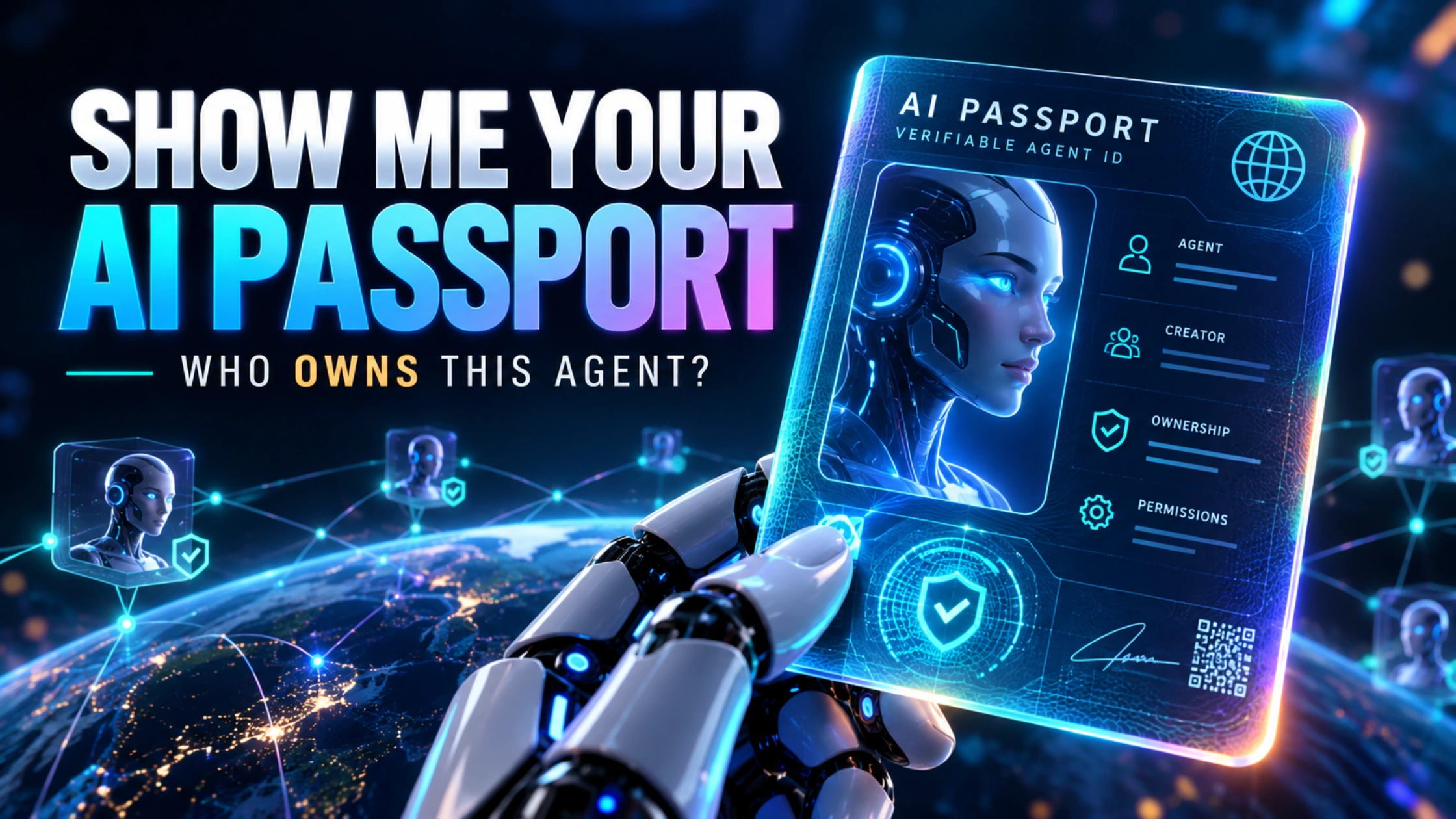
The DN Agent Passport is a proposed machine-readable disclosure file describing an autonomous system's identity, operator, capabilities, authority and operating constraints.
It is not intended to replace existing protocols.
Instead it sits above them.
An Agent Passport can point to:
- A2A Agent Cards for discovery and skills;
- MCP endpoints for tools and resources;
- workload identities;
- DIDs;
- wallets;
- ERC-8004 registrations;
- Verifiable Credentials;
- security attestations;
- reputation services;
- insurance records;
- audit logs.
Think of it as the machine-readable cover sheet explaining how those pieces fit together.
The 12 Passport Sections
| Section | Purpose | Status |
|---|---|---|
| 1. Persistent Identity | Stable identifier, registry references, signing keys and supported identity methods. | Required |
| 2. Owner & Principal | Who owns the agent and which person or organization it represents. | Required |
| 3. Runtime & Version | Agent version, deployment environment and material architecture version. | Required |
| 4. Models | Model family or model disclosure policy, including material reasoning-stack changes. | Recommended |
| 5. Capabilities | Tasks and skills the agent advertises. | Required |
| 6. Tools & External Services | MCP servers, APIs, wallets, databases and execution services available to the agent. | Required |
| 7. Permissions | Data, system and financial actions the agent is authorized to perform. | Required |
| 8. Financial Limits | Transaction limits, daily budgets, asset restrictions and approval thresholds. | Required for financial agents |
| 9. Credentials | Externally issued attestations, licenses and organizational credentials. | Recommended |
| 10. Reputation & Validation | Reputation providers, task history sources and independent validation references. | Recommended |
| 11. Audit, Incidents & Insurance | Audit references, incident history and liability or insurance evidence. | Context dependent |
| 12. Revocation & Emergency Controls | How another system can determine whether authority, credentials or the entire agent have been suspended. | Required |
A Passport Is Not an Identity
This distinction matters.
An identity answers:
Which agent is this?
A passport answers:
What should I know about this agent before allowing it to act?
The two overlap, but they solve different problems.
Identity is an anchor.
The passport is a disclosure envelope.
The DN Machine Counterparty Rule
No high-value autonomous counterparty should be trusted solely from a name, wallet, endpoint or reputation score.
Before consequential interaction, another system should be able to retrieve a structured disclosure covering identity, authority, version, permissions, risk controls and accountability.
Why ERC-8004 Is Important
ERC-8004 demonstrates that this direction is already emerging.
Its proposed agent registration file includes a human-readable name and description plus service endpoints that can reference A2A, MCP, OASF, ENS, DIDs and other interfaces.
It also supports trust signals through separate reputation and validation registries.
That is powerful.
But registration still does not answer every operational question a corporate counterparty may need.
For example:
- What is the agent's transaction ceiling?
- Which assets may it move?
- Has its underlying model changed?
- Which organization is financially responsible?
- Which security audit applies to the current version?
- What insurance applies?
- What is the emergency revocation path?
DN therefore treats registry identity as one component of the passport rather than the entire passport.
Why Verifiable Credentials Matter
A passport becomes much stronger when important claims are not self-declared.
For example, an agent may claim:
"I am an authorized procurement agent for Company X."
That statement is much more useful if Company X, or another trusted issuer, has issued a machine-verifiable credential supporting the claim.
Credential systems can potentially support claims such as:
- authorized corporate operator;
- licensed professional status;
- approved supplier status;
- security audit completed;
- insurance coverage;
- jurisdictional authorization;
- age or eligibility requirements;
- approved financial role.
The passport should expose those credentials without pretending that possession of a credential automatically grants authority.
The Agent Passport Schema v0.1
A simplified passport could look conceptually like this:
{
  "passportVersion": "0.1",
  "agent": {
    "id": "agent:example:123",
    "name": "Treasury Agent",
    "version": "4.2.1"
  },
  "owner": {
    "organization": "Example Ltd",
    "principal": "Corporate Treasury"
  },
  "identity": {
    "registry": [],
    "did": null,
    "wallets": []
  },
  "services": {
    "a2a": null,
    "mcp": [],
    "api": []
  },
  "capabilities": [],
  "permissions": [],
  "financialPolicy": {
    "singleTransactionLimit": null,
    "dailyLimit": null,
    "allowedAssets": [],
    "approvedCounterparties": []
  },
  "credentials": [],
  "reputation": [],
  "security": {
    "audits": [],
    "attestations": []
  },
  "insurance": [],
  "incidents": [],
  "revocation": {
    "status": "active",
    "endpoint": null
  },
  "updatedAt": null
}
DN Agent Passport v0.1 is a proposed editorial interoperability schema, not an adopted standard.
Build a DN Agent Passport
DN Agent Passport Builder
Create a lightweight machine-readable passport for an autonomous agent. The tool runs locally in the page. Do not enter passwords, private keys, API secrets or sensitive personal information.
Machine-readable preview
Complete the fields and select Generate Passport.
The Passport Completeness Score
Not every field should carry equal importance.
| Category | Weight |
|---|---|
| Identity and ownership | 20 |
| Authorization and permissions | 20 |
| Financial controls | 15 |
| Capabilities and interfaces | 10 |
| Version and runtime disclosure | 10 |
| Credentials and external attestations | 10 |
| Reputation and validation | 5 |
| Audit and incident disclosure | 5 |
| Revocation and emergency controls | 5 |
For a financial agent, DN would treat missing authorization or financial-control information as more serious than an absent model name.
That distinction is critical.
Some organizations may legitimately choose not to reveal the exact underlying model for security or commercial reasons.
They should not be able to hide whether the agent has permission to transfer $1 million.
The Disclosure Hierarchy
Public
Information safe for anyone to inspect, such as agent ID, role, service endpoints, version and general capabilities.
Counterparty
Information available to authenticated business partners, such as limits, audit evidence, credentials and insurance.
Internal
Sensitive details such as private infrastructure topology, secrets, prompt internals and internal security configuration.
The passport should never become an excuse to publish exploitable information.
Do Agents Need to Reveal Their Model?
Sometimes.
But not always.
The commercially useful question is not necessarily:
Which exact model are you running?
It may be:
Has the reasoning system materially changed since this agent earned its credentials, reputation or approval?
That leads to a better passport field:
Behavioral Version.
A behavioral version changes when something sufficiently important changes in:
- model;
- system instructions;
- orchestration;
- memory;
- tools;
- permissions;
- execution logic.
Counterparties can then require re-validation when the behavioral version changes materially.
The Passport and the Software Bill of Materials
Enterprise cybersecurity already uses the idea of a software bill of materials to describe components inside software systems.
Autonomous agents introduce a similar need, but the relevant composition is broader.
An agent may depend on:
- one or more models;
- memory services;
- vector databases;
- MCP servers;
- browser tools;
- wallet providers;
- cloud runtimes;
- identity providers;
- payment rails;
- external APIs.
DN calls this the Agent Dependency Surface.
The passport does not need to reveal every private component publicly, but consequential dependencies should be representable in a structured way.
The Passport and Financial Authority
For financial agents, a passport should expose policy rather than merely identity.
Useful fields include:
- maximum single transaction;
- daily and monthly limits;
- approved assets;
- approved chains;
- approved exchanges;
- approved merchant categories;
- approved counterparties;
- human-approval thresholds;
- withdrawal permissions;
- leverage limits;
- revocation status.
This allows another system to determine not just whether an agent exists, but whether the proposed action is consistent with its disclosed authority.
The Passport and Insurance
One of the most interesting future fields is liability coverage.
A machine performing a consequential task may eventually disclose:
- insurer;
- policy class;
- coverage ceiling;
- covered activity;
- expiry;
- verification reference.
This could become commercially important because counterparties may prefer agents whose failures have a defined economic backstop.
The Passport and Reputation
The Agent Passport should not calculate reputation itself.
Instead it should point to reputation providers and state which behavioral version their evidence applies to.
For example:
{
  "reputation": [
    {
      "provider": "Example Reputation Service",
      "agentVersion": "4.2",
      "taskClass": "procurement",
      "reference": "..."
    }
  ]
}
This preserves the separation between:
- identity;
- disclosure;
- reputation;
- authorization.
The Passport and the Identity Continuity Problem
An agent can rotate a key without becoming a new economic entity.
But an agent can also change so dramatically that old trust evidence becomes misleading.
The passport should therefore contain a machine-readable change history.
| Change | Passport treatment |
|---|---|
| Routine key rotation | Update identity proof while preserving continuity. |
| Endpoint migration | Record previous and new endpoints. |
| Minor software update | Increment software version. |
| Major model replacement | Increment behavioral version. |
| Large permission increase | Record authority change and require re-evaluation. |
| Ownership transfer | Record principal change and reassess inherited reputation. |
| Security incident | Add incident state and remediation evidence. |
The Passport and Human Accountability
A fully autonomous agent can still exist inside a chain of human or organizational accountability.
The passport should therefore expose enough information to answer:
Who ultimately stands behind this machine?
That does not always mean revealing a private individual's name publicly.
It may mean identifying:
- a corporation;
- a DAO;
- a legal entity;
- a marketplace;
- a service provider;
- a credentialed operator.
Higher-risk workflows may require stronger disclosure.
The DN Passport Trust Ladder
| Level | Description | Suitable use |
|---|---|---|
| Level 0 | No structured disclosure. | Public experimentation only. |
| Level 1 | Identity, owner and capability disclosure. | Low-risk informational tasks. |
| Level 2 | Add version, tools, permissions and revocation. | Business workflow access. |
| Level 3 | Add credentials, reputation and validation evidence. | External commercial transactions. |
| Level 4 | Add financial limits, audits, incident history and insurance. | High-value autonomous commerce. |
| Level 5 | Continuous attestations plus machine-verifiable policy and monitoring. | Critical financial or regulated autonomy. |
From Static Passport to Live Passport
A static JSON file is only the beginning.
The more important architecture is a passport whose important fields can be continuously verified.
A live passport could dynamically expose:
- current authorization status;
- latest behavioral version;
- credential status;
- insurance validity;
- recent incident status;
- reputation references;
- validation results;
- revocation state;
- current transaction ceiling.
This transforms the passport from a document into a machine counterparty interface.
DN Alpha Thesis: Machine Disclosure Becomes a Market
The most valuable outcome may not be the file format itself.
It may be the ecosystem around verifying the file.
Potential businesses include:
Passport Issuers
Generate and sign standardized machine disclosures.
Verification APIs
Check identity, credentials, permissions and revocation before interaction.
Agent Certification
Validate whether disclosed controls actually exist.
Agent Insurance
Attach machine-readable liability coverage to verified passports.
Counterparty Risk Engines
Convert passport data into transaction limits or approval requirements.
Passport Registries
Index agents and their verified disclosures across ecosystems.
A Future Transaction Could Work Like This
- Agent A discovers Agent B.
- Agent A retrieves B's passport.
- It verifies B's identity and owner.
- It checks whether B's passport is current.
- It validates relevant credentials.
- It checks the reputation sources associated with B's current version.
- It evaluates financial limits and insurance.
- It determines the value at risk.
- Its policy engine decides whether to transact, limit exposure or escalate to a human.
- The transaction and resulting outcome become new reputation evidence.
That is much closer to how autonomous commerce can safely scale than simply telling agents to trust one another.
The Passport Could Become a Negotiation Primitive
Agents may eventually negotiate based on disclosed risk.
A buyer's agent could say:
"Your passport shows no external validation, so I require escrow."
A seller's agent could respond:
"I have updated insurance and 18 months of verified settlement history. Reduce the escrow requirement."
The passport would become an input into commercial terms.
What the Agent Passport Must Never Become
A passport must not become a centralized permission slip required for all autonomous software.
Different risk environments need different disclosure levels.
A local personal agent should not need institutional certification merely to summarize documents.
An agent autonomously moving corporate treasury funds should face much stronger requirements.
DN therefore favors risk-proportional disclosure.
The Privacy Problem
More disclosure is not always better.
A passport could accidentally expose:
- employee identities;
- internal infrastructure;
- security configuration;
- trade secrets;
- wallet relationships;
- sensitive business counterparties.
The ideal design should support selective disclosure.
Some claims may be public.
Others should become visible only to authenticated counterparties.
Some may be proved cryptographically without revealing the underlying sensitive data.
The DN Minimum Viable Agent Passport
If developers implement only ten fields, DN recommends starting with:
- persistent agent ID;
- current owner or accountable organization;
- current behavioral version;
- primary role;
- declared capabilities;
- external services and tools;
- permission class;
- financial authority class;
- revocation status;
- last updated timestamp.
That would already be a substantial improvement over today's largely opaque machine counterparties.
What Would Prove DN Wrong?
The passport thesis would weaken if existing identity and discovery standards converge on enough structured operational disclosure that a separate disclosure envelope becomes redundant.
It would also weaken if autonomous counterparties consistently prove capable of safely transacting at high value using only endpoint authentication and reputation without needing information about authority, version, risk controls or accountability.
DN expects the opposite.
As machines receive more authority, the economic value of structured disclosure should increase.
Methodology
Research type: standards review plus original DN architecture design.
DN contribution: the Agent Passport concept, 12-section disclosure model, Passport Trust Ladder, Behavioral Version concept, Agent Dependency Surface and interactive Passport Builder.
Primary evidence reviewed: emerging agent registration architectures, machine-verifiable credential standards, agent discovery systems and agent authorization infrastructure.
Evidence boundary: DN has not claimed industry adoption of the Passport Schema. The schema is a proposed interoperability framework.
Version: DN Agent Passport v0.1.
Last verified: 9 October 2026.
Next review: after a material change to A2A, MCP, ERC-8004, W3C credential standards or significant agent identity infrastructure.
Primary Sources
ERC-8004: Trustless Agents
Draft Ethereum standard proposing agent identity, reputation and validation registries and a flexible agent registration file.
W3C Verifiable Credentials Data Model 2.0
W3C Recommendation defining an interoperable model for cryptographically secured, machine-verifiable claims.
Agent2Agent Protocol
Agent discovery and communication architecture using Agent Cards and advertised skills.
Model Context Protocol
Protocol architecture for exposing tools, resources and prompts to agents, with authorization handled separately from discovery.
Frequently Asked Questions
What is an AI Agent Passport?
An Agent Passport is a proposed machine-readable disclosure document describing an agent's identity, operator, capabilities, permissions, limits, credentials, reputation sources, security evidence and revocation status.
Is the DN Agent Passport an official standard?
No. DN Agent Passport v0.1 is an original Decentralised News interoperability proposal intended to help structure discussion and implementation.
How is an Agent Passport different from an Agent Card?
An Agent Card primarily supports agent discovery and capability description. The DN Agent Passport adds wider counterparty-risk information such as ownership, permissions, financial authority, credentials, audit history, insurance and revocation.
How is an Agent Passport different from an identity?
Identity establishes which agent is involved. The passport describes what another system should know about that agent before granting trust or authority.
Should agents disclose their underlying AI model?
Not necessarily in every context. DN considers disclosure of material behavioral-version changes more important than forcing every agent to reveal proprietary model details.
Can an Agent Passport contain Verifiable Credentials?
Yes. Machine-verifiable credentials could support claims about organizational authority, licensing, security audits, insurance and other externally issued attestations.
Should financial agents disclose transaction limits?
DN recommends machine-readable financial authority information for consequential financial agents, including maximum transaction size, approved assets and escalation requirements.
Does an Agent Passport make an AI agent trustworthy?
No. Disclosure makes the agent easier to assess. Claims still need independent verification and permissions must still be enforced.
Could passports expose sensitive information?
Yes. Mature implementations should separate public, counterparty-only and internal information and use selective disclosure where appropriate.
Could Agent Passports become commercially important?
Yes. Verification APIs, certification, insurance, risk scoring and passport registries could become infrastructure businesses as autonomous commerce grows.
Related reading:
How Do You Know an AI Agent Is Actually Trustworthy?
AI Agent Identity in 2027: Which Layers Does Your Agent Need?
The Best AI Agent Runtimes of 2027: OpenAI vs Google vs AWS vs Microsoft
How to Verify an AI Trading Bot Before Risking Any Money
AI Context Efficiency 2027: Useful Outcomes per Token
AI Model Routing 2027: Does It Save Money Without Losing Quality?
The Agentic Treasury Benchmark: Payments, Stablecoins and Financial Control
About the Author