The Convexity Edge: How High-Gamma Options Turn 15% Moves Into 1,000% Payoffs
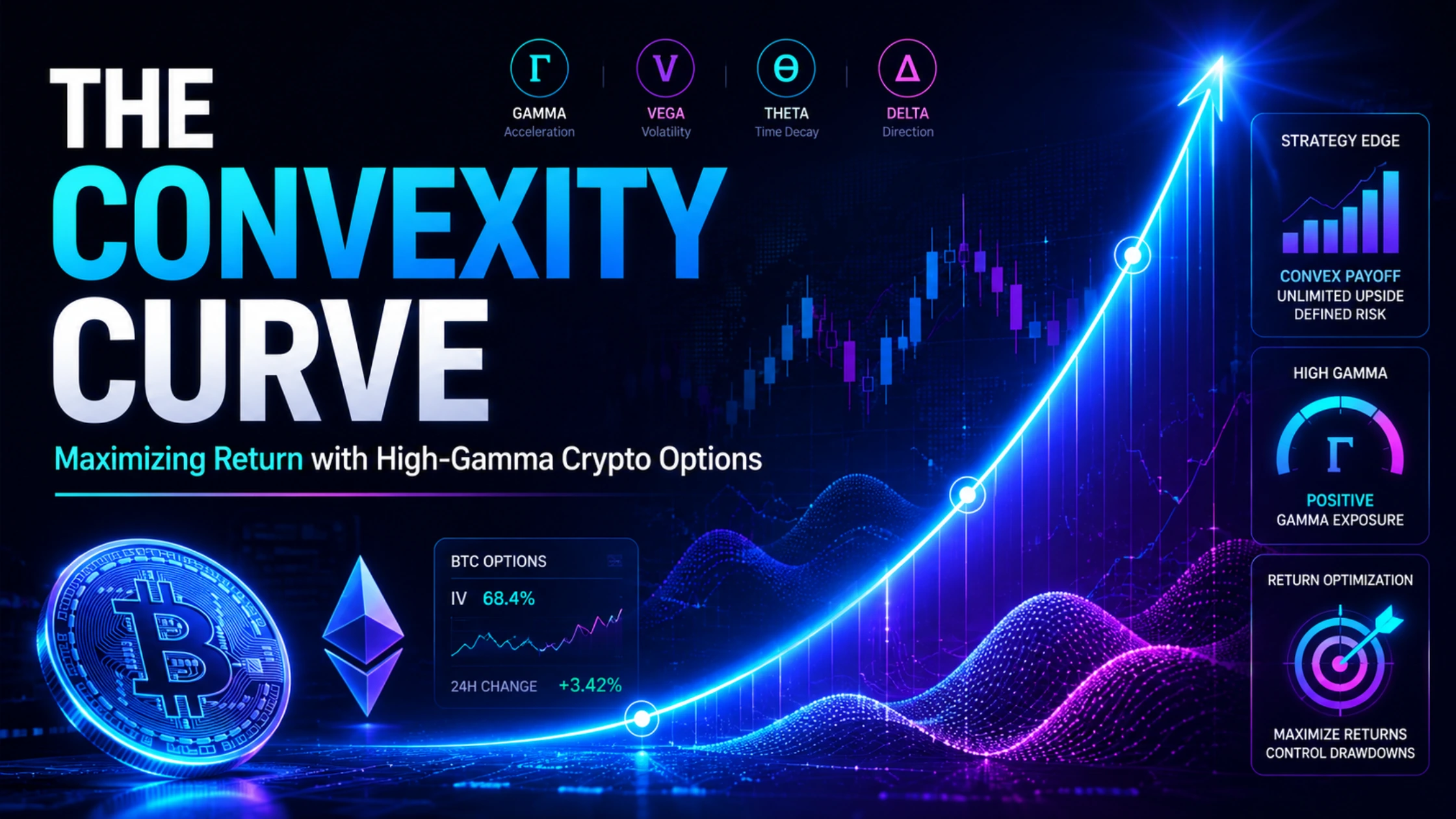
The Convexity Curve: Maximizing Return with High-Gamma Crypto Options
In traditional retail trading, participants overwhelmingly focus on linear payoffs: buying spot or leveraged perpetual contracts where every 1% move in underlying asset price produces a 1% linear change in return (adjusted for leverage). Institutional derivatives desks, however, exploit a far more powerful mathematical force: Non-Linear Convexity and High Gamma Acceleration.
By positioning capital in low-cost, Out-of-The-Money (OTM) options contracts experiencing high **Gamma ($\Gamma$)**—the second derivative of option value with respect to spot price—quant desks engineer asymmetric profiles. In these setups, downside risk is capped strictly to a tiny option premium, while upside returns accelerate exponentially during high-volatility expansions or tail-risk market squeezes.
1. Deconstructing Option Convexity & Gamma Acceleration
To master asymmetric options trading, you must understand how option Greeks interact as an asset moves toward and through strike price boundaries:
While **Delta ($\Delta$)** measures the rate of change of option price per $1 move in spot, **Gamma ($\Gamma$)** measures the rate of change of Delta itself. When an option is far Out-of-The-Money, its premium is cheap and its Delta is low (e.g., 0.10). As spot price surges toward the strike, high Gamma rapidly transforms that 0.10 Delta into a 0.80+ Delta instrument, giving the trader massive directional exposure for a tiny initial outlay.
The Mathematical Formula for Option Gamma Acceleration
$$\Gamma = \frac{\partial^2 V}{\partial S^2} = \frac{N'(d_1)}{S \cdot \sigma \sqrt{T}}$$
Because Gamma ($\Gamma$) is inversely proportional to time to expiration ($\sqrt{T}$) and implied volatility ($\sigma$), short-dated OTM options experience extreme local convexity spikes as expiration approaches—turning small spot breakouts into massive percentage payouts.
2. Interactive Gamma Convexity & Tail-Risk Payoff Plotter
Use our quantitative derivative engine below to model non-linear options convexity. Test how spot price moves, implied volatility surges, and short-dated expiration dynamics amplify small premium allocations into massive asymmetric payoffs.
3. The Institutional Convexity Blueprint
Deploying high-gamma options strategies safely requires balancing rapid time decay (Theta) against explosive price acceleration. Follow this 4-step framework:
High-gamma convexity plays require buying options when IV is artificially depressed. Scan options term structures on premier derivative clearing platforms like Deribit (Code: 5969.4030), Aevo, or Paradex. Target options when IV sits below the 20th percentile of its 90-day range.
Structure low-cost long call or put positions right before major macro announcements or technical chart compression breakouts. Execute trades across liquid venues like Drift, Bybit (Code: 46164), or OKX (Code: 2136301).
Because short-dated high-gamma options lose value rapidly if spot price stalls, program automated take-profit triggers using algorithmic tools like Coinrule, Cryptohopper, or 3Commas.
After harvesting high-convexity options payouts, sweep trading profits into air-gapped hardware cold storage like Ledger or OneKey (Code: 46Z9TD) to protect profits against exchange platform vulnerabilities.
4. Options Analytics & Gamma Tracking Stack
To monitor real-time option chain Greeks, institutional call/put volume sweeps, and gamma exposure (GEX) profiles, integrate these quantitative tools into your workflow:
- Options Order Flow & Gamma Exposure Maps: Track institutional option sweeps and market-maker GEX levels using Unusual Whales.
- Multi-Exchange Charting & Volatility Term Structures: Plot implied volatility surfaces and technical price channels using TradingView or Coinigy.
- Cross-Exchange Arbitrage & Volatility Scanners: Scan options mispricings across global venues using ArbitrageScanner or ASCN AI.
About the Author