The CEX-DEX Arbitrage Leakage: How Toxic Bots Drain Value From Passive AMM Liquidity
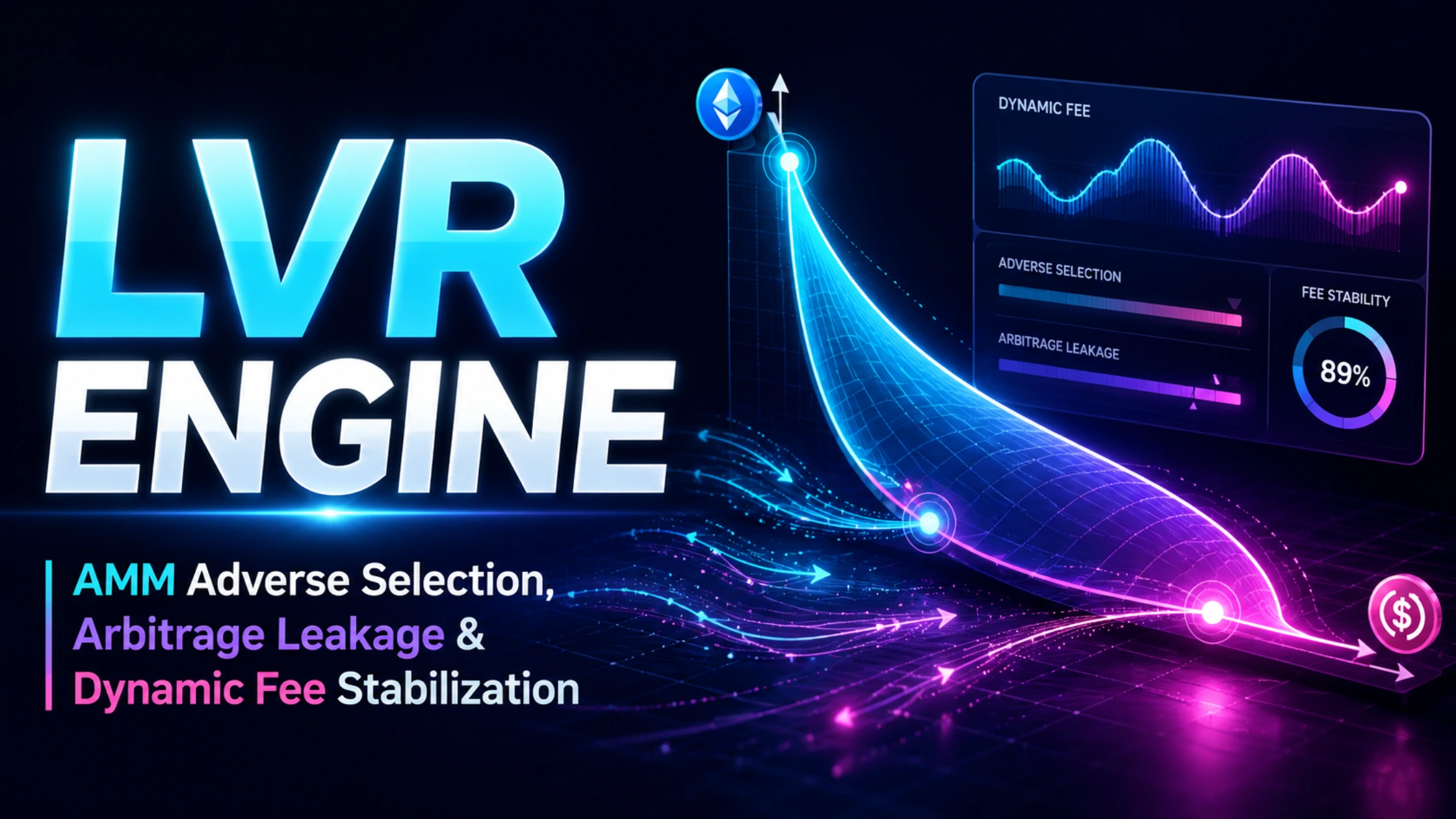
The Loss-Versus-Rebalancing (LVR) Engine: Quantitative Modeling of AMM Adverse Selection, Arbitrage Leakage, and Dynamic Fee Stabilization
For years, decentralized finance (DeFi) participants evaluated Automated Market Maker (AMM) performance using standard Impermanent Loss (IL) models. However, institutional quant desks and academic researchers have exposed a crucial flaw in traditional IL: Impermanent Loss assumes price movements are path-independent and reversible if prices return to their initial deposit levels. In reality, liquidity providers (LPs) on constant-product AMMs suffer a far more dangerous, path-dependent bleed known as Loss-Versus-Rebalancing (LVR).
LVR isolates the true cost of adverse selection borne by passive liquidity providers. Whenever market prices move on high-frequency centralized exchanges (CEXs) like Binance or Coinbase, toxic latency arbitrageurs rebalance the stale pricing on decentralized exchanges (DEXs) like Uniswap before public user order flow arrives. This continuous leakage of value from passive LPs to CEX-DEX arbitrageurs occurs regardless of whether the market trends up, drops down, or returns to its starting point. Understanding and mitigating LVR is the single most critical breakthrough for institutional liquidity provision in modern DeFi.
1. Deconstructing LVR and CEX-DEX Arbitrage Leakage
To master LVR protection, you must separate uninformed retail order flow (which generates fee revenue for LPs) from toxic arbitrage order flow (which snatches stale AMM quotes at the LP's expense):
Unlike Impermanent Loss, LVR accumulates monotonically over time as a function of the underlying asset's continuous volatility ($\sigma$). Under continuous Black-Scholes market dynamics, the cumulative LVR rate for a constant-product ($x \cdot y = k$) liquidity pool is governed by the following mathematical formula:
The Mathematical Formula for Loss-Versus-Rebalancing (LVR)
$$\text{LVR}_T = \frac{1}{8} \sigma^2 \int_{0}^{T} V_t \, dt$$
Where $\sigma$ represents the annualized volatility of the underlying asset, $V_t$ is the instantaneous dollar value of the liquidity pool position, and $T$ is the duration of liquidity provision. Notice that LVR depends strictly on realized volatility variance ($\sigma^2$) and pool capital—it is completely independent of net price direction or final settlement price.
2. Interactive Loss-Versus-Rebalancing (LVR) & Adverse Selection Modeler
Use our quantitative AMM risk engine below to model LVR leakage versus fee collection. Adjust LP pool capital, annualized asset volatility, daily volume-to-liquidity ratios, swap fee tiers, and LVR mitigation mechanisms (such as dynamic fees or L2 priority auctions) to calculate net LP returns.
3. The LVR Mitigation Execution Blueprint
Protecting LP capital from toxic adverse selection and CEX-DEX arbitrageurs requires deploying liquidity into next-generation AMM architectures and automated rebalancing vaults. Follow this 4-step framework:
Deploy liquidity into protocols utilizing dynamic fee hooks (such as Uniswap v4, SynFutures, or Astros (Code: 88SHOV)) that increase swap fees when volatility surges, effectively taxing toxic arbitrageurs and offsetting LVR leakage.
Because LVR is driven by realized variance ($\sigma^2$), hedge your LP position's volatility exposure by shorting variance or selling options straddles/strangles on premier derivative platforms like Deribit (Code: 5969.4030), Aevo, or Drift.
When rebalancing your LP position's delta, execute hedging orders on high-liquidity centralized exchanges rather than swapping back through DEX pools. Deploy rebalancing capital across major exchanges including Bybit (Code: 46164), OKX (Code: 2136301), Binance (Code: CPA_00SXKU7IO9), or Kraken.
Automate LP rebalancing routines using programmatic execution tools like Coinrule, Cryptohopper, or 3Commas. Store non-custodial validator signing keys and LP withdrawal permissions in air-gapped hardware cold storage provided by Ledger or OneKey (Code: 46Z9TD).
4. LVR Analytics & Quantitative AMM Tooling Stack
To monitor real-time CEX-DEX price spreads, toxic arbitrage flow ratios, and dynamic pool returns, integrate these quantitative software platforms into your workflow:
- Cross-Exchange & DEX Spread Scanners: Scan live CEX-DEX arbitrage spreads in real time with ArbitrageScanner or ASCN AI.
- Institutional Options Flow & Volatility Analytics: Track implied vs. realized volatility surfaces to project LVR variance decay using Unusual Whales.
- Advanced Technical & Pool Charting: Map historical volatility channels and AMM volume profile shifts using TradingView or Coinigy.
- Multi-Chain Portfolio & LP Tax Accounting: Track net-of-LVR LP returns and cost-basis movements using CoinStats or Koinly.
About the Author