The Quant Trader’s Guide to Grid Bots and Automated Arbitrage
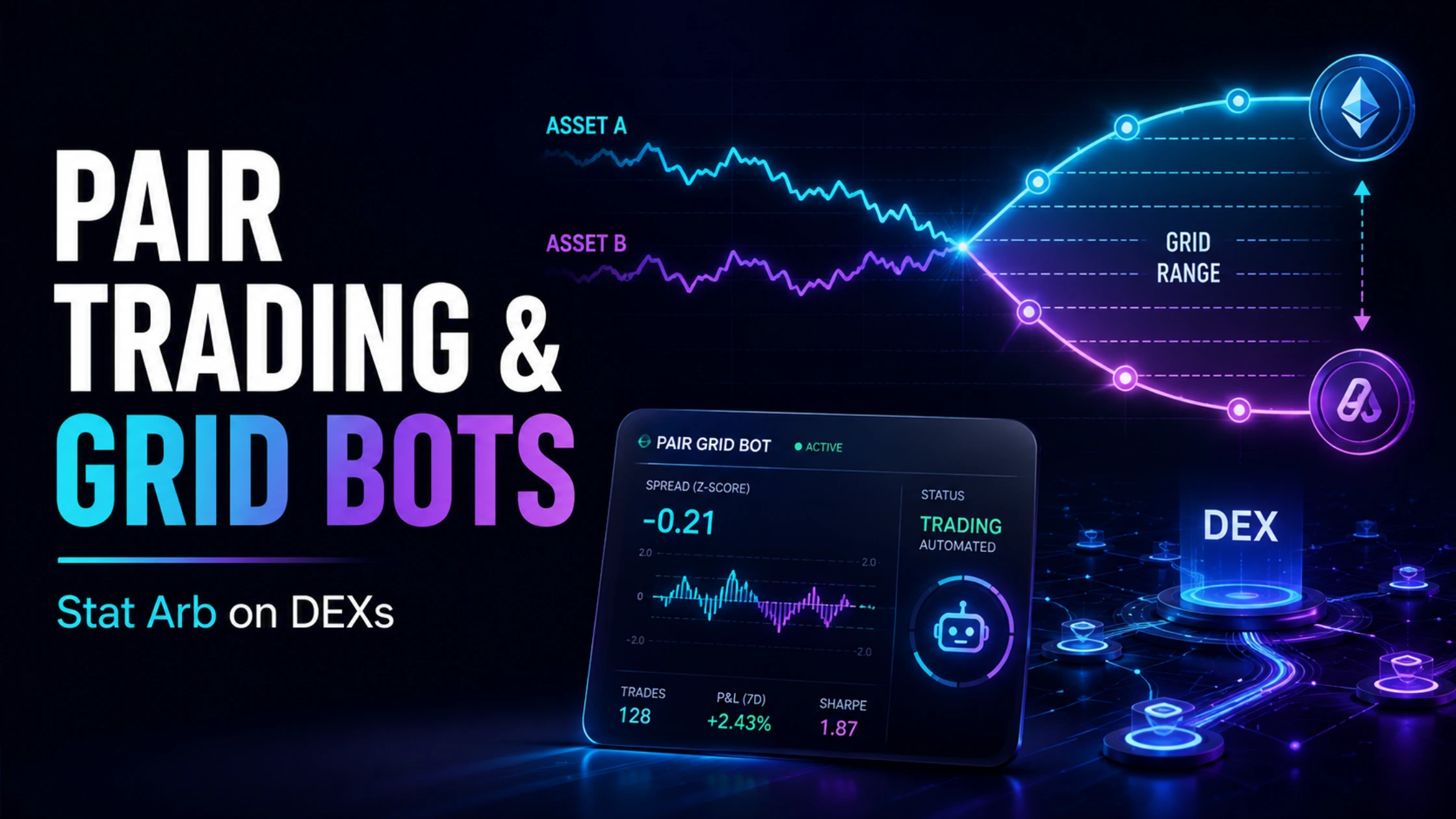
Quantitative Pair Trading & Grid Bots: Unlocking Statistical Arbitrage on DEXs
Key Takeaways (DN Quantitative Benchmarks)
- Statistical Arbitrage (StatArb): Pair trading capitalizes on the historical price correlation between two structurally similar assets (e.g., ETH and stETH, or BTC and ETH). By shorting the outperforming asset and going long on the underperformer, bots profit when the price ratio reverts to the historical mean.
- Automated Grid Bots: Grid trading excels in sideways, high-volatility markets. By blanketing an order book with incremental buy and sell limits, grid bots extract steady yield from market noise without requiring directional predictions.
- Execution Infrastructure: Success in pair trading and grid automation relies entirely on low-latency API execution and robust webhook integration. Platforms like Pionex (built-in grids) and 3Commas (API webhook routing) dominate the 2026 automation stack.
Featured Bot Execution Platforms & VIP Portals
Launch automated grid bots and pair trading algorithms with reduced trading fees via our verified partner portals:
- 🔹 Pionex (Native Grid Bots): Launch Pionex Automated Bots — Referral Code:
HvkLD4aU - 🔹 3Commas (Webhook Arbitrage API): Connect 3Commas Trading Desk — Promo Code:
tc475383 - 🔹 Evedex (Low-Latency DEX Routing): Claim Evedex VIP API Key — Promo Code:
9e3mk2nx
1. The Mathematics of Statistical Arbitrage (Pair Trading)
Unlike directional trading (guessing if an asset will go up or down), statistical arbitrage (StatArb) relies on relative pricing.
In crypto, certain assets exhibit strong cointegration—meaning their prices move together over time due to shared underlying fundamentals or market psychology (e.g., L1 tokens like SOL and AVAX, or AI tokens like TAO and FET).
When a sudden market event causes these two highly correlated assets to temporarily diverge (the "spread" widens), a pair trading algorithm executes two simultaneous trades:
- Short the asset that has pumped abnormally high.
- Long the asset that has lagged abnormally low.
Because the strategy is delta-neutral (market-neutral), the trader does not care if the overall crypto market crashes or moons. Profit is generated exclusively when the two assets converge back to their historical pricing ratio (mean reversion).
2. DN Cointegration Arbitrage Radar (DN-CAR) Framework
To successfully execute pair trades and automated grids, Decentralised News evaluates bot software against four critical engineering requirements:
- Exchange API Integration Depth: Stability of REST/WebSocket connections to both CEX (Binance, Bybit) and high-speed DEXs (Evedex, Aevo) to prevent "one-sided fills."
- Grid Density Capabilities: The maximum number of simultaneous limit orders a bot can post without triggering exchange rate-limit bans.
- Trailing Grid Mechanics: The bot's ability to automatically shift the grid range upward or downward when an asset breaks out of the initial sideways channel.
- Webhook Latency: The millisecond delay between a TradingView PineScript signal firing and the bot executing the cross-exchange trade.
3. Bot Architecture Comparison: Pionex vs. 3Commas
Below is a benchmark comparison of the top two automated execution platforms in 2026:
| Feature | Pionex (Exchange + Native Bots) | 3Commas (API Routing Terminal) |
|---|---|---|
| Architecture | Centralized Exchange with 16 Free Built-in Bots | Multi-Exchange API Trading Terminal |
| Grid Bot Setup | Instant (AI backtested parameters provided) | Highly Customizable (Requires API connection) |
| Pair Trading Support | Manual setup via spot/futures pairs | Advanced Webhook integration via TradingView |
| Trailing Grid Features | Native Trailing Up/Down Grids | Dynamic Grid Adjustments via API |
| Execution Latency | Sub-10ms (Internal matching engine) | ~150-300ms (API round-trip to target exchange) |
| Ideal Persona | Retail Investors, Set-and-Forget Grid Farmers | Quant Devs, StatArb Desks, Multi-Exchange Traders |
| Partner Portal | Pionex Setup (Code: HvkLD4aU) | 3Commas Setup (Code: tc475383) |
4. Setting Up Automated Market-Neutral Grid Bots
A Grid Bot places a ladder of buy orders below the current price and a ladder of sell orders above the current price. As the price naturally oscillates, the bot constantly buys low and sells high.
Strategy Walkthrough: The Infinity Grid
Standard grids stop functioning if an asset pumps above your upper price limit. An Infinity Grid solves this by dynamically calculating the grid boundaries as a percentage rather than fixed fiat prices.
- Select a High-Volatility, Range-Bound Asset: (e.g., SOL/USDT).
- Platform: Pionex.
- Configuration: Select the "Infinity Grid Bot" option. Set your lower limit (the price below which the bot stops buying to protect capital). Set the profit per grid level (typically 0.5% to 1%).
- Execution: The bot retains a small portion of the base asset as it pumps, ensuring you never run out of inventory to sell if the asset enters a multi-month bull run, while continuously harvesting volatility yield.
5. Backtesting Pair Trades to Avoid Liquidation
The biggest risk in pair trading is a structural paradigm shift—when two assets permanently de-couple (e.g., one protocol gets hacked, or one token undergoes massive inflation). If you are trading a highly leveraged pair and the spread widens infinitely instead of reverting, you will face liquidation.
The Z-Score Divergence Strategy (TradingView + 3Commas)
- Identify Cointegration: Use a PineScript indicator on TradingView to calculate the Z-Score of the spread between Asset A and Asset B.
- Set the Trigger: Configure the script to alert when the Z-Score exceeds +2.5 (meaning Asset A is highly overvalued relative to B) or drops below -2.5.
- Route via Webhook: Connect the TradingView alert to a 3Commas Webhook.
- Execution Rules: The webhook simultaneously triggers a SHORT on Asset A and a LONG on Asset B on a low-latency exchange like Evedex.
- Take Profit: Configure 3Commas to close both legs of the trade the moment the Z-Score returns to 0 (the historical mean).
Frequently Asked Questions (FAQ)
Is pair trading completely risk-free?
No. While pair trading eliminates broad market risk (delta-neutral), it carries "spread risk." If the historical correlation between the two assets breaks permanently (e.g., a fundamental change in tokenomics), the spread may never revert to the mean, resulting in a loss on both legs of the trade.
What happens to a grid bot if the market crashes?
If the price falls below the lowest rung of your grid configuration, the bot will stop executing trades. You will be left holding the base asset (e.g., BTC or ETH) that the bot purchased all the way down. This results in an unrealized loss, which is why grid bots should only be run on high-conviction blue-chip assets.
Can I run 3Commas bots on decentralized exchanges?
While 3Commas natively supports major CEXs via API keys, running high-frequency grid or pair bots on DEXs requires platforms that offer robust, low-latency REST/WebSocket endpoints. We recommend using 3Commas to route webhook signals to off-chain matching DEXs like Evedex for optimal DEX arbitrage.
About the Author