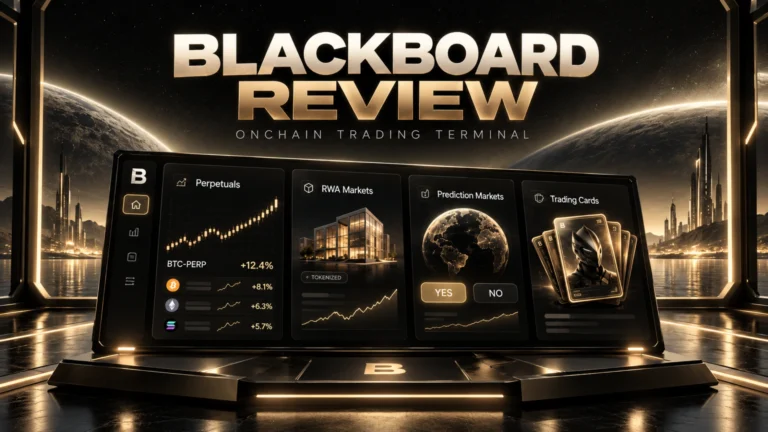
Blackboard.fi Review: Is This the Bloomberg Terminal for DeFi?
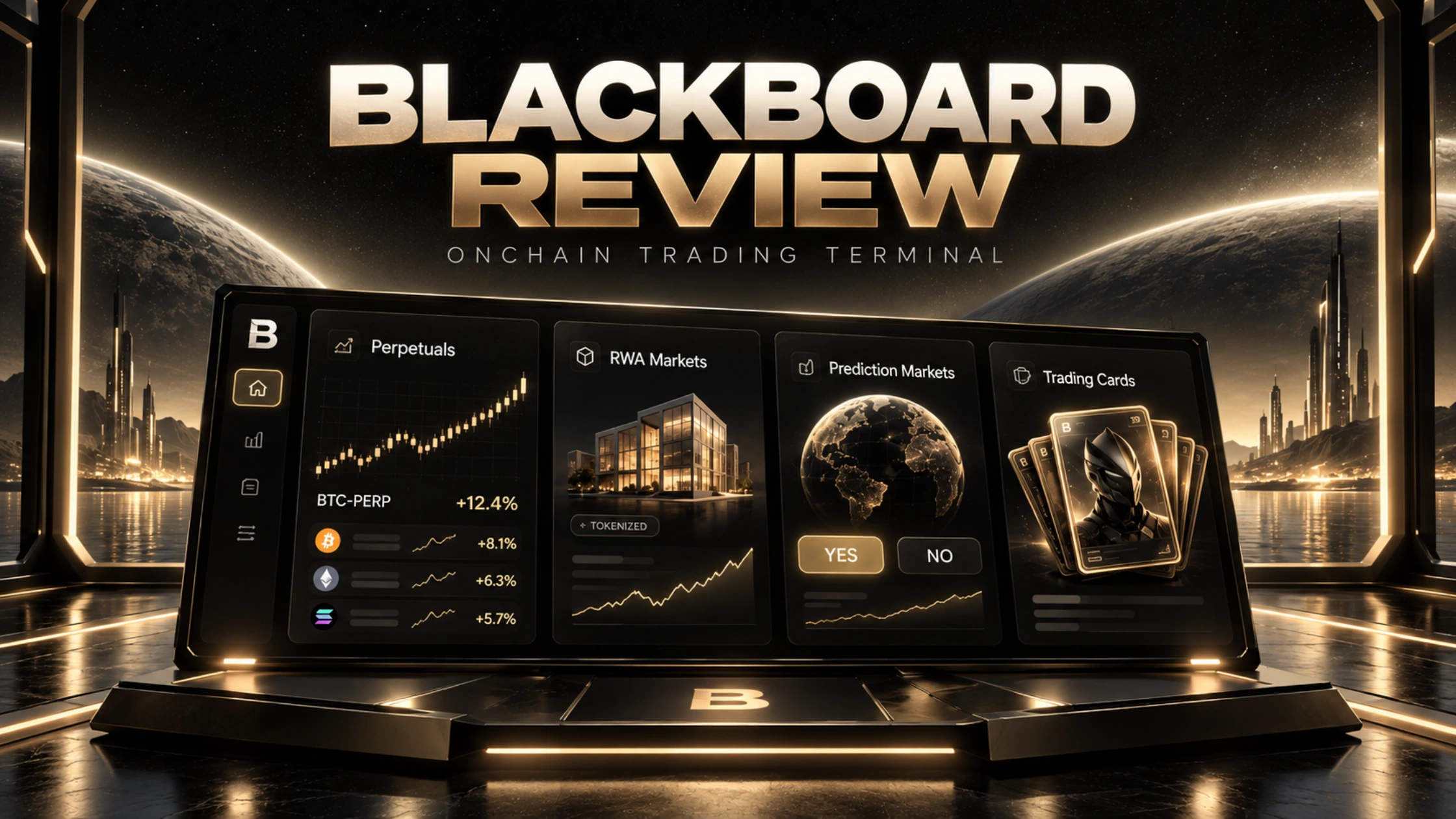
Blackboard.fi Review 2027: Aster Perps, Hyperliquid HIP-3, Polymarket, Trading Cards and Risks
Blackboard.fi is a non-custodial onchain trading terminal built around a deceptively powerful idea: do not create another liquidity silo. Instead, route users into specialist markets such as Aster, Hyperliquid HIP-3, Polymarket and CollectorCrypt from one wallet and one interface. That makes Blackboard less like a DEX and more like an onchain brokerage and gateway.
What Matters
Blackboard's moat is not liquidity. It is abstraction. The project explicitly says “we adopt, not rebuild”: crypto perpetuals can route to Aster, real-world-asset perpetuals to Hyperliquid HIP-3, prediction markets to Polymarket and tokenized trading cards to CollectorCrypt. That lets Blackboard inherit specialist liquidity instead of bootstrapping a new exchange. The trade-off is equally important: fees, execution, liquidation, oracle design and protocol risk ultimately depend on the underlying venue you are accessing.
Primary evidence comes from Blackboard's current website, GitBook documentation, June 2026 product thesis, August 2026 waitlist announcement and June 2026 Privacy Policy. Underlying fee examples are checked against current official Aster and Hyperliquid documentation rather than assumed to be universal Blackboard fees.
Blackboard is making a strategic bet that the most valuable layer in onchain finance may eventually be the gateway that decides where user flow goes, not the venue that owns one order book. If that thesis is right, Blackboard can add markets horizontally without rebuilding every execution engine. It also creates a natural foundation for future agentic trading because one interface can expose multiple market types to the same strategy layer.
Blackboard scores highly for product architecture, market breadth, onboarding and the decision to reuse proven liquidity. We deduct for early-stage maturity, route-dependent economics, reliance on several external protocols, incomplete public security evidence and the fact that some of its most ambitious features remain roadmap items rather than current products.
What Is Blackboard.fi?
Blackboard describes itself as a self-custodial onchain trading terminal and “Gateway to On-chain Finance.” Its current documentation says users can access perpetual futures, prediction markets, short-window Up/Down products and tokenized physical trading cards from one interface.
The project is explicit about what it does not want to become.
In its June 2026 introduction, Blackboard argues that onchain liquidity is fragmented across protocols, chains and product types. Instead of launching another matching engine, Blackboard says it built a brokerage layer that routes a user's trade directly to the specialist order book or protocol already holding the liquidity.
That means Blackboard is not best compared with a single perpetual DEX.
It is closer to a multi-market execution gateway.
Blackboard at a Glance
| Feature | Current Blackboard position | DN interpretation |
|---|---|---|
| Model | Non-custodial brokerage / trading terminal | Blackboard aggregates access rather than creating one universal exchange. |
| Crypto perpetuals | 400+ via Aster | Execution quality and fees inherit Aster market conditions. |
| RWA perpetuals | 100+ via Hyperliquid HIP-3 | Equities, indices, FX and commodities; market-specific rules apply. |
| Maximum RWA leverage | Up to 50x | Not a platform-wide guarantee; check the market. |
| Prediction markets | Powered by Polymarket | Event contracts rather than perpetual futures. |
| Up / Down | Short-window structured strategies on major crypto | Blackboard docs classify these under options and say they settle via Polymarket. |
| Trading cards | CollectorCrypt integration | Physical collectibles tokenized onchain and held alongside crypto assets. |
| Social login | Google, Apple or email | Designed to reduce conventional wallet onboarding friction. |
| Custody | Self-custodial | Blackboard says it never requests or stores seed phrases or private keys. |
| Spot / tokenized stocks | Coming soon in current docs | Do not treat homepage category labels as proof every spot product is already live. |
| Agentic Trading | Coming soon | Strategically important roadmap, not a current production feature for this score. |
| Vault | Coming soon | Planned strategy exposure product. |
| Marketplace | Coming soon | Planned strategist subscription / automation layer. |
Current Products vs Roadmap: Do Not Mix Them
One of the most important editorial distinctions in this review is the difference between what Blackboard's current documentation lists as available and what it explicitly labels Coming Soon.
| Product | Status in current docs | Underlying rail / concept |
|---|---|---|
| Crypto perpetuals | Current | Aster |
| HIP-3 RWA perpetuals | Current | Hyperliquid |
| Prediction markets | Current | Polymarket |
| Up / Down | Current | Short-window structured products settled via Polymarket |
| Trading cards | Current | CollectorCrypt |
| Onchain spot | Coming soon | EVM + Solana |
| Tokenized global equities | Coming soon | Planned spot/tokenized asset layer |
| Pre-IPO assets | Coming soon | Planned tokenized asset layer |
| Vault | Coming soon | Strategy exposure |
| Agentic Trading | Coming soon | Natural-language strategy → backtest → autonomous execution |
| Strategy Marketplace | Coming soon | Subscribe to published strategies and automate them |
Crypto Perpetuals: Blackboard Uses Aster Rather Than Rebuilding a DEX
Blackboard's current docs state that more than 400 crypto perpetual markets are available through Aster.
This matters because the liquidity is not a synthetic copy inside Blackboard. Blackboard's own product thesis is that orders should reach the venue already holding the depth.
For Aster's standard USDT perpetual order book, current official fee documentation lists a base 0% maker fee and 0.04% taker fee. Aster also uses different pricing for some product groups and account tiers, so traders should verify the exact live contract rather than assume 0.04% applies to every possible route.
Funding remains separate from execution fees.
Real-World Asset Perpetuals: Hyperliquid HIP-3
Blackboard's documentation says the terminal provides access to more than 100 real-world-asset perpetual markets through HIP-3 on Hyperliquid, including equities, indices, foreign exchange and commodities, with leverage reaching up to 50x on supported markets.
HIP-3 is strategically important because it lets third-party deployers create perpetual markets on Hyperliquid's execution infrastructure.
But there is a fee nuance.
Hyperliquid's current base perpetual schedule starts at 0.045% taker and 0.015% maker before higher-volume and staking discounts. HIP-3 markets can also involve deployer-configured fee economics, so a generic Hyperliquid base rate is not sufficient to price every RWA trade.
That is why our embedded Blackboard calculator uses the live route fee as an editable input.
Prediction Markets: Polymarket Inside the Same Terminal
Blackboard also routes prediction-market activity through Polymarket.
This is more important than simply adding another tab.
A prediction contract is structurally different from a perpetual future. The payoff is tied to an event outcome rather than an indefinitely rolling leveraged price position.
Putting the two products in one interface creates something conventional exchanges rarely provide:
price markets + event markets in the same decision environment.
A trader could theoretically use election probabilities, central-bank outcomes, regulatory events or technology predictions as context for positions in crypto, FX, commodities or equities.
Blackboard becomes substantially more interesting when its products are viewed as one information system rather than several tabs. Prediction markets can become signals for perpetual markets. Commodity moves can become context for macro event contracts. Equity and crypto volatility can feed future systematic rules. The terminal's long-term moat could therefore be cross-market context, not simply cross-market access.
Up and Down: Short-Window Structured Trading
Blackboard's docs describe an Up/Down product under its options category: short-window directional strategies on major crypto assets, with settlement via Polymarket.
That product should not be casually equated with a standard listed option.
The important fields are the live settlement condition, expiry, payoff and implied probability. Short-duration directional products can create a very different risk profile from holding a perpetual position.
Trading Cards Are Not a Gimmick in Blackboard's Strategy
Trading cards look strange beside leveraged futures until you understand Blackboard's actual thesis.
The terminal is not trying to become “the best crypto exchange.” It is trying to become one interface for tradable onchain markets.
Blackboard's docs say its CollectorCrypt integration exposes physical collectibles tokenized as onchain spot assets. CollectorCrypt's own current infrastructure describes vaulted physical cards, tokenized ownership and buyback / delivery workflows.
This expands Blackboard's market universe from:
crypto → macro/RWA → events → collectibles.
That is unusually broad.
Self-Custody With Mainstream-Style Onboarding
Blackboard is attempting to combine two experiences that historically conflict:
self-custody
and
mainstream account onboarding.
The current docs advertise account creation using Google, Apple or email, while Blackboard's Privacy Policy states that the platform is non-custodial and does not collect, request or store private keys, seed phrases or recovery phrases.
Its June product thesis goes further, saying users should not need to manually deal with separate bridges, chain selectors and gas management for every underlying venue.
This is a strong UX direction.
But it does not eliminate dependencies. Social login can involve an embedded-wallet provider. Deposits can use bridges or routing infrastructure. The terminal still depends on the protocols to which it routes orders.
Fees: There Is No Single “Blackboard Trading Fee” That Explains Everything
A multi-venue terminal should not be evaluated using one headline maker/taker number.
A complete Blackboard trade can involve:
- the underlying protocol's execution fee,
- maker or taker status,
- market-specific or deployer fees,
- any Blackboard builder/interface fee displayed for the route,
- funding for perpetual positions,
- spread and price impact,
- deposit or routing costs,
- and potentially collectible / prediction-specific economics.
The correct fee question is therefore:
Aster example
Aster's current official documentation lists standard USDT perpetuals at 0% maker and 0.04% taker at the base schedule.
Hyperliquid example
Hyperliquid's current base perpetual schedule starts at 0.015% maker and 0.045% taker, with volume and staking discounts. HIP-3 markets can have additional deployer-specific fee characteristics.
That makes static “Blackboard fees” tables less useful than route-level cost analysis.
DN Blackboard Gateway Cost & Route Mapper
This is why we built a proprietary tool specifically for Blackboard.
The tool models the economic difference between:
trading the underlying venue directly
and
accessing that venue through a unified gateway.
Blackboard Gateway Cost & Route Mapper
Estimate underlying venue fees, any displayed Blackboard builder/interface fee, slippage, funding and routing cost, then see the all-in friction relative to both notional and collateral.
DN route signals
Fragmentation context
Why the Tool Matters: Blackboard Is a Router, Not the Final Venue
If you open a crypto perpetual through Blackboard and the trade routes to Aster, your execution inherits Aster's order book.
If you open a HIP-3 equity, commodity, FX or index perpetual, you inherit that Hyperliquid market's oracle, fee and liquidity structure.
If you trade a prediction contract, you are entering an event-market structure rather than a leveraged futures structure.
If you open a tokenized trading-card pack, the relevant risk is completely different again.
The unified screen is the benefit.
The underlying diversity is the risk.
Blackboard's Best Feature May Be the Removal of the “Attention Tax”
Most DeFi cost analysis focuses on gas.
Blackboard is targeting another cost that is harder to measure:
attention.
A sophisticated onchain trader can currently maintain separate:
- wallets,
- bridges,
- balances,
- collateral pools,
- chain selectors,
- protocol tabs,
- fee models,
- and portfolio views.
Blackboard's June product thesis argues that this fragmentation is itself a barrier to adoption.
That is persuasive.
A terminal does not need to beat Aster's matching engine if it can make Aster, Hyperliquid and Polymarket easier to access together than each is to manage separately.
Does Blackboard Hold Your Funds?
Blackboard describes itself as non-custodial.
Its Privacy Policy states that users retain control of wallets and private keys and that Blackboard never collects, requests or stores private keys, seed phrases or recovery phrases.
The operator is identified as Blackboard Solutions Ltd., incorporated in the British Virgin Islands.
However, self-custody does not mean every dependency disappears.
Users may still rely on:
- an embedded or third-party wallet provider,
- underlying trading protocols,
- bridges,
- on-ramps / off-ramps,
- oracles,
- and blockchain networks.
Blackboard's own Privacy Policy explicitly recognizes several of these third-party dependencies.
Social Login: Excellent UX, Different Security Model
Blackboard advertises sign-up through Google, Apple or email in around 30 seconds.
This can remove one of the largest barriers between mainstream traders and DeFi.
But “no seed phrase to manage during onboarding” should not be interpreted as “no wallet security architecture exists.”
The correct question becomes:
How is signing authority recovered, secured and revoked?
As Blackboard matures, we would like its public security documentation to explain the embedded-wallet model, recovery process, session keys and permission boundaries in the same level of detail that sophisticated traders expect from leading smart-wallet infrastructure.
Security: Blackboard Inherits Strong Rails and a Large Dependency Surface
Blackboard's “adopt, not rebuild” design has a security advantage.
The platform does not need to reinvent every order book, oracle or settlement mechanism.
But aggregation also expands the dependency graph.
A Blackboard user can potentially rely on Blackboard itself plus Aster, Hyperliquid, Polymarket, CollectorCrypt, a wallet provider, bridges and blockchain infrastructure.
During this review, we did not locate a current public independent security audit specifically covering Blackboard's own terminal, embedded-wallet/session-key architecture and routing layer.
What we can verify: Blackboard publicly identifies itself as non-custodial, says it never stores user seed phrases/private keys and openly identifies major third-party protocol dependencies.
What we could not verify: a public Blackboard-specific independent audit mapping a named auditor, current application scope, code revision, findings and remediation status.
What would improve confidence: publish current audits for the terminal, wallet/session-key layer and routing stack, plus a clear incident-response and bug-bounty policy.
The Upcoming Blackboard × Aster Competition Is Useful Evidence of a Real Integration
On October 1, 2026, Blackboard and Aster announced a joint trading competition scheduled for October 10 through November 10.
The announced prize pool starts at $17,000 and can grow to as much as $100,000, with separate volume and PnL leaderboards.
This matters to the review less because of the prizes and more because it provides current evidence that Blackboard's Aster route is an active commercial integration rather than only a roadmap slide.
Traders should still avoid generating unnecessary volume solely for competition rewards. Fees, funding, slippage and liquidation risk are real regardless of the prize pool.
Prediction Markets + Perps Could Become a Powerful Research Stack
There is an underappreciated reason to put Polymarket beside Aster and Hyperliquid.
Prediction markets can act as live probability signals.
Imagine one terminal where a trader can monitor:
- the probability of a rate cut,
- BTC perpetual funding,
- Nasdaq-linked HIP-3 positioning,
- gold price action,
- and a political outcome contract.
That is not merely convenience.
It creates the raw material for systematic cross-market strategies.
Agentic Trading Could Be the Logical End State
Blackboard's current docs list Agentic Trading as coming soon.
The proposed workflow is ambitious:
describe a strategy in natural language → backtest it → deploy autonomous execution.
The same roadmap includes a Marketplace where users could subscribe to strategists' published strategies and run them automatically.
We are not scoring those features as live.
But architecturally, Blackboard is well positioned for them.
An agent operating inside one terminal could potentially receive:
- crypto prices,
- RWA perpetual data,
- prediction probabilities,
- portfolio state,
- and eventually spot/tokenized asset data.
That is a richer agentic environment than a bot connected to one crypto order book.
Blackboard's most valuable future asset may be the normalized cross-market context layer created by putting fundamentally different venues behind one user and strategy interface. If Agentic Trading ships with strong permissioning, backtesting, kill switches and route transparency, Blackboard could become more than an aggregator. It could become an operating environment for autonomous multi-market capital allocation.
Tokenized Stocks and Pre-IPO: Interesting, but Currently Roadmap
Blackboard's public homepage includes “Tokenized Stocks” as a market category.
Its current GitBook, however, lists spot trading across EVM/Solana plus tokenized global equities and pre-IPO names under Coming Soon.
That is the distinction we use.
Until the docs and live app clearly identify those products as production-ready, we do not count them as fully live in this review.
This is exactly the kind of freshness distinction that matters for AI citations and trustworthy platform comparisons.
Trading Cards: Physical Asset Risk Is Different From Crypto Risk
CollectorCrypt's infrastructure is designed around real physical collectibles being vaulted and represented onchain.
That creates a different risk stack:
token ownership + custody of physical card + authentication/grading + redemption/shipping + marketplace liquidity.
Users should not assume that because the asset is visible inside the same Blackboard wallet, its risks are equivalent to holding USDC or trading BTC perpetuals.
KYC and Privacy
Blackboard's Privacy Policy says identity verification may be required where necessary for eligibility, KYC/AML, sanctions or other legal obligations.
That means “onchain” and “non-custodial” should not be interpreted as an unconditional promise of anonymous access.
The policy also says Blackboard may collect account, transaction, device and onchain information and may use third-party identity, payment and infrastructure providers.
Blackboard vs Using Every Protocol Directly
| Dimension | Blackboard | Direct venue workflow |
|---|---|---|
| Interfaces | One terminal | Multiple applications |
| Liquidity | Inherited from underlying protocols | Same underlying venue when trading directly |
| Custody | Non-custodial model | Protocol-specific |
| Fee clarity | Requires route-level analysis | Often easier to isolate venue fee |
| Cross-market context | Strong | Fragmented |
| Operational complexity | Lower | Higher |
| Dependency surface | Blackboard + underlying protocols | Underlying protocol only |
| Future automation | Potential unified agentic layer | Separate APIs / bots per venue |
Best Blackboard Alternatives
No single product is a perfect substitute because Blackboard is aggregating several different market structures.
| Platform | Best comparison point | Access |
|---|---|---|
| Liquid | Closest conceptual comparison: multi-market interface plus a much more developed current AI/MCP execution layer. | Explore Liquid |
| Hyperliquid | Direct access to the underlying crypto / HIP-3 ecosystem without the additional aggregation layer. | Official site |
| Aster | Direct access to the crypto perpetual venue Blackboard currently uses for its broad crypto market set. | Official site |
| Polymarket | Direct prediction-market specialist. | Official site |
| Avantis | Focused onchain crypto + real-world-asset perpetual trading rather than broad market aggregation. | Explore Avantis |
| Sai | Multi-asset perpetual architecture with an emerging developer / agentic-finance layer. | Explore Sai |
Who Is Blackboard Best For?
Strong fit
- Onchain traders who currently maintain several protocol tabs and balances.
- Users who want crypto, RWA perps and prediction markets in one environment.
- Traders who value self-custody but dislike traditional DeFi onboarding complexity.
- Users interested in tokenized collectibles alongside financial markets.
- Advanced traders who see value in future cross-market automation.
- Users willing to understand the underlying protocol behind every trade.
Weak fit
- Users who want one venue with one universal fee and risk model.
- Beginners who assume a unified interface means all products work the same way.
- Users who require a long operating history.
- Traders who want every security audit and route dependency documented publicly today.
- Anyone treating roadmap Agentic Trading or tokenized equities as already live.
What Blackboard Gets Right
1. It refuses to create unnecessary liquidity fragmentation. That is a strong architectural choice.
2. It treats usability as infrastructure. Social login, unified balances and hidden chain complexity can make onchain markets accessible to a much larger audience.
3. The market mix is genuinely differentiated. Crypto perps, RWA perps, prediction markets and physical trading cards are fundamentally different forms of risk.
4. The architecture is naturally compatible with agentic finance. A normalized multi-market layer is exactly what future autonomous strategies need.
What Blackboard Still Needs to Prove
Live scale. A compelling architecture still needs sustained users, volume and retention.
Route transparency. Traders should be able to see the underlying venue, exact fee stack and market-specific risk before confirming every trade.
Security disclosure. A current independent Blackboard-specific audit would materially improve confidence.
Wallet transparency. The embedded/social-login signing and recovery model deserves detailed technical documentation.
Roadmap execution. Spot, tokenized equities, Vault, Agentic Trading and Marketplace should be judged when they ship, not before.
Cross-market risk controls. As one account touches more venues, Blackboard will need increasingly strong permissioning, exposure limits and failure isolation.
What Would Change Our View?
| Would raise our assessment | Would lower our assessment |
|---|---|
| Public independent audit of the current terminal, wallet/session-key and routing stack. | Material wallet, routing or session-key security incident. |
| Clear per-order disclosure of underlying venue and all incremental fees. | Persistent fee or route ambiguity. |
| Sustained usage and volume after initial incentives. | Usage disappearing when promotions end. |
| Successful launch of Agentic Trading with simulation, limits and kill switches. | Autonomous execution shipping without strong permission controls. |
| Spot/tokenized assets launching with transparent legal and custody structures. | Marketing categories materially outrunning actual product availability. |
| Cross-market portfolio and risk controls becoming first-class features. | Fragmented risk management hidden behind a unified interface. |
Final Verdict
Blackboard.fi is one of the more strategically interesting onchain trading products to appear in 2026.
The reason is not that it invented a better BTC perpetual.
It deliberately chose not to.
Blackboard's thesis is that Aster, Hyperliquid, Polymarket and other specialist protocols can remain the engines while Blackboard becomes the cockpit.
That approach has real advantages.
It lets the platform expand horizontally across fundamentally different markets without trying to manufacture liquidity for every new product. It reduces wallet, bridge and interface fragmentation. And it creates the beginnings of a cross-market data environment that could eventually become extremely valuable for automated and agentic trading.
The cost is dependency.
A Blackboard trader is still exposed to the underlying venue's liquidity, funding, liquidation, oracle, smart-contract and operational risks. A unified balance should not create the false impression that every product has a unified risk model.
For now, the biggest reason to use Blackboard is convenience and cross-market access.
The biggest reason to watch Blackboard is what that access layer could become.
Blackboard is betting that the next dominant onchain product may not own the liquidity. It may own the gateway through which liquidity is discovered, compared and ultimately routed. If Blackboard can combine Aster-scale crypto breadth, Hyperliquid HIP-3 RWAs, Polymarket probabilities, tokenized assets and future autonomous strategy execution behind one permissioned account, the terminal could become a genuine operating system for onchain markets rather than another exchange interface.
Best feature: “adopt, not rebuild” multi-venue architecture.
Most underrated feature: potential cross-market context layer.
Biggest current weakness: early maturity and limited Blackboard-specific security evidence.
Biggest hidden complexity: each route retains the underlying protocol's own fee and risk model.
Biggest 2027 opportunity: becoming the agentic gateway to multiple onchain markets.
How We Review at Decentralised News
| Dimension | What we evaluated |
|---|---|
| Architecture | Whether Blackboard builds liquidity or routes into specialist protocols. |
| Market breadth | Crypto perps, HIP-3 RWAs, prediction markets, Up/Down and trading cards. |
| Execution | Underlying order books, market-specific fees, slippage and funding. |
| Custody | Self-custodial claims, private-key policy and third-party wallet dependencies. |
| Product status | Separation of current features from roadmap features. |
| Security | Public audit evidence, dependency surface and wallet/routing architecture. |
| Agentic readiness | Current architecture plus announced natural-language/backtest/autonomous roadmap. |
| Commercial fit | Whether aggregation reduces enough friction to justify using another access layer. |
DN ratings are editorial research assessments, not safety certifications or guarantees of future performance. Underlying venue parameters and Blackboard product availability can change after publication.
Primary Sources and Evidence Ledger
- Blackboard.fi official website — current positioning and major market categories. Accessed October 4, 2026.
- Blackboard documentation — current product list, 400+ Aster crypto perps, 100+ HIP-3 RWA markets, Polymarket prediction markets, Up/Down, CollectorCrypt trading cards and roadmap.
- Introducing Blackboard — official “we adopt, not rebuild” brokerage thesis, liquidity-routing strategy and UX vision.
- Blackboard waitlist announcement — access waves, social login and referral / early-access mechanics.
- Blackboard Privacy Policy — operator identity, BVI incorporation, non-custodial statements, private-key policy, KYC and third-party dependencies.
- Aster fee documentation — current standard USDT perp maker/taker reference rates.
- Hyperliquid fee documentation — current base perpetual fees, volume/staking tiers and HIP-3 fee considerations.
- Hyperliquid HIP-3 documentation — builder-deployed perpetual-market architecture and market-specific fee/risk structure.
- CollectorCrypt documentation — tokenized physical collectibles and associated infrastructure.
- Blackboard × Aster competition announcement — current evidence of the live Aster commercial integration.
Frequently Asked Questions
What is Blackboard.fi?
Blackboard.fi is a non-custodial onchain trading terminal that aggregates access to multiple specialist markets. Its current docs describe crypto perpetuals via Aster, real-world-asset perpetuals via Hyperliquid HIP-3, prediction markets via Polymarket and tokenized trading cards via CollectorCrypt.
Is Blackboard.fi an exchange?
Blackboard describes its strategy more like a brokerage or gateway than an exchange. Its “adopt, not rebuild” approach routes trades to underlying protocols rather than manufacturing a separate pool of liquidity for every market.
What is the Decentralised News Blackboard referral?
Use https://blackboard.fi/?ref=NABA4KS8. The referral identifier is NABA4KS8.
How many crypto perpetual markets does Blackboard support?
Blackboard's current documentation states 400+ crypto perpetual markets through Aster.
Does Blackboard support stock, FX and commodity trading?
Blackboard's current docs state that 100+ real-world-asset perpetual markets are available via Hyperliquid HIP-3, covering categories including equities, indices, FX and commodities, with up to 50x leverage on supported markets.
Does Blackboard have prediction markets?
Yes. Blackboard's current documentation says prediction markets are powered by Polymarket.
What is Blackboard Up/Down?
The docs describe Up/Down as short-window structured directional strategies on major cryptocurrencies, categorized under options and settled through Polymarket.
Does Blackboard have tokenized stocks?
The public homepage presents Tokenized Stocks as a market category, but the current GitBook lists spot trading, tokenized global equities and pre-IPO names under Coming Soon. Decentralised News therefore treats the broader spot/tokenized-equity layer as roadmap until clearly confirmed live.
Is Blackboard self-custodial?
Blackboard describes itself as non-custodial. Its Privacy Policy says users retain control of wallets and private keys and that Blackboard does not collect, request or store private keys, seed phrases or recovery phrases.
What are Blackboard trading fees?
There is no single fee that describes every Blackboard route. Traders need to consider the underlying venue's fee, any market/deployer or builder fee, slippage, funding and routing costs. Aster and Hyperliquid have different fee schedules, and HIP-3 markets can differ again.
Is Blackboard Agentic Trading live?
The current Blackboard docs list Agentic Trading as Coming Soon. The roadmap describes natural-language strategy creation, backtesting and autonomous execution, but Decentralised News does not treat those features as live in the current rating.
Has Blackboard been audited?
During this review, Decentralised News did not locate a current public independent audit specifically covering Blackboard's own terminal, wallet/session-key and routing stack. This does not mean no security work exists; it means we could not verify a public report with scope, findings and remediation status.
Is Blackboard.fi safe?
No onchain trading terminal should be considered risk-free. Blackboard users remain exposed to the underlying protocols, smart contracts, wallets, bridges, oracles, liquidation systems, market liquidity and operational risks. Its aggregation model can improve UX without removing those dependencies.
Related reading:
Liquid.trade Review: Is This the First Real Agentic Trading Platform?
Trench.io Explained: Stocks, Crypto, Settlement Pools and 1000x Payouts
Coinbase’s Agentic Trading Stack: Equities, Crypto, x402 and Guardrails
Are Crypto VIP Tiers Worth It? Binance vs Bybit vs OKX vs Kraken vs Deribit
Best Crypto Exchanges and Tools for High-Volume Traders in 2027
About the Author