Trench.io Explained: Stocks, Crypto, Settlement Pools and 1000x Payouts
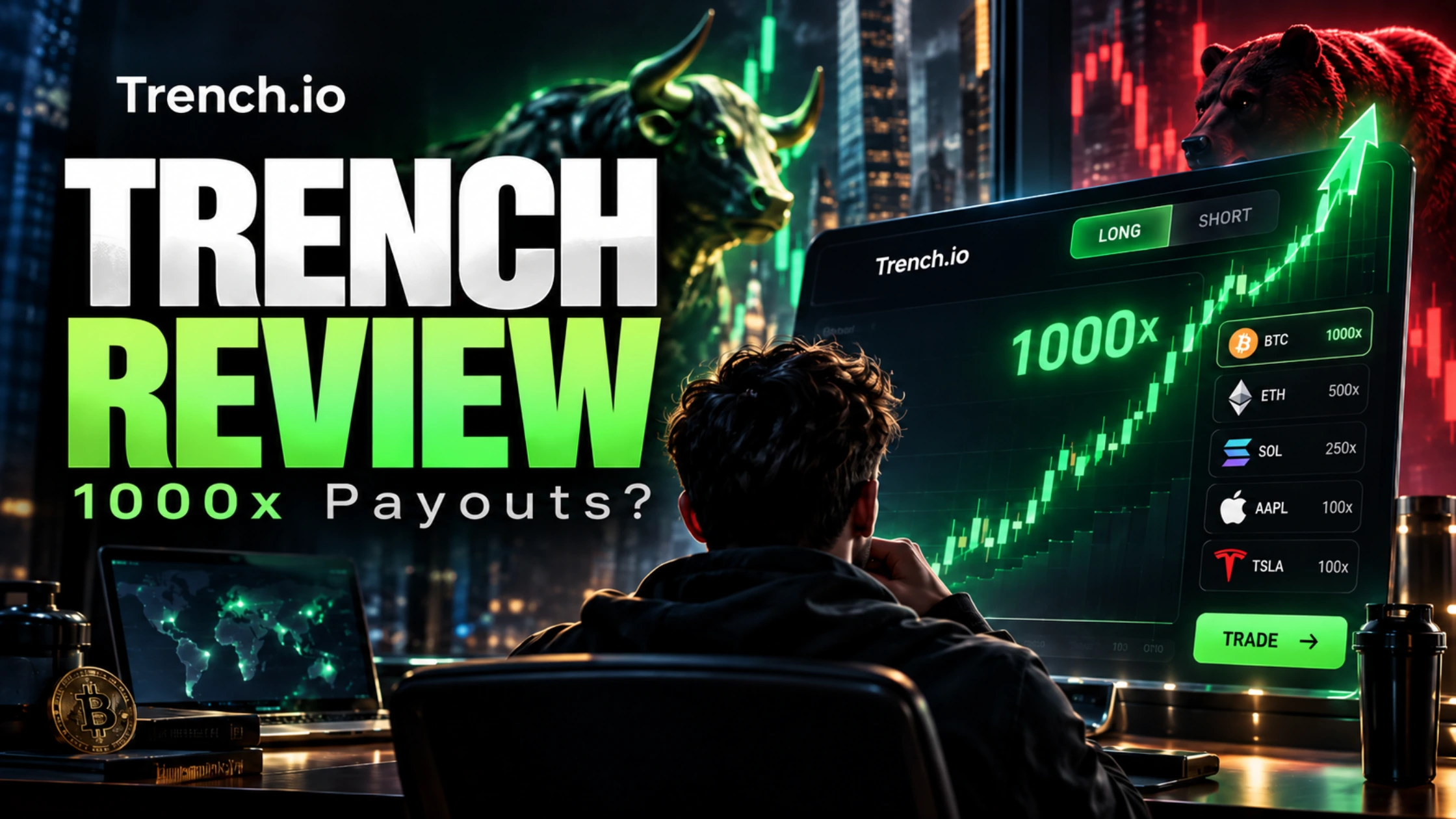
Trench.io Review 2027: 1000x Payout Multipliers, Stock Trading, Fees and Risks Explained
Trench.io is an unusual self-custodial trading interface built around peer-to-peer on-chain transactions, settlement pools and headline payout multipliers of up to 1000x across markets including stocks, crypto and commodities. The product is deliberately simple on the surface. The risk structure underneath is not.
What Matters
Trench.io should not be evaluated as if “1000x payout multiplier” meant the same thing as 1000x leverage on a conventional perpetual exchange. The public homepage uses payout-multiplier language, while the Terms describe peer-to-peer derivatives through smart contracts and settlement pools. The exact economics of any trade are therefore defined by the live trade ticket, not by the headline multiplier alone. Trench is easy to understand at the marketing layer and much less transparent at the public fee, pricing and security-evidence layers.
DN Evidence Block
The Signal
Trench's most interesting idea is not extreme leverage. It is the attempt to turn speculative directional trading into a simple stake-and-outcome experience backed by self-custodial wallets and on-chain P2P settlement. That can make derivatives easier to approach, but it also compresses complex concepts such as counterparty collateral, liquidation, settlement conditions and pricing into a simple interface.
Trench scores well for simplicity, self-custodial architecture and product originality. It scores materially lower for publicly verifiable fee detail, security/audit transparency, full market visibility and beginner suitability given the extreme headline multipliers and explicit counterparty risks in its own Terms.
What Is Trench.io?
Trench.io is a browser-based trading platform whose public homepage currently promotes stock trading with an advertised 1000x payout multiplier. The homepage highlights META, AMZN, TSLA, MSFT, AAPL, NVDA and SPCX, while public metadata describes trading across stocks, crypto and commodities.
Its August 2026 Terms provide the structural detail: Layer 1 and Layer 2 blockchain technologies, self-custodial digital wallets, decentralized applications, peer-to-peer trading, settlement pools, swapping and cross-chain bridges. The Terms also say Trench is a developer and software provider rather than a broker, centralized exchange, fund manager or dealer.
Trench.io at a Glance
| Feature | Current evidence | DN interpretation |
|---|---|---|
| Headline maximum | Up to 1000x payout multiplier | Do not automatically read this as 1000x conventional leverage. |
| Public market categories | Stocks, crypto, commodities | Full live catalogue is behind sign-in. |
| Public stock examples | META, AMZN, TSLA, MSFT, AAPL, NVDA, SPCX | Reference-market exposure should not be confused with share ownership. |
| Custody | Self-custodial wallet framework | User bears private-key/recovery responsibility. |
| Execution | P2P smart-contract transactions | Counterparty and settlement-pool risk matter. |
| Bridge | Cross-chain functionality described | Adds bridge/smart-contract risk. |
| Fees | Platform Fee + third-party fees | No detailed public percentage schedule found. |
| Transaction finality | Final and irreversible | Errors may not be refundable. |
| Referral | decentralisednews | Confirm attribution before funding or trading. |
What Does “1000x Payout Multiplier” Mean?
Trench's public website uses the phrase “1000x Payout Multiplier.” That is materially different from saying “1000x leverage.”
A conventional leverage ratio measures notional exposure relative to collateral. A payout multiplier describes a payoff if a defined trade condition is met. Without the exact live trade ticket, its trigger, duration, settlement rule, fee and maximum loss, the headline multiplier alone is insufficient to calculate the economics.
Stocks on Trench Are Not the Same as Owning Shares
The public homepage displays familiar stock tickers, but Trench's Terms describe P2P derivative-style transactions and settlement pools. We found no public evidence that a TSLA, NVDA or META position on Trench gives ordinary shareholder rights such as voting rights or direct title to the underlying security.
For publication purposes, the safer description is directional derivative-style exposure referencing these markets, not verified direct share ownership.
How Trench's P2P Settlement Changes the Risk
Trench's Terms say users can enter peer-to-peer transactions through blockchain smart contracts, with each side providing collateral in settlement pools. Trench explicitly warns that it does not guarantee every settlement pool contains sufficient collateral to maintain or settle a transaction.
The Terms also warn that a counterparty's collateral can fall to zero or become negative during a rapid market move. In that case there may be no mechanism to force the counterparty to deposit more collateral, which means a winning trader may be unable to realize all expected profits.
Fees: The Biggest Public Information Gap
Trench's Terms define a Platform Fee plus potential gas and third-party fees. They also say fee estimates can differ from the final amount actually paid.
We did not locate a sufficiently detailed current percentage schedule on the public homepage or public Terms. We therefore do not invent one.
DN Trench Trade-Ticket Reality Check
The headline multiplier is not enough to make a decision. The tool below converts the values from the live trade ticket into net reward, maximum loss, break-even win rate and scenario expected value.
Trench Trade-Ticket Reality Check
Turn a live Trench ticket into the numbers that matter. This tool does not predict whether the trade will win.
DN ticket signals
What the tool cannot tell you
Self-Custody Is a Strength and a Responsibility
Trench's Terms describe users creating or connecting self-custodial digital wallets and storing digital assets locally on their own devices. The trade-off is explicit: users are responsible for protecting private keys, passwords and recovery phrases, and Trench says it cannot restore lost credentials or reverse unauthorized blockchain activity.
Bridging Adds Another Risk Layer
The Terms describe cross-chain bridging and explicitly warn that bridge smart contracts can be exploited or fail, potentially causing total loss. Volume limits can also affect how quickly assets move into or out of the protocol.
Can Trench Reverse a Bad Trade?
The current Terms say confirmed P2P blockchain transactions are final and irreversible. Trench says it has no obligation to reverse or refund a transaction even if it was submitted in error.
Pricing and Liquidity Risk
Trench's Terms say pricing may be higher or lower than prices available elsewhere and that limited liquidity can cause slippage, delayed execution or an inability to execute. Those risks matter even more when the advertised payoff is highly sensitive to the underlying settlement condition.
Referral Code
Decentralised News Trench.io Referral
Referral link: https://trench.io?ref=decentralisednews
Code: decentralisednews
Confirm referral attribution and any live benefit in your account before depositing or trading because referral-program rules can change.
Security: The Biggest Public Evidence Gap
Trench's Terms contain extensive warnings around smart contracts, wallets, networks, bridges and third-party services. What we did not locate was a public independent Trench-specific audit report showing the auditor, contract scope, audited revisions, findings and remediation status.
DN Security Evidence Gate
Verified: Trench publicly describes smart-contract P2P settlement, self-custodial wallets and bridges.
Not verified: a current public independent security audit specific to the live Trench application/protocol.
What would improve confidence: auditor, contract addresses, audited commits, findings and remediation status.
User Reviews: Useful Signal, Not Proof
At the October 3 research snapshot, Trench's claimed Trustpilot profile showed 41 reviews and a 2.9/5 TrustScore. Feedback was highly polarized: some users reported positive experiences, while others alleged problems with trade closing, withdrawals or price behavior.
These are user allegations and anecdotes, not independently verified findings. They should not be used as proof of misconduct. But the concentration of recent complaints is relevant enough to include in due diligence for a new high-risk trading product.
Jurisdictional Restrictions
Trench's public restricted-jurisdictions page currently lists Cuba, Iran, North Korea, Syria, Russia and Belarus, plus Crimea, Sevastopol, Donetsk, Luhansk, Kherson and Zaporizhzhia. The Terms prohibit using VPNs or IP-masking techniques to evade restrictions and specify Panama as governing law for disputes.
Points, Tiers and Trading Incentives
The Terms allow Trench to issue Points, Tiers, referral rewards and trading incentives, including potential loss refunds or other bonuses. The same Terms say these can be modified, withheld, cancelled or reset and may not have intrinsic value.
Trench vs Conventional Perpetual Futures
| Dimension | Trench.io | Conventional perp venue |
|---|---|---|
| Headline metric | Payout multiplier | Leverage ratio |
| Public maximum | Up to 1000x payout multiplier | Typically stated as x leverage |
| Core decision input | Stake + payout + settlement condition + max loss | Notional + collateral + leverage + liquidation price |
| Execution | P2P smart-contract / settlement-pool framework | CLOB, AMM, RFQ or peer-to-pool |
| Counterparty risk | Explicitly material in Terms | Architecture-dependent |
| Fee transparency | Live-ticket dependent | Often published in a fee table |
Who Is Trench Best For?
Stronger fit
- Experienced speculative traders who understand asymmetric payoff products.
- Users comfortable reading every field on a live trade ticket.
- Traders who value self-custody and on-chain settlement.
- Users who can tolerate complete loss of the amount staked.
Weak fit
- Beginners who interpret 1000x as guaranteed or conventional leverage.
- Users looking to own actual shares.
- Traders who require a public fixed fee schedule before opening an account.
- Anyone uncomfortable with P2P counterparty or smart-contract risk.
- Anyone using essential or borrowed money.
What Trench Gets Right
Simple framing: the product is immediately understandable at the surface level.
Self-custody: the wallet model reduces direct custodial-exchange exposure.
Risk language: the Terms are unusually explicit about counterparty, bridge, liquidity and irreversibility risks.
Broad speculative-market concept: familiar stock names bring non-crypto reference markets into an on-chain environment.
What Trench Still Needs to Prove
Fee transparency: publish a clear, versioned public schedule.
Security transparency: publish independent audits and live contract addresses.
Settlement mechanics: explain payout multipliers, settlement rules and collateral with worked examples.
Market transparency: make the full live catalogue visible without sign-in.
Execution reliability: independent data on fills, closes and withdrawals would materially strengthen confidence.
What Would Change Our View?
| Would raise our assessment | Would lower our assessment |
|---|---|
| Public smart-contract audit with remediation status. | Material unresolved contract, wallet or bridge incident. |
| Versioned public fee schedule and worked trade examples. | Fees materially diverging from pre-trade quotes without explanation. |
| Public payout/settlement methodology. | Persistent inability to explain settlement or reference prices. |
| Independent evidence of reliable closes and withdrawals. | Growing verified evidence of execution or withdrawal failures. |
| Transparent settlement-pool solvency safeguards. | Losses from undercollateralized counterparties without adequate disclosure. |
Final Verdict
Trench.io is a genuinely unusual trading product. Its combination of familiar stock references, a self-custodial wallet model, peer-to-peer smart-contract settlement and headline payout multipliers up to 1000x gives it a distinct identity.
That originality is also why the platform needs more public explanation, not less. The phrase “1000x payout multiplier” is powerful marketing, but it is not enough information to evaluate a trade.
Serious evaluation requires the live ticket: stake + direction + settlement condition + payout + fee + maximum loss + counterparty mechanics.
DN Alpha Thesis
Trench is part of a broader shift toward outcome-first derivatives: choose a direction, stake a defined amount, see an explicit payoff and let on-chain infrastructure handle the derivative plumbing underneath. This can expand the audience for derivatives dramatically. It can also make sophisticated risk look deceptively simple. The winners in this category will make the payoff simple without hiding how the risk is created.
Best feature: simple high-multiplier directional trading experience.
Most important distinction: payout multiplier is not automatically conventional leverage.
Biggest hidden risk: P2P counterparty and settlement-pool solvency.
Biggest transparency gap: public fees and independent security evidence.
Biggest opportunity: making complex on-chain derivatives understandable without disguising their risk.
How We Review at Decentralised News
| Dimension | What we evaluated |
|---|---|
| Product structure | Payout-multiplier framing, P2P model and settlement conditions. |
| Custody | Self-custodial wallet responsibilities. |
| Counterparty risk | Settlement-pool collateral and bad-debt possibility. |
| Fees | Platform and third-party fees plus disclosure quality. |
| Markets | Publicly advertised stock, crypto and commodity coverage. |
| Security | Public audit evidence and smart-contract/bridge disclosure. |
| User experience | Signup, public market visibility and sentiment signals. |
DN ratings are editorial assessments, not safety certifications or investment recommendations.
Primary Sources and Evidence Ledger
- Trench.io official homepage — 1000x payout-multiplier claim, signup options and stock examples.
- Trench.io markets — redirects unauthenticated users to sign-in at the research date.
- Trench.io Terms of Use — self-custody, P2P settlement, bridging, fees, counterparty risk and transaction finality.
- Restricted jurisdictions — current geographic restrictions.
- Trustpilot Trench.io profile — used only as a sentiment signal, not factual proof of individual claims.
Frequently Asked Questions
What is Trench.io?
Trench.io is a self-custodial blockchain-based trading interface whose public site advertises stocks, crypto and commodities with payout multipliers up to 1000x. Its Terms describe P2P transactions through smart contracts and settlement pools.
What is the Trench.io referral code?
The Decentralised News referral code is decentralisednews. Use https://trench.io?ref=decentralisednews.
Does 1000x payout multiplier mean 1000x leverage?
Do not assume so. Trench publicly uses payout-multiplier terminology. Read the live ticket's stake, payout, fees, maximum loss and settlement conditions.
Can I trade stocks on Trench.io?
The public homepage highlights META, AMZN, TSLA, MSFT, AAPL, NVDA and SPCX. Treat them as directional derivative-style exposure unless the live product explicitly establishes ownership of the underlying security.
Does Trench.io publish a fee schedule?
Its Terms define a Platform Fee and potential third-party/gas fees, but we did not locate a sufficiently detailed public percentage schedule during this review.
Is Trench.io self-custodial?
Its current Terms describe users creating or connecting self-custodial digital wallets and taking responsibility for wallet credentials and recovery information.
Can Trench reverse an on-chain trade?
The Terms say confirmed P2P blockchain transactions are final and irreversible.
Has Trench.io been audited?
Decentralised News did not locate a current public independent Trench-specific security audit on the official site during this review.
Is Trench.io safe?
No high-risk derivatives platform should be described as risk-free. Trench users face market, liquidity, counterparty, smart-contract, wallet, bridge, pricing and operational risks, and its own Terms warn users can lose substantial or all digital assets involved in transactions.
About the Author