What Matters
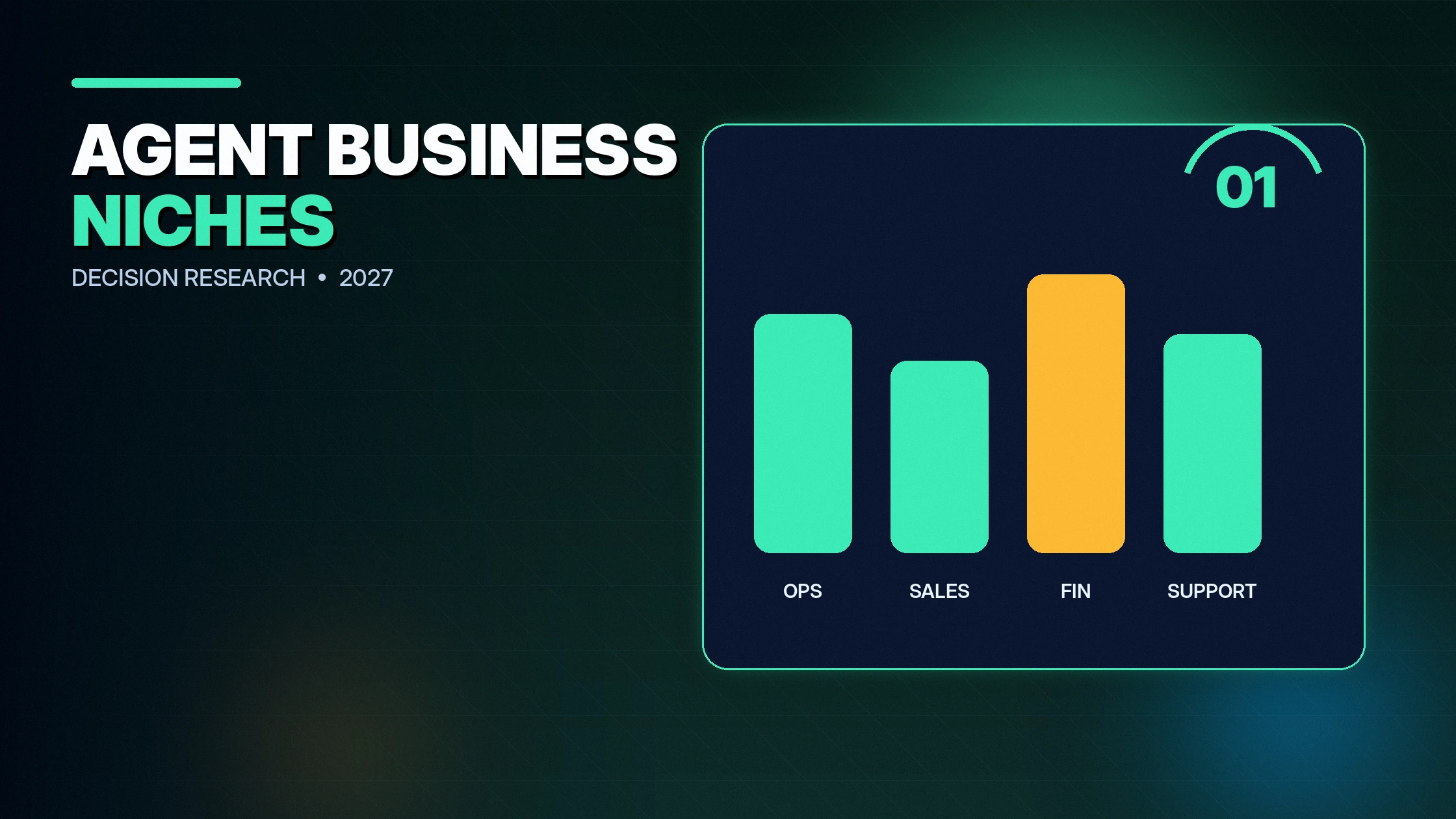
The best AI-agent business niche is not the one with the most hype. It is the one where a specific buyer has a repeated problem, usable data, a measurable result and enough budget to support ongoing operation. DN scores 15 niches on commercial and operational factors. The scores are an editorial decision aid, not measured market demand.
DN Evidence Block
Reviewed: 16 November 2026 · Evidence type: current product capabilities, known workflow structures and DN’s transparent scoring model.
Not established: DN did not obtain representative revenue, win-rate or market-size data for every niche. “Open” and “crowded” are relative editorial assessments. A strong niche still fails without distribution, domain knowledge and reliable delivery.
How the Scoring Works
Each niche receives five scores from 1 to 5:
- Buyer pain: frequency and consequence of the problem.
- Willingness to pay: whether a buyer can connect the workflow to time, revenue, risk or compliance.
- Evaluation clarity: whether success can be checked on representative cases.
- Data access: whether the agent can legally and practically obtain the required context.
- Delivery risk: a reverse score; 5 means lower regulatory, security and support risk.
The maximum is 25. The scoring model favors useful, bounded work over impressive demos. It should be combined with the Agent Specialization Threshold and the Verifiability Gradient.
| Rank | Niche | Pain | Pay | Eval | Data | Risk | Total |
|---|---|---|---|---|---|---|---|
| 1 | Customer-support triage and draft resolution | 5 | 4 | 5 | 4 | 4 | 22 |
| 2 | Accounts-receivable follow-up and exception routing | 5 | 5 | 5 | 4 | 3 | 22 |
| 3 | Field-service intake and scheduling preparation | 5 | 4 | 5 | 4 | 4 | 22 |
| 4 | Sales-call research, qualification and CRM hygiene | 4 | 5 | 4 | 4 | 4 | 21 |
| 5 | Procurement quote comparison and renewal tracking | 4 | 5 | 4 | 4 | 4 | 21 |
| 6 | Bookkeeping preparation and missing-document chasing | 5 | 4 | 5 | 4 | 2 | 20 |
| 7 | Property-management enquiry and maintenance coordination | 5 | 4 | 4 | 4 | 3 | 20 |
| 8 | Proposal, statement-of-work and client-report preparation | 4 | 4 | 4 | 5 | 3 | 20 |
| 9 | Compliance evidence collection and policy mapping | 5 | 5 | 4 | 3 | 2 | 19 |
| 10 | E-commerce catalogue and support operations | 4 | 4 | 4 | 4 | 3 | 19 |
| 11 | Crypto-community support and documentation assistant | 4 | 3 | 4 | 4 | 3 | 18 |
| 12 | Tax-document preparation and transaction reconciliation | 5 | 5 | 4 | 3 | 1 | 18 |
| 13 | Content repurposing and distribution operations | 3 | 3 | 3 | 5 | 4 | 18 |
| 14 | Recruitment screening and interview preparation | 4 | 4 | 3 | 3 | 1 | 15 |
| 15 | Autonomous trading or portfolio management for clients | 5 | 5 | 2 | 3 | 0 | 15 |
1. Customer-Support Triage and Draft Resolution
This niche works because the workflow is frequent, examples already exist, and the first deployment can remain in draft mode. A useful agent classifies the issue, retrieves approved documentation, drafts a response, records evidence and routes unresolved cases to the right person.
Good first offer: reduce the untriaged queue and response-preparation time without allowing the agent to issue refunds or promises. Common failure: measuring ticket closure instead of genuine resolution. DN’s True Resolution Index explains the distinction.
2. Accounts-Receivable Follow-Up
The agent can identify overdue invoices, classify dispute state, draft reminders, prepare account histories and escalate broken promises. The economic outcome is observable: days outstanding, manual touches and disputed balances.
Good first offer: prepare follow-up and internal exception records. Do not automate first: changing payment terms, threatening collection or making legal statements.
3. Field-Service Intake and Scheduling Preparation
HVAC, maintenance, plumbing and repair businesses receive unstructured requests through calls, forms and messages. An agent can collect missing details, classify urgency, identify the asset or site and prepare a scheduling recommendation.
The niche is attractive because the process is operational and local rather than purely digital. It still needs safety escalation: gas, electrical, flooding or medical risk must not be handled as routine booking.
4. Sales Research, Qualification and CRM Hygiene
An agent can research an account, map likely needs, summarize prior contact, enrich the CRM and prepare a call brief. Buyers pay when the work reduces preparation time and improves sales focus. The offer becomes weak when it promises pipeline without controlling list quality, deliverability or sales execution.
Do not confuse activity with outcomes. Track accepted opportunities, response quality and conversion by source, not just emails produced.
5. Procurement Quote Comparison and Renewal Tracking
Small and mid-sized businesses often renew software, insurance, telecoms or suppliers without a structured record. An agent can normalize quotes, flag changed terms, record renewal dates and prepare questions for the buyer.
The buyer retains decision authority. The agent should not treat the cheapest price as best without comparing service scope, cancellation, warranty, implementation and switching cost. DN’s Agentic Procurement Benchmark provides a deeper framework.
6. Bookkeeping Preparation
The agent can chase missing receipts, classify documents, identify duplicates, reconcile obvious references and prepare an exception queue. It should not invent account codes or declare tax treatment when evidence is missing.
This niche has strong evaluation potential because the output can be checked against a closed ledger. It also has privacy, retention and professional-responsibility risk. Position the service as preparation and exception management, not unsupervised accounting advice.
7. Property-Management Operations
Property managers coordinate tenants, owners, contractors, renewals, inspections and maintenance. An agent can route enquiries, prepare notices, gather evidence and keep follow-up records. The buyer value comes from response speed and fewer lost handoffs.
Local law and contractual authority matter. Do not allow an agent to issue a legal notice or commit owner funds merely because it can draft the document.
8. Proposal and Client-Reporting Preparation
Agencies and consultancies repeat the same research, scope, reporting and formatting work. An agent can assemble approved facts, calculate standard metrics and prepare a draft. This is easy to sell when the provider already knows the domain and has strong templates.
The risk is commoditization. The agent should automate preparation, not the judgment clients hired the firm to provide.
9. Compliance Evidence Collection
An agent can map a policy requirement to existing records, identify missing evidence and prepare a review package. Buyers value reduced preparation time, but the agent must distinguish “document present” from “control effective.”
This niche requires explicit disclaimers, versioned sources and qualified human sign-off. It is not suitable for a generalist selling instant compliance.
10. E-Commerce Catalogue and Support Operations
Agents can clean titles, map attributes, identify missing images, draft support responses and monitor order exceptions. The workflow is data-rich and measurable. Platform terms, consumer rights, merchant identity and product-claim accuracy remain the seller’s responsibility.
11. Crypto-Community Support
Projects need documentation search, scam warnings, status communication and routing across Discord, Telegram and support systems. A grounded agent can reduce repeated questions. It should refuse price predictions, private-key requests and individualized trading instructions.
The niche is commercially relevant to DN’s audience, but it has impersonation and regulatory risk. Strong identity and escalation controls are mandatory.
12. Tax-Document Preparation
An agent can collect exports, identify missing wallets or exchanges, map transaction records and prepare an unresolved-event queue. It should not make final tax classifications without the appropriate professional and jurisdictional context.
This is valuable because record preparation is expensive. It is risky because an error can affect a filing. Keep original records, source timestamps and human review.
13. Content Repurposing
Turning a webinar into clips, posts, summaries and a newsletter is easy to demonstrate and crowded to sell. The niche improves when the seller owns distribution knowledge, a vertical audience or measurable editorial standards.
Do not promise that volume creates attention. Track qualified traffic, subscribers and downstream action.
14. Recruitment Screening
An agent can schedule, summarize job-related evidence and prepare structured interview questions. Automated ranking or rejection introduces discrimination, accessibility and privacy risk. Use it for administration and consistency before using it for decisions.
15. Client-Facing Trading or Portfolio Management
The buyer pain and willingness to pay are high, but so are licensing, suitability, custody, market and liability risks. This is not a sensible beginner niche. Building a research or journaling tool is materially safer than taking discretionary control of client capital.
DN Niche Fit Scorer
Score a niche you understand. Higher scores indicate a better candidate for validation, not guaranteed demand.
How Distribution Changes the Ranking
A lower-scoring niche can outperform a higher-scoring niche when the founder already has trusted access to buyers. A property manager with ten years of landlord relationships may be better positioned than a generalist targeting “customer support,” even if support has stronger average economics. Add a sixth, founder-specific score:
- Can you reach ten buyers without paid advertising?
- Do you understand their terminology and exceptions?
- Can you obtain representative data legally?
- Do you have a reason they should trust you with the workflow?
Distribution is not a substitute for product quality, but it determines how cheaply the seller can validate the niche.
Three Offer Designs
Low-Risk Starter Offer: Readiness Audit
Map the process, identify inputs, permissions and failure modes, and deliver a recommendation without deploying an agent. This is appropriate when the buyer’s data is sensitive or the workflow is poorly documented. The audit can be a paid discovery product rather than free presales work.
Measured Pilot: Draft or Shadow Mode
Run the agent against real work without external side effects. Compare its proposed outputs with the human’s actions. This is the strongest general first offer because it produces evidence while limiting risk.
Managed Workflow: Bounded Production
Operate a tested process with monitoring, human escalation and a recurring fee. The seller owns updates, incident response and reporting. This offer should be reserved for a workflow that has passed a representative pilot.
Pricing by Operating Model
| Model | Good use | Pricing logic | Risk |
|---|---|---|---|
| Fixed project | Audit, prototype or bounded implementation | Scope and deliverables | Unlimited revisions destroy margin |
| Setup + recurring | Managed workflow | Implementation plus monthly operation/support | Recurring fee omits usage or exceptions |
| Usage-based | High-volume standardized workflow | Per accepted case or volume band | Incentive to count low-quality activity |
| Outcome-linked | Clearly attributable savings/revenue | Share of verified outcome | Attribution disputes and regulatory exposure |
For early services, setup plus recurring operation is usually clearer than an outcome-share promise. Outcome-linked fees should be used only when the outcome, baseline, attribution and legal structure are defensible.
Niche-Specific Evidence Requirements
- Support: labelled tickets, correct resolution and customer recontact.
- Receivables: invoices, payment state and dispute reasons.
- Field service: urgency, asset/site and safety escalation.
- Sales: accepted opportunities and downstream conversion, not messages generated.
- Procurement: quote scope, switching cost and final accepted contract.
- Bookkeeping: source document, account treatment and reconciliation status.
- Tax/compliance: primary authority, source date, reviewer and unresolved questions.
- Trading: pre-written strategy, costs, risk, execution and complete outcome record.
Regional and Language Opportunity
Generic English-language workflows are crowded. Local language, payment, tax and regulatory context can create a defensible niche, especially in African and other under-served markets. But local context is not a marketing label. The provider must test language quality, date the legal source, support local payment rails and understand data-protection obligations.
DN’s Multilingual Agent Gap Index explains why translation quality alone is not enough.
The Proof Pack for Each Niche
A strong niche page or sales offer should include:
- one real process map;
- a representative test set;
- a baseline cost or failure measure;
- a permission and data map;
- a labelled worked example;
- an incident and revocation path;
- a clear “who should not use this” section;
- a dated list of platform dependencies.
This standard prevents the niche ranking from becoming a generic list of AI ideas.
When Two Niches Should Become One Product
Merge niches only when the same data, permissions, buyer and acceptance test apply. Support triage and CRM hygiene may share some integrations but serve different owners and outcomes. Bookkeeping preparation and tax-document preparation share records but have different professional boundaries. Keep the product narrow until evidence shows that a broader bundle improves delivery rather than simply increasing scope.
When to Walk Away
- The buyer wants an agent to approve high-impact actions without oversight.
- The data source is unlicensed, inaccessible or unreliable.
- The workflow changes materially for every customer.
- The buyer’s expected savings are lower than the support burden.
- The niche requires credentials or professional authorization you do not have.
- The offer depends on claims you cannot substantiate.
How to Validate the Top Three
Do not choose a niche from the table alone. For each candidate:
- Interview five process owners.
- Collect at least 20 representative cases.
- Write the current workflow and its failure points.
- Estimate the full monthly cost of the current process.
- Build a read-only or draft-mode prototype.
- Measure success against pre-agreed cases.
- Ask whether the buyer will pay for a limited pilot.
The winner is the niche that produces evidence and access, not the niche with the highest theoretical score.
Who Should Avoid the “AI Agency” Route
- People looking for a product that needs no sales, support or maintenance.
- Builders without domain access who plan to learn the customer’s regulated workflow after deployment.
- Operators who cannot protect credentials and customer data.
- Anyone whose differentiation is only a generic model or prompt.
- Anyone relying on guaranteed income claims to close a sale.
Frequently Asked Questions
Is the highest-scoring niche always the best?
No. Founder access, credibility and distribution can outweigh a few points in the framework.
Should I specialize by industry or workflow?
Start with a workflow inside an industry you can access. Specialization improves source quality, evaluation and sales language.
Are regulated niches off-limits?
No, but they require qualified oversight, tighter scope and stronger evidence. They are poor beginner choices.
How do I know whether a niche is saturated?
Search for competing offers, interview buyers about existing tools, and determine whether the unmet problem is distribution, integration, reliability or domain fit.
Methodology and Limitations
DN assigned editorial scores using the definitions above. They are not based on representative survey data and should not be interpreted as market-size forecasts. Scores can change by country, buyer size and implementation. Validate demand directly before investing.
Affiliate disclosure: DN may earn from selected tools used to build these services, including Make, Taskade, Chatbase, and Fireflies. The niche scores do not depend on affiliate availability.
Primary Sources
- OpenAI — Agent orchestration and specialist workflows
- OpenAI — Safety in building agents
- NIST — Generative AI Risk Management Profile
- Taskade — Agent playbook
- Make — Current automation plans
- Chatbase — Current agent plans
Related DN Research
- How to Build an AI Agent Business in 30 Days
- 50 Small-Business Processes Ranked for AI Agents
- The Agent Specialization Threshold
About the Author