What Matters
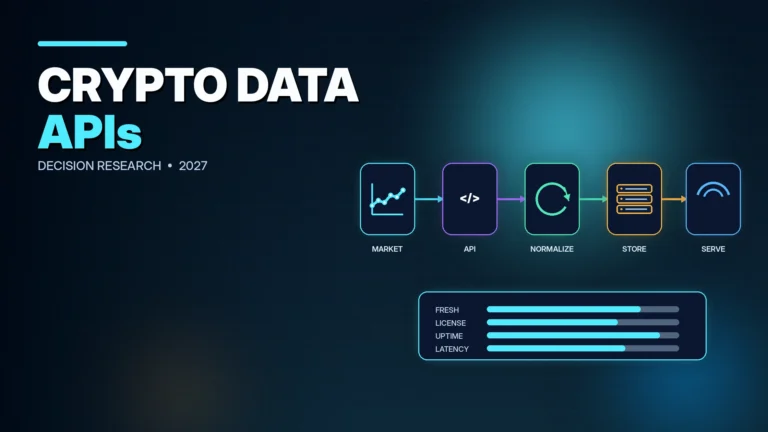
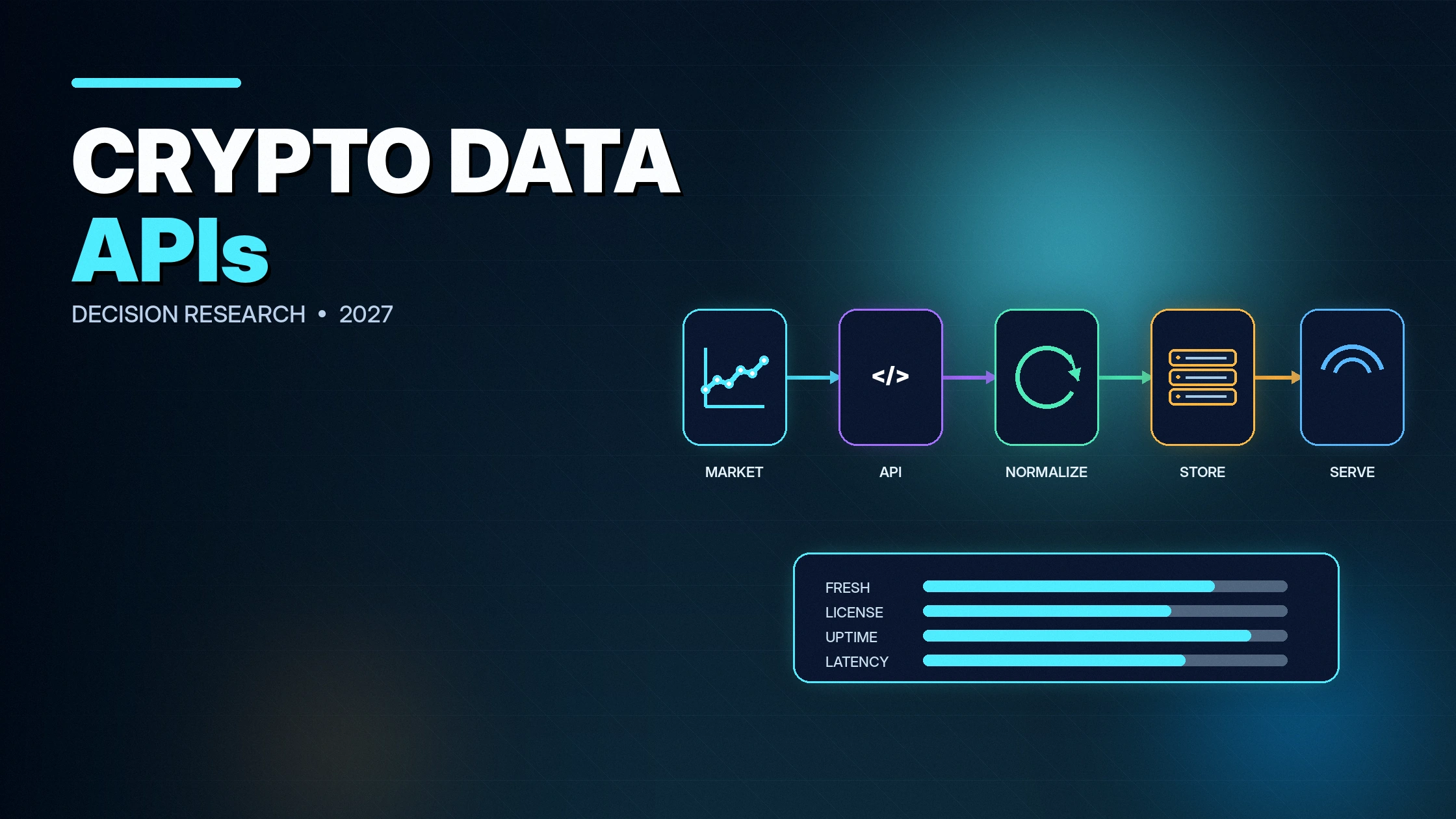
The right crypto API depends on the data model, licence and failure budget — not the largest free allowance. Market prices, exchange books, wallet balances, decoded transactions, protocol metrics and custom SQL are different products. This comparison separates permanent free tiers from time-limited trials and low-cost paid entry points.
DN Evidence Block
Reviewed: 16 November 2026 · Evidence type: current official pricing, terms and API documentation.
Scope: twelve general crypto/onchain data routes suitable for prototypes or low-cost agent workflows. Exchange-specific public APIs are not comprehensively ranked. Plans, limits and commercial rights can change.
Important: “Free” does not always include commercial use. CoinStats’ free API plan, for example, requires attribution and excludes commercial use, while CoinMarketCap’s free Basic tier currently includes limited commercial rights.
Quick Comparison
| Provider | Best for | Entry access reviewed | Commercial-use warning |
|---|---|---|---|
| CoinGecko | Market, metadata, exchange and onchain/DEX data | Free Demo: 10,000 calls/month, 100/min; paid from $35 monthly | Free requires attribution; commercial licence begins on paid plan |
| CoinMarketCap | Market, CEX/DEX and reference data | Free Basic: 15,000 credits/month; keyless subset also available | Free Basic currently includes limited commercial use |
| CoinStats | Market + wallet + exchange portfolio + DeFi aggregation | Free: 20,000 credits/month, 2 requests/sec | Free terms prohibit commercial use and require attribution |
| DefiLlama | TVL, fees, revenue, yields and DeFi protocol data | Many keyless free endpoints; Pro/MCP API plan, premium listed $300/month | Endpoint availability differs; yield endpoints moved to paid in Nov 2026 |
| The Graph | Querying indexed onchain application data via subgraphs | 100,000 free monthly queries; then usage pricing | Subgraph-specific data and schema quality vary |
| Etherscan | Explorer/reference data across supported chains | Free: 3 calls/sec, up to 100,000/day, attribution | Selected chains/endpoints; check licence and attribution |
| Alchemy | RPC, enhanced APIs, webhooks and app infrastructure | Free: 30M compute units/month, 25 requests/sec | Compute-unit cost varies by method |
| QuickNode | RPC and chain-specific infrastructure | One-month free trial: 10M credits, 15 requests/sec | Trial is not a permanent free tier |
| GoldRush | Decoded wallet, transaction, token, NFT and DEX data | 14-day trial 25,000 credits; Vibe Coding $10/month | Trial not for production; credit costs vary |
| Dune | Custom SQL analytics across 100+ chains | Free view-only; 7-day paid-feature trial; Analyst $65/month | Ongoing API/query execution needs paid access |
| Bitquery | Real-time GraphQL/REST and blockchain streams | 7-day trial; paid personal/pro plans | Personal plan restricts commercial use; history/streams vary |
| Moralis | Wallet, token, NFT, DeFi APIs, streams and data feeds | No ongoing legacy free plan after 1 Sep 2026; Data Feeds from $10, API plans from $149; trials by request | Do not rely on outdated articles describing a permanent free tier |
1. CoinGecko
CoinGecko is the broadest low-friction starting point for token prices, market caps, historical charts, metadata, exchanges and GeckoTerminal onchain DEX data. The current Demo plan gives 10,000 monthly calls and 100 calls per minute. Paid plans begin at $35 monthly and add credits, freshness, history and commercial licensing.
Use it when: an agent needs general market reference data or a public MCP route. Watch: attribution, price methodology, data age and whether the endpoint is suitable for execution rather than research.
2. CoinMarketCap
CoinMarketCap’s free Basic plan currently provides 15,000 monthly call credits and dozens of endpoints; the pricing page says the free plan includes limited commercial use. A keyless public subset is also available for quick prototypes.
Use it when: market rankings, listings and standardized CEX/DEX reference data fit the application. Watch: credit weights, history limits and restrictions on redistributing data as a standalone service.
3. CoinStats
CoinStats combines market data with wallet balances, exchange accounts, portfolios and DeFi positions. The free tier offers 20,000 credits a month at two requests per second. Endpoint cost ranges from a few credits for simple market calls to hundreds for complex DeFi aggregation.
Use it when: the agent needs personal portfolio or wallet context. Watch: the free plan’s terms say no commercial use, community support only and mandatory attribution. Querying all networks can consume substantially more credits than named chains.
4. DefiLlama
DefiLlama is a strong source for protocol-level TVL, fees, revenue, stablecoins, bridges and DeFi categories. Many endpoints remain free and keyless. The current docs say the MCP server requires an API plan, and free yield endpoints were retired on 13 November 2026.
Use it when: the research question concerns protocols and sector structure. Watch: metric definitions, chain/protocol attribution and endpoint changes. Cache responsibly instead of polling every dataset.
5. The Graph
The Graph lets applications query indexed blockchain data through subgraphs. Subgraph Studio currently includes 100,000 free monthly queries; additional queries are priced on a usage basis.
Use it when: a known subgraph exposes the exact entities and events your agent needs. Watch: each subgraph has its own schema, indexing status and maintainers. “The Graph” does not guarantee that a particular subgraph is complete or current.
6. Etherscan
Etherscan’s free API plan currently lists three calls per second and up to 100,000 calls per day, with attribution and selected-chain/community endpoints. It is useful for account, contract and transaction reference workflows.
Use it when: an agent needs explorer-style facts on supported chains. Watch: chain coverage, endpoint availability and the distinction between explorer indexing and direct node/RPC state.
7. Alchemy
Alchemy provides RPC access, enhanced blockchain APIs, webhooks and developer infrastructure. Its free tier currently includes 30 million compute units a month, 25 requests per second, five apps and five webhooks.
Use it when: the agent needs chain access, webhooks or application infrastructure rather than only aggregated market data. Watch: “one request” is not one cost unit; expensive methods can consume more compute units.
8. QuickNode
QuickNode offers RPC and chain-specific services. The current free access is a one-month trial with 10 million credits and 15 requests per second, not a permanent free tier.
Use it when: testing RPC or specialized chain services. Watch: the transition from trial to paid, chain/add-on pricing and application dependence on provider-specific endpoints.
9. GoldRush
GoldRush provides decoded balances, transactions, approvals, token, NFT and DEX/protocol data across more than 100 chains. It offers a 14-day trial with 25,000 credits and a $10-per-month Vibe Coding tier aimed at agents and small builders. An x402 route supports pay-per-request access.
Use it when: normalized multi-chain wallet/application data is more useful than raw RPC. Watch: credit weights, production suitability and spend controls for autonomous x402 calls.
10. Dune
Dune provides raw, decoded and curated blockchain tables queried with DuneSQL across more than 100 chains. Viewing public dashboards remains free, but current pricing says free accounts are view-only; query execution and ongoing API use require a trial or paid plan. Analyst is listed at $65 a month.
Use it when: the agent needs custom analytical queries rather than fixed endpoints. Watch: query credits, freshness, SQL correctness and whether a dashboard result can be reused under the data terms.
11. Bitquery
Bitquery provides GraphQL/REST and real-time streams for onchain and DEX data. It currently offers a seven-day free trial and paid self-service plans; streaming starts above the personal API-only tier.
Use it when: real-time trades, mempool or structured streams are central. Watch: request points, historical add-ons, personal/commercial licensing and stream-minute costs.
12. Moralis
Moralis combines wallet, token, NFT, DeFi, streams, RPC and data feeds. Legacy free plans stopped serving usage on 1 September 2026. Current pricing starts at $10 a month for Data Feeds, while full API plans begin much higher, with trials available by request.
Use it when: the data model and managed streams justify the paid entry point. Watch: outdated comparisons that still claim a permanent free API tier.
Market Data, Chain Data and Analytics Are Different
A price API aggregates venues and applies a methodology. An RPC endpoint exposes chain state. A decoded data API transforms transactions into higher-level records. A SQL analytics platform lets the user define the query. Agents need the correct layer:
- Market data: price, volume, market cap, exchange and instrument metadata.
- RPC: blocks, logs, calls, receipts and raw chain state.
- Indexed application data: protocol-specific entities and events.
- Decoded wallet data: balances, transfers, approvals and positions.
- Analytics: joins, cohorts, labels and derived metrics.
Using a market API to answer a protocol-state question or raw RPC to build a portfolio can create unnecessary cost and error.
Reliability Test
Before choosing a provider, run a seven-day test using representative calls:
- Record HTTP status, latency, response size and source timestamp.
- Compare critical values with an independent source.
- Test rate limiting and retry headers.
- Test chain reorganization or late-indexing behaviour where relevant.
- Send invalid identifiers and inspect error clarity.
- Measure null/missing-field rates.
- Track usage credits exactly as the provider counts them.
Publish p50/p95 latency and error rate separately. A fast 404 or stale response is not successful data delivery.
Identifier Quality
Symbols are not unique. Use provider IDs for market assets and chain + contract address for tokens. Preserve decimals and native/quote currency. For wallets and contracts, normalize checksum or chain-specific encoding without changing the underlying identifier.
An agent should not infer that two assets are the same because both use “USDT” or “BTC.” Wrapped, bridged and synthetic assets can have different risk and pricing.
Historical Data Questions
- How far back does the plan include?
- Is history daily, hourly, minute or tick?
- Does the provider revise historical values?
- How are delisted assets handled?
- Are prices aggregated or venue-specific?
- Does the timestamp represent trade, block, observation or ingestion time?
- Can the query be reproduced after a plan change?
Backtests should store the dataset version or retrieval time. A provider may improve or revise history, changing a result later.
Commercial and Redistribution Rights
| Use | Question |
|---|---|
| Internal research | Does the plan permit business/internal use? |
| Customer-facing dashboard | Is display allowed and is attribution required? |
| Agent output | Can derived summaries be delivered to customers? |
| Data export | Can users download provider-derived records? |
| Your own API | Is raw or lightly transformed redistribution prohibited? |
| Model training | Do terms allow storage or training use? |
Do not assume that an API key authorizes every downstream use. Keep a licence note in the source registry.
Provenance Schema for Agent Results
{
  "provider": "example",
  "endpoint": "/path",
  "plan": "free|paid|trial",
  "request_id": "safe-id",
  "asset_or_chain_id": "provider-or-contract-id",
  "requested_at": "ISO-8601",
  "observed_at": "ISO-8601-or-null",
  "units": "USD|token|count|percent",
  "result_status": "success|partial|error",
  "licence_note": "internal-use|attribution|commercial",
  "cache_age_seconds": 0
}
This metadata should travel with a decision record. It is especially important when several providers are blended.
Cost Model
Estimate:
Monthly API cost = scheduled calls + user-driven calls + retries + background refresh + development/staging + overage + paid add-ons.
Then divide by accepted outcomes, not raw calls. A portfolio endpoint costing 400 credits may be cheaper than hundreds of chain-specific requests and custom maintenance.
Batching and Caching
- Batch assets and wallets where the endpoint supports it.
- Cache metadata longer than prices.
- Use event/webhook updates instead of polling when available.
- Separate hot and cold historical data.
- Do not cache account balances beyond the decision’s maximum age.
- Respect provider cache and redistribution terms.
- Use request coalescing so concurrent agent runs do not fetch the same data repeatedly.
Provider Switching
Abstract the application’s internal schema from provider-specific fields. Keep adapter tests with known fixtures. When switching:
- run providers in parallel on representative queries;
- compare identifiers, units, timestamps and missing fields;
- investigate differences rather than averaging blindly;
- update provenance and licensing;
- re-run downstream evals and backtests;
- retain rollback until the new source is stable.
Agent Safety Controls
- Allowlist endpoints and parameters.
- Cap calls, credits and spend per run/day.
- Reject queries outside permitted chains/assets.
- Validate response schema and units.
- Do not turn missing data into zero.
- Separate data tools from action tools.
- Alert on quota exhaustion and unexplained cost spikes.
- Disable a provider after repeated stale or malformed results.
When Two Providers Are Better Than One
Use a second provider when the consequence of a bad value justifies verification, when one source supplies market data and another chain state, or when continuity matters during outages. Do not use two providers merely to choose the value you prefer. Define deviation thresholds and what happens when sources disagree.
What to Publish in an API Comparison
A trustworthy page includes the review date, exact plan, free-vs-trial label, commercial rights, rate/credit model, history, supported data, update frequency, test method and unresolved questions. Avoid copying outdated plan tables. Moralis’ retired legacy free tier and DefiLlama’s November 2026 yield-endpoint change show why dates matter.
Choose by Data Model
| Need | Start with | Why |
|---|---|---|
| General token/market data | CoinGecko or CoinMarketCap | Broad coverage and easy prototype access |
| Wallet and portfolio aggregation | CoinStats or GoldRush | Normalized balances and positions |
| DeFi protocol metrics | DefiLlama | Protocol and category datasets |
| Custom historical onchain analysis | Dune | SQL over decoded tables |
| App-specific indexed entities | The Graph | Subgraph schemas |
| RPC and webhooks | Alchemy or QuickNode | Node/infrastructure layer |
| Explorer facts | Etherscan | Account, transaction and contract reference |
| Real-time streams | Bitquery | GraphQL/streaming focus |
DN Crypto API Selector
Choose the core requirement. The result suggests a shortlist to test.
API Evaluation Checklist
- Define the exact entity, field, history and freshness required.
- Test five known records against an independent source.
- Measure nulls, reorg handling and identifier consistency.
- Read free-tier and commercial-use terms.
- Calculate endpoint-weighted cost, not calls alone.
- Test 429, timeout and malformed-response handling.
- Cache according to data volatility and terms.
- Keep keys server-side and separate by environment.
- Set quota and spend alerts.
- Record source, endpoint, timestamp and plan version in downstream data.
Worked Cost Example
An agent checks 100 assets every five minutes. A naive design makes one request per asset: 28,800 calls a day. A batched endpoint may return the same data in a few hundred calls. The plan decision therefore depends on batching, cache and endpoint credit weight, not the apparent number of assets.
For wallet/DeFi APIs, one aggregated call may consume dozens or hundreds of credits. Prototype with representative queries and inspect the usage dashboard before projecting cost.
Frequently Asked Questions
Which free API is best?
CoinGecko or CoinMarketCap for general market data; The Graph for a suitable subgraph; Alchemy for RPC. “Best” depends on data and licence.
Can I use free API data commercially?
Sometimes. CoinMarketCap’s current free Basic includes limited commercial use, while CoinStats’ free plan does not. Read the actual terms.
Should an agent query the API directly?
Usually through an application layer that validates inputs, caches, enforces budgets and records provenance.
Is an MCP server better than REST?
It can reduce integration work for AI clients. REST may offer greater control and predictable schemas. Choose by application design.
Methodology and Limitations
DN reviewed official pricing and product pages on 16 November 2026. The comparison is not exhaustive and excludes many exchange-specific APIs. Plan limits, terms and regional prices can change. Test the exact endpoint and read the live licence before production.
Affiliate disclosure: DN may earn from the CoinStats API. The other providers are included without current DN affiliate links. Affiliate status does not affect the data-model or licence assessment.
Primary Sources
- CoinGecko API pricing
- CoinMarketCap API pricing
- CoinStats API
- CoinStats terms
- DefiLlama API docs
- The Graph pricing
- Etherscan API plans
- Alchemy pricing
- QuickNode pricing
- GoldRush pricing
- Dune pricing
- Bitquery pricing
- Moralis pricing
About the Author