What Matters
Institutional AI quants do not win simply because they have a larger model. They operate a different production system. The durable gap is often data licensing, direct connectivity, execution quality, financing, portfolio constraints, independent risk controls, compliance, and the ability to diagnose every order. A retail bot can use the same public model library and still face a completely different result.
DN Evidence Block
Reviewed: 17 November 2026. Primary evidence: SEC market-access controls, FINRA algorithmic-trading supervision materials, CFTC automated-trading risk-control materials, Nasdaq co-location documentation, and current institutional API documentation from major venues.
Boundary: this is a structural comparison, not a claim that every institution outperforms every retail trader. Institutional systems can fail, and a simple retail strategy can outperform a complex one over a chosen period.
The Seven Structural Differences
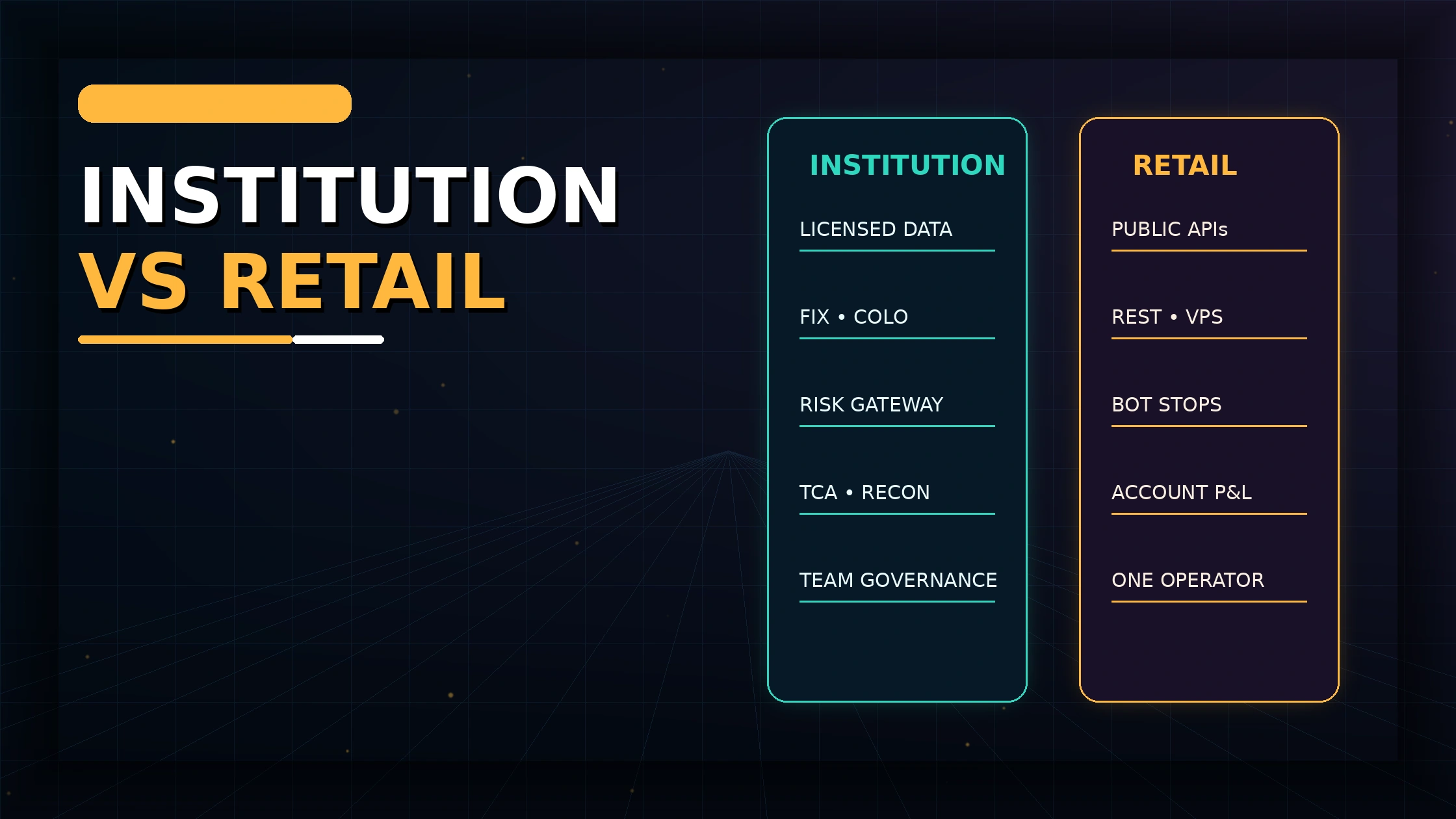
| Dimension | Institutional desk | Typical retail bot | Why it changes the result |
|---|---|---|---|
| 1. Data | Licensed feeds, normalized history, venue metadata, quality controls | Public APIs, exchange candles, third-party dashboards | Timestamp, survivorship and depth errors enter the signal |
| 2. Connectivity | Direct market access, FIX/SBE/UDP, co-location or optimized networks | Internet REST/WebSocket from VPS or home connection | Latency and message reliability affect fills and cancellations |
| 3. Execution | Order-management system, smart routing, queue models, transaction-cost analysis | Single venue and generic market/limit logic | The same signal produces different realized prices |
| 4. Capital | Prime services, credit, collateral optimization, cross-venue inventory | Prefunded accounts and fragmented balances | Capital can be positioned where the opportunity appears |
| 5. Risk controls | Independent pre-trade limits, kill switches, exposure aggregation and surveillance | Bot-level stops and exchange settings | Bad orders are blocked outside the strategy code |
| 6. Research | Versioned pipelines, review, shadow trading, experiment logs and attribution | Backtest plus live account | Teams know whether signal, execution or operations failed |
| 7. Governance | Roles, approvals, incident response, compliance and audit records | One operator holds keys, code and decision authority | Separation reduces uncontrolled changes and hidden risk |
1. Data Is an Operating Asset
Institutional data work begins before model training. Feeds are licensed, mapped to instruments, timestamped, validated and reconciled. Corporate actions, symbol changes, contract rolls, delistings, funding events and venue outages require explicit treatment. In crypto, an exchange candle can hide order-book state, partial outages and trade corrections.
Retail researchers often download a clean dataframe and assume each row represents the information available at that time. The real questions are whether the asset existed in the sample, whether the API revised history, whether missing intervals were filled, and whether the label uses a price that could actually be traded.
What a retail team can copy
- Store raw source responses before cleaning.
- Record exchange, endpoint, retrieval time and event time.
- Version symbol mappings and contract specifications.
- Keep delisted and failed assets in historical samples.
- Run duplicate, gap and timestamp checks automatically.
2. Connectivity and Market Access
Nasdaq markets co-location as a way to reduce latency and network complexity, with direct access to market data and order entry. Crypto venues increasingly expose REST, WebSocket and FIX interfaces, while some institutional products add binary market-data protocols. Coinbase Derivatives documents REST, FIX, SBE and UDP APIs; Kraken advertises REST, WebSocket and FIX access for institutional and algorithmic workflows.
Latency only matters when the strategy’s edge decays faster than the communication path. A daily rebalance gains little from microseconds. A queue-sensitive market-making or arbitrage strategy can lose its apparent edge before a retail cloud request is acknowledged.
The correct metric is not server ping alone. Measure decision-to-send, network transit, venue acknowledgment, queue position, fill time, cancel latency and the frequency of unknown order states.
3. Execution Turns Forecasts Into P and L
An institutional execution stack separates signal generation from order management. It can choose venue, order type, participation rate, urgency, child-order schedule and inventory hedge. It also measures implementation shortfall against the price available when the decision was made.
A retail bot that buys with a market order may correctly predict direction and still lose through spread, fees and price impact. A limit order can avoid immediate spread but introduces non-fill and adverse-selection risk. Execution is a decision problem of its own.
Minimum retail execution record
- decision timestamp and reference price;
- order-send and acknowledgment timestamps;
- requested and filled quantity;
- average fill and fees;
- cancel and replace events;
- position before and after;
- market state and spread at the decision;
- reason for any rejected or missing order.
4. Capital and Inventory
Many opportunities require balances on several venues, margin arrangements or the ability to hedge quickly. Institutions can maintain inventory, credit lines and collateral processes that reduce transfer delay. Retail traders usually prefund accounts, which creates idle capital and counterparty exposure.
More capital is not automatically an advantage. Larger orders create market impact and capacity limits. The structural advantage is the ability to allocate and finance capital with a documented risk process, not simply account size.
5. Independent Risk Controls
SEC Rule 15c3-5 requires broker-dealers with market access to maintain financial and regulatory risk controls designed to prevent orders that exceed credit or capital thresholds and to reject erroneous price or size. The controls remain under the broker-dealer’s direct and exclusive control. CFTC materials likewise discuss maximum order size, message-rate limits, circuit breakers, execution throttles and volatility alerts.
The lesson for crypto is architectural: the strategy should not be able to rewrite its own hard limits. Daily loss, gross exposure, order size, message rate, allowed symbols, withdrawal permissions and kill switches should sit outside the model.
DN Rule
A stop loss inside the same process that can malfunction is not an independent risk control. Put critical limits at the exchange, account, gateway or separate supervisory service.
6. Research and Model Governance
Institutional research processes distinguish idea, dataset, feature pipeline, model version, portfolio rule, execution rule and production release. Changes are reviewed and can be rolled back. A strategy may run in shadow mode before it can send orders.
Retail bots often collapse these layers into one script. That makes iteration fast but attribution weak. When performance changes, the operator may not know whether the cause was the signal, a library update, an exchange API change, a fee change or an execution bug.
7. Compliance, Operations and Accountability
Regulated firms maintain supervisory procedures, restricted lists, surveillance, access controls and post-trade reporting. These obligations create cost, but also force evidence and separation of duties. Retail users retain responsibility for exchange terms, tax, market conduct and local law even when a third-party bot places the order.
An institutional-looking interface does not transfer accountability. Read the platform agreement, identify the legal entity, confirm regional access and understand who bears loss from an erroneous order.
DN Structural Trading Gap Test
Score a retail or small-team system against seven production layers.
What Retail Traders Can Realistically Replicate
- Clean data lineage and time-based evaluation.
- Dedicated exchange sub-accounts with withdrawals disabled.
- Independent account and order limits.
- End-to-end logging and reconciliation.
- Paper, shadow and small-capital release stages.
- Simple transaction-cost analysis.
- Versioned code, configuration and model artifacts.
What Is Harder to Replicate
- Licensed full-depth historical feeds across venues.
- Co-location and direct market connectivity.
- Prime credit and cross-venue balance-sheet efficiency.
- Large operational teams and 24/7 supervision.
- Negotiated fees and specialized market access.
- Capacity to internalize or hedge order flow.
Worked Example
A retail model identifies a 12-basis-point price gap between two exchanges. It assumes simultaneous fills. In production, one order fills, the hedge is acknowledged 180 milliseconds later, the price moves 9 basis points, and fees consume another 8. The research signal was not necessarily false; the implementation assumed an institutional execution environment that did not exist.
A better system estimates fill probability and hedge latency, requires a minimum net spread after all costs, caps unhedged inventory and records both legs under one strategy identifier.
Who This Is For
- Retail quants deciding where engineering effort matters most.
- Teams moving from notebooks to production trading.
- Investors evaluating claims that a bot has institutional technology.
- Risk managers comparing signal quality with operating quality.
Who Should Avoid It
- Users looking for a shortcut to institutional returns.
- Teams without permission to use the data or market access described.
- Operators who cannot enforce limits outside the strategy.
- Anyone who treats leverage as a substitute for infrastructure.
Methodology and Limitations
DN compared institutional and retail systems across data, connectivity, execution, capital, risk, research and governance. The comparison describes common structural differences, not every firm or trader. We did not benchmark a named institution against a named retail platform.
Frequently Asked Questions
Do institutions always have faster execution?
No, but firms that purchase direct connectivity and co-location can reduce latency. The value depends on the strategy horizon.
Can a retail trader use FIX?
Some crypto venues provide FIX to qualifying clients. Access, limits and commercial terms vary.
Is a better model the main institutional advantage?
Often not. Data quality, execution, financing, risk controls and operations can matter more than model complexity.
What is the highest-impact retail improvement?
For many bots, honest execution records and independent risk limits create more value than changing the prediction model.
Can institutional systems fail?
Yes. Complex systems can fail at scale, which is why independent controls, supervision and incident response exist.
Primary Sources
- SEC: Market Access Risk Management Controls
- SEC: Rule 15c3-5 FAQs
- FINRA Regulatory Notice 15-09
- CFTC: Automated Trading Risk Controls
- Nasdaq Co-Location
- Coinbase Derivatives APIs
- Kraken Trading APIs
Commercial disclosure: DN has affiliate relationships with several crypto venues, but none paid for inclusion in this structural comparison. Venue access and features vary by region.
About the Author