What Matters
A crypto trading agent is not one Python package. It is a controlled system for data, decisions, execution, state, testing and reconciliation. Libraries reduce implementation time, but each also creates version, API, security and correctness dependencies. The production question is not which package is most popular. It is which responsibility the package owns and how failure is contained.
DN Evidence Block
Reviewed: 17 November 2026. Primary evidence: official CCXT, web3.py, pandas, NumPy, scikit-learn, PyTorch, Freqtrade and pytest documentation.
Boundary: this guide does not recommend a trading strategy or promise profitability. Package APIs and supported exchanges change. Pin versions, read changelogs and verify every live integration against the venue’s official documentation.
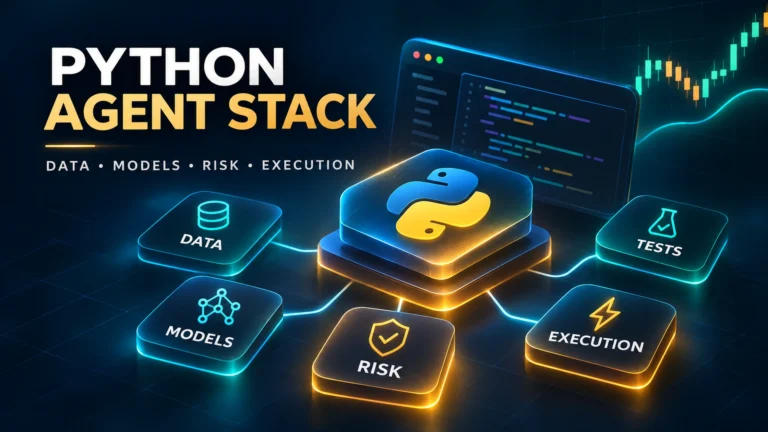
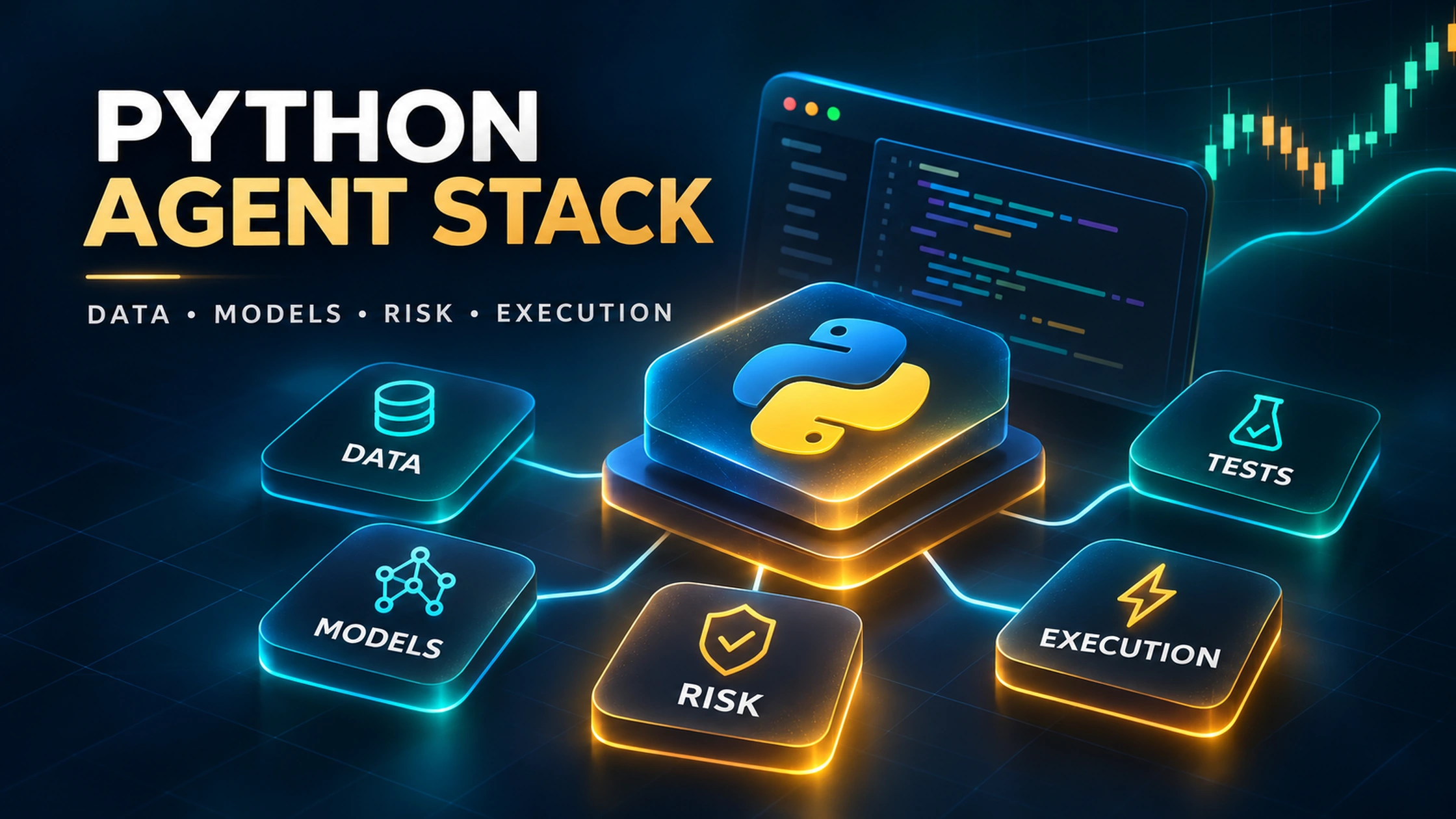
The Eight-Layer Python Stack
| Library or layer | Primary job | Production value | Main risk |
|---|---|---|---|
| 1. CCXT | Unified exchange REST access | Common market, balance and order interfaces | Venue differences hidden by a common API |
| 2. web3.py | EVM data and transactions | Contract calls, events, transaction building and receipts | Key handling, nonce, gas and chain-specific behavior |
| 3. pandas | Time-series tables and joins | Timestamp alignment, resampling and feature pipelines | Silent index and timezone mistakes |
| 4. NumPy | Arrays, numerical operations and simulation | Fast vectorized math and reproducible scenarios | Shape, dtype and numerical-stability errors |
| 5. scikit-learn | Classical machine learning and evaluation | Pipelines, preprocessing, baselines and time-series splits | Leakage and inappropriate random cross-validation |
| 6. PyTorch or TensorFlow | Deep sequence, text or graph models | Custom training and GPU acceleration | Overfitting, nondeterminism and deployment burden |
| 7. Freqtrade | Research and bot framework | Backtesting, dry run, strategy lifecycle and exchange integration | Lookahead bias and false live assumptions |
| 8. pytest | Automated testing | Regression, failure injection and release gates | Testing only happy paths |
1. CCXT: Unified Exchange Access
CCXT exposes a common interface across more than 100 exchange and prediction-market APIs. Its unified methods cover markets, tickers, order books, orders and balances, while exchange-specific methods remain available when the common layer is insufficient. Python supports synchronous and asynchronous modes; WebSocket streaming is part of CCXT Pro.
The abstraction is useful, but it does not make exchanges identical. Symbol formats, precision, order types, margin modes, client-order identifiers, trigger behavior, rate limits and error responses still differ. Load market metadata and inspect exchange capabilities before assuming a method works the same everywhere.
Production checklist
- Pin a CCXT version and record it with every run.
- Call
load_markets()and validate precision and minimums. - Use exchange-specific feature flags instead of guessing support.
- Enable the built-in rate limiter and add application-level throttles.
- Use client order IDs where supported.
- Reconcile open orders and positions after every uncertain response.
- Disable withdrawals on trading API keys.
2. web3.py: On-Chain Data and Execution
web3.py provides Ethereum-compatible RPC access, contract objects, event decoding and transaction workflows. A contract instance can read state or build and send transactions from an ABI and address. The transaction guide distinguishes node-managed sending from signing raw transactions locally.
Execution code must manage chain ID, nonce, gas parameters, receipt status, reorgs and replacement transactions. A transaction hash proves submission, not final success. Read the receipt and verify the resulting contract state before a workflow marks the action complete.
Safer architecture
Keep the strategy process separate from the signer. The model or agent can prepare call data, while a policy service checks contract, method, recipient, amount, slippage and gas. Use a dedicated small-balance account or smart account rather than a savings wallet.
3. pandas: Time-Series Data Engineering
pandas provides timestamp, timezone, resampling, joining, missing-data and table operations. Crypto trades around the clock, so timestamp hygiene is essential. Normalize source time zones to UTC, preserve event time and retrieval time, and never forward-fill a field unless the meaning supports it.
Common errors include joining a daily metric to intraday prices using the final day’s value, sorting strings instead of timestamps, mixing milliseconds and seconds, and dropping missing intervals that represent an exchange outage.
Acceptance tests
- Index is monotonic and unique where expected.
- Timezone is explicit.
- Rows before the decision contain no future publication values.
- Resampling distinguishes empty intervals from zero activity.
- Instrument identifiers survive symbol changes and contract rolls.
4. NumPy: Numerical Core and Simulation
NumPy supplies multidimensional arrays, linear algebra, statistics, random simulation and vectorized operations. It is the numerical foundation beneath much of the Python data and machine-learning ecosystem.
Use explicit random seeds for reproducible research, inspect dtypes, and avoid comparing floating-point values as exact equality. In portfolio or scenario code, test shapes and units. A basis-point value, percentage and decimal return can all look plausible while being off by 100 times.
5. scikit-learn: Baselines, Pipelines and Evaluation
scikit-learn is ideal for transparent baselines and structured pipelines. It combines preprocessing, feature selection, models, calibration and metrics. For trading data, use time-aware splits rather than shuffling observations. Fit scalers and feature selectors only on the training portion.
A simple logistic regression, random forest or gradient-boosted tree should usually precede a deep model. If a complex network cannot outperform a simple baseline on an untouched period after costs, complexity has not earned production authority.
6. PyTorch or TensorFlow: Deep Models
Deep-learning libraries support sequence, text, graph and multimodal models. PyTorch provides tensors, autograd, neural-network modules and CPU or GPU acceleration. TensorFlow offers a broad training and deployment ecosystem. Either can be appropriate; using both in one small system often creates unnecessary duplication.
Record framework version, device, seed, data hash, model configuration and weights. Deep-model outputs should remain inputs to a bounded decision process, not direct permission to trade unrestricted capital.
DN Rule
Do not add deep learning because the strategy needs to look like AI. Add it only when the data and target justify the capacity, and when the team can reproduce, monitor and retire the model.
7. Freqtrade: Strategy Lifecycle and Dry Run
Freqtrade is an open-source trading-bot framework with installation paths, exchange integrations, backtesting, dry-run trading and strategy tooling. Its documentation explicitly includes lookahead analysis because a strategy can accidentally access future candle information in a dataframe.
A framework shortens development, but does not validate the strategy. Use dry run, realistic fees, startup-candle handling, pair-list controls and exchange-specific checks. Keep secrets outside the repository and review updates because exchange APIs evolve.
8. pytest: Tests Before Capital
pytest supports assertions, fixtures, parametrization, temporary files, monkeypatching and exception tests. These features are directly useful for trading agents because external systems fail in repeatable categories.
Test at least:
- stale and missing data;
- rate-limit and timeout responses;
- partial fills and rejected orders;
- duplicate events and retries;
- minimum quantity and precision boundaries;
- incorrect chain or token identifiers;
- expired credentials;
- position mismatch after restart;
- kill-switch activation;
- unknown transaction outcome.
Two Supporting Layers: asyncio and Schemas
Python’s standard asyncio helps coordinate market streams, order updates and timers without blocking one task behind another. Concurrency creates its own hazards: race conditions, shared-state corruption and out-of-order events. Serialize updates to each order and position state.
A schema library can validate configuration, tool arguments and external payloads. Validation rules must reflect exchange and chain semantics, not only data types.
DN Python Stack Builder
Select what the agent must do. The result suggests a minimum stack and the controls to add.
Reference Project Structure
project/pyproject.tomlconfig/data/raw/ and data/processed/src/connectors/, src/features/, src/models/, src/risk/, src/execution/, src/reconciliation/tests/, notebooks/, artifacts/, logs/
The connector layer should not contain strategy rules. The strategy should not store private keys. The risk layer should be able to block execution even when the model says trade. Reconciliation should compare internal state with the venue or chain after each uncertain event.
Worked Build Path
A paper-trading CEX agent can start with CCXT, pandas, NumPy and pytest. Add scikit-learn only when a labelled prediction problem exists. Use Freqtrade if its strategy and dry-run lifecycle match the project. Add asynchronous streams when polling no longer meets the decision horizon. Deep learning is the last addition, not the first.
An on-chain agent replaces or supplements CCXT with web3.py and a signer boundary. It also needs chain-specific simulation, receipt and state checks. The same data-science stack can support research, but transaction safety becomes a separate engineering discipline.
Version and Dependency Control
- Use a project environment and lock dependencies.
- Pin production versions and review updates deliberately.
- Record Python, OS, library and exchange API versions.
- Run tests and dry-run scenarios before deployment.
- Keep a rollback artifact.
- Monitor deprecations and exchange changelogs.
- Scan dependencies and restrict outbound network access where feasible.
Readers who want a hosted development environment can evaluate Replit, but secret handling, uptime and network suitability should be assessed before live trading. A cloud IDE is not automatically a production execution host.
Who This Is For
- Python developers building research and controlled trading systems.
- Quants moving from notebooks to reproducible pipelines.
- Teams auditing which package owns each responsibility.
- Beginners willing to paper trade and test failures first.
Who Should Avoid It
- Anyone seeking a copy-paste profitable bot.
- Users who cannot secure API keys or private keys.
- Teams unwilling to maintain dependencies and exchange changes.
- Projects that cannot reconcile orders, positions and transactions.
Methodology and Limitations
DN selected libraries by role coverage, documentation and common production use. This is not a performance benchmark. Alternatives can be appropriate, and package suitability depends on the project’s chain, venue, latency and governance requirements.
Frequently Asked Questions
Is CCXT enough to build a trading bot?
No. It standardizes exchange access, but you still need data validation, strategy logic, independent risk controls, state, testing and reconciliation.
Should I use web3.py with a private key in code?
No. Keep keys in a dedicated signer or secure secret system and bound what transactions can be authorized.
Do I need PyTorch?
Not unless a deep model materially improves an explicit target over simpler baselines and the team can reproduce and operate it.
What should I test first?
Timeouts, partial fills, duplicates, stale data, precision, rejected orders and restart reconciliation.
Can I run a live bot from a notebook?
A notebook is useful for research, but production requires durable state, monitoring, secrets, restart behavior and controlled releases.
Primary Sources
- CCXT Manual
- web3.py Contracts
- web3.py Transactions
- pandas Time Series Guide
- NumPy Documentation
- scikit-learn Documentation
- PyTorch Documentation
- Freqtrade Documentation
- pytest Documentation
Commercial disclosure: this article contains an affiliate link to Replit. DN may earn compensation if a reader registers through it. Replit did not pay for inclusion or editorial treatment.
About the Author