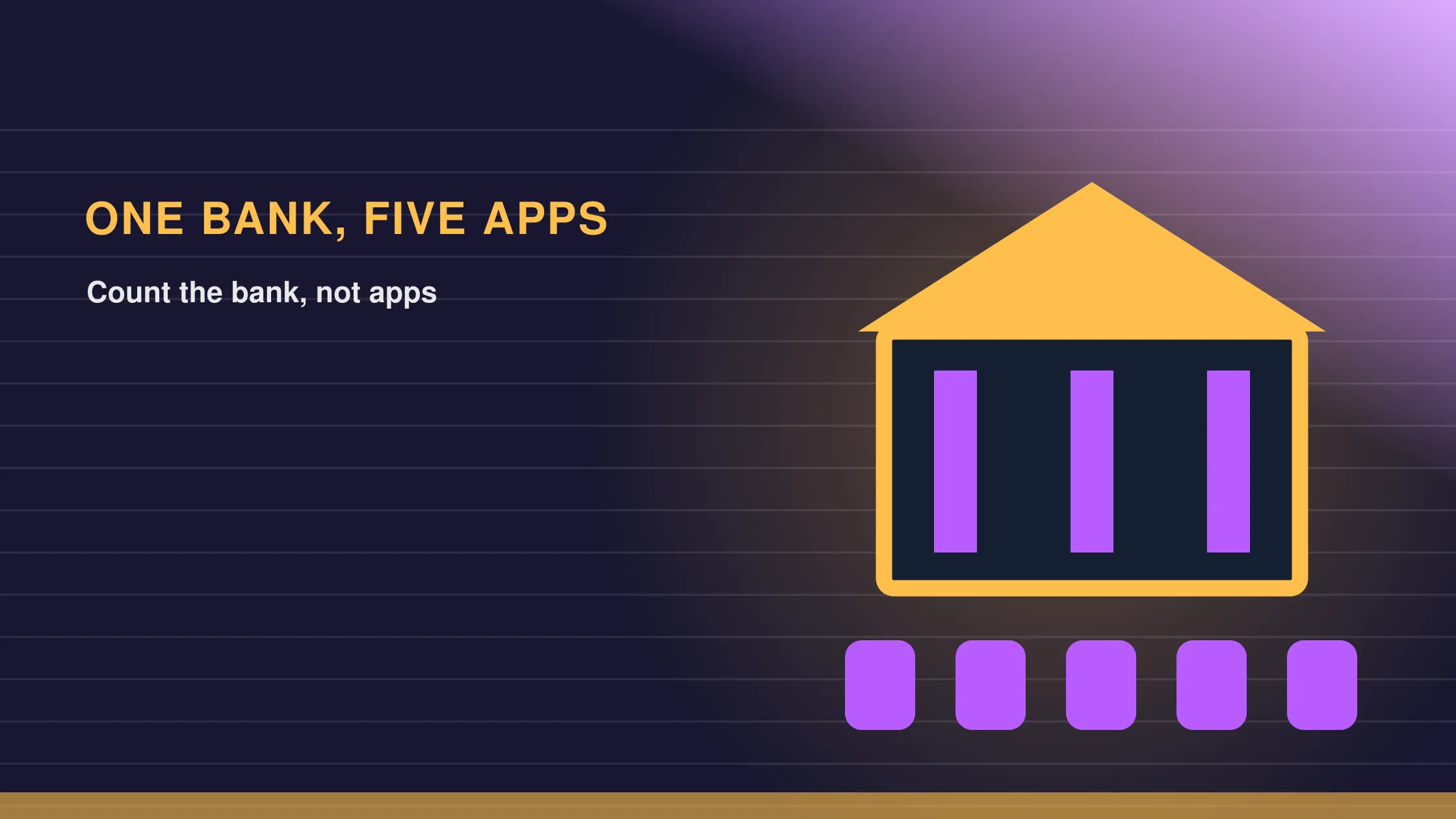
A consumer can see separate fintech logos, cards and account balances yet have several claims routed through one underlying US bank. Deposit insurance does not reset each time the interface changes. A $100,000 app account, a $90,000 second app balance and a $120,000 direct account at the same insured bank are not automatically three isolated $250,000 protections.
Heath Muchena · Decentralised News · Reviewed 23 November 2026 · 2027 editorial edition · Agentic Finance
What Matters
The relevant aggregation key is the actual insured bank, depositor, ownership category and valid pass-through record—not the number of branded apps.
The signal: Evidence, units and contractual scope decide whether an apparently precise result can be trusted. We separate documented facts, illustrative scenarios and unresolved questions.
The decision that conventional coverage misses
A consumer can see separate fintech logos, cards and account balances yet have several claims routed through one underlying US bank. Deposit insurance does not reset each time the interface changes. A $100,000 app account, a $90,000 second app balance and a $120,000 direct account at the same insured bank are not automatically three isolated $250,000 protections.
For a reader building a company, using an AI agent or evaluating a financial platform, the useful question is not whether the marketing story sounds impressive. It is what decision changes after the hidden unit, party, right or obligation is identified. This is the reason Decentralised News publishes an inspectable instrument alongside the article, rather than relying on a product score that cannot be reproduced.
We do not claim to have independently audited every institution in this market. The factual boundary of each source is identified below. All examples can be changed by the reader; none is presented as an observed provider performance metric.
The app is not necessarily the bank
Many financial apps are interfaces or programme managers rather than insured depository institutions. Marketing language about banking services being provided by a partner bank requires investigation of the deposit placement structure. An app’s wallet balance may be held in a custodial account, distributed among programme banks, or represent a different legal claim altogether. The brand on the home screen is not the institution whose failure invokes FDIC insurance.
How aggregation works
The FDIC states its standard limit is $250,000 per depositor, per insured bank, per ownership category. Qualifying pass-through deposits are generally combined with the true owner’s other deposits in the same ownership category at that same bank. Three consumer-facing apps can therefore map to one insured bank for the relevant depositor; another app might use a different insured bank, requiring a different aggregation.
Pass-through has requirements
Do not assume that all fintech pooled accounts automatically meet pass-through recordkeeping and ownership disclosure conditions. The FDIC identifies requirements concerning the account title, relevant records and the identification of beneficial ownership interests. If these conditions are not satisfied, the coverage analysis can change materially. The existence of an app promise is not proof that its underlying books can reconstruct each end user’s share.
Same group is not always same institution
Separately chartered insured banks can receive separate aggregation treatment even if a holding company owns both. Conversely, different offices and brand experiences of the same insured bank do not provide separate limits merely because the customer sees different interfaces. Verify the exact bank’s charter and FDIC certificate rather than matching a partial brand name.
Insured deposits versus claims
FDIC coverage is not a general insurance policy for investment losses, cryptocurrency price declines, brokerage failure, payment outages or fraudulent transactions. Even where cash is eligible for protection against a bank failure, access delays, account freezes and programme-manager insolvency present other issues. A cautious assessment must keep those contingencies apart.
A useful exposure register
For each app, record end-customer legal owner, named underlying bank, bank identifier, account type, ownership category, direct or pass-through nature, allocation amounts, latest statement date and supporting documents. Flag balances whose underlying bank cannot be established as unknown rather than assuming they diversify the exposure. Recalculate when the app changes its programme bank or allocations.
Tool boundary
The calculator assumes the three illustrative balances belong to one depositor in the same single-account ownership category at one insured bank, and that all relevant pass-through requirements are satisfied. If any assumption is false, its figure is not an insurance determination. Use the FDIC’s own estimator and contact relevant institutions before relying on coverage.
DN decision instrument: Fintech Deposit Protection in 2027
Change the illustrative inputs, calculate the result, and export a local JSON record for your own working papers. The form runs in your browser without contacting an external service.
The export is an input record, not an official verification receipt. Recompute against authoritative evidence before relying on an actual decision.
DN methodology and limitations
Scope: this analysis addresses the relevant aggregation key is the actual insured bank, depositor, ownership category and valid pass-through record—not the number of branded apps.
Evidence hierarchy: primary regulator, issuer, standard-setter or payment-provider documentation outranks promotional copy; the original contractual or technical record outranks a secondary interpretation. Where claims cannot be independently verified, they remain questions. The article is updated from information available on 23 November 2026. References to 2027 indicate forward-looking decision frameworks, not future observations.
Reproducibility: the calculator uses visible arithmetic or document-status logic, user-supplied values and explicit constraints. It neither connects to wallets nor sends transactions. Downloaded input records are not independently audited datasets. Legal, regulatory, accounting and investment decisions require the governing records and relevant professional judgment.
Editorial separation: there are no product rankings, disguised sponsored endorsements or invented real-world measurements in this piece. Any adjacent DN guide linked below is for methodological context; it is not evidence of the claims made in the external sources.
Primary sources and companion records
- FDIC deposit insurance FAQ
- FDIC pass-through coverage and aggregation
- DN fiat exchange safeguarding companion
Source documents are linked for independent verification. Publication or website content may subsequently change; preserve the original edition date and consult updated official documentation when applying these rules to live transactions.
Frequently asked questions
Does this article describe a verified 2027 event?
No. The 2027 date identifies the planning edition. Facts are grounded in published sources available by 23 November 2026; user-entered examples are hypothetical.
Does the calculator use live financial, regulatory or market data?
No. It is a deterministic local illustrative model. Inputs are supplied by the reader and no external account or live platform is queried.
When should a reader stop and request additional evidence?
When identity, scope, contract terms, dates, source provenance or rights needed for the decision remain unresolved. A plausible numerical output never substitutes for that missing evidence.
DN Alpha Thesis
The relevant aggregation key is the actual insured bank, depositor, ownership category and valid pass-through record—not the number of branded apps. The durable advantage is not a prediction about 2027. It is having enough source-linked evidence to understand which answer would change when a document, price, contract or input changes.
Disclosure: educational research. No financial product is being recommended. Calculators are deterministic illustrations, not investment, legal or tax opinions.
About the Author